
Written by Arthur Simitian | PartsAdvisory
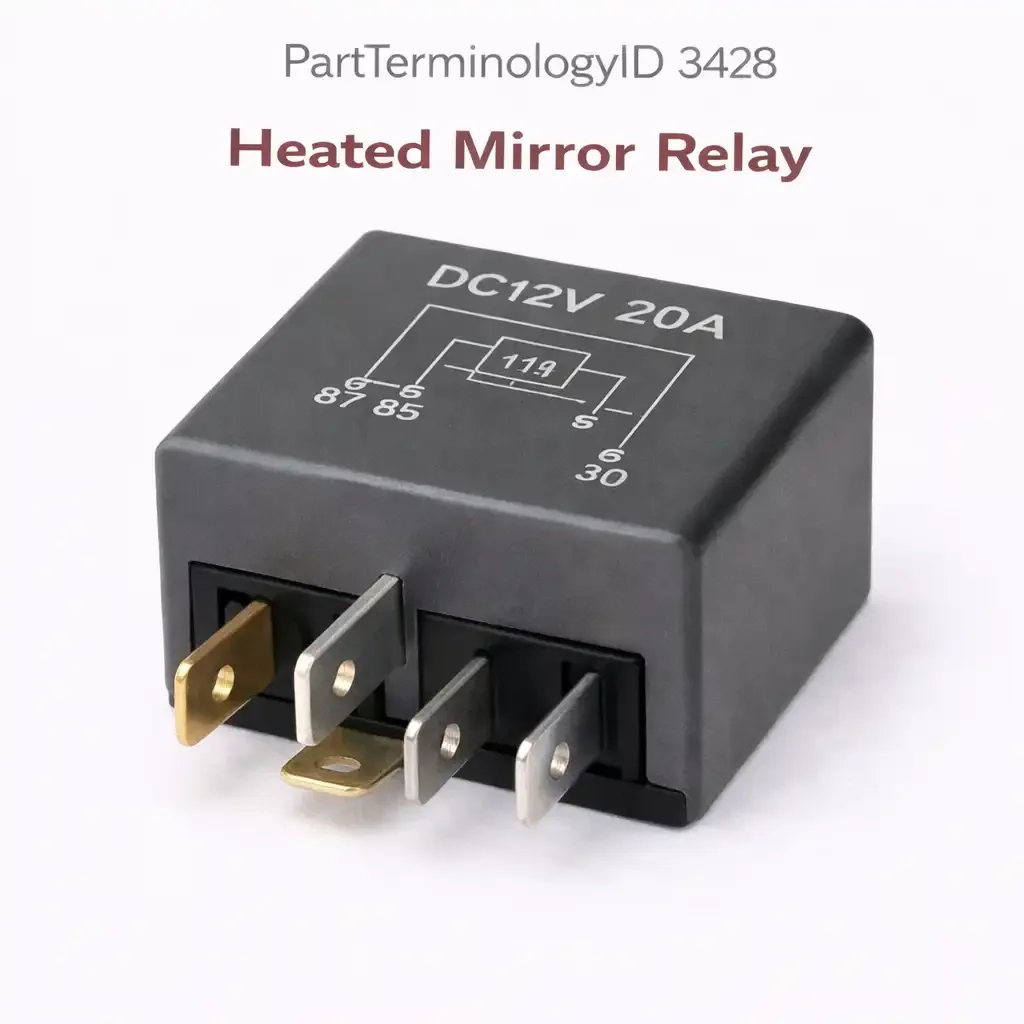
PartTerminologyID 3428, Heated Mirror Relay, is the relay that supplies power to the resistive heating element embedded in each exterior side mirror glass, clearing frost, ice, condensation, and road film from the mirror surface to restore rear visibility in cold or wet weather. The relay controls both mirror heating elements simultaneously through a single contact on most applications, delivering battery voltage to the mirror heating circuit when the driver activates the rear window defroster switch or when a dedicated mirror defrost switch commands the BCM to energize the circuit. The three attributes that determine correct fitment are the activation source and whether the mirror heating circuit is interlocked with the rear window defroster relay or operates through a fully independent circuit; the contact current rating relative to the combined draw of both mirror heating elements; and the timed cut-off behavior on applications where the BCM limits mirror heating duration to a calibrated maximum to prevent element overheating.
What the Heated Mirror Relay Does
Mirror heating element circuit and dual mirror supply
Each exterior mirror contains a thin film resistive heating grid bonded to the back of the mirror glass, drawing between 2 and 5 amperes per mirror depending on element resistance and ambient temperature. The heated mirror relay contact supplies battery voltage to the heating circuit that connects both mirror elements in parallel, meaning both mirrors heat simultaneously from a single relay contact. A relay contact failure that is stuck open prevents both mirrors from heating. A single mirror that fails to heat while the other heats correctly indicates a heating element failure within that specific mirror rather than a relay fault, since a relay fault affects both mirrors simultaneously. This simultaneous-versus-single failure pattern is the primary diagnostic differentiator between a relay fault and a mirror element fault and must be included in every listing under this PartTerminologyID.
Rear defroster interlock and activation source
On most applications, the heated mirror circuit is interlocked with the rear window defroster circuit and activates simultaneously when the rear defroster button is pressed. The BCM receives the defroster switch input and activates both the rear window defroster relay and the heated mirror relay together, treating the mirror heating as a companion function to the rear window defrost cycle. On these applications, a driver who presses the rear defroster button and observes rear window defogging but no mirror heating has a heated mirror relay fault or a wiring fault in the mirror heating branch, since the defroster switch input is reaching the BCM correctly and the BCM is activating the defroster circuit. On applications with a dedicated mirror defrost switch independent of the rear defroster, the mirror relay is activated by a separate BCM input and a mirror-only failure does not affect the rear defroster circuit at all.
Timed cut-off and BCM activation duration
Many applications limit the mirror heating duration to a calibrated maximum, typically 10 to 20 minutes, after which the BCM de-activates the relay regardless of switch position. This prevents prolonged element heating on a warm day when the defroster was activated incidentally or when the driver forgot to deactivate it after the mirror was clear. A relay that appears to function correctly for a short period and then stops is experiencing this normal timed cut-off behavior rather than an intermittent relay fault. Buyers who observe the mirrors heating briefly and then stopping on a warm day have experienced correct BCM timer behavior. Buyers who observe the mirrors stopping prematurely in genuinely cold conditions where extended heating is appropriate may have a BCM timer calibration issue or a failing relay that drops out intermittently before the BCM cut-off would normally occur.
Top Return Scenarios
Scenario 1: "Both side mirrors do not heat when rear defroster is activated"
The heated mirror relay contact has failed open. The rear window is defogging correctly because its relay is functioning, but the mirror heating circuit receives no power. Testing relay coil activation voltage from the BCM when the defroster switch is pressed, then testing relay contact output voltage at the mirror wiring connector, confirms the relay contact failure. If no coil activation is present from the BCM when the defroster switch is activated, the BCM mirror relay output has failed independently of the defroster relay output.
Prevention language: "Both mirrors not heating with correct rear window defogging indicates the heated mirror relay has failed independently of the rear defroster relay. Test for BCM relay coil output when the defroster is activated, then test contact output at the mirror harness connector. Coil activation present with no contact output confirms relay contact failure."
Scenario 2: "One mirror heats, the other does not"
The relay is supplying the mirror heating circuit correctly since one mirror is functioning. The non-heating mirror has a failed heating element, a broken wire in the mirror harness between the relay output and that mirror's element, or a corroded connector at the mirror base. A relay fault simultaneously affects both mirrors; a single-mirror failure is always downstream of the relay in the circuit. Testing voltage at the non-heating mirror's connector confirms whether supply voltage is reaching the mirror. Voltage present at the connector with no heating indicates a failed element. No voltage at the connector indicates a wiring or connector fault between the relay and that specific mirror.
Prevention language: "A single non-heating mirror with the other heating correctly is never a relay fault. The relay supplies both mirrors from a single contact and a relay fault affects both simultaneously. Test voltage at the non-heating mirror's connector. Voltage present with no heat indicates a failed mirror element. No voltage indicates a broken wire or corroded connector in the harness to that mirror."
Scenario 3: "Mirrors heated briefly after pressing defroster but stopped before frost cleared"
On a genuinely cold day with heavy frost accumulation, the BCM timed cut-off may expire before the frost is fully cleared if the ambient temperature is very low and the heating cycle requires longer than the calibrated maximum duration. This is a BCM timer calibration limitation rather than a relay fault on most applications. Pressing the defroster button again restarts the heating cycle for another timed duration. If the mirrors stop heating after a shorter period than the calibrated maximum, an intermittent relay contact that drops out before the BCM cut-off is the fault, confirmed by measuring contact voltage drop under element load during the heating cycle.
Listing Requirements
PartTerminologyID: 3428
controlled circuit: both mirror heating elements simultaneously (mandatory)
activation source: rear defroster interlock or dedicated switch (mandatory)
timed cut-off behavior note (mandatory)
simultaneous vs. single mirror failure as relay vs. element diagnostic (mandatory)
contact current rating vs. combined element draw (recommended)
OEM part number cross-reference (mandatory)
FAQ (Buyer Language)
My rear defroster works but neither mirror heats. Is the relay the problem?
Yes, that symptom points directly to the heated mirror relay. The rear defroster relay is functioning correctly since the rear window is clearing. The heated mirror relay has failed open and is not supplying the mirror heating circuit. Confirm with a quick relay contact output voltage test at the mirror wiring connector when the defroster is activated. No voltage at the connector with a functioning rear defroster confirms the mirror relay is the fault.
Do I need to replace both mirror heating elements if one fails?
No. Mirror heating elements fail independently. If one mirror heats and the other does not, only the failed mirror's element needs replacement. The relay supplies both mirrors correctly. Confirm the non-heating mirror has supply voltage at its connector before removing the mirror glass for element replacement, since a broken harness wire can mimic an element failure.
My mirrors used to heat but now they stop after about five minutes. Is the relay failing?
First confirm how long the BCM allows the heating cycle to run on your application. On many vehicles, 10 to 15 minutes is the designed maximum per cycle. If the mirrors are stopping at the BCM's calibrated limit, the system is working correctly. If the mirrors are stopping well before the expected cut-off duration and the ambient temperature is genuinely cold, measure contact voltage during the heating cycle. A relay contact with intermittent resistance will show a voltage drop that increases as the contact heats during the cycle, eventually dropping below the element's operating threshold and causing apparent heating to stop before the BCM cut-off.
What Sellers Get Wrong About PartTerminologyID 3428
The most common listing error is omitting the simultaneous-versus-single mirror failure diagnostic. Buyers who have one mirror heating and one that does not will order a relay based on a general heated mirror relay search, install it, and find no improvement because the relay was functioning correctly and the single-mirror failure is a downstream element or wiring fault. Every listing under PartTerminologyID 3428 must state that a relay fault affects both mirrors simultaneously and that a single-mirror failure is not a relay fault, redirecting single-mirror buyers to the element or connector diagnosis before they order the relay.
The second error is omitting the timed cut-off note. Buyers on vehicles where the BCM limits the heating cycle to 10 or 15 minutes will report that the relay stops working after a brief period when they are actually experiencing correct BCM behavior. A single sentence explaining the timed cut-off prevents returns from buyers who concluded the relay was intermittently failing when it was following BCM instructions correctly.
Cross-Sell Logic
Window Defroster Relay (PartTerminologyID 3432): the rear window defroster relay and the heated mirror relay are activated together on most applications by the same defroster switch input; a rear window that defrosts correctly while mirrors do not heat isolates the fault to the mirror relay
Exterior Mirror Assembly: if relay supply voltage is confirmed at the mirror connector but the element does not heat, the mirror heating element has failed and the mirror assembly or element film requires replacement
BCM: if no relay coil activation is present from the BCM when the defroster switch is activated, and the rear defroster relay is also not activating, the BCM defroster output circuit has failed and both relays are affected from the same BCM fault
Final Take for PartTerminologyID 3428
Heated Mirror Relay (PartTerminologyID 3428) is the exterior mirror defrost relay where simultaneous-versus-single mirror failure diagnosis, rear defroster interlock identification, and timed cut-off explanation are the three listing attributes that prevent the highest volume of wrong-diagnosis returns in this category. The simultaneous failure note prevents orders from single-mirror-failure buyers who need a mirror element rather than a relay. The timed cut-off note prevents returns from buyers who replaced a correctly functioning relay because it stopped heating at the BCM's designed limit. Sellers who include both notes alongside the activation source identification and the relay contact output test give buyers the complete diagnostic path from symptom to correct component for every heated mirror complaint.