
Written by Arthur Simitian | PartsAdvisory
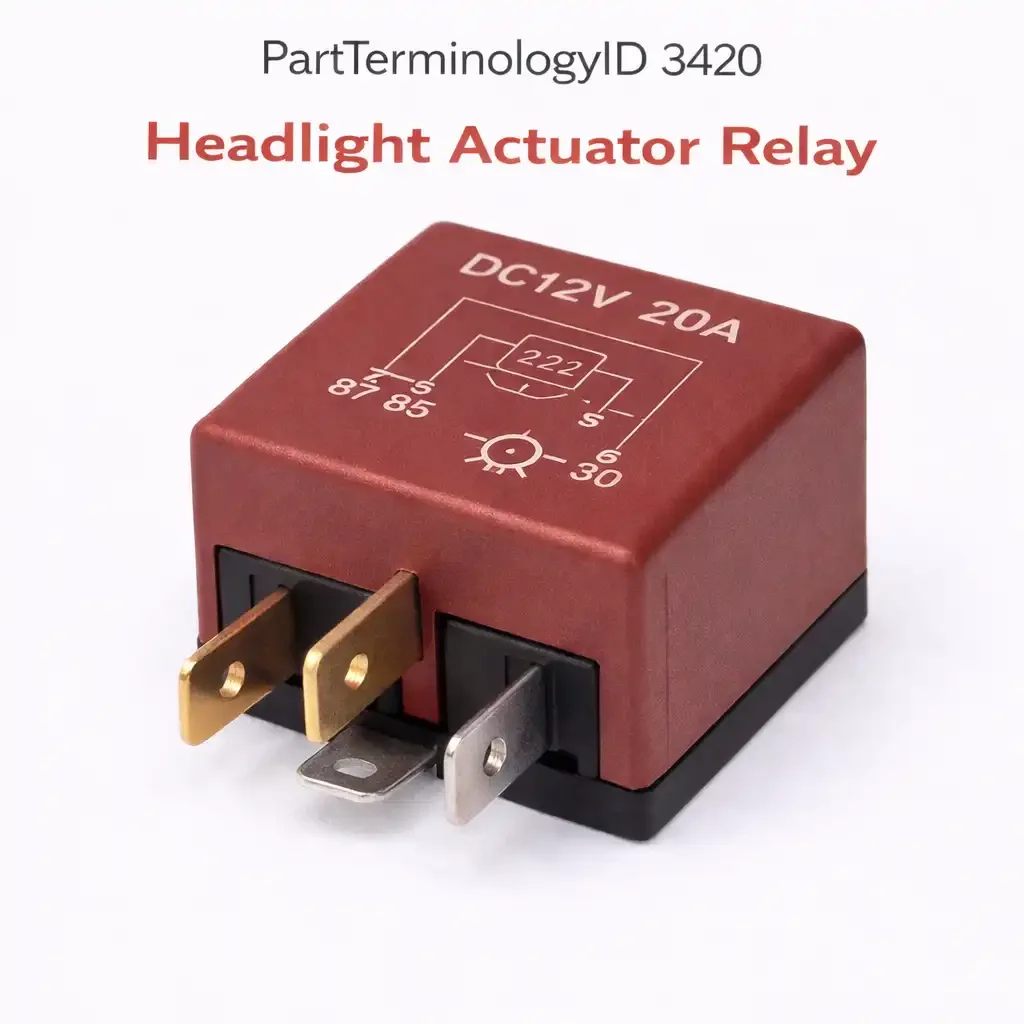
PartTerminologyID 3420, Headlight Actuator Relay, is the relay that controls power delivery to the headlight aim actuator motor or solenoid, which adjusts the vertical or horizontal aim of the headlight beam assembly in response to commands from the headlight leveling control module or adaptive front lighting system. The relay is distinct from the Headlight Motor Relay (PartTerminologyID 3408), which controls the pop-up pod positioning motor on retractable headlight systems, because the actuator relay controls a beam aim adjustment mechanism on a fixed headlight assembly rather than a pod travel motor on a retractable system. The three attributes that determine correct fitment are the actuator type the relay controls; whether the relay operates a manual load-compensating leveling system or an automatic dynamic leveling system; and the control module activation logic that governs when and by how much the relay positions the actuator.
What the Headlight Actuator Relay Does
Aim actuator circuit and leveling system architecture
The headlight aim actuator is a small electric motor or solenoid mounted within or behind the headlight assembly that adjusts the aim of the reflector or projector element by driving a screw mechanism or pivot linkage. On manual load-compensating systems, the driver selects an aim compensation level from a dashboard switch based on vehicle load, and the control module activates the actuator relay to drive the actuator to the selected position. On automatic dynamic leveling systems, a vehicle attitude sensor or suspension position sensor provides continuous feedback to the leveling control module, which commands the actuator relay to maintain a constant headlight aim angle regardless of changes in vehicle pitch from load or braking. The relay supplies the actuator motor or solenoid with the current required to drive the aim mechanism to the commanded position, and the control module monitors the actuator's position feedback signal to confirm the aim has reached the target before de-energizing the relay.
Differentiation from Headlight Motor Relay (PartTerminologyID 3408)
The Headlight Motor Relay (3408) drives a travel motor that raises or lowers an entire headlight pod assembly through a mechanical drive cycle with defined end positions marked by limit switches. The Headlight Actuator Relay (3420) drives a small aim adjustment actuator that repositions the beam within the fixed headlight assembly through a continuous range of motion governed by the leveling control module rather than by mechanical end stops. The symptom of a failed Headlight Motor Relay (3408) is a pod that does not raise or lower. The symptom of a failed Headlight Actuator Relay (3420) is a headlight beam that is fixed at one aim angle and does not adjust with load changes or does not respond to the dashboard aim switch, while the headlight illuminates normally because the lamp supply circuit is unaffected. These distinct symptom patterns are the primary differentiating feature between the two relay PartTerminologyIDs and must be included in listings for both.
Control module activation and fault code generation
The leveling control module or BCM monitors the actuator position feedback circuit and logs a fault code when the actuator does not reach the commanded position within the expected time. A relay that fails open prevents the actuator from receiving power and the module logs an actuator circuit fault or an aim control fault. On some applications the module distinguishes between an open circuit fault, which indicates no current is flowing through the actuator at all and points to the relay or wiring, and a mechanical fault, which indicates current is flowing but the actuator position is not changing and points to the actuator motor or linkage. Reading the specific fault code before replacing any component directs the diagnosis to the correct circuit element on module-equipped applications.
Top Return Scenarios
Scenario 1: "Headlight beam does not adjust when dashboard aim switch is changed"
The relay contact has failed open or the relay coil is not receiving the control module activation signal. The headlights illuminate correctly because the lamp supply circuit is independent of the actuator relay. With the dashboard aim switch at a position other than the current actuator position, the control module outputs a relay coil activation signal to drive the actuator to the new position. Testing for coil activation voltage at the relay terminal during a switch position change confirms whether the module is commanding the relay. Coil voltage present with no actuator movement confirms a relay contact failure. No coil voltage during a switch change indicates a module output fault.
Prevention language: "Confirm headlights illuminate normally before diagnosing the actuator relay. A relay fault affects only beam aim adjustment, not lamp illumination. Test for control module relay coil output during a dashboard aim switch change. No coil output indicates a module fault. Coil output present with no actuator response confirms a relay contact failure."
Scenario 2: "Headlight leveling fault code logged but headlights work normally"
A leveling fault code with normal lamp operation is the characteristic presentation of a headlight actuator relay or actuator fault rather than a headlight supply fault. The fault code identifies the circuit element the module could not command to the target position. Reading the specific fault code sub-type distinguishes an open circuit fault from a mechanical actuator fault, directing the diagnosis to the relay contact test or the actuator motor test without requiring both components to be replaced speculatively.
Listing Requirements
PartTerminologyID: 3420
actuator type: aim adjustment motor or solenoid (mandatory)
system type: manual load-compensating or automatic dynamic leveling (mandatory)
differentiation from Headlight Motor Relay (PartTerminologyID 3408) (mandatory)
fault code pre-read guidance before relay diagnosis (mandatory)
lamp illumination unaffected by relay failure note (mandatory)
OEM part number cross-reference (mandatory)
FAQ (Buyer Language)
My headlights work fine but I have a headlight leveling warning on the dash. Is this the relay?
Possibly. A headlight leveling warning with normal lamp operation is consistent with an actuator relay or actuator fault. Read the specific fault code from the leveling control module before ordering a relay. An open circuit fault code points to the relay or wiring. A position feedback fault code with current flowing through the actuator points to a mechanical actuator fault. Replacing the relay on a mechanical actuator fault will not resolve the warning.
How is this relay different from the headlight relay?
The Headlight Relay (PartTerminologyID 3400) supplies the headlight lamp bulb circuit and controls whether the lamps illuminate. The Headlight Actuator Relay (3420) supplies the aim adjustment actuator motor and controls the direction the beam points. A failed Headlight Relay produces no light. A failed Headlight Actuator Relay produces correct light output but incorrect or fixed beam aim. The two relays serve entirely different functions and are not interchangeable.
What Sellers Get Wrong About PartTerminologyID 3420
The most common listing error is conflating the headlight actuator relay with the headlight motor relay (3408) without distinguishing between aim adjustment on a fixed assembly and pod travel on a retractable system. Buyers on fixed-headlight vehicles with aim control complaints and buyers on retractable headlight vehicles with pod travel complaints may both search for a headlight motor or actuator relay, and a listing that does not specify which mechanism the relay controls will generate orders from the wrong application. Every listing under PartTerminologyID 3420 must state that this relay controls the beam aim adjustment actuator within a fixed headlight assembly, not a pod travel motor, and must include the lamp-illuminates-normally symptom note that distinguishes an actuator relay fault from a lamp supply relay fault.
Cross-Sell Logic
Headlight Motor Relay (PartTerminologyID 3408): controls pop-up pod travel motor on retractable headlight systems; symptom is pod that does not raise or lower rather than incorrect beam aim
Headlight Aim Actuator: if relay output voltage is confirmed at the actuator connector during a level command but beam aim does not change, the actuator motor or linkage has failed mechanically
Leveling Control Module: if no relay coil activation is present during a level command with correct sensor inputs, the control module output has failed and the module is the diagnosis target
Vehicle Attitude Sensor: on automatic dynamic leveling systems, a failed attitude sensor provides incorrect pitch data to the control module, producing continuous or erratic actuator commands that may damage the actuator or relay contact through excessive cycling
Final Take for PartTerminologyID 3420
Headlight Actuator Relay (PartTerminologyID 3420) is the beam aim control relay where actuator type identification, system type disclosure, differentiation from the Headlight Motor Relay (3408), and fault code pre-read guidance are the four listing attributes that direct buyers to the correct component for their specific headlight aim complaint. The lamp-illuminates-normally symptom note is the most useful single piece of buyer guidance because it immediately separates the actuator relay fault presentation from all lamp supply relay fault presentations, giving buyers the self-diagnosis criterion that confirms the actuator relay is the correct part category before any electrical testing begins. Sellers who specify the aim adjustment function, differentiate from the pod motor relay, and include the fault code read recommendation give buyers the framework to arrive at the correct diagnosis and correct component on the first order.