
Written by Arthur Simitian | PartsAdvisory
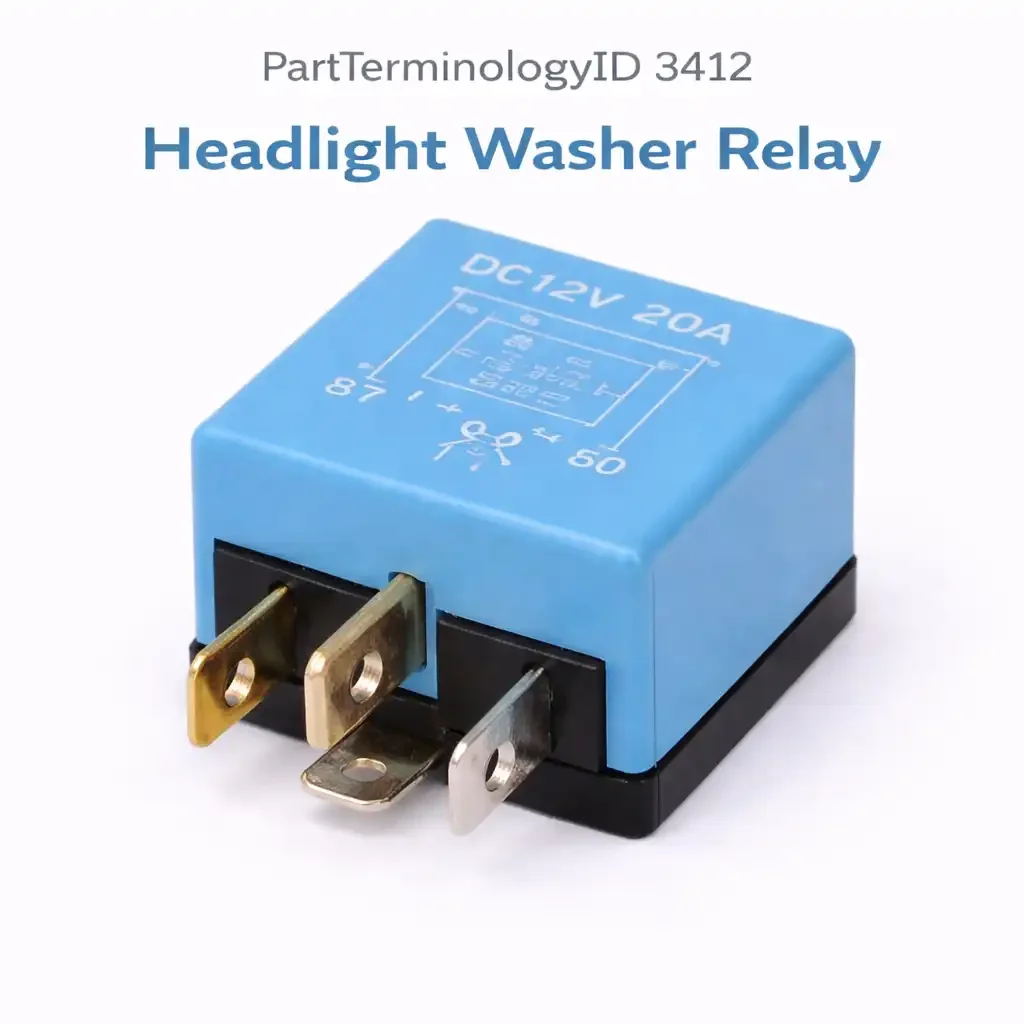
PartTerminologyID 3412, Headlight Washer Relay, is the relay that supplies power to the headlight washer pump motor, which pressurizes and delivers washer fluid to the headlight lens cleaning nozzles when the driver activates the windshield washer or a dedicated headlight washer switch. The relay operates the headlight washer pump independently of the windshield washer pump on applications where separate pumps serve the two washing circuits, and it is subject to enabling conditions that restrict its activation to specific vehicle states, most commonly requiring the headlights to be switched on before the relay will activate the headlight washer pump. The three attributes that determine correct fitment are the enabling conditions the BCM or lighting control module applies before permitting relay activation; the interlock relationship with the windshield wiper or washer switch input that triggers the headlight wash cycle; and the application concentration on European and luxury vehicles from approximately 1990 onward, where headlight washers are required by regulation on vehicles equipped with HID or high-lumen headlight systems.
What the Headlight Washer Relay Does
Washer pump circuit and enabling condition logic
The headlight washer relay coil receives its activation command from the BCM after the BCM evaluates whether all enabling conditions are satisfied. The most universal enabling condition is headlights-on: the BCM will not activate the headlight washer relay unless the headlight relay is also active and the headlights are illuminated. This condition prevents headlight washer fluid from being sprayed onto cold, dry headlight lenses when the headlights are off, which on HID headlight applications can thermally shock the outer lens surface. A second common enabling condition is vehicle speed above a minimum threshold, which prevents washer activation at very low speeds where overspray could affect other drivers. A buyer who activates the washer switch and observes no headlight washer response with the headlights off is experiencing correct inhibit behavior rather than a relay fault, and the most common non-fault return on this circuit is from buyers who tested with the headlights switched off.
Windshield wiper interlock and activation trigger
On most applications, the headlight washer activates automatically when the windshield washer is activated, without a separate headlight washer switch. The BCM detects the windshield washer pump activation signal and simultaneously commands the headlight washer relay, synchronizing both wash cycles. On applications with a dedicated headlight washer switch, the relay activates independently of the windshield washer when the dedicated switch is pressed. The activation trigger identification matters for diagnosis because a non-functioning headlight washer on an automatic-interlock application may indicate a BCM interlock output fault rather than a relay fault, while a non-functioning headlight washer on a dedicated-switch application may indicate a switch fault before the relay circuit is reached.
HID headlight regulatory requirement and application window
European ECE regulations require headlight washers on vehicles equipped with HID xenon headlights above a defined luminous flux threshold, because the higher light output of HID systems creates greater glare for oncoming drivers when the lenses are contaminated with road film, insects, or mud. Most vehicles equipped from the factory with headlight washers are European-market or globally-specified vehicles sold in markets where this regulation applies. North American market vehicles rarely include headlight washers as standard equipment, though some luxury and performance models offer them as optional equipment. Confirming that the application is equipped with headlight washers before ordering under PartTerminologyID 3412 prevents orders from buyers whose vehicle has no headlight washer nozzles, pump, or relay socket.
Top Return Scenarios
Scenario 1: "Headlight washers do not activate when the washer button is pressed"
The most common cause is an unsatisfied enabling condition rather than a relay fault. Test with the headlights switched on, vehicle speed above the minimum threshold if applicable, and the windshield washer activated. If the headlight washers still do not activate with all enabling conditions met, test for BCM relay coil activation voltage at the relay coil terminal during a washer activation attempt. No coil voltage with all conditions met indicates a BCM output fault. Coil voltage present with no relay output indicates a relay contact failure.
Prevention language: "Test headlight washer function with the headlights switched on and the vehicle above any speed threshold requirement. Most headlight washer systems will not activate with the headlights off, producing a no-response symptom that is not a relay fault. Confirm all enabling conditions before diagnosing the relay."
Scenario 2: "Headlight washers activate continuously when headlights are switched on"
The relay contact is stuck closed and the washer pump runs continuously whenever the enabling conditions are met. The BCM is not commanding continuous activation but the relay contact is not opening between commanded wash cycles. Removing the relay from its socket should stop the pump immediately, confirming a stuck-closed relay contact rather than a BCM continuous output fault.
Prevention language: "Continuous headlight washer pump operation when headlights are on indicates a stuck-closed relay contact. Remove the relay from its socket. Pump stops on relay removal confirms relay contact failure. Pump continues after relay removal indicates BCM is outputting a continuous activation signal and the fault is in the BCM."
Listing Requirements
PartTerminologyID: 3412
controlled circuit: headlight washer pump motor (mandatory)
enabling conditions: headlights-on and speed threshold (mandatory)
activation trigger: windshield washer interlock or dedicated switch (mandatory)
application window: European and luxury HID-equipped vehicles (mandatory)
enabling condition pre-check before relay diagnosis (mandatory)
OEM part number cross-reference (mandatory)
FAQ (Buyer Language)
My headlight washers used to work but stopped. The headlights are on when I test. Is this the relay?
Possibly. With the headlights on and the windshield washer activated, test for BCM relay coil activation voltage at the headlight washer relay coil terminal. If activation voltage is present but the washer pump does not run, test for relay contact output voltage at the pump motor connector. No contact output with confirmed coil activation confirms a relay contact failure. If no coil activation is present despite correct enabling conditions, the BCM output for the headlight washer circuit has failed.
Does the headlight washer use the same fluid reservoir as the windshield washer?
On most applications, both the windshield and headlight washer systems draw from the same washer fluid reservoir. The headlight washer pump is a separate motor mounted on or near the reservoir, drawing fluid from the same tank through a separate pump outlet. A low fluid level affects both systems simultaneously. On some applications a dedicated headlight washer fluid reservoir is used, which must be filled independently of the windshield washer reservoir.
What Sellers Get Wrong About PartTerminologyID 3412
The most common listing error is omitting the headlights-on enabling condition. This single omission generates more non-fault returns on the headlight washer relay than any other listing gap, because buyers who test the washer system with the headlights off observe no response and conclude the relay has failed when the system is functioning correctly and the BCM is correctly inhibiting activation. Every listing under PartTerminologyID 3412 must state that the relay will not activate unless the headlights are switched on, and must direct buyers to test with headlights on as the first step before any electrical diagnosis. The second error is failing to identify the application window. Buyers on North American vehicles without headlight washer equipment will find no relay socket and no pump when they attempt to install the relay, generating a return that a one-sentence application note would have prevented.
Cross-Sell Logic
Headlight Relay (PartTerminologyID 3400): the headlight relay must be active and the headlights must be on for the headlight washer relay to receive its BCM activation command; a headlight relay fault that prevents headlight operation also prevents headlight washer activation
Headlight Washer Pump: if relay contact output voltage is confirmed at the pump motor connector but the pump does not run, the pump motor has failed and is the replacement target
BCM: if no relay coil activation voltage is present with all enabling conditions met, the BCM headlight washer output driver has failed and the BCM is the diagnosis target
Final Take for PartTerminologyID 3412
Headlight Washer Relay (PartTerminologyID 3412) is the headlight lens cleaning relay where enabling condition disclosure, activation trigger identification, and application window confirmation are the three listing attributes that prevent the highest volume of non-fault returns and wrong-application orders in this low-volume but technically specific category. The headlights-on enabling condition note is the single most valuable instruction in the listing and the one that eliminates the largest share of relay returns before they occur. Sellers who disclose the enabling conditions, identify the activation trigger, state the application window, and include the enabling condition pre-check as the first diagnostic step give buyers the complete context to determine whether the relay is the correct component for their application and whether it is the correct fault for their symptom before the order is placed.