
Written by Arthur Simitian | PartsAdvisory
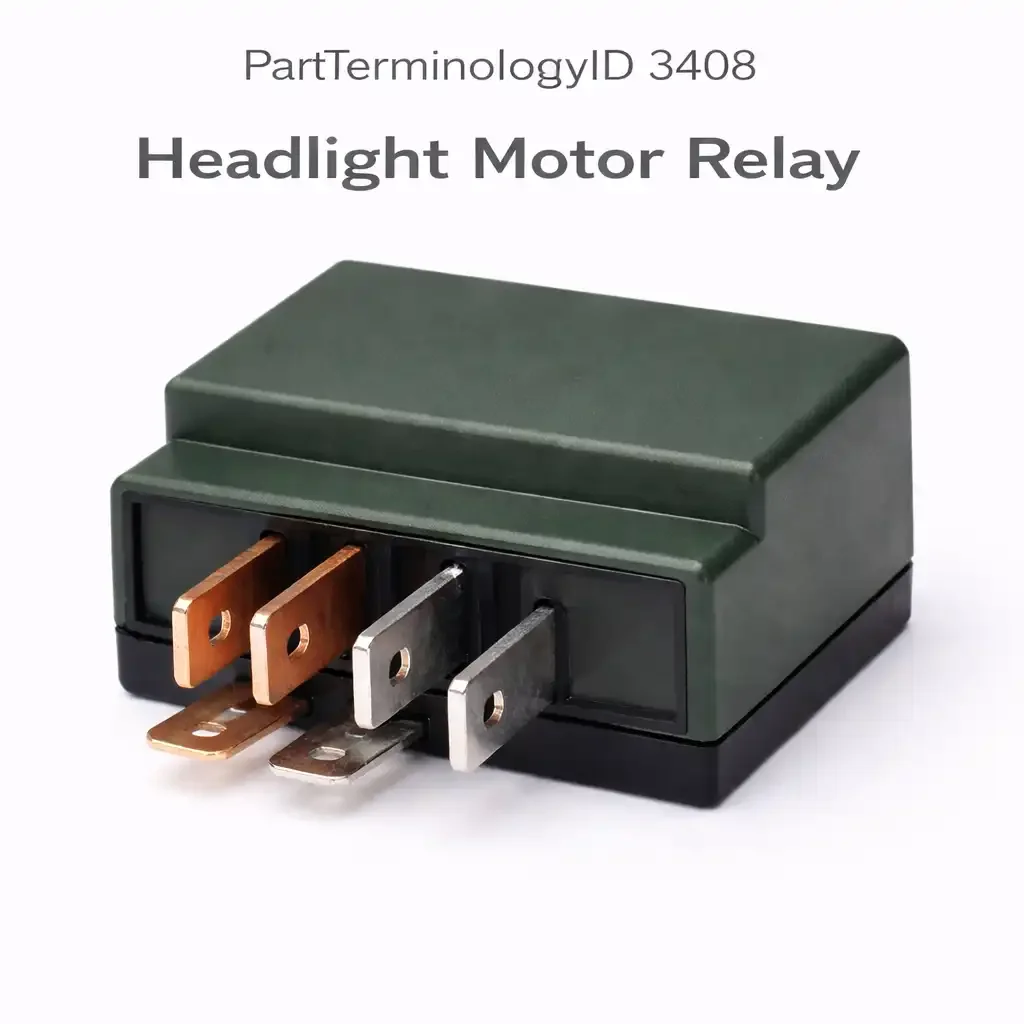
PartTerminologyID 3408, Headlight Motor Relay, is the relay that controls power delivery to the pop-up or retractable headlight pod motor, reversing the motor's rotation direction to raise or lower the headlight assembly as commanded by the headlight switch or lighting control module. The relay is distinct from the Headlight Relay (PartTerminologyID 3400), which supplies the headlight lamp bulb circuit, because the motor relay controls the mechanical actuator that positions the headlight pod rather than the lamp that produces light. The four attributes that determine correct fitment are the motor direction the relay controls within the raise-lower relay pair; the contact current rating relative to the motor's stall current, which occurs at the end of each travel cycle when the limit switch has not yet cut motor power; the limit switch interaction that terminates motor power when the pod reaches its fully raised or fully lowered position; and the application window concentrated on sports and performance vehicles from approximately 1967 through 2004 that used retractable headlight systems.
The headlight motor relay is one of the more technically specific relay applications in the lighting category because it serves a bidirectional DC motor in a reversing circuit where two relays work as a pair, each controlling one direction of motor rotation, and the failure of one relay in the pair produces a pod that moves in only one direction rather than a complete loss of pod movement. Understanding the two-relay pair architecture is the prerequisite for any correct diagnosis on a retractable headlight motor complaint.
What the Headlight Motor Relay Does
Motor direction control and reversing relay pair architecture
The pop-up headlight pod motor is a bidirectional DC motor that raises the pod when current flows in one direction through the motor windings and lowers the pod when current flows in the opposite direction. Reversing the current direction requires reversing the polarity of the supply and return connections to the motor, which is accomplished by a relay pair in an H-bridge configuration. The raise relay closes to supply positive voltage to the motor's raise terminal and ground to the return terminal, driving the motor in the raise direction. The lower relay closes to supply positive voltage to the motor's lower terminal and ground to the return terminal, driving the motor in the lower direction. When the headlight switch is activated, the raise relay closes and the motor raises the pod. When the headlight switch is deactivated, the lower relay closes and the motor lowers the pod. Only one relay in the pair should be closed at any given time; simultaneous closure of both relays creates a direct short circuit across the motor supply and can damage the motor control circuit.
Stall current rating and limit switch interaction
The headlight pod motor draws its highest current at the beginning of the travel cycle, when the pod is being accelerated from rest against the mechanical resistance of the pod mechanism, and at the end of the travel cycle when the pod has reached the fully raised or fully lowered position and the motor is stalled against the mechanical stop before the limit switch cuts power. Stall current is typically 3 to 5 times the motor's running current, and the relay contact must handle this stall current for the fraction of a second between the pod reaching its travel limit and the limit switch opening the motor circuit. A relay with a contact rating based only on running current without accounting for stall current inrush will experience accelerated contact erosion at each cycle's end and fail prematurely. The OEM relay for the application is rated specifically for the stall current of the specific motor, and aftermarket substitutes must match or exceed this stall current specification.
Limit switch function and stuck-motor diagnosis
Each direction of pod travel is terminated by a limit switch that opens the motor circuit when the pod reaches the fully raised or fully lowered position. The limit switch is mounted on the pod mechanism and is actuated by a cam or tab on the motor drive gear when the motor has completed the travel cycle. A limit switch that has failed to open keeps the motor stalled against the mechanical stop with continuous current flowing through the motor winding, rapidly overheating the motor and the relay contact. A motor that runs continuously without stopping at the end of travel, or that produces a burning smell during operation, indicates a failed open limit switch rather than a relay fault. Testing the limit switch before replacing the motor or relay prevents condemning functional components on a stuck-motor complaint.
Differentiation from Headlight Relay (PartTerminologyID 3400) and Concealed Headlight Relay (PartTerminologyID 3192)
The Headlight Relay (3400) supplies battery voltage to the headlight lamp bulbs and controls whether the lamps illuminate. The Headlight Motor Relay (3408) supplies battery voltage to the pod positioning motor and controls whether the pod raises or lowers. The Concealed Headlight Relay (PartTerminologyID 3192) controls the overall concealed headlight system activation sequence on some applications, commanding both the motor relay pair and the lamp relay in the correct sequence so the pod is fully raised before the lamps are energized. On applications with all three relay types, a symptom of pods that raise and lower correctly but lamps that do not illuminate points to the Headlight Relay (3400). A symptom of lamps that illuminate but pods that do not move points to the Motor Relay (3408). A symptom of the entire retractable headlight system failing to activate points to the Concealed Headlight Relay (3192) if that relay is present in the architecture.
Top Return Scenarios
Scenario 1: "Pop-up headlight raises but does not lower when headlights are switched off"
The lower direction relay has failed open. The raise relay closes correctly when the headlight switch is activated and the motor raises the pod to the fully raised position. When the headlight switch is deactivated, the lower relay does not close and the motor receives no power in the lower direction, leaving the pod in the raised position permanently. Confirming the lower relay coil receives its activation signal from the headlight switch or control module when the switch is deactivated, then testing for motor power at the lower terminal of the motor connector, identifies a lower relay contact failure as the fault. A functioning lower relay that receives its coil signal and produces output voltage at the motor lower terminal but the pod still does not lower indicates a mechanical pod mechanism fault rather than a relay fault.
Prevention language: "A pod that raises but will not lower indicates the lower direction relay has failed, not the raise relay. Test for lower relay coil activation when the headlight switch is turned off, then test for motor voltage at the lower terminal. No motor voltage with confirmed coil activation confirms a lower relay contact failure. Replace the lower relay in the pair; the raise relay is functioning correctly."
Scenario 2: "One headlight pod raises and the other does not move"
On applications where each pod has its own dedicated motor relay pair, the relay pair for the non-moving pod has failed. On applications where both pods share a common relay pair, a single relay failure should affect both pods simultaneously, and a single-pod failure indicates either a motor fault on the non-moving pod or a wiring fault between the relay output and that pod's motor. Testing motor supply voltage at both pod motor connectors simultaneously when the raise command is issued identifies whether the relay is supplying both pods or only one.
Scenario 3: "Pod moves slowly or incompletely and stops before reaching full travel"
The relay contact has elevated resistance from wear, reducing the voltage supplied to the motor below the level needed to drive the pod through its full travel cycle, particularly against the increased resistance encountered toward the end of the travel cycle when the pod mechanism is at its highest load point. Testing voltage drop across the relay contact under motor load confirms contact resistance as the fault source. A contact voltage drop above 0.2 volts under motor running current indicates sufficient degradation to cause reduced motor torque and incomplete travel.
Prevention language: "A pop-up headlight pod that moves slowly or stops before completing its travel cycle may have a relay contact with elevated resistance rather than a failed motor. Measure voltage drop across the raise relay contact with the motor running. A drop above 0.2 volts under motor load indicates contact degradation reducing motor supply voltage and torque."
Listing Requirements
PartTerminologyID: 3408
motor direction controlled: raise, lower, or both (mandatory)
relay pair architecture description (mandatory)
stall current rating vs. running current (mandatory)
limit switch interaction and stuck-motor pre-check (mandatory)
differentiation from Headlight Relay (3400) and Concealed Headlight Relay (3192) (mandatory)
application window: retractable headlight vehicles (mandatory)
OEM part number cross-reference (mandatory)
FAQ (Buyer Language)
My pop-up headlights come up but will not go back down. Do I need one relay or two?
On most applications you need only the lower direction relay, since the raise relay is functioning correctly if the pods come up normally. Confirm your application's relay pair configuration: some applications use a single reversing relay that handles both directions, others use separate raise and lower relays. If separate relays are used, replace only the lower relay unless testing reveals the raise relay also has degraded contacts. Replacing both relays in the pair at the same time is reasonable on high-mileage applications since both relays have experienced the same number of switching cycles and similar contact wear.
Can I use a standard automotive relay to replace the headlight motor relay?
A standard relay with the correct terminal configuration and a contact current rating that meets or exceeds the motor's stall current specification can be substituted on most applications. The critical rating is stall current, not running current. A standard 30-ampere relay is adequate for most single-pod motors with stall currents in the 15 to 25 ampere range. On four-pod systems where the relay drives two motors simultaneously, the combined stall current may exceed a standard relay's rating and a higher-rated contact is required.
My headlight pods are stuck in the raised position and the motor does not run at all when I turn the headlights off. How do I confirm it is the relay?
With the headlight switch in the off position, test for lower relay coil activation voltage at the relay coil terminal. If the coil is receiving its activation signal but the motor is not running, test for output voltage at the motor's lower terminal from the relay contact. No output voltage with confirmed coil activation indicates a failed relay contact. If no coil activation signal is present, trace the activation circuit from the headlight switch or control module to the relay coil terminal to find the open circuit in the activation path.
What Sellers Get Wrong About PartTerminologyID 3408
The most common listing error is describing the headlight motor relay as equivalent to the headlight relay without distinguishing the pod motor circuit from the lamp circuit. Buyers searching for a headlight relay on a retractable headlight vehicle may have either a lamp circuit fault or a motor circuit fault, and a listing that does not separate these two distinct relay functions will generate orders for the wrong relay from buyers whose symptom points to one circuit while they receive a relay for the other. Every listing under PartTerminologyID 3408 must state explicitly that this relay controls the pod positioning motor, not the lamp circuit, and must include the symptom distinction that separates motor relay faults from lamp relay faults.
The second common error is omitting the stall current rating note. Sellers who list the relay with only a running current specification give buyers no basis for evaluating whether an aftermarket substitute is adequate for the stall current that occurs at each end of the pod travel cycle. An undersized contact rating relative to the motor's stall current produces premature contact failure, and the relay will fail again after one to two seasons if the stall current specification is not met. The stall current requirement must appear in every listing under this PartTerminologyID.
Cross-Sell Logic
Headlight Relay (PartTerminologyID 3400): the lamp supply relay operates independently of the motor relay; pods that move correctly but lamps that do not illuminate indicate a Headlight Relay (3400) fault rather than a motor relay fault
Concealed Headlight Relay (PartTerminologyID 3192): on applications with an overall concealed headlight system relay, this relay commands both the motor relay pair and the lamp relay in sequence; system-level failures that affect both the motor and lamp function simultaneously may indicate a Concealed Headlight Relay fault
Pop-Up Headlight Motor: if relay output voltage is confirmed at the motor connector in both directions but the pod does not move, the motor has failed mechanically or electrically and is the replacement target
Limit Switch: a motor that runs continuously past the end of travel without stopping indicates a failed limit switch; the relay is functioning correctly and the limit switch must be replaced to prevent motor overheating
Final Take for PartTerminologyID 3408
Headlight Motor Relay (PartTerminologyID 3408) is the retractable headlight pod motor control relay where relay pair architecture description, stall current rating, limit switch interaction, and lamp-versus-motor circuit differentiation are the four listing attributes that direct buyers to the correct component for their specific failure mode. The direction-specific symptom pattern is the most useful buyer guidance on this circuit: a pod that moves in only one direction identifies the failed relay in the pair without requiring any electrical testing, and listing this symptom-to-relay mapping gives buyers a self-diagnosis path that produces a correct order before a shop visit. Sellers who identify the motor direction each relay controls, note the stall current requirement, include the limit switch pre-check, and distinguish the motor relay from the lamp relay give buyers everything needed to identify the correct relay, confirm the correct fault, and install the correct replacement on a retractable headlight pod complaint.