
Written by Arthur Simitian | PartsAdvisory
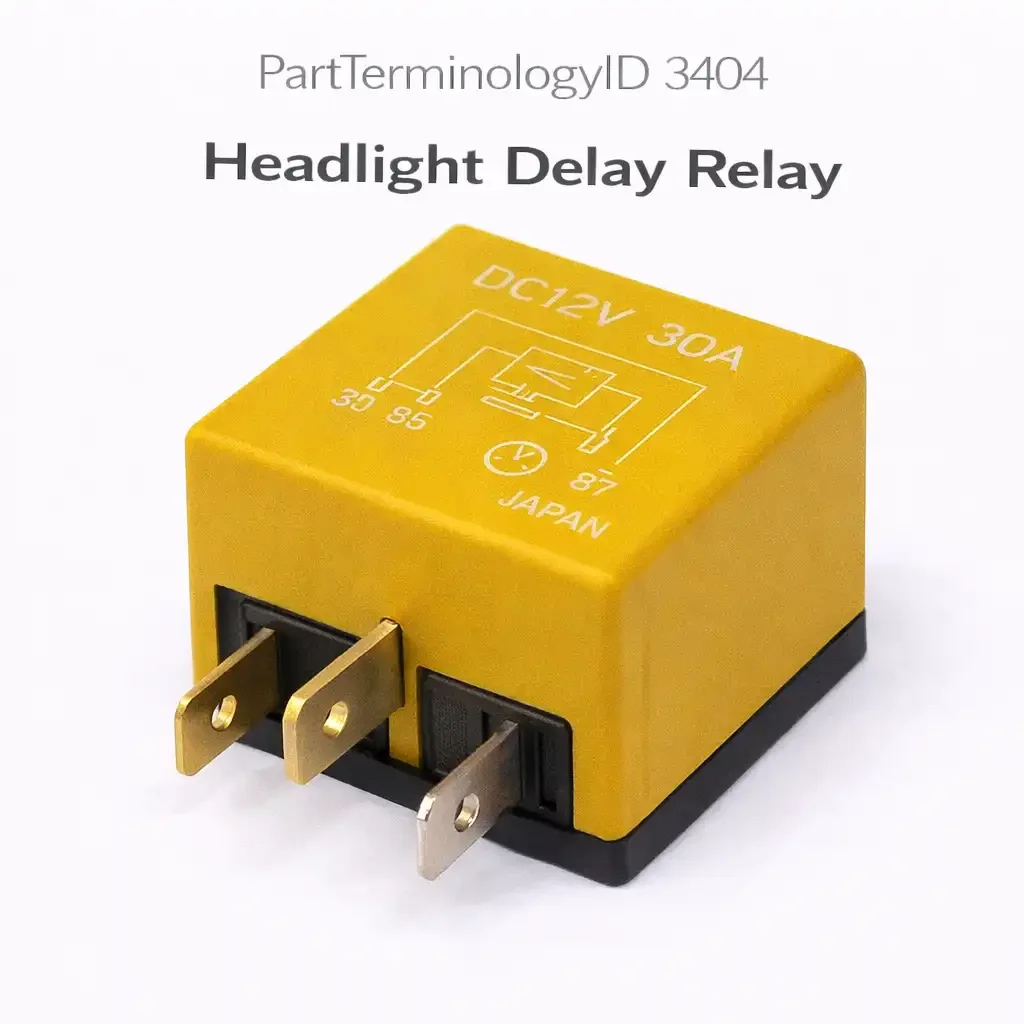
PartTerminologyID 3404, Headlight Delay Relay, is the relay that keeps the headlights energized for a calibrated time period after the ignition is switched off, allowing the driver to see their path from the vehicle to a building entrance before the lights extinguish. The relay monitors the ignition state and begins its timer countdown when the ignition transitions from on to off, holding the headlight circuit closed through its contact for the calibrated delay duration and then opening the contact to extinguish the headlights. The three attributes that determine correct fitment are the delay duration and whether it is fixed or adjustable in the relay unit; the circuit architecture and how the delay relay interacts with the main Headlight Relay (PartTerminologyID 3400) and the headlight switch in the overall headlight power supply sequence; and the failure modes, which produce either headlights that never delay after ignition-off or headlights that remain on indefinitely without extinguishing, and require different diagnostic approaches for each.
What the Headlight Delay Relay Does
Ignition-off timer circuit and delay activation
The headlight delay relay uses an internal electronic timer circuit that begins counting down when the ignition voltage at the relay's ignition monitor terminal drops from battery voltage to zero on ignition-off. During the countdown, the relay contact remains closed and the headlight circuit remains energized regardless of the ignition state. When the countdown expires, the contact opens and the headlights extinguish. On applications where the delay duration is user-adjustable, a potentiometer or multi-position switch on the relay body sets the delay from approximately 15 seconds to 3 minutes depending on the application. On applications with a fixed delay, the relay's internal timer is calibrated at the factory and cannot be adjusted. The relay requires battery voltage at its constant power terminal to maintain the timer circuit during the countdown period, meaning the headlight delay function is powered from the battery rather than the ignition circuit during the delay phase.
Interaction with the main headlight relay and headlight switch
The headlight delay relay typically sits in the headlight power circuit downstream of the headlight switch and upstream of the main headlight relay or directly upstream of the lamp circuits on applications without a separate main headlight relay. When the headlights are on and the ignition is switched off, the delay relay's contact remains closed and continues to supply the headlight circuit. The headlight switch must remain in the on position for the delay function to operate on most non-BCM applications, because the delay relay is in series with the switch circuit. On BCM-controlled applications, the BCM manages the delay timing internally and commands the headlight relay to remain active for the delay period without requiring the driver to leave the headlight switch in any particular position. On discrete relay applications, a driver who switches the headlights off before switching the ignition off bypasses the delay function because the switch has already broken the headlight supply circuit.
Failed-open versus failed-closed failure modes
The headlight delay relay has two distinct failure modes with opposite symptoms. A relay with a failed timer circuit that has lost the ability to hold its contact closed after ignition-off produces headlights that extinguish immediately when the ignition is switched off, with no delay period. This is a loss-of-convenience fault with no safety consequence, and it is the most common failure mode. A relay with a failed timer circuit that has lost the ability to open its contact after the delay period expires produces headlights that remain on indefinitely after ignition-off and will drain the battery if the vehicle is parked overnight. This is the more serious failure mode and the one most frequently attributed to a stuck headlight switch or a BCM fault before the delay relay is tested. A relay contact stuck in the closed position after the delay period has expired is confirmed by disconnecting the relay and verifying that the headlights extinguish immediately when the relay is removed, indicating the relay contact rather than the headlight switch or BCM is holding the circuit closed.
Top Return Scenarios
Scenario 1: "Headlights stay on indefinitely after ignition-off, battery drains overnight"
The delay relay contact is stuck closed and the timer circuit has lost the ability to open the contact after the delay period. The headlights remain on as long as the battery has sufficient charge. Removing the delay relay from its socket should immediately extinguish the headlights if the relay contact is the fault. If the headlights remain on after relay removal, the headlight switch or BCM is holding the circuit closed independently of the relay and the diagnosis should proceed to those components.
Prevention language: "If headlights remain on indefinitely after ignition-off, remove the headlight delay relay from its socket. Headlights that extinguish immediately on relay removal confirm a stuck-closed relay contact. Headlights that remain on after relay removal indicate the headlight switch or BCM is holding the circuit closed and the relay is not the fault."
Scenario 2: "Headlights turn off immediately when ignition is switched off, no delay"
The delay relay timer circuit has failed and the contact is no longer held closed after ignition-off. The relay activates correctly when the headlights are switched on and supplies the lamp circuit normally during operation, but provides no post-ignition delay. This is a timer circuit failure within the relay and requires relay replacement to restore the delay function. The headlight system operates safely without the delay relay functioning, but the convenience feature of illuminating the path from the vehicle is lost.
Prevention language: "Headlights that turn off immediately on ignition-off indicate the delay relay timer circuit has failed. The headlights operate normally during driving. Replace the relay to restore the post-ignition illumination delay. This fault has no effect on normal headlight operation while the vehicle is running."
Scenario 3: "Replaced the headlight delay relay but headlights still do not delay"
On BCM-controlled applications, the delay function may be managed within the BCM software rather than through a discrete delay relay. The buyer has ordered and installed a delay relay but the application does not use a discrete relay for this function, and the headlight delay behavior is a BCM-programmed function that may be adjustable through the BCM configuration or may require a software update. On non-BCM applications where a discrete relay is present, the delay function may not restore after relay replacement if the headlight switch is not left in the on position at the time of ignition-off, since the switch must be on for the discrete relay to hold the circuit.
Prevention language: "On BCM-controlled applications, the headlight delay function may be a BCM software feature rather than a discrete relay function. Confirm your application uses a discrete delay relay before ordering. On discrete relay applications, the headlight switch must be in the on position when the ignition is switched off for the delay function to activate."
Delay Architecture Across Vehicle Generations
Discrete relay timer units (1980s through early 2000s)
The earliest headlight delay systems on domestic and imported vehicles used a self-contained relay timer unit with an integrated RC circuit or dedicated timer IC that controlled the contact hold duration. These units were typically located in the passenger compartment fuse box or in a dedicated relay bracket near the headlight switch. The delay duration on these early units is set by the RC time constant of the internal resistor and capacitor combination, and the duration drifts slightly as the capacitor ages. A unit that originally delayed for 30 seconds may delay for only 10 to 15 seconds after several years of use as the capacitor loses capacitance. If the delay duration is shorter than expected but the feature still functions, capacitor aging within the relay timer circuit is the cause, and relay replacement restores the original delay duration. This is a normal wear characteristic of first-generation discrete timer relays and does not represent a relay fault in the conventional sense.
BCM-integrated delay with no discrete relay (mid-2000s onward)
From the mid-2000s onward, most manufacturer platforms moved the headlight delay function into the BCM software, eliminating the discrete delay relay entirely. On these platforms the BCM monitors the ignition state transition and holds its headlight relay output active for the programmed delay duration after ignition-off. The delay duration on BCM-integrated systems is often configurable through the dealer scan tool or through a driver menu in the instrument cluster, with delay options ranging from 0 seconds to several minutes depending on the platform. A vehicle on a BCM-integrated platform where the headlight delay function has stopped working requires BCM diagnosis and possible software reconfiguration rather than a relay replacement. The absence of a discrete delay relay socket in the fuse box is the confirming sign that the application uses BCM-integrated delay control.
Combination delay and auto-light relay units
Some applications combine the headlight delay function with an automatic headlight activation function in a single relay module. This combination unit monitors both the ambient light sensor input for auto-light activation and the ignition state transition for delay timing, and controls the headlight relay output for both functions from within the same module. A failed combination unit may lose one function while retaining the other, producing a symptom of correct auto-light activation but no post-ignition delay, or correct delay function but no auto-light response. Each failure mode within the combination unit points to a different internal circuit, and the combination unit must be replaced as an assembly since the internal circuits are not serviceable separately.
Seasonal and Environmental Failure Patterns
Thermal effects on timer circuit accuracy
The internal timer circuit's RC components or timer IC are sensitive to temperature extremes. In very cold climates, the relay's timer capacitor charges more slowly and the delay duration extends beyond its calibrated value, producing headlights that stay on significantly longer than intended after ignition-off. In hot climates, the capacitor charges more quickly and the delay shortens. On vehicles parked in direct sunlight in summer, relay housing temperatures can exceed 70 degrees Celsius, which accelerates capacitor aging and produces a progressively shortening delay duration over several seasons. A vehicle that arrives for service with a delay that is noticeably shorter than its original specification has experienced capacitor aging from thermal exposure and requires relay replacement to restore the designed delay duration.
Moisture ingress and contact contamination
Headlight delay relays located in engine compartment relay centers are exposed to moisture from rain intrusion, condensation, and engine bay washing. Moisture ingress into the relay housing can contaminate the timer circuit components and cause erratic delay behavior, where the delay duration varies unpredictably from activation to activation rather than maintaining a consistent timing period. A relay exhibiting inconsistent delay duration with no pattern related to temperature is experiencing moisture contamination. Inspecting the relay socket for water intrusion and corrosion on the relay terminals before replacing the relay confirms whether a socket seal fault is contributing to the failure, since a new relay installed in a moisture-contaminated socket will experience the same contamination-related failure in a shorter service interval.
Listing Requirements
PartTerminologyID: 3404
delay duration: fixed or adjustable, and duration range (mandatory)
circuit position relative to headlight switch and main headlight relay (mandatory)
failed-open vs. failed-closed symptom descriptions (mandatory)
relay removal test for stuck-closed diagnosis (mandatory)
BCM-integrated application note where no discrete relay is present (mandatory)
OEM part number cross-reference (mandatory)
FAQ (Buyer Language)
My headlights used to stay on for about 30 seconds after I turned the key off. Now they go off immediately. Is this the delay relay?
Yes. The loss of the post-ignition delay with all other headlight functions operating normally is the characteristic symptom of a failed headlight delay relay timer circuit. The relay contact is no longer being held closed by the timer after ignition-off. Replace the relay to restore the delay function. The delay duration on the new relay should match the original relay's calibration; confirm the delay duration specification from the OEM part number before ordering a fixed-timer replacement.
How is this relay different from the main headlight relay?
The main Headlight Relay (PartTerminologyID 3400) supplies the headlight lamp circuit whenever the headlight switch commands it on, during normal headlight operation. The Headlight Delay Relay (3404) extends that supply for a timed period after the ignition is switched off. The main relay controls whether the headlights work at all during normal operation. The delay relay controls only the post-ignition timing behavior. A failed main relay prevents headlight operation entirely. A failed delay relay affects only the post-ignition illumination feature without impacting normal headlight operation.
Can the delay duration be adjusted on my relay?
On some applications the delay relay has an adjustable potentiometer or a multi-position selector that sets the delay duration. On others the delay is fixed in the relay's internal timer circuit and cannot be adjusted without replacing the relay. Check the relay body for an adjustment control. If none is present, the delay duration is fixed and the replacement relay must match the OEM delay specification to restore the same post-ignition illumination period.
What Sellers Get Wrong About PartTerminologyID 3404
The most common listing error is failing to describe both failure modes. A listing that only describes the headlights-stay-on-indefinitely symptom misses the much more common headlights-turn-off-immediately failure mode, and buyers whose delay has simply stopped working will not recognize the relay as the correct component from a listing that only discusses the battery-drain symptom. Every listing under PartTerminologyID 3404 must describe both failure modes with their distinct symptoms so buyers can identify which failure mode they are experiencing and confirm the relay is the correct component before ordering.
The second error is omitting the relay removal test for the stuck-closed failure mode. Buyers with headlights that stay on indefinitely frequently attribute the fault to the headlight switch or BCM before the delay relay is tested. The relay removal test takes under 30 seconds, requires no tools on most applications, and immediately confirms or excludes the relay as the fault source. This test instruction in the listing prevents the return of a correctly identified relay from a buyer who ordered based on the symptom description but found the headlights did not extinguish on relay removal, indicating the switch or BCM is the actual fault.
Cross-Sell Logic
Headlight Relay (PartTerminologyID 3400): the main headlight relay and delay relay work in series on the headlight supply circuit; a failed main relay prevents headlight operation entirely while a failed delay relay affects only the post-ignition timing feature
Headlight Switch: on discrete relay delay applications, a headlight switch left in the off position at ignition-off bypasses the delay relay and prevents the delay from activating; a failed switch that cannot hold the on position will also prevent delay operation
BCM: on BCM-controlled delay applications, delay function loss after relay replacement indicates the delay is a BCM software function; BCM configuration or reprogramming is the correct resolution
Final Take for PartTerminologyID 3404
Headlight Delay Relay (PartTerminologyID 3404) is the post-ignition headlight timer relay where dual failure mode description, relay removal test guidance, and BCM-integrated application clarification are the three listing attributes that prevent the most common misdiagnosis and wrong-component returns. The relay removal test is the most actionable single instruction in the listing because it resolves the stuck-closed failure mode diagnosis in under 30 seconds and prevents orders from buyers whose fault is actually in the headlight switch or BCM. Sellers who describe both failure modes, include the relay removal test instruction, and note BCM-integrated applications give buyers the complete diagnostic path from symptom to correct component and correct resolution for every headlight delay complaint.