
Written by Arthur Simitian | PartsAdvisory
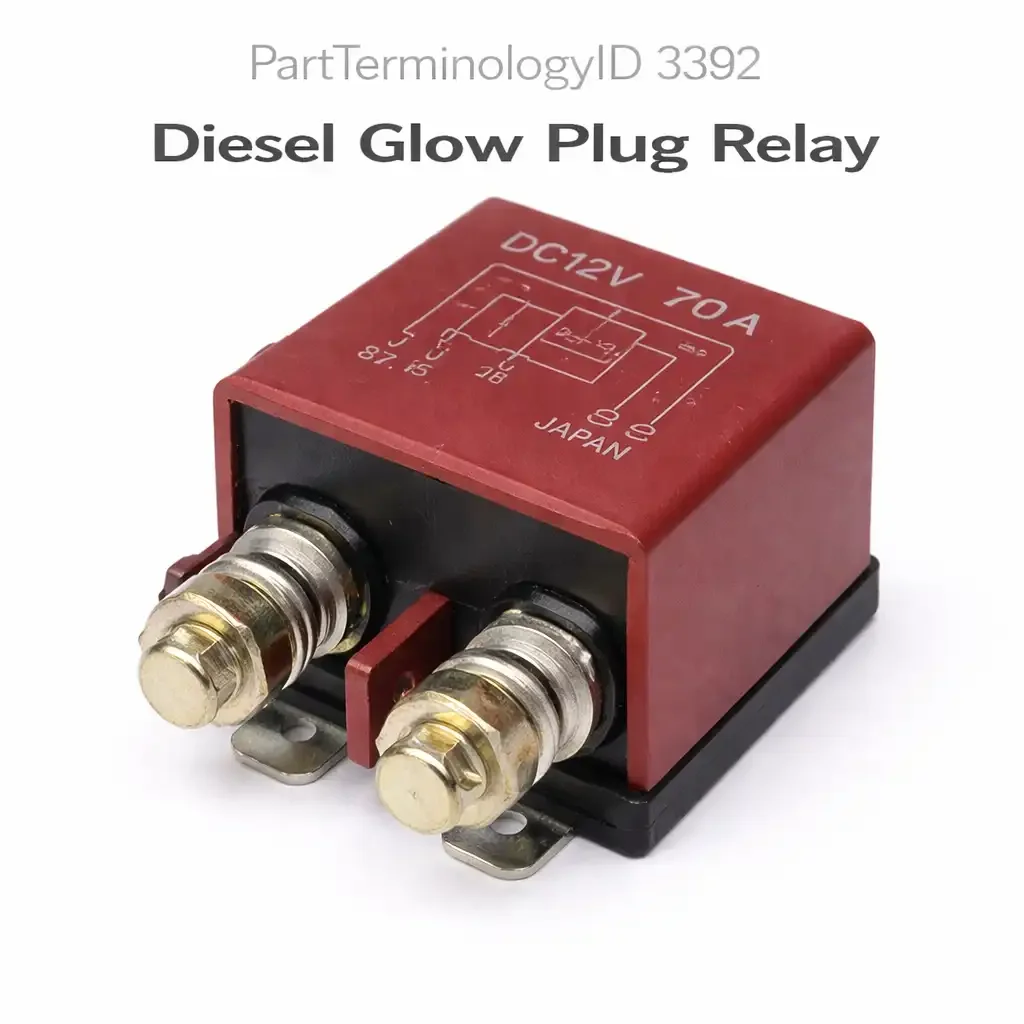
PartTerminologyID 3392, Diesel Glow Plug Relay, is the relay that delivers high-current battery voltage to the glow plug bus bar, supplying all glow plugs simultaneously with the power required to heat the combustion chamber prechamber or swirl chamber to the temperature necessary for reliable cold diesel ignition. Each glow plug draws between 10 and 25 amperes during the initial preheat cycle depending on plug design and temperature, meaning a four-cylinder diesel with four glow plugs draws 40 to 100 amperes through this relay during the preheat phase. The relay contact must be rated for this sustained high current load, and a contact with insufficient rating or degraded contact surfaces will fail under glow plug current demand before it shows any fault during lower-current circuit testing. The three attributes that determine correct fitment are the contact current rating relative to the total glow plug load for the application's cylinder count; the preheat and post-heat cycle timing and how the relay activation duration is controlled; and the activation source, whether a dedicated glow plug control module, the ECM, a timer relay, or a direct coolant temperature switch input governs when and for how long the relay energizes the glow plugs.
The glow plug relay is the highest sustained current relay in the diesel starting system, and it is also the component whose failure is most commonly attributed to the glow plugs themselves before the relay supply voltage is tested at the glow plug bus bar. A relay that has failed open produces the same symptom as a full set of failed glow plugs: hard cold start, white smoke during cold cranking, and extended crank duration in cold weather. Testing bus bar voltage before removing and testing individual plugs is the single diagnostic step that separates a relay fault from a plug fault.
What the Diesel Glow Plug Relay Does
High-current glow plug supply and contact rating
The glow plug relay contact carries the combined current draw of all glow plugs simultaneously during each preheat cycle. On a six-cylinder diesel with plugs drawing 15 amperes each, the relay contact carries 90 amperes during preheat. This is substantially higher than most other automotive relay applications, and the OEM glow plug relay is specifically rated for this load with contact materials and surface area designed for repeated high-current switching cycles over the relay's service life. An undersized aftermarket replacement relay with a standard 30-ampere contact rating will experience contact erosion and premature failure when installed in a high-cylinder-count diesel application drawing more than twice the contact's rated capacity. Contact current rating must be verified against the application's total glow plug current demand before any relay substitution is made.
Preheat and post-heat cycle activation logic
The glow plug relay activates in two phases on most modern diesel applications. The preheat phase begins when the ignition key is turned to the on position, before the engine is cranked, and lasts for a duration determined by the glow plug control module or ECM based on coolant temperature at the time of activation. At very cold coolant temperatures the preheat duration may extend to 15 to 25 seconds. At moderate coolant temperatures the preheat duration is reduced to 2 to 5 seconds. Above the warm cutoff temperature, typically around 40 to 50 degrees Celsius depending on the application, the preheat phase is skipped entirely and the relay does not activate on ignition-on. The post-heat phase begins after the engine starts and continues for a calibrated duration to maintain combustion chamber temperature during the initial run period, reducing white smoke emissions and rough running while the engine warms up. A relay that activates the preheat phase correctly but fails to activate the post-heat phase indicates a controller output fault on the post-heat command rather than a relay contact fault, since the same relay contact serves both phases.
Activation source: controller, ECM, timer relay, or temperature switch
The glow plug relay coil receives its activation signal from different sources depending on the application's generation and manufacturer. On older applications from the late 1970s through the mid-1980s, a dedicated bimetal or electronic timer relay activates the glow plug relay coil for a fixed duration on ignition-on without ECM input. On applications from the mid-1980s onward, a dedicated glow plug control module monitors coolant temperature and calculates preheat and post-heat duration, activating the relay coil through a module output transistor. On more recent applications, the ECM integrates the glow plug control function and commands the relay directly through an ECM output driver. Each activation architecture has a different diagnostic sequence for confirming whether an absent relay coil signal is caused by the activation source or by the relay coil itself, and the listing must identify which activation source the application uses.
Top Return Scenarios
Scenario 1: "Hard cold start with white smoke, glow plugs tested and all pass"
The glow plug relay contact has failed open. The plugs are receiving no preheat power and are cold when the engine is cranked, producing white smoke from unvaporized fuel and requiring extended cranking to achieve compression ignition. The glow plugs test correctly because they are functional components receiving no supply voltage, not defective components. Testing voltage at the glow plug bus bar connector during the preheat cycle before removing or testing individual plugs would have identified the absent supply as a relay fault immediately.
Prevention language: "On any hard cold start complaint on a diesel application, test voltage at the glow plug bus bar during the preheat cycle before removing or testing individual glow plugs. Zero voltage at the bus bar with a confirmed relay coil activation signal indicates a relay contact failure. This test takes under two minutes and prevents the unnecessary removal and testing of a complete set of functional glow plugs."
Scenario 2: "Glow plug warning light does not illuminate on cold start"
The glow plug relay coil is not being activated by the control module or ECM because the coolant temperature sensor is reading an incorrect warm temperature, the control module has a fault, or the coil activation signal wire has an open circuit. The relay contact is intact but the coil is not receiving an activation signal. The warning light circuit on most applications monitors the preheat cycle completion signal from the control module rather than the relay contact state directly, so a control module that is not commanding the relay will also not illuminate the warning light. Testing for coil activation voltage at the relay coil terminal during a cold-soak ignition-on event confirms whether the controller is sending the preheat command before the relay is replaced.
Prevention language: "A missing glow plug warning light on a cold start indicates the control module is not commanding the preheat cycle. Test coolant temperature sensor resistance at ambient temperature to confirm the module is receiving a correct cold temperature input before diagnosing the relay. A sensor reading warm temperature when the engine is cold will suppress the preheat command and leave the relay correctly de-activated."
Scenario 3: "Engine starts fine from cold but runs rough and smokes for several minutes after start"
The relay is activating the preheat phase correctly, allowing the engine to start from cold, but the post-heat phase relay activation is not occurring. The combustion chamber temperature drops during the initial run period without post-heat support, producing rough running and white smoke until the engine reaches normal operating temperature. On controller-activated applications, the controller post-heat output has failed while the preheat output remains functional. Testing for relay coil activation voltage during the post-start period confirms whether the controller is sending the post-heat command.
Listing Requirements
PartTerminologyID: 3392
contact current rating vs. total glow plug load for cylinder count (mandatory)
preheat and post-heat cycle description (mandatory)
activation source: timer relay, control module, or ECM (mandatory)
bus bar voltage test as first diagnostic step (mandatory)
coolant temp sensor pre-check on no-preheat complaints (mandatory)
OEM part number cross-reference (mandatory)
FAQ (Buyer Language)
How do I know if the relay has failed or if I have a bad glow plug?
Test voltage at the glow plug bus bar or at one glow plug supply terminal during the preheat cycle with the ignition on and before cranking. If battery voltage is present at the bus bar and the engine still has a hard cold start, one or more glow plugs have failed and individual plug resistance testing is the next step. If no voltage is present at the bus bar during the preheat cycle, the relay contact has failed open and all plugs are cold regardless of their individual condition. The bus bar voltage test takes under two minutes and resolves the relay-versus-plug diagnostic question completely before any component is removed.
My diesel starts fine in summer but struggles every winter. Is this the relay getting worse?
Thermal intermittency in a glow plug relay contact can produce exactly this seasonal pattern. The relay contact resistance may be elevated but still sufficient to pass enough current to heat plugs adequately at moderate ambient temperatures, while at low ambient temperatures the marginally heated plugs are not warm enough to ignite the denser cold air and fuel mixture. A relay that shows elevated contact resistance under high current load during summer testing will fail more obviously in cold weather before complete contact failure occurs. Testing contact voltage drop under glow plug load rather than just testing for contact continuity identifies marginal contact resistance before the winter cold-start failure occurs.
Do I need a special high-current relay for a diesel application?
Yes on high-cylinder-count applications. The glow plug relay contact must be rated for the combined current draw of all glow plugs simultaneously. A standard automotive relay with a 30-ampere contact rating is adequate for some two and three-cylinder diesel applications but undersized for four, six, and eight-cylinder diesel engines whose total glow plug current draw significantly exceeds the contact rating. Confirm the total glow plug current for the application from the service manual and verify the replacement relay contact rating meets or exceeds that specification before ordering.
What Sellers Get Wrong About PartTerminologyID 3392
The most damaging listing error is omitting the contact current rating requirement. Sellers who list a generic relay with a standard automotive contact rating without noting the high-current requirement for multi-cylinder diesel applications will generate a contact failure return within one or two heating seasons from buyers who installed an undersized relay. Every listing under PartTerminologyID 3392 must state the contact current rating and note that it must be matched to the application's total glow plug current draw. The second most common error is omitting the bus bar voltage test guidance. This diagnostic step prevents the most common wrong-diagnosis sequence on this circuit, where the glow plugs are removed and tested individually before the relay supply voltage is checked, wasting diagnostic time and generating unnecessary plug replacement orders on applications where the relay is the actual fault.
Cross-Sell Logic
Glow Plugs: if bus bar voltage is confirmed correct during preheat but cold start difficulty persists, individual glow plug resistance testing is the next step; plugs that read open circuit or significantly higher resistance than specification have failed
Glow Plug Control Module: if no relay coil activation signal is present during a cold-soak ignition-on event with a correct coolant temperature sensor reading, the control module output driver has failed and the module is the replacement target
Coolant Temperature Sensor: a sensor reading warm temperature when cold suppresses the preheat command and produces the same no-preheat symptom as a failed relay; always pre-check the sensor reading before diagnosing the relay or control module on a no-preheat complaint
Diesel Injection Pump Relay (PartTerminologyID 3376): the injection pump relay and glow plug relay both operate during the cold diesel start sequence; both should be tested on a cold diesel no-start complaint
Final Take for PartTerminologyID 3392
Diesel Glow Plug Relay (PartTerminologyID 3392) is the highest sustained current relay in the diesel starting system, and contact current rating disclosure, bus bar voltage test guidance, and preheat cycle description are the three listing attributes that prevent the most costly and time-consuming return scenarios on this part number. The bus bar voltage test is the single most valuable diagnostic instruction in the entire listing because it redirects the majority of hard-cold-start diagnoses away from glow plug removal and toward the relay supply circuit, where the fault actually resides in most relay-related cold start complaints. Sellers who state the current rating requirement, describe the preheat and post-heat cycle, and lead with the bus bar voltage test guidance give diesel buyers the diagnostic framework to identify the correct fault component on the first attempt and confirm correct glow plug system operation after relay installation.