
Written by Arthur Simitian | PartsAdvisory
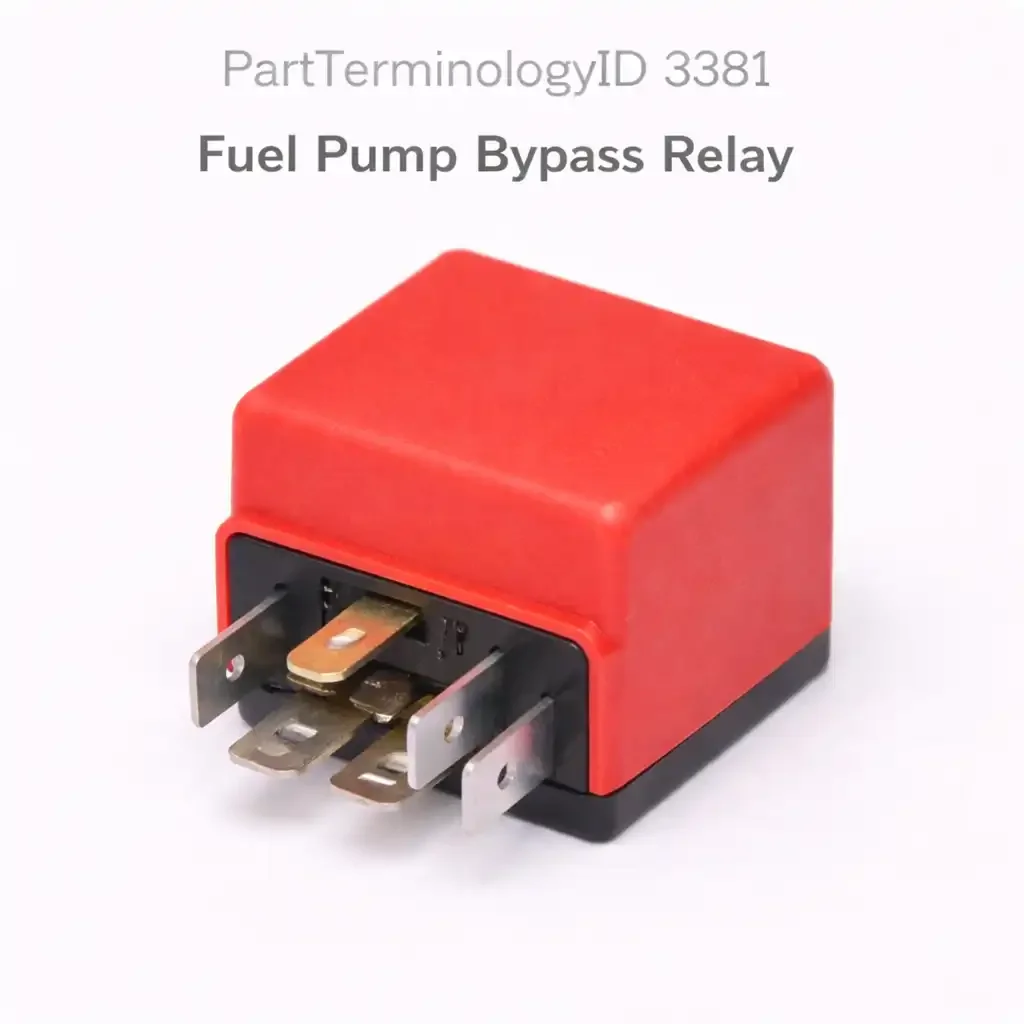
PartTerminologyID 3381, Fuel Pump Bypass Relay, is the relay that bypasses a resistor or voltage-reducing element in the fuel pump power circuit to deliver full battery voltage to the fuel pump motor during high fuel demand conditions. On applications that use a two-speed fuel pump architecture, the pump operates at reduced voltage and lower flow rate during normal light-load driving by running the pump motor through a resistor that drops supply voltage below battery level. When the PCM detects high fuel demand conditions such as wide-open throttle, high engine load, or low fuel pressure, it activates the bypass relay, which short-circuits the resistor and delivers full battery voltage directly to the pump motor, increasing pump speed and fuel flow to meet the demand. The three attributes that determine correct fitment are the bypass circuit the relay controls and how it connects to the main fuel pump relay circuit; the PCM activation conditions that command the bypass relay versus the main relay; and the differentiation from the Fuel Pump Relay (PartTerminologyID 3380), which supplies the primary pump circuit independently of the bypass relay function.
What the Fuel Pump Bypass Relay Does
Resistor bypass circuit and two-speed pump operation
On two-speed fuel pump applications, the fuel pump circuit contains a resistor or resistor pack that reduces the pump motor's supply voltage during low-demand operation. The pump runs at reduced speed and lower current draw during cruise and light throttle, reducing fuel system noise, extending pump motor life, and lowering heat generation in the in-tank module. When the PCM determines that higher fuel flow is required, it activates the bypass relay coil. The bypass relay contact shorts across the resistor, removing its voltage-dropping effect and allowing full battery voltage to reach the pump motor. The pump spins faster, increases fuel flow, and the fuel pressure rises to meet the higher demand. A bypass relay that fails open keeps the pump in the low-speed mode permanently, which on high-demand applications produces a lean condition at wide-open throttle because the pump cannot supply sufficient fuel volume at reduced speed to meet injector demand. This lean-at-high-load symptom is the diagnostic signature of the bypass relay fault on two-speed pump architectures.
Differentiation from Fuel Pump Relay (PartTerminologyID 3380)
The Fuel Pump Relay (3380) supplies the primary power circuit to the fuel pump motor and controls whether the pump runs at all. The Fuel Pump Bypass Relay (3381) controls only the speed of a pump that is already running through the primary relay. On applications with both relays, the main relay (3380) must be closed for the pump to operate, and the bypass relay (3381) determines whether the pump operates at reduced voltage through the resistor or at full battery voltage with the resistor bypassed. A failed main relay produces a complete no-start with no pump activity. A failed bypass relay produces an engine that starts and runs normally at light load but goes lean and loses power at high load because the pump cannot deliver sufficient flow at reduced speed. These two distinct symptom patterns are the most reliable distinguishing feature between the two relay faults and must be included in listings for both PartTerminologyIDs.
Top Return Scenarios
Scenario 1: "Engine runs lean or loses power only at wide-open throttle or high load"
The bypass relay contact has failed open. The pump is receiving power through the main relay and operating at reduced speed through the resistor during all operating conditions including wide-open throttle, because the bypass relay is not closing to short the resistor. Fuel pressure holds at normal idle and cruise values but drops below specification at high engine speed and load when injector demand exceeds what the low-speed pump can supply. Confirming fuel pressure drop at high load while pressure is normal at idle and cruise identifies a fuel supply volume deficit consistent with a stuck-low-speed pump rather than a fuel pressure regulator fault.
Prevention language: "A lean condition or power loss only at wide-open throttle with normal fuel pressure at idle indicates the fuel pump is stuck in low-speed mode. Test for bypass relay activation voltage from the PCM during a wide-open throttle event. No PCM activation signal during high demand indicates a PCM output fault. PCM signal present but relay not closing confirms a bypass relay contact failure."
Scenario 2: "Replaced the fuel pump relay but engine still loses power at high load"
The buyer replaced the main Fuel Pump Relay (3380) based on a high-load power loss complaint. The main relay was functioning correctly and is not the fault. The bypass relay (3381) contact has failed open and the pump remains in low-speed mode at high demand. Replacing the main relay has no effect on the bypass circuit. The correct replacement is PartTerminologyID 3381, and listings for both relay IDs should cross-reference each other's symptom patterns to redirect buyers who have ordered the wrong relay to the correct one.
Prevention language: "High-load lean condition or power loss is a bypass relay fault, not a main relay fault. If replacing PartTerminologyID 3380 did not resolve a high-load performance complaint, test the bypass relay (3381) contact and PCM activation signal during a high-demand event."
Listing Requirements
PartTerminologyID: 3381
bypass circuit function: resistor short-circuit at high demand (mandatory)
PCM activation conditions: WOT, high load, low fuel pressure signal (mandatory)
differentiation from Fuel Pump Relay (PartTerminologyID 3380) (mandatory)
lean-at-high-load as primary symptom of bypass relay failure (mandatory)
OEM part number cross-reference (mandatory)
FAQ (Buyer Language)
Does my vehicle have a fuel pump bypass relay?
Not all vehicles use a two-speed fuel pump architecture with a bypass relay. This design is more common on applications from the late 1980s through the mid-2000s that used variable-speed pump control through a resistor rather than PWM electronic speed control. Check your vehicle's wiring diagram for a fuel pump resistor and a second fuel pump relay position. If no resistor is present in the fuel pump circuit, your application does not use a bypass relay and the Fuel Pump Relay (3380) is the only relay in the pump circuit.
Can a failed bypass relay cause the check engine light to come on?
On applications where the PCM monitors fuel pressure directly through a fuel pressure sensor, a bypass relay failure that results in insufficient fuel pressure at high load may trigger a lean fuel trim fault code or a low fuel pressure fault code. The fault code will point to a fuel system lean condition or fuel pressure inadequacy rather than specifically to the relay, and the relay diagnosis requires confirming that the pump is receiving reduced voltage during conditions when the PCM is commanding full voltage through the bypass relay.
What Sellers Get Wrong About PartTerminologyID 3381
The most common listing error is omitting the bypass circuit explanation entirely and listing the relay as a generic fuel pump relay interchangeable with PartTerminologyID 3380. Buyers who search for a fuel pump relay on a high-load lean symptom complaint will find both listings and have no basis for distinguishing which relay serves their application's fault without a clear explanation of the bypass function. Every listing under PartTerminologyID 3381 must state that this relay controls the high-speed bypass circuit, not the primary pump supply, and must describe the lean-at-high-load symptom as the characteristic failure pattern. The second error is failing to note the applications that use this architecture, since buyers on single-speed pump applications will search for the relay and waste diagnostic time looking for a relay socket that does not exist on their vehicle.
Cross-Sell Logic
Fuel Pump Relay (PartTerminologyID 3380): the main relay and bypass relay work together on two-speed pump applications; the main relay should be confirmed functional before diagnosing the bypass relay on any fuel delivery complaint
Fuel Pump Resistor: the resistor the bypass relay shorts across is a wear item on some applications; a resistor with increased resistance produces a lower-than-normal low-speed pump voltage and may cause fuel pressure issues even when the bypass relay is functioning correctly
In-Tank Fuel Pump: if bypass relay activation is confirmed at wide-open throttle but fuel pressure still drops under high demand, the pump motor itself has degraded and cannot maintain sufficient flow even at full voltage
Final Take for PartTerminologyID 3381
Fuel Pump Bypass Relay (PartTerminologyID 3381) is the two-speed pump control relay where bypass circuit identification, lean-at-high-load symptom description, and differentiation from the main Fuel Pump Relay (3380) are the three listing attributes that direct buyers to the correct relay for their specific failure mode. The symptom distinction between a failed main relay (no-start, no pump activity) and a failed bypass relay (starts and idles normally, goes lean at high load) is the single most useful piece of buyer guidance on this circuit and must appear in every listing under both PartTerminologyID 3380 and 3381. Sellers who explain the bypass function, describe the high-load lean symptom, and cross-reference the main relay give buyers the framework to identify the correct fault relay on the first search and order the correct component without requiring a return.