
Fuel Pump Relay (PartTerminologyID 3380): Where Prime Cycle Behavior, PCM Activation Logic, Inertia Switch Interaction, and Current Rating Determine Correct Fuel Pump Relay Diagnosis and Fitment
Written by Arthur Simitian | PartsAdvisory
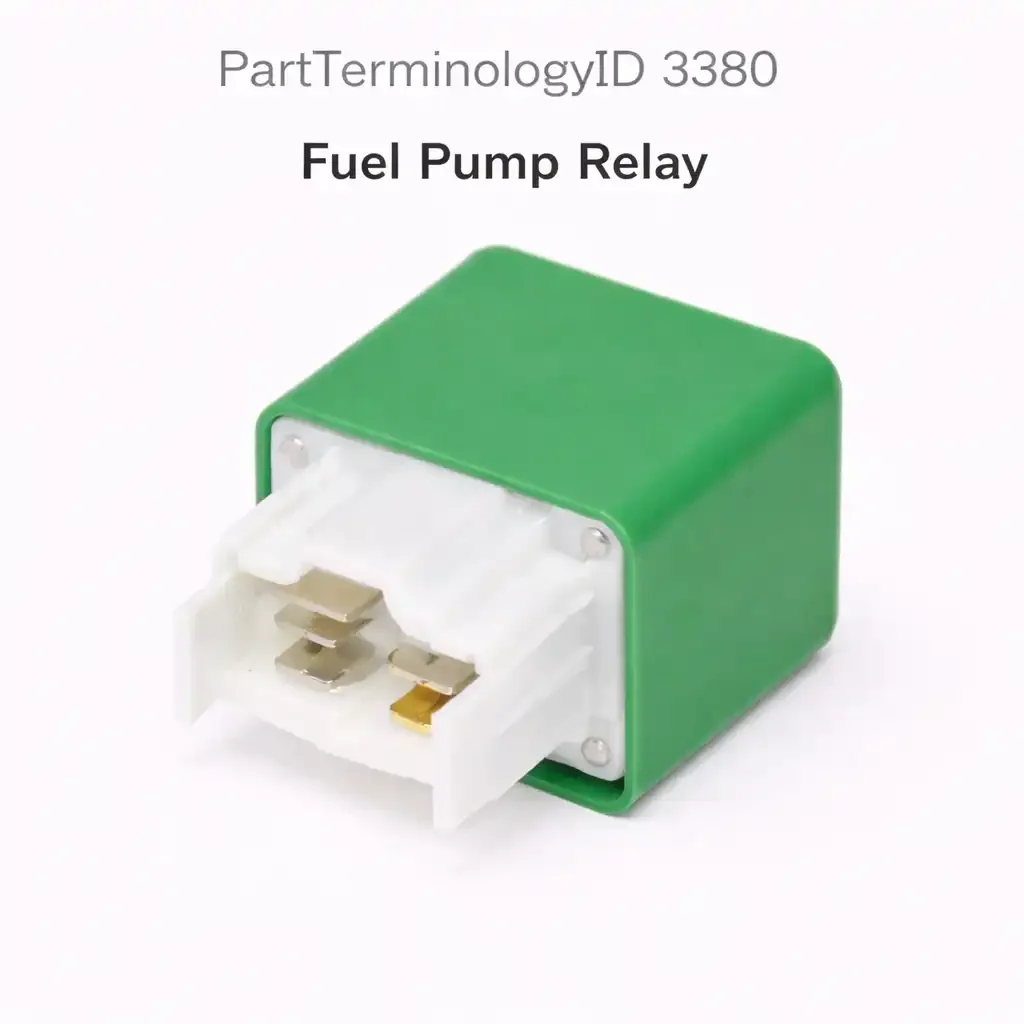
PartTerminologyID 3380, Fuel Pump Relay, is the relay that supplies switched power to the in-tank electric fuel pump, delivering battery voltage to the pump motor so the fuel system can pressurize the fuel rail and maintain operating fuel pressure throughout the engine run cycle. Without this relay closed, the fuel pump receives no power, the fuel rail has no pressure, and the engine cannot start or continue running regardless of how correct the ignition system or injector operation may be. The relay's failure mode, symptom pattern, and diagnostic sequence are among the most commonly misunderstood in the fuel system category, and the three attributes that determine correct fitment are the PCM activation logic and prime cycle behavior specific to the application; the inertia switch interaction on applications where the fuel pump relay and the inertia switch are both in the fuel pump power circuit; and the contact current rating relative to the fuel pump motor's sustained current draw, which on high-demand applications determines whether an undersized relay contact will fail prematurely under normal operating load.
The fuel pump relay is the most frequently replaced relay in the fuel system category across all vehicle segments, and it is also the relay most commonly replaced unnecessarily when the actual fault is in the fuel pump motor, the inertia switch, or the PCM activation circuit. Listings that explain the prime cycle test, the inertia switch reset procedure, and the PCM activation signal test sequence prevent the majority of wrong-diagnosis returns on this part number.
What the Fuel Pump Relay Does
Prime cycle behavior and ignition-on activation
On most EFI applications from the mid-1980s onward, the fuel pump relay activates for a short prime cycle of 1 to 3 seconds when the ignition key is turned to the on position before the engine is cranked. The PCM activates the relay coil immediately on ignition-on and de-activates it after the prime duration if no engine speed signal is received from the crankshaft position sensor, indicating the engine has not been cranked. When the engine is cranked and the PCM receives a crank signal, the relay is re-activated and held closed continuously while the engine runs. The prime cycle is an important diagnostic indicator: a fuel pump relay that activates the prime cycle correctly but does not re-activate during cranking indicates a PCM activation signal fault during the crank event rather than a relay fault. A relay that produces no prime cycle hum from the fuel pump on ignition-on and no pump activity during cranking indicates either a relay contact failure or an absent PCM activation signal on both the prime and crank phases.
PCM activation logic and relay coil circuit
The fuel pump relay coil is driven by a PCM output transistor on most applications, meaning the PCM grounds the relay coil circuit to energize the relay. The relay coil receives battery voltage through the ignition switched circuit at one terminal, and the PCM provides the ground at the other terminal to complete the coil circuit. A relay that does not activate when the ignition is turned on should be diagnosed by testing for both the ignition-switched voltage at the coil supply terminal and the PCM ground at the coil activation terminal simultaneously. If ignition voltage is present but the PCM ground is absent, the relay coil has no complete circuit and the relay cannot activate regardless of its internal condition. This PCM output fault is the second most common cause of no-prime-cycle symptoms after relay contact failure and must be tested before the relay is condemned.
Inertia switch interaction and reset procedure
Many Ford and some other applications include an inertia switch in the fuel pump power circuit between the relay contact output and the fuel pump motor. The inertia switch is a mechanical safety device that trips and opens the fuel pump circuit in a collision event, cutting power to the fuel pump to prevent fuel delivery after an impact. A tripped inertia switch produces exactly the same symptom as a failed fuel pump relay: no fuel pump prime cycle, no pump activity during cranking, and a no-start condition with correct spark and injector activity. The inertia switch must be inspected and reset before the relay is replaced on any application that uses one. The inertia switch reset button is typically located in the trunk, cargo area, or under the dash, and a tripped switch has a visible button that has popped up from its normal flush position. Pressing the button down resets the switch and restores the fuel pump circuit without requiring any part replacement.
Contact current rating and pump motor load
The fuel pump motor is the highest sustained current draw device in the fuel system, and the relay contact must be rated for the pump motor's full load current continuously throughout the engine run cycle. Most OEM fuel pump relays are rated at 20 to 30 amperes continuous contact current. Aftermarket relays with contact ratings below the pump motor's full load current will experience accelerated contact wear and premature contact failure because the contact surfaces are operating above their thermal design limit on every run cycle. On high-performance applications with upgraded fuel pumps drawing more current than the OEM pump, the relay contact rating must be matched to the upgraded pump's current specification rather than the OEM relay specification.
Top Return Scenarios
Scenario 1: "No fuel pump prime cycle on ignition-on, engine cranks but does not start"
The two most common causes are a failed relay contact and a tripped inertia switch on applicable applications. Before replacing the relay, inspect the inertia switch reset button on applications equipped with one. If the inertia switch is not tripped, test for relay coil activation voltage from the PCM during ignition-on. If PCM activation is present but no relay output voltage reaches the fuel pump connector, the relay contact has failed open. If PCM activation is absent, the PCM output transistor or the PCM activation circuit wiring has failed.
Prevention language: "Before replacing the fuel pump relay on a no-prime-cycle complaint: check the inertia switch reset button if equipped, test for PCM relay coil ground during ignition-on, and test for relay output voltage at the fuel pump connector. Each step takes under two minutes and identifies the correct fault component before any part is ordered."
Scenario 2: "Engine starts and runs but stalls at operating temperature"
The relay contact has developed thermal intermittency and opens when contact resistance increases with heat. The engine runs correctly from cold start but stalls after reaching operating temperature when the relay contact resistance rises above the threshold at which the contact can no longer carry the pump motor's full current. The engine may restart after a cool-down period when the contact resistance returns to a lower value. A relay producing this symptom has degraded contacts and requires replacement, but the symptom may not be present during a shop diagnosis if the vehicle has cooled before testing.
Prevention language: "A fuel pump relay with thermal intermittency may test correctly when cold but fail when the relay body reaches operating temperature. If a stall-at-temperature complaint cannot be reproduced during a cold diagnosis, test relay contact voltage drop under load with the engine at operating temperature. A voltage drop above 0.1 volts across the relay contact under pump motor load indicates contact degradation."
Scenario 3: "Replaced the fuel pump relay but the engine still does not start"
The relay was not the fault. The fuel pump motor has failed, the inertia switch remains tripped after the collision event that triggered it, or the PCM activation signal is absent and the new relay is also not being activated. Confirming prime cycle pump operation by listening for the characteristic 1 to 2 second pump hum on ignition-on after relay replacement verifies that the new relay is activating and the pump is responding. If no pump hum is present after relay replacement, the diagnosis should continue to the fuel pump motor, the inertia switch, and the PCM output circuit.
Prevention language: "After relay replacement, confirm the fuel pump prime cycle by listening for the pump hum on ignition-on before attempting a start. No prime cycle hum after relay replacement confirms the relay is not the only fault. Continue diagnosis to the pump motor, inertia switch, and PCM output circuit."
Listing Requirements
PartTerminologyID: 3380
prime cycle behavior and duration (mandatory)
PCM activation logic: PCM-grounded coil circuit (mandatory)
inertia switch check note on applicable applications (mandatory)
contact current rating relative to pump motor load (mandatory)
prime cycle confirmation test after installation (mandatory)
OEM part number cross-reference (mandatory)
FAQ (Buyer Language)
How do I know if the fuel pump relay is bad or the fuel pump itself?
Test voltage at the fuel pump connector with the ignition on during the prime cycle. If battery voltage is present at the pump connector but the pump produces no hum and no fuel pressure builds, the pump motor has failed. If no voltage is present at the pump connector during the prime cycle, test the relay contact output terminal for voltage. Voltage at the relay output but not at the pump connector indicates a wiring fault between the relay and the pump. No voltage at the relay output with a confirmed relay coil activation signal indicates a relay contact failure. This three-point voltage test identifies the fault location without requiring part removal.
My car starts fine when cold but after it sits for 20 minutes it cranks longer before starting. Is this the relay?
Long crank after a hot soak is more commonly caused by fuel pressure bleed-down from a leaking fuel pressure regulator or leaking injectors than by a relay fault. When the engine is hot and fuel evaporates from the rail during the soak period, the next start requires the pump to re-pressurize the rail from a lower starting pressure, extending the crank duration. If the prime cycle produces a full 1 to 2 second pump run and fuel pressure builds correctly to specification on the first ignition-on, the relay is functioning and the extended crank is a fuel pressure retention fault rather than a relay fault.
Can I run a relay bypass wire directly to the fuel pump to test if the relay is bad?
A direct 12-volt source applied to the fuel pump connector will confirm whether the pump motor is functional, but it bypasses both the relay and the inertia switch and should only be used as a diagnostic test, not as a permanent fix. Running the fuel pump without the inertia switch in circuit removes the crash safety shutoff, and running without the PCM activation circuit means the pump will operate whenever the direct power source is connected regardless of ignition state. Use the direct power test only to confirm pump motor function during diagnosis, then restore the correct relay-controlled circuit before returning the vehicle to service.
What Sellers Get Wrong About PartTerminologyID 3380
The most damaging listing error for the fuel pump relay is omitting the inertia switch check note. A significant percentage of no-start complaints attributed to the fuel pump relay on Ford applications are actually tripped inertia switches that require only a button press to reset, producing zero-cost resolution without any part order. Sellers who include the inertia switch reset instruction in their listing prevent the return of a correctly functioning relay from a buyer who replaced it while a tripped inertia switch was the actual cause. The second most common error is omitting the prime cycle test as the first diagnostic step. Without the prime cycle guidance, buyers who cannot hear the pump hum proceed directly to relay replacement without confirming whether the PCM is sending an activation signal or whether the pump motor itself has failed.
The third error is listing the relay with an undersized contact current rating for high-demand applications. Sellers who list a generic relay with a 20-ampere contact rating for all applications without noting the current requirement mismatch on upgraded pump applications will generate a return when the undersized relay contact fails prematurely on a vehicle with a higher-draw pump.
Cross-Sell Logic
Fuel Pump Bypass Relay (PartTerminologyID 3381): the bypass relay provides an alternate activation path for the fuel pump on applications where the main fuel pump relay circuit includes a bypass circuit for diagnostics or fail-safe operation; both should be noted in listings for architectures that use both relays
In-Tank Fuel Pump: if relay output voltage is confirmed at the pump connector during the prime cycle but no pump activity occurs, the fuel pump motor is the replacement target
Fuel Pressure Regulator: hot soak extended crank complaints with correct relay function should direct diagnosis to fuel pressure retention testing at the regulator and injectors
Inertia Switch: should be referenced in every fuel pump relay listing for applicable applications as the first check before relay replacement on no-start complaints
Final Take for PartTerminologyID 3380
Fuel Pump Relay (PartTerminologyID 3380) is the highest-volume fuel system relay in the aftermarket category, and the prime cycle behavior explanation, the inertia switch check note, and the PCM activation signal test sequence are the three listing attributes that separate the listings that generate returns from the listings that generate correct first-order purchases. The inertia switch note alone prevents a meaningful share of the wrong-diagnosis returns on Ford applications, and the prime cycle test guidance prevents the relay-replaced-but-still-no-start scenario that produces the most frustrated repeat contacts in the fuel system category. Sellers who explain the prime cycle, include the inertia switch reset reminder, and describe the PCM activation test sequence give buyers a complete diagnostic framework that leads to the correct fault component before the part is ordered and confirms correct installation after it is received.