
Written by Arthur Simitian | PartsAdvisory
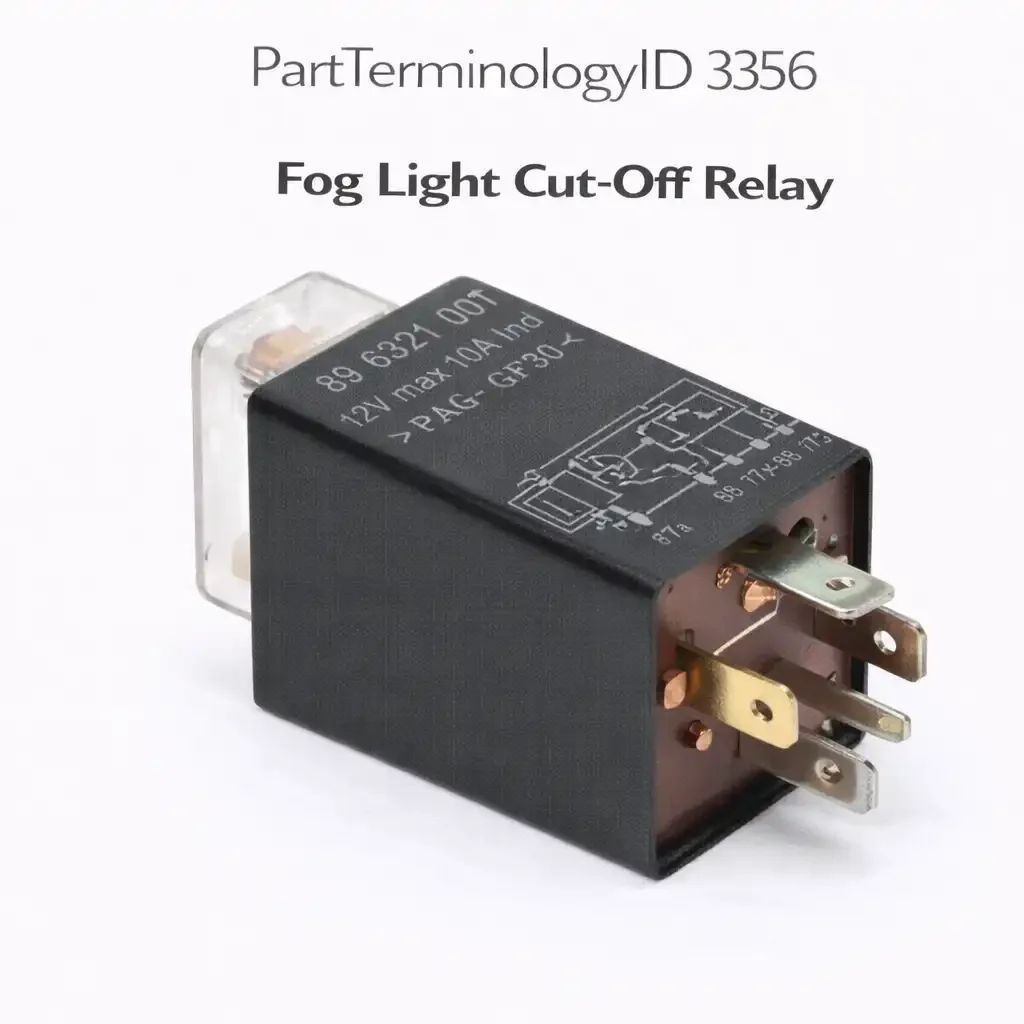
PartTerminologyID 3356, Fog Light Cut-Off Relay, is the relay that interrupts power to the fog light circuit when a defined cut-off condition is met, most commonly when the high beam headlights are activated or when the ignition is switched off. Where the Fog Light Relay (PartTerminologyID 3352) supplies power to the fog lights when the driver activates them, the fog light cut-off relay monitors a separate interlock input and de-energizes the fog light circuit when the interlock condition is triggered, regardless of the fog light switch position. The three attributes that determine correct fitment are the specific cut-off trigger the relay responds to; whether the relay operates as a normally closed contact that opens on cut-off or as a normally open contact controlled by a separate logic circuit; and the differentiation from the Fog Light Relay (3352) on applications where both relays are present in the same lighting control architecture.
What the Fog Light Cut-Off Relay Does
Interlock circuit function and cut-off trigger sources
The fog light cut-off relay receives its de-activation signal from one or more interlock sources depending on the application. The most common cut-off trigger is the high beam circuit: when the driver switches from low beam to high beam, a signal from the high beam circuit reaches the fog light cut-off relay coil, causing the relay to open and interrupt fog light power. This behavior prevents simultaneous use of high beams and front fog lights, which on most front fog light applications produces a combined light pattern that reduces forward visibility rather than improving it. A second common cut-off trigger is the ignition-off signal: the relay opens when the ignition is switched off to ensure the fog lights do not remain energized after the vehicle is parked, preventing battery drain from a fog light switch left in the on position.
Normally closed contact architecture and interlock logic
On applications where the fog light cut-off relay uses a normally closed contact, the relay contact is closed at rest and the fog lights receive power through the contact whenever the fog light relay (3352) is also closed. When the cut-off condition is triggered, the cut-off relay coil is energized and the normally closed contact opens, interrupting fog light power. This means a cut-off relay with a failed coil that cannot be energized will leave the fog lights permanently enabled with no automatic cut-off on high beam activation. A cut-off relay with a failed contact that is stuck open will prevent fog light operation entirely even when no cut-off condition is active. Distinguishing between these two failure modes requires testing both the coil circuit and the contact continuity separately.
Differentiation from Fog Light Relay (PartTerminologyID 3352)
The Fog Light Relay (3352) is activated by the driver's fog light switch input and supplies power to the fog light circuit when the driver commands fog lights on. The Fog Light Cut-Off Relay (3356) operates independently of the driver's fog light switch and interrupts the circuit when an interlock condition overrides the driver's input. On applications with both relays, the fog light power circuit passes through the cut-off relay contact before reaching the fog lights, making the cut-off relay the upstream controller and the fog light relay the downstream switch. A failed cut-off relay that is stuck open prevents fog light operation even when the fog light relay is functioning correctly and the driver has activated the fog light switch. This failure pattern is the most common source of fog-lights-inoperative complaints on dual-relay fog light architectures and is frequently misdiagnosed as a fog light relay fault before the cut-off relay contact is tested.
Top Return Scenarios
Scenario 1: "Fog lights do not work at all after replacing the fog light relay"
The fog light relay (3352) is functioning but the fog light cut-off relay (3356) contact is stuck open, preventing power from reaching the fog lights regardless of switch position. The buyer replaced the fog light relay based on the inoperative fog lights symptom, found no improvement, and is returning the relay. Testing contact continuity through the cut-off relay with no cut-off condition active confirms a stuck-open contact failure. The fog light relay is not the fault on this application.
Prevention language: "On applications with a separate fog light cut-off relay, test contact continuity through the cut-off relay before replacing the fog light relay. A stuck-open cut-off relay contact prevents fog light operation and produces the same symptom as a failed fog light relay. The cut-off relay contact test takes under one minute and eliminates the most common misdiagnosis on this circuit."
Scenario 2: "Fog lights stay on when high beams are activated"
The fog light cut-off relay coil is not receiving the high beam interlock signal, or the coil has failed open and cannot be energized. The normally closed contact remains closed when high beams are activated, and the fog lights continue to operate. The fog lights are receiving power correctly through the cut-off relay contact, which confirms the contact is intact, but the coil is not opening the contact on the high beam trigger. Testing for high beam interlock voltage at the relay coil terminal when high beams are active identifies whether the cut-off signal is reaching the relay or whether the coil itself has failed.
Prevention language: "Fog lights that remain on during high beam use indicate the cut-off relay coil is not being activated by the high beam interlock signal. Test for voltage at the cut-off relay coil trigger terminal with high beams active. No voltage at the coil terminal indicates a wiring or BCM fault upstream of the relay. Voltage at the coil with no relay response indicates a failed relay coil."
Listing Requirements
PartTerminologyID: 3356
cut-off trigger source: high beam, ignition-off, or BCM output (mandatory)
contact configuration: normally closed or normally open (mandatory)
differentiation from Fog Light Relay (PartTerminologyID 3352) (mandatory)
stuck-open contact as primary failure mode causing inoperative fogs (mandatory)
OEM part number cross-reference (mandatory)
FAQ (Buyer Language)
My fog lights turn off when I switch to high beams. Is the cut-off relay working correctly?
Yes. Fog lights turning off when high beams are activated is the correct and intended behavior on applications with a fog light cut-off relay. The relay is functioning as designed. If you want fog lights and high beams to operate simultaneously, the cut-off relay circuit would need to be modified, which on most applications requires bypassing the interlock input to the relay coil. Note that some regional regulations require fog lights to cut off with high beams, and bypassing the interlock may affect compliance with those regulations.
Do all vehicles with fog lights have a cut-off relay?
No. Many fog light systems use a single relay (PartTerminologyID 3352) with the interlock logic handled internally by the BCM or lighting control module rather than through a separate cut-off relay. The fog light cut-off relay is more common on applications from the late 1980s through the mid-2000s that used discrete relay logic rather than module-integrated lighting control. Confirm your application's fog light circuit architecture before ordering under PartTerminologyID 3356.
Can a failed cut-off relay drain the battery?
A cut-off relay with a failed normally closed contact that is stuck closed will prevent the ignition-off cut-off from working, leaving the fog lights energized after the vehicle is parked if the fog light switch is left in the on position. This will drain the battery over several hours depending on fog light wattage. A vehicle that repeatedly returns to a dead battery with no apparent cause should have the fog light cut-off relay contact tested as part of the parasitic draw diagnosis when the fog light switch has been left in the on position.
What Sellers Get Wrong About PartTerminologyID 3356
The most damaging listing error is describing the fog light cut-off relay as equivalent to the fog light relay without explaining the cut-off function. Buyers who search for a fog light relay and receive a listing that does not distinguish between the supply relay (3352) and the cut-off relay (3356) will order the wrong component for their application's failure mode. A buyer with a stuck-open cut-off relay needs PartTerminologyID 3356, not 3352, and a listing that does not explain the cut-off relay's distinct function will generate a return when the buyer installs 3352 and finds no improvement. The second error is omitting the contact configuration. A normally closed cut-off relay and a normally open fog light relay have different contact configurations and cannot substitute for each other even if they share the same relay body dimensions and terminal pinout.
Cross-Sell Logic
Fog Light Relay (PartTerminologyID 3352): the supply relay and cut-off relay operate in series on dual-relay fog light architectures; both should be tested when fog lights are inoperative
Headlight Relay (PartTerminologyID 3400): on applications where the high beam interlock signal routes through the headlight relay circuit, a headlight relay fault can prevent the cut-off relay from receiving its trigger signal
Fog Light Switch: a fog light switch stuck in the on position combined with a failed cut-off relay will cause battery drain; the switch should be tested alongside the relay on parasitic draw complaints
Final Take for PartTerminologyID 3356
Fog Light Cut-Off Relay (PartTerminologyID 3356) is the fog light interlock relay where cut-off trigger identification, contact configuration disclosure, and differentiation from the Fog Light Relay (3352) are the three listing attributes that prevent the most common wrong-component order and misdiagnosis scenarios. The distinction between the supply relay and the cut-off relay is the single most important piece of buyer guidance on this circuit, because the two relays produce opposite failure symptoms and require opposite diagnostic approaches. Sellers who explain the cut-off relay's interlock function, state the contact configuration, and direct buyers to test the cut-off relay contact before replacing the fog light relay give buyers the diagnostic path that leads to the correct component on the first order.