
Written by Arthur Simitian | PartsAdvisory
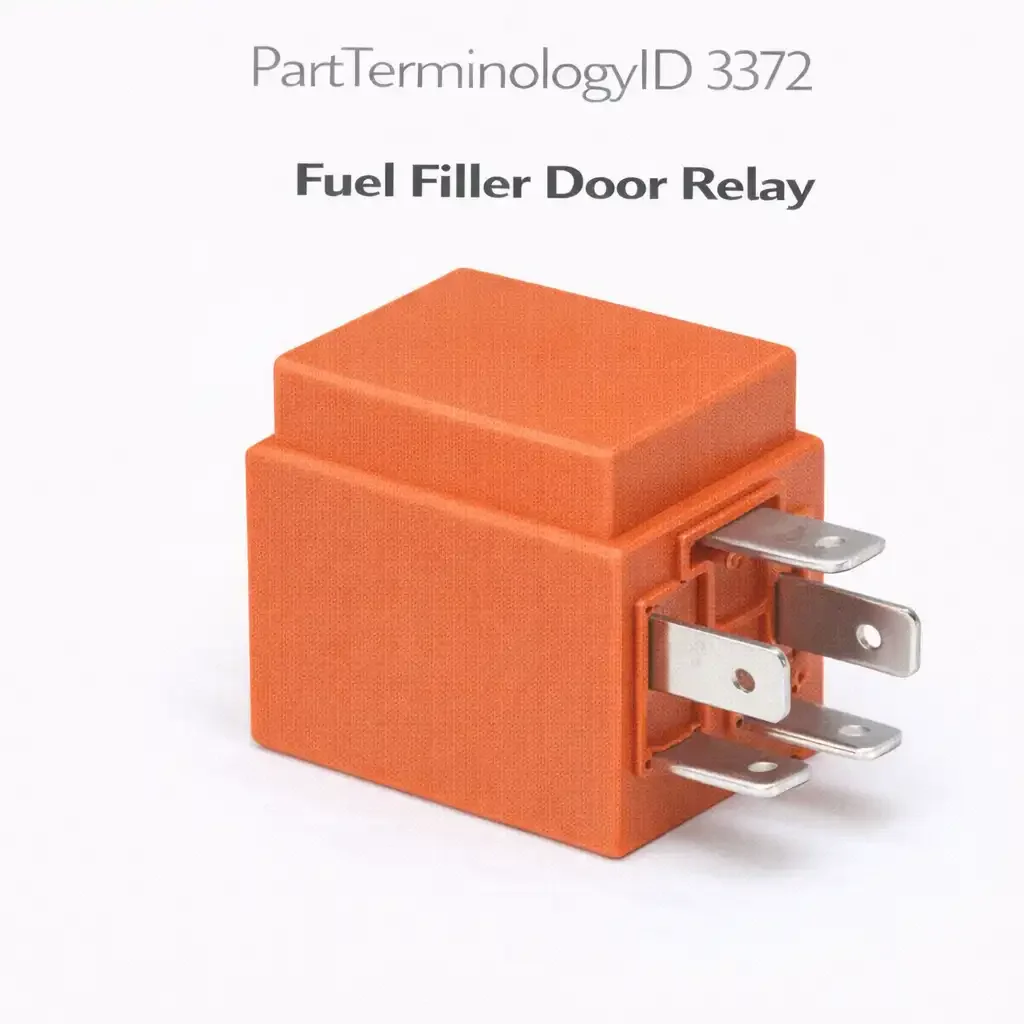
PartTerminologyID 3372, Fuel Filler Door Relay, is the relay that controls power delivery to the fuel filler door actuator solenoid, which releases or locks the fuel filler door on vehicles equipped with an electrically operated fuel door release system. The relay bridges the BCM or body control module release command and the actuator solenoid that physically unlocks or pops open the fuel filler door when the driver activates the interior release switch or the remote key fob. The three attributes that determine correct fitment are the actuator solenoid circuit the relay controls; the BCM release logic that governs when the relay is permitted to activate; and the door-locked inhibit condition present on many applications, which prevents the relay from activating the fuel door release while the vehicle's central locking system has the doors in the locked state.
What the Fuel Filler Door Relay Does
Actuator solenoid supply and release pulse duration
The fuel filler door relay delivers a short power pulse to the actuator solenoid when the BCM commands a release event. On spring-loaded fuel door designs, the solenoid retracts a latch pin that holds the door closed, and the door springs open under its own spring tension once the latch pin is retracted. On motorized designs, the relay supplies power to a small motor that both unlatches and opens the door through a short drive cycle. The relay pulse duration is typically under one second on solenoid-type actuators, and the relay is de-energized by the BCM after the release event is complete. A relay that fails open prevents any release pulse from reaching the actuator, and the fuel filler door cannot be opened electrically. A relay that fails closed keeps the solenoid energized continuously, which on most designs means the latch pin remains retracted and the fuel door has no positive latching engagement, allowing it to rattle or swing open during driving.
BCM release logic and door-locked inhibit
On most applications from the mid-1990s onward, the BCM controls the fuel filler door release and applies an inhibit condition when the central locking system is in the locked state. This means the fuel filler door relay will not activate when the vehicle is locked, even if the interior release switch is pressed. The purpose of this inhibit is to prevent unauthorized fuel door access when the vehicle is unattended. A buyer who reports that the fuel door cannot be opened with the interior switch while the vehicle is locked is experiencing correct inhibit behavior, not a relay fault. Confirming that the vehicle is in the unlocked state before diagnosing a relay fault eliminates the most common non-fault return scenario on this circuit.
Top Return Scenario
Scenario 1: "Fuel door will not open from the interior switch or key fob"
The relay contact has failed open. The BCM is sending a release command and activation voltage is present at the relay coil terminal, but the relay contact is not closing and the actuator receives no power. Testing voltage at the actuator solenoid connector during a release command attempt, after confirming the relay coil is being activated, confirms a contact failure. If no activation voltage is present at the relay coil terminal during a release attempt with the vehicle unlocked, the fault is upstream of the relay in the BCM output circuit or the release switch wiring.
Prevention language: "Confirm the vehicle is in the unlocked state before diagnosing a fuel filler door relay fault. The BCM inhibits relay activation when the doors are locked on most applications. With the vehicle unlocked, test for relay coil activation voltage during a release attempt. Coil voltage present but no actuator output confirms a relay contact failure."
Listing Requirements
PartTerminologyID: 3372
controlled circuit: fuel filler door actuator solenoid or motor (mandatory)
activation source: BCM release command (mandatory)
door-locked inhibit condition note (mandatory)
relay pulse duration and solenoid vs. motor actuator type (recommended)
OEM part number cross-reference (mandatory)
FAQ (Buyer Language)
My fuel door only opens sometimes. Is this the relay?
Intermittent fuel door release is a common symptom of a relay with degraded contacts that close inconsistently. Test for BCM release command voltage at the relay coil terminal on a failed release attempt to confirm the BCM is sending the command. If coil voltage is present but the actuator does not respond, the relay contact is intermittently failing. If no coil voltage is present, the BCM output or release switch circuit is the intermittent fault source.
Can I open the fuel door manually if the relay fails?
Most vehicles with electrically operated fuel door releases include a manual emergency release cable or lever accessible from inside the trunk or cargo area. Consult the owner's manual for the manual release location before diagnosing the relay, as the manual release confirms whether the actuator mechanism is functional before the electrical circuit is tested.
What Sellers Get Wrong About PartTerminologyID 3372
The most common listing error is omitting the door-locked inhibit note. Buyers who attempt to open the fuel door while the vehicle is locked and find no response will attribute the non-response to a relay fault and order a replacement. The relay is functioning correctly and is correctly inhibited by the BCM. Every listing under PartTerminologyID 3372 must state that the BCM inhibits fuel door release when the vehicle is locked, directing buyers to test with the vehicle unlocked before concluding the relay has failed. The second error is failing to specify whether the relay controls a solenoid-type or motor-type actuator, since the two actuator types have different current draw profiles and some relay contact ratings are not adequate for motor-type actuators on larger fuel door designs.
Cross-Sell Logic
Fuel Filler Door Actuator: if relay output voltage is confirmed at the actuator connector during a release command but the door does not open, the actuator solenoid or motor has failed and is the next replacement target
BCM: if no release command voltage is present at the relay coil terminal during a release attempt with the vehicle unlocked and the switch confirmed functional, the BCM output driver for the fuel door circuit has failed
Central Door Lock Relay: on applications where the fuel door inhibit is tied to the central locking relay circuit, a door lock relay fault that leaves the system in a permanently locked state will also permanently inhibit the fuel door relay
Final Take for PartTerminologyID 3372
Fuel Filler Door Relay (PartTerminologyID 3372) is the fuel door release relay where actuator circuit identification, BCM release logic disclosure, and door-locked inhibit guidance are the three listing attributes that eliminate the most common non-fault return scenario on this circuit. The door-locked inhibit note is the highest-value piece of buyer guidance because it prevents the return of a correctly functioning relay from a buyer who tested in the locked state and concluded the relay was faulty. Sellers who include the inhibit condition, the BCM activation source, and the actuator voltage test sequence give buyers the three steps needed to confirm relay fault before ordering and to verify correct operation after installation.