
Written by Arthur Simitian | PartsAdvisory
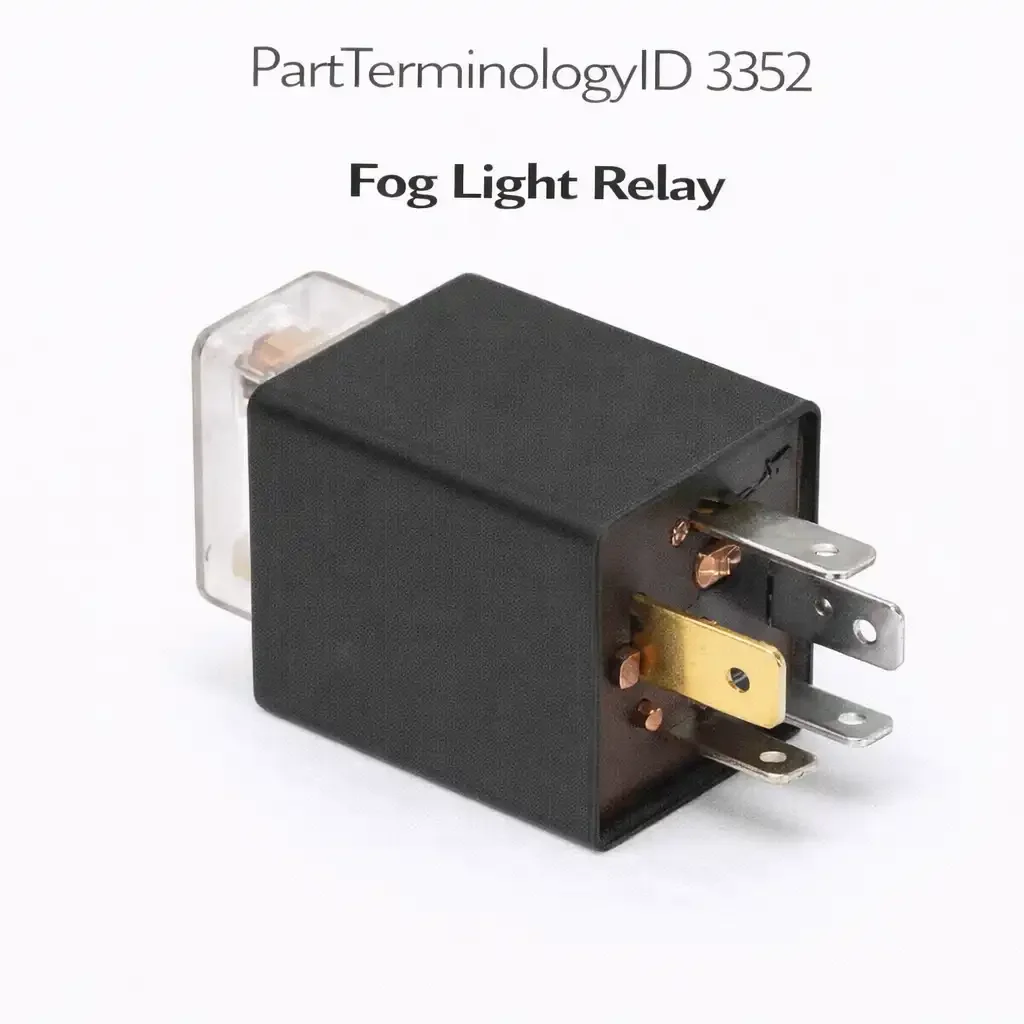
PartTerminologyID 3352, Fog Light Relay, is the relay that controls power delivery to the fog lamp circuit, switching the fog lights on and off in response to the driver's fog light switch input and the vehicle's enabling condition logic. That definition correctly describes the fog light relay's primary function and leaves unresolved the four attributes that determine fitment correctness and prevent the most frequent return scenarios: whether the relay controls the front fog light circuit, the rear fog light circuit, or both; what enabling conditions the BCM or body control circuit requires before the relay can be activated; whether the application is an OEM factory-installed fog light system or an aftermarket fog light kit that may use a different relay position and activation architecture; and the relationship between the fog light relay and the Fog Light Cut-Off Relay (PartTerminologyID 3356), which is a separate relay on some applications that disables the fog lights under specific conditions such as high-beam activation or vehicle speed threshold events.
Fog lights are among the most frequently misdiagnosed lighting circuits on the vehicle because their activation is conditional. A fog light that does not illuminate is not always a relay fault , it may be a switch fault, a BCM enabling condition that is not met, a wiring fault in the signal circuit, or a bulb fault. The fog light relay is the correct diagnosis only after the enabling conditions have been verified and the activation signal at the relay coil terminal has been confirmed absent. Sellers who include enabling condition verification guidance in their fog light relay listings reduce diagnostic errors and the returns that result from them.
What the Fog Light Relay Does
Front fog light circuit and low-beam interlock
On most OEM applications, the front fog light relay is wired with a low-beam interlock condition that requires the parking lights or low-beam headlights to be active before the fog light relay can be energized. This interlock is not a relay function , it is a wiring condition or BCM logic condition that prevents the fog lights from operating as standalone driving lights without the primary lighting circuit active. When a buyer reports that fog lights do not work with parking lights off but work correctly with low beams on, the relay is functioning correctly; the enabling condition logic is operating as designed. Listings that do not disclose the low-beam interlock generate returns from buyers who believe the relay is faulty because fog lights do not operate in isolation.
The front fog light relay contact rating must match the combined current draw of the fog lamp bulbs. Standard halogen fog lamps draw approximately 4 to 6 amperes per lamp at 55 watts, producing a total circuit current of 8 to 12 amperes for a two-lamp system. Aftermarket fog lamp upgrades using higher-wattage bulbs or additional lamp pods can exceed the OEM relay's contact rating, causing premature contact failure from overcurrent. Sellers listing fog light relays for applications that are commonly upgraded with higher-wattage aftermarket lamps should note the OEM contact current rating and recommend verification against the installed lamp wattage.
Rear fog light circuit and European application prevalence
The rear fog light relay controls power to the rear fog lamp, a single high-intensity red lamp mounted at the rear of the vehicle that is required equipment on vehicles sold in European markets and on European-specification vehicles sold globally. Rear fog lights are not standard equipment on most North American market vehicles, although some imported European vehicles sold in North America include a rear fog lamp and its associated relay. The rear fog light relay is typically activated by a dedicated rear fog switch independent of the front fog light switch, and the enabling conditions for rear fog light activation differ from front fog conditions on most applications , rear fog lights can typically be activated with parking lights alone on European-specification vehicles, while front fog lights on the same vehicle may require low-beam activation.
A rear fog light relay for a European-specification vehicle is not interchangeable with a front fog light relay even if the relay body dimensions and coil specifications are identical, because the activation circuit, the switch input, and the BCM control logic differ between the two circuits. Listings under PartTerminologyID 3352 that cover rear fog applications must specify the rear fog circuit function explicitly and must not be presented as front fog light relay replacements.
BCM-controlled fog light systems and direct-wired architecture
On vehicles from approximately 2005 onward with body control module-integrated lighting management, the fog light relay may be energized by a BCM output rather than by a direct switch input. In these systems, the driver's fog switch provides a signal input to the BCM, which evaluates the enabling conditions and then commands the fog light relay coil through a BCM output pin. A failed fog light relay in this architecture may produce a BCM fault code in addition to the symptom of inoperative fog lights. Buyers replacing a fog light relay on a BCM-controlled system who do not address the fault code may find that the new relay does not restore fog light operation because the BCM has commanded the relay off in a protection mode following a prior fault event.
On earlier direct-wired applications from approximately 1985 through 2005, the fog light switch provides battery or ignition power directly to the relay coil through the enabling condition wiring, and the relay contact powers the fog lamp circuit directly without BCM involvement. Diagnosis on these systems is straightforward: verify activation voltage at the relay coil terminal with the fog switch on and the enabling conditions met, substitute the relay if no activation is occurring despite correct voltage, and verify load-side voltage at the fog lamp socket after relay replacement.
Top Return Scenarios
Scenario 1: "Fog lights still don't work after relay replacement"
The replacement relay is correctly installed but the enabling condition for relay activation is not being met. On low-beam interlock applications, the buyer has the parking lights on but not the low beams, and the BCM or interlock wiring is correctly preventing relay activation. On BCM-controlled systems, a stored fault code is keeping the BCM from commanding the relay coil. The relay itself is functioning, but the activation signal is absent because the system's enabling logic has not been satisfied.
Prevention language: "Fog light activation requires [enabling conditions: parking lights on / low beams on / BCM fault codes cleared]. Verify all enabling conditions are met before testing the relay. On BCM-controlled systems, clear any stored lighting fault codes before replacing the relay , a BCM in fault protection mode will not command the fog light relay regardless of relay condition."
Scenario 2: "Fog lights work intermittently , sometimes on, sometimes off"
Intermittent fog light operation is most commonly caused by a relay with degraded contact surfaces that are arcing at the contact interface. This symptom is accelerated when the fog lamp circuit is drawing close to or exceeding the relay's contact current rating, which is common on applications where higher-wattage aftermarket bulbs have been installed. The contact arcing causes the relay to operate intermittently until contact failure becomes complete.
Prevention language: "Contact current rating: [X] amperes. Verify installed lamp wattage matches OEM specification before replacing the relay. Aftermarket fog lamp upgrades using higher-wattage bulbs can exceed the relay's contact rating and cause premature contact failure. If non-OEM wattage bulbs are installed, replace with a relay rated for the upgraded load or restore OEM bulb wattage."
Scenario 3: "Relay is in the box but there's no socket for it in the fuse box"
The buyer has a base-trim vehicle that was not factory-equipped with fog lights. The relay socket position in the relay center is unpopulated because the fog light relay was only installed on fog-light-equipped trim levels. The wiring harness on base-trim vehicles may not include the fog lamp circuit wiring at all, meaning the relay socket alone is insufficient , the complete fog lamp wiring harness, switch, and lamps must also be present for the relay to serve any function.
Prevention language: "This relay applies to [fog light equipped trim levels only]. Base trim vehicles without factory fog lights do not have a populated relay socket or fog lamp circuit wiring. Verify your vehicle was factory-equipped with fog lights before ordering."
Scenario 4: "Fog lights come on with high beams and shouldn't"
The Fog Light Cut-Off Relay (PartTerminologyID 3356) is the component responsible for disabling front fog lights when the high beams are activated, which is a legal requirement in many markets and a standard OEM design feature on most applications. If the fog lights remain on when the high beams are activated, the fault is in the cut-off relay circuit, not the fog light relay. Buyers who order the fog light relay (3352) when the symptom is fog lights staying on with high beams have ordered the wrong component.
Prevention language: "If fog lights remain illuminated when high beams are activated, the fault is in the Fog Light Cut-Off Relay (PartTerminologyID 3356), not this relay. This relay (3352) controls fog light activation. PartTerminologyID 3356 controls fog light deactivation when high beams are commanded."
Listing Requirements
PartTerminologyID: 3352
circuit function: front fog, rear fog, or combined (mandatory)
enabling conditions: parking light interlock, low-beam interlock, or BCM-controlled (mandatory)
contact current rating and OEM lamp wattage (mandatory)
trim level restriction if fog lights are optional equipment (mandatory)
differentiation from Fog Light Cut-Off Relay (PartTerminologyID 3356) (mandatory)
BCM fault code clearing note for BCM-controlled systems (recommended)
OEM part number cross-reference (mandatory)
FAQ (Buyer Language)
Why won't my fog lights turn on with just the parking lights?
Most OEM fog light systems require the low-beam headlights to be active before the fog light relay can be energized. This is a design requirement, not a fault. The relay and switch may both be functioning correctly. Activate the low-beam headlights and then test the fog light switch. If fog lights operate with low beams on, the system is functioning as designed. If fog lights still do not operate with low beams active, proceed with relay and switch diagnosis.
My fog lights worked yesterday and not today. What failed?
Intermittent fog light failure is most often caused by a relay with degraded contacts, a loose relay socket connection, or a fog light switch with intermittent contact failure. Remove the fog light relay and inspect the relay socket terminals for corrosion or spread terminal contacts. Substitute a known-good relay as the first diagnostic step. If the problem persists with a new relay, test the fog light switch for intermittent open conditions under operation.
Can I use a generic 30-amp relay instead of the OEM fog light relay?
A generic five-terminal 30-ampere relay with the correct coil resistance and terminal pinout can function in the fog light relay position if the contact current rating meets or exceeds the fog lamp circuit's current draw. Verify the terminal pinout matches the relay socket before installation. On BCM-controlled systems, some vehicles require a relay with a specific coil resistance range for correct BCM driver compatibility; a relay with coil resistance outside the BCM's expected range may not be energized reliably by the BCM output.
What is the difference between the fog light relay and the fog light cut-off relay?
The fog light relay (PartTerminologyID 3352) enables the fog light circuit when the driver activates the fog switch under the required enabling conditions. The fog light cut-off relay (PartTerminologyID 3356) disables the fog light circuit when the high beams are activated, which is required by regulation in many markets. Both relays work in the same fog lamp circuit but serve opposite functions: one activates, the other deactivates.
What Sellers Get Wrong About PartTerminologyID 3352
The most damaging listing error for fog light relays is failing to state the enabling conditions. Fog lights are conditional circuits, and buyers who do not know the enabling conditions will install a functioning relay and still report inoperative fog lights because the activation signal is never present. Every fog light relay listing must explicitly state whether the circuit requires parking lights, low beams, or BCM enabling before the relay can be commanded. The second error is failing to differentiate PartTerminologyID 3352 from PartTerminologyID 3356. Buyers whose fog lights stay on when high beams are activated need the cut-off relay, not the fog light relay, and listing copy that explains this functional boundary prevents a common wrong-part order. The third error is omitting trim level restrictions. On vehicles where fog lights are optional equipment, a significant percentage of the vehicle population does not have a populated relay socket, and a listing without trim level confirmation will produce uninstallable returns from base-trim buyers. Sellers who state enabling conditions, differentiate from the cut-off relay, and specify applicable trim levels address all three of the primary fog light relay return drivers in a single listing.
Cross-Sell Logic
Fog Light Cut-Off Relay (PartTerminologyID 3356): the cut-off relay disables fog lights when high beams are active; frequently diagnosed alongside PartTerminologyID 3352 when fog light behavior is abnormal
Driving Light Relay (PartTerminologyID 3276): auxiliary driving lights use a separate relay with different enabling condition logic; buyers upgrading to driving lights from fog lights should be directed to 3276
Headlight Relay (PartTerminologyID 3400): on low-beam interlock applications, headlight relay failure prevents the enabling condition from being met and may appear as fog light relay failure
Fog Light Bulbs: fog lamp bulb failure is a common co-occurring fault; a relay replacement that restores circuit voltage but produces no illumination indicates a failed bulb rather than an ongoing relay fault
Final Take for PartTerminologyID 3352
Fog Light Relay (PartTerminologyID 3352) is the conditional lighting relay where enabling condition disclosure, front versus rear circuit identification, OEM versus aftermarket architecture, and differentiation from the Fog Light Cut-Off Relay (PartTerminologyID 3356) are the four listing attributes that determine whether buyers diagnose the correct fault and order the correct component the first time. Fog lights are not always-on circuits, and the relay is the correct diagnosis only when the enabling conditions are met and the activation signal is absent. Listings that explain enabling conditions prevent the most common return scenario , a functioning replacement relay installed in a system where the enabling condition was never satisfied. Sellers who include all four attributes in every fog light relay listing give buyers the diagnostic context to confirm correct application, correct fault, and correct component before the part ships.