
Written by Arthur Simitian | PartsAdvisory
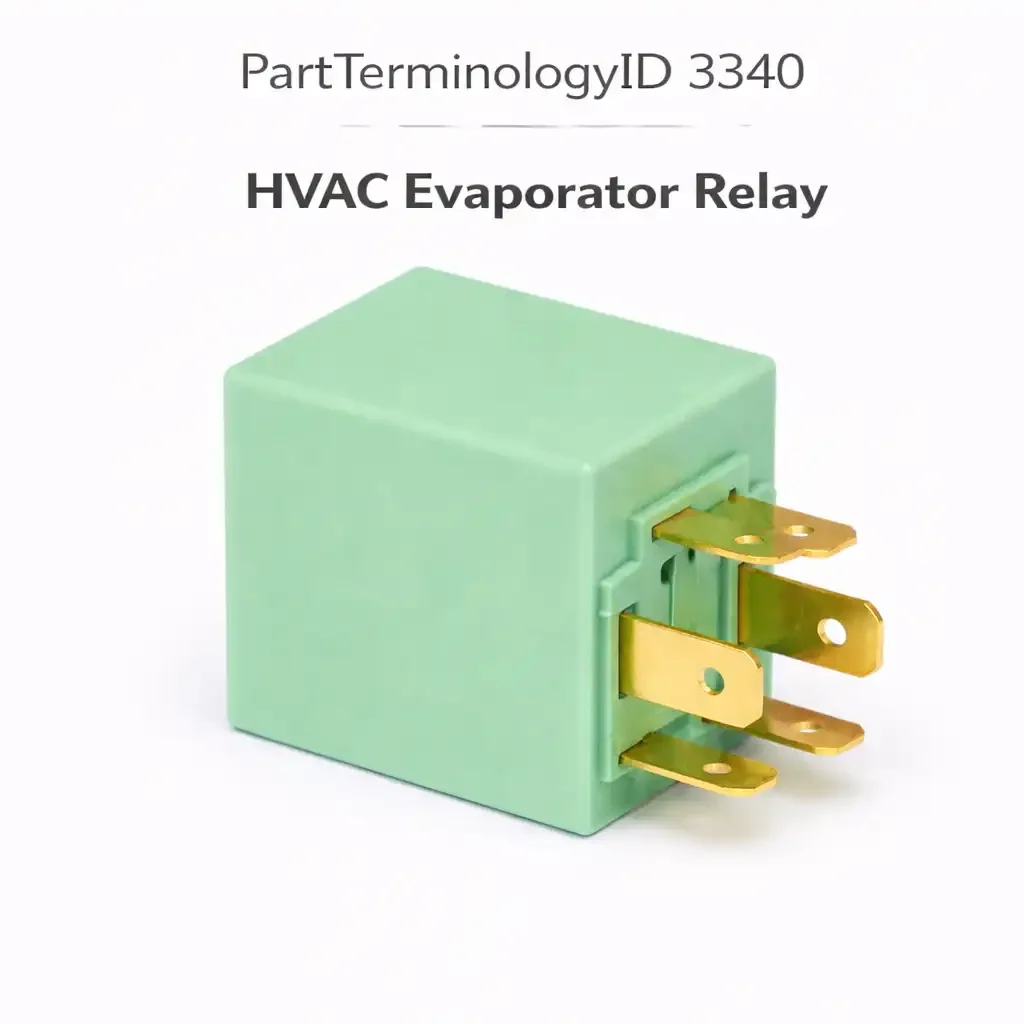
PartTerminologyID 3340, HVAC Evaporator Relay, is the relay that controls a specific circuit function within the HVAC evaporator system, either enabling power to the evaporator blower, switching an evaporator temperature-sensing circuit, or managing a freeze protection function that cycles the compressor off when evaporator core temperature drops below the icing threshold. The three attributes that determine correct fitment are the specific evaporator circuit the relay controls; how the relay interacts with the blower motor and compressor clutch relay in the broader HVAC control sequence; and the evaporator temperature sensor or thermistor that serves as the activation source on freeze-protection applications, which must be tested before the relay is condemned.
What the HVAC Evaporator Relay Does
Evaporator circuit function and freeze protection
On applications where the HVAC evaporator relay serves a freeze protection function, the relay is activated by an evaporator temperature sensor mounted in or near the evaporator core. When evaporator surface temperature drops below the calibrated freeze threshold, typically between 0 and 2 degrees Celsius, the sensor signal changes and either de-energizes the relay, which interrupts the compressor clutch enable circuit, or energizes the relay to command a compressor cutoff through the HVAC control module. This cycling prevents the evaporator from icing over, which would block airflow through the core and eliminate cooling capacity. A failed evaporator relay in freeze-protection service produces one of two symptoms: evaporator icing with restricted airflow and loss of cooling, indicating the relay is stuck closed and the freeze cutoff is not occurring; or a compressor that short-cycles or does not engage at all, indicating the relay is stuck open and the compressor enable circuit is interrupted at the relay.
Evaporator temperature sensor as the activation source
The evaporator temperature sensor is the activation source for the relay on freeze-protection applications, and sensor failure is more common than relay failure in this circuit. A sensor that has drifted out of calibration will cause the relay to activate the compressor cutoff at ambient temperatures that do not require freeze protection, producing a symptom of AC that blows warm intermittently in moderate temperatures. Buyers who replace the relay without testing the evaporator temperature sensor first frequently install a functioning relay on a system where the sensor is commanding incorrect relay behavior. The sensor must be tested for correct resistance or voltage output across the operating temperature range before the relay is replaced.
Top Return Scenario
Scenario 1: "AC still not cooling after relay replacement"
The replacement relay is functioning but the evaporator temperature sensor is providing an out-of-range signal that continues to command the compressor cutoff at normal operating temperatures. The relay correctly responds to the sensor signal, but the sensor signal is incorrect. Replacing the relay a second time does not restore AC performance because the fault is in the sensor, not the relay.
Prevention language: "Test the evaporator temperature sensor resistance at ambient temperature before replacing the relay. A sensor reading outside the specified resistance range at ambient temperature is commanding incorrect relay behavior. Replace the sensor before the relay when sensor output is out of specification."
Listing Requirements
PartTerminologyID: 3340
evaporator circuit function: freeze protection, blower enable, or temperature control (mandatory)
activation source: evaporator temp sensor, HVAC module, or BCM output (mandatory)
evaporator temperature sensor pre-check note (mandatory)
OEM part number cross-reference (mandatory)
FAQ (Buyer Language)
My AC blows warm intermittently. Is the evaporator relay the problem?
Possibly. But first test the evaporator temperature sensor by checking its resistance at ambient temperature against the specification in the service manual. A sensor that is out of calibration will command the evaporator relay to cut the compressor off at temperatures that do not require freeze protection. If the sensor reads correctly, test the relay by substitution. If both test correctly, check the HVAC control module output signal to the relay coil terminal.
What Sellers Get Wrong About PartTerminologyID 3340
The most common listing error is omitting the evaporator temperature sensor pre-check guidance. The sensor is the primary activation source for the relay on freeze-protection applications, and sensor failure drives a higher proportion of returns on this component than relay failure does. Every listing under PartTerminologyID 3340 must direct buyers to test the sensor before replacing the relay. The second error is failing to specify which evaporator circuit function the relay serves. Listings that describe the relay as a generic HVAC part without identifying whether it controls freeze protection, blower enable, or temperature management give buyers no way to confirm they have the right component for their system's architecture.
Cross-Sell Logic
Evaporator Temperature Sensor: the primary activation source for the relay on freeze-protection applications; should be tested and listed alongside the relay
A/C Compressor Control Relay (PartTerminologyID 3184): the compressor relay works in the same control sequence as the evaporator relay; both should be verified when compressor cycling is abnormal
HVAC Heater Blower Relay (PartTerminologyID 3448): the blower relay controls airflow through the evaporator; a failed blower relay produces no-airflow symptoms that can be confused with evaporator icing
Final Take for PartTerminologyID 3340
HVAC Evaporator Relay (PartTerminologyID 3340) is the evaporator system relay where circuit function identification, evaporator temperature sensor pre-check, and compressor interaction disclosure are the three listing attributes that prevent the highest-frequency return scenario for this component. The sensor is the most common fault source on freeze-protection applications, and listings that direct buyers to test the sensor before the relay eliminate the majority of returns that arrive with a functioning replacement relay and an unresolved symptom. Sellers who specify evaporator circuit function, activation source, and include a sensor pre-check note in every listing provide buyers with the diagnostic framework to identify the correct fault before ordering.