
Written by Arthur Simitian | PartsAdvisory
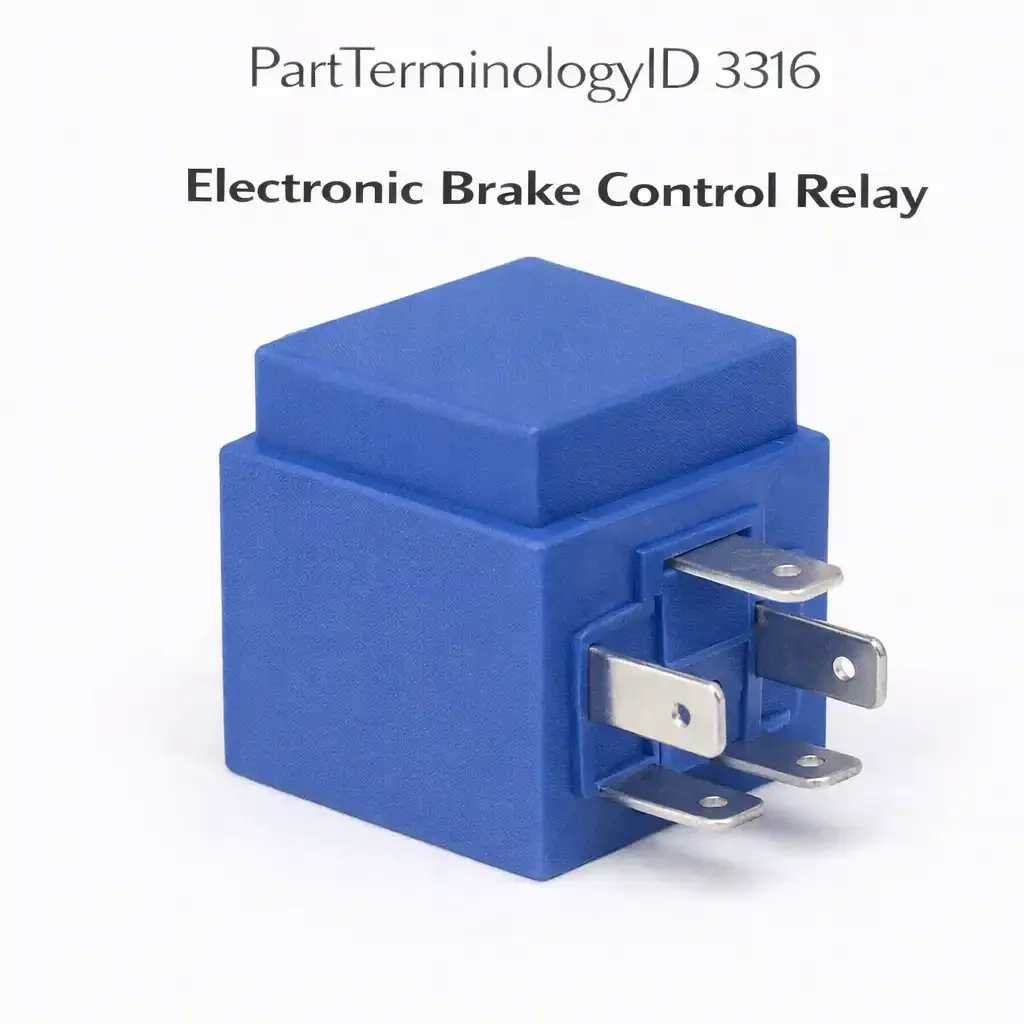
PartTerminologyID 3316, Electronic Brake Control Relay, is the relay that supplies switched power to the Electronic Brake Control Module (EBCM) or ABS control module, enabling the module to monitor wheel speed inputs, manage hydraulic actuator commands during ABS events, and communicate with the vehicle's other control modules over the data bus. The relay does not perform any braking function itself , it is a power supply relay whose failure removes the operating voltage the EBCM requires to initialize and function. The three attributes that determine correct fitment and prevent the most common diagnostic errors are the specific module the relay powers, whether it is the EBCM alone, the EBCM and traction control module combined, or the EBCM and electronic stability control system; the contact resistance tolerance that determines whether the relay delivers clean ignition-level voltage to the module or introduces a voltage drop that causes the module to log intermittent fault codes without fully failing; and the requirement to clear EBCM fault codes after relay replacement, since a module that has logged fault codes during a relay failure event may not restore normal ABS operation until the codes are cleared and the system performs a successful self-test.
What the Electronic Brake Control Relay Does
EBCM power supply and module initialization
The electronic brake control relay provides the primary power supply to the EBCM on most applications. When the ignition is switched on, the relay coil is energized through the ignition circuit, closing the relay contacts and supplying battery voltage to the EBCM power input terminal. The EBCM then performs a self-test, illuminates the ABS warning lamp briefly, and enters normal monitoring mode. A relay that fails open means the EBCM receives no power, the module does not initialize, and the ABS warning lamp remains illuminated continuously because the module cannot perform its startup self-test and extinguish the lamp. The base brake system continues to operate because the ABS module is not in the brake hydraulic circuit during non-ABS stops, but ABS, traction control, and electronic stability control functions are all disabled until the relay is restored.
Contact resistance and intermittent fault codes
A degraded relay with increased contact resistance does not fail completely but introduces a voltage drop between the battery supply and the EBCM power input terminal. The EBCM may still initialize under light electrical load conditions but log intermittent communication faults, wheel speed sensor faults, or actuator performance faults when the contact resistance causes the supply voltage to drop below the module's operating voltage threshold during high-current events such as ABS hydraulic actuator operation. These intermittent fault codes are frequently misdiagnosed as sensor faults, wiring faults, or module faults because the relay appears to be functioning. Testing supply voltage at the EBCM power input terminal under load, rather than just confirming relay coil continuity, is the correct diagnostic step that identifies contact resistance as the fault source before replacing sensors or the module.
Top Return Scenarios
Scenario 1: "ABS light still on after relay replacement"
The replacement relay restores supply voltage to the EBCM, but the module has stored fault codes from the previous relay failure event. The EBCM does not extinguish the ABS warning lamp until the fault codes are cleared with a scan tool and the module performs a successful initialization sequence. The relay is functioning correctly, but the stored codes are keeping the lamp illuminated.
Prevention language: "After replacing the electronic brake control relay, clear all ABS and brake system fault codes with a scan tool. The EBCM stores fault codes during power supply interruptions that must be cleared before the ABS warning lamp will extinguish and the system will return to normal operation."
Scenario 2: "Intermittent ABS light with no obvious cause"
The relay has degraded contacts that produce a voltage drop under load without failing completely. The EBCM logs intermittent faults and the ABS lamp illuminates occasionally, clearing itself after the ignition is cycled. The fault codes point to wheel speed sensors or actuator circuits, not the relay, because the module logs the downstream symptom rather than the supply voltage fault. Testing supply voltage at the EBCM power terminal under load, rather than at the relay output terminal at rest, reveals the voltage drop from the degraded contacts.
Prevention language: "If intermittent ABS fault codes do not point to a specific sensor or actuator fault, test supply voltage at the EBCM power input terminal with the ABS system active. A voltage reading below [X] volts under load indicates contact resistance in the supply relay rather than a sensor or module fault."
Listing Requirements
PartTerminologyID: 3316
controlled module: EBCM only, EBCM plus traction control, or EBCM plus ESC (mandatory)
contact resistance specification and voltage drop limit (recommended)
fault code clearing note after replacement (mandatory)
supply voltage test procedure under load (recommended)
OEM part number cross-reference (mandatory)
FAQ (Buyer Language)
Will replacing this relay fix my ABS light?
If the relay has failed open and is not supplying power to the EBCM, replacing it will restore power to the module. However, the ABS light will remain on until fault codes are cleared with a scan tool. If the relay tests functional but the ABS light persists, the fault source is likely stored fault codes, a degraded relay with high contact resistance, a wheel speed sensor, or the EBCM itself. Test supply voltage at the EBCM power terminal under load before condemning the relay.
My ABS works fine sometimes and not others. Is it this relay?
Intermittent ABS operation is a characteristic symptom of a relay with degraded contacts and increased resistance. The relay supplies sufficient voltage under light load but drops below the EBCM's operating threshold when the hydraulic actuators draw current during an ABS event. Measure supply voltage at the EBCM power input terminal during a simulated ABS activation. A voltage drop below specification confirms a contact resistance fault in the relay.
What Sellers Get Wrong About PartTerminologyID 3316
The most damaging listing error is omitting the fault code clearing requirement. Buyers who replace the relay and find the ABS light still on will return the part as non-functional when the relay is working correctly and the only required step is clearing stored codes. Every listing under PartTerminologyID 3316 must state clearly that fault codes must be cleared after relay replacement for the ABS warning lamp to extinguish. The second error is failing to specify which module the relay powers. On applications with combined EBCM and traction control or stability control modules, the relay failure disables all three systems simultaneously and the listing must reflect the full scope of controlled systems so buyers understand the impact of the failure and the importance of correct replacement.
Cross-Sell Logic
ABS Wheel Speed Sensors: intermittent EBCM fault codes from relay contact resistance are frequently misdiagnosed as wheel speed sensor faults; sellers should note the relay as a diagnostic step before sensor replacement
Electric Brake Controller Relay (PartTerminologyID 3292): for tow vehicle applications where both the EBCM relay and the trailer brake controller relay are in the brake system power supply circuit
ECM Power Relay (PartTerminologyID 3312): the ECM power relay and electronic brake control relay are frequently in the same relay center and may be the same relay part number on some applications; verify before ordering both
Final Take for PartTerminologyID 3316
Electronic Brake Control Relay (PartTerminologyID 3316) is the brake system power supply relay where EBCM module identification, contact resistance voltage drop, and post-replacement fault code clearing are the three listing attributes that determine whether the buyer gets a functioning ABS system after relay replacement. The fault code clearing requirement is the single most important piece of information for this PartTerminologyID because it is the step most buyers omit and the most common reason a correctly installed replacement relay appears not to have fixed the problem. Sellers who include the fault code clearing note, the controlled module identification, and a contact resistance voltage test recommendation in every listing give buyers what they need to complete the repair correctly the first time.