
Written by Arthur Simitian | PartsAdvisory
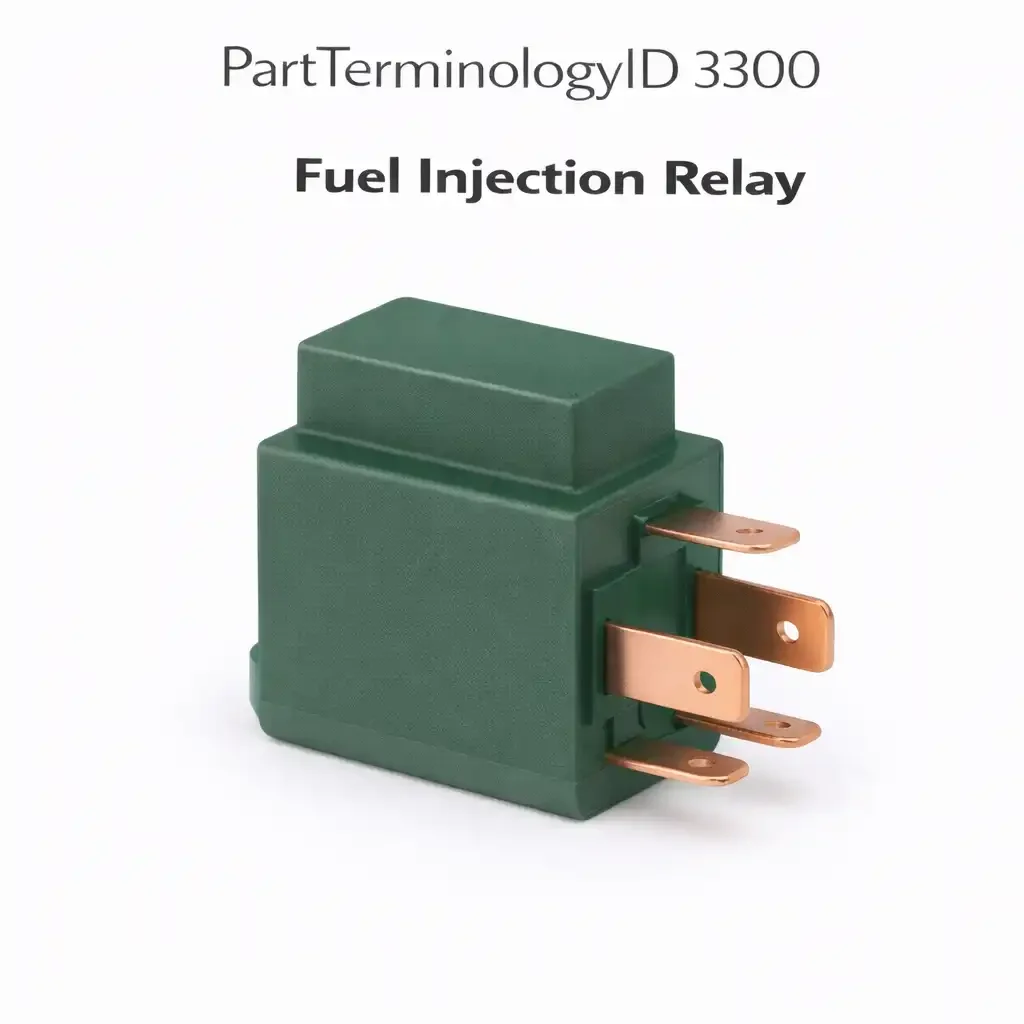
PartTerminologyID 3300, Fuel Injection Relay, is the relay that supplies switched power to the fuel injector circuit, delivering battery voltage to the injector solenoid supply terminals so the ECM can command individual injector pulses by grounding each injector driver circuit. Without this relay in closed contact, the injectors receive no supply voltage and the ECM cannot pulse fuel regardless of how correct its driver signals are. The relay's failure produces a complete no-start condition with no injector activity, no fuel delivery, and no audible injector clicking during a crank event. The three attributes that determine correct fitment are the specific injector circuit the relay supplies; how this relay relates to the Fuel Injection Main Relay (PartTerminologyID 3312) and the Fuel Injection Combination Relay (PartTerminologyID 3308) on applications that use multiple fuel injection relays in the same system; and the diagnostic sequence that separates a relay fault from an ECM driver fault or injector fault when no-start with no injector pulse is the complaint.
The fuel injection relay family across PartTerminologyIDs 3300, 3304, 3308, and 3312 represents four distinct relay positions in the fuel injection power supply architecture, and the most common listing error across all four is using the terms interchangeably without specifying which relay position in the vehicle's relay architecture the listing applies to. Buyers who search for a fuel injection relay and receive a listing that does not identify the relay's position in the fuel injection system will order the wrong component for their specific architecture and generate a return that cannot be resolved with a substitute relay of the same body style.
What the Fuel Injection Relay Does
Injector supply voltage and ECM driver circuit interaction
The fuel injection relay supplies battery voltage to the positive terminal of each fuel injector solenoid. The ECM controls injection timing and duration by grounding the negative terminal of each injector driver circuit through internal ECM driver transistors. This means the injector solenoid has supply voltage on one terminal at all times when the relay is closed, and the ECM provides the ground pulse that completes the circuit and opens the injector. A relay that fails open removes supply voltage from the injector solenoid terminals, making it impossible for the ECM to pulse any injector regardless of how correct its ground commands are. A relay that fails closed keeps supply voltage on the injectors continuously, which on its own does not inject fuel because the ECM ground is still required to complete the circuit, but it can cause the ECM's injector driver transistors to overheat and fail if a fault condition causes continuous grounding.
Differentiation from Fuel Injection Main Relay and Combination Relay
On applications that separate the fuel injection power supply into multiple relays, the architecture typically works as follows: the Fuel Injection Main Relay (PartTerminologyID 3312) supplies power to the ECM and to the fuel injection system's primary power distribution point; the Fuel Injection Relay (PartTerminologyID 3300) supplies power specifically to the injector solenoid rail from that distribution point; and the Fuel Injection Combination Relay (PartTerminologyID 3308) combines two of these functions in a single relay housing on applications where the manufacturer chose to consolidate the circuits. On applications with a main relay and a separate injector relay, both must be functioning for injector pulse to occur: the main relay must supply the ECM, and the injector relay must supply the solenoid rail. Replacing only one when both have failed produces a partial restoration that appears as correct relay function but continued no-start.
Activation source and ignition circuit interaction
The fuel injection relay coil is activated through the ignition switched circuit on most applications, meaning the relay closes when the ignition key is turned to the on position and opens when the ignition is switched off. On some applications, the relay coil is activated by an ECM output rather than directly from the ignition circuit, allowing the ECM to control when the injector supply is live. On ECM-activated configurations, a relay that does not close when the ignition is on but the ECM has not yet initialized represents a normal startup sequence condition for 1 to 2 seconds while the ECM performs its power-on self-test. A relay that never closes after ECM initialization on an ECM-activated application indicates either a relay coil fault or an ECM output driver fault, and distinguishing between these two requires testing for activation voltage at the relay coil terminal from the ECM output pin before condemning the relay.
Top Return Scenarios
Scenario 1: "No injector pulse on a crank-no-start diagnosis"
The fuel injection relay contact set has failed open. The ECM is initialized and sending correct driver ground pulses, but the injectors have no supply voltage and no current flows through them. A noid light test shows no injector activity not because the ECM is failing to pulse but because the supply side voltage is absent. Testing supply voltage at the injector wiring harness supply terminal before performing a noid light test immediately identifies the relay fault without requiring injector removal or ECM testing.
Prevention language: "Before using a noid light to test injector pulse, verify supply voltage at the injector harness supply terminal with the ignition on. Zero voltage at the injector supply with a functioning ignition circuit means the fuel injection relay is not supplying power to the injector rail. Test the relay first on any crank-no-start with no injector activity."
Scenario 2: "Replaced the fuel injection relay but engine still does not start"
On applications with both a Fuel Injection Main Relay (3312) and a separate Fuel Injection Relay (3300), both relays must be functioning for the system to operate. The buyer replaced PartTerminologyID 3300 but the Fuel Injection Main Relay (3312) is also failed. The injector rail now has supply voltage but the ECM has no power and cannot command injection. Or the reverse: the main relay was replaced but the injector relay was not, leaving the ECM powered but the injector rail without supply voltage.
Prevention language: "On applications using both a Fuel Injection Relay (3300) and a Fuel Injection Main Relay (3312), both relays must be functioning for the fuel injection system to operate. If replacing one relay does not restore starting, test the other relay in the fuel injection supply sequence before inspecting the ECM or injectors."
Scenario 3: "Intermittent no-start that clears after key cycling"
The relay has degraded contacts with intermittent open conditions that close again after thermal cycling from key-off to key-on. The symptom is a vehicle that fails to start on the first crank attempt but starts on the second or third attempt after the key has been cycled. This behavior is caused by contact chatter or intermittent contact resistance that resolves when the contact surfaces shift position during relay re-energization. A relay producing this symptom will eventually fail completely, and the intermittent symptom is sufficient justification for relay replacement before complete failure occurs.
Prevention language: "Intermittent no-start that clears after key cycling is an early warning of fuel injection relay contact failure. The relay contacts are intermittently open and closing again on re-energization. Replace the relay at the first occurrence of this symptom to prevent a complete no-start failure."
Listing Requirements
PartTerminologyID: 3300
controlled circuit: injector solenoid supply rail (mandatory)
activation source: ignition switched or ECM output (mandatory)
differentiation from FI Main Relay (3312) and Combination Relay (3308) (mandatory)
injector supply voltage test as first diagnostic step (mandatory)
OEM part number cross-reference (mandatory)
FAQ (Buyer Language)
How do I know if it is this relay or the fuel injection main relay that has failed?
Test supply voltage at two points: the ECM power input terminal and the injector wiring harness supply terminal. If the ECM has no power, the main relay (3312) has failed. If the ECM has power but the injector supply terminal has no voltage, the fuel injection relay (3300) has failed. If neither has power, both may have failed, or the ignition circuit supplying both relay coils has a fault.
My injectors click when I prime the system but the engine still does not start. Is this relay the problem?
If the injectors are clicking during the prime cycle, the fuel injection relay is supplying voltage to the injector rail and the ECM is commanding injection. A no-start with audible injector activity is a fuel delivery fault, an ignition fault, or a mechanical fault, not a relay fault. The fuel injection relay is the correct diagnosis only when injector supply voltage is absent and injectors produce no activity during cranking.
Can I use a generic relay in place of the OEM fuel injection relay?
A generic relay with the correct coil resistance, contact current rating, and terminal pinout can function in the fuel injection relay position on direct-wired ignition-activated applications. On ECM-activated applications, the coil resistance must fall within the range the ECM output driver is designed to drive. A coil that is too low in resistance will overload the ECM driver transistor. Verify the coil resistance specification from the service manual before substituting a generic relay on ECM-controlled applications.
What Sellers Get Wrong About PartTerminologyID 3300
The most damaging listing error for the fuel injection relay is conflating it with the fuel injection main relay (3312) or the combination relay (3308) without specifying which relay position in the vehicle's architecture the listing covers. All three PartTerminologyIDs appear in fuel injection power supply circuits and are sometimes installed in adjacent relay positions in the same relay center, and buyers who order based on name alone without relay position confirmation will install the wrong relay or order a duplicate of a relay they already have. Every listing under PartTerminologyID 3300 must identify the specific circuit the relay supplies, state whether the application has a separate main relay, and explain how the two relay positions relate to each other in the activation sequence. The injector supply voltage test guidance is the second essential listing element because it directs buyers to the correct first diagnostic step and prevents the return scenario where the buyer tests every other fuel system component before reaching the relay.
Cross-Sell Logic
Fuel Injection Main Relay (PartTerminologyID 3312): on applications with separate main and injector relays, both must be tested on any no-start diagnosis; sellers should note both relay positions in listings for multi-relay fuel injection architectures
Fuel Injection Combination Relay (PartTerminologyID 3308): the combination relay supersedes both 3300 and 3312 on applications where the manufacturer combined the circuits; verify architecture before ordering either separate relay
Fuel Injection Cold Start Relay (PartTerminologyID 3304): the cold start relay operates a cold-start enrichment injector on some applications and should be verified alongside 3300 on cold-specific no-start complaints
Fuel Injectors: injector supply voltage testing that confirms the relay is functioning correctly but the engine still does not start should direct the next diagnostic step to injector resistance and spray pattern testing
Final Take for PartTerminologyID 3300
Fuel Injection Relay (PartTerminologyID 3300) is the injector supply relay where controlled circuit identification, differentiation from the main and combination relays, and injector supply voltage test guidance as the first diagnostic step are the three listing attributes that determine whether buyers diagnose the correct fault and order the correct relay from the correct position in their vehicle's fuel injection architecture. The fuel injection relay family across 3300, 3304, 3308, and 3312 is the most commonly confused relay group in the fuel system category, and listings that explain each relay's specific position and function in the sequence eliminate the majority of wrong-component orders. Sellers who identify the injector supply circuit, differentiate from the main relay architecture, and include the supply voltage test note give buyers the three pieces of information needed to confirm correct application, correct position, and correct diagnosis before the part ships.