
Written by Arthur Simitian | PartsAdvisory
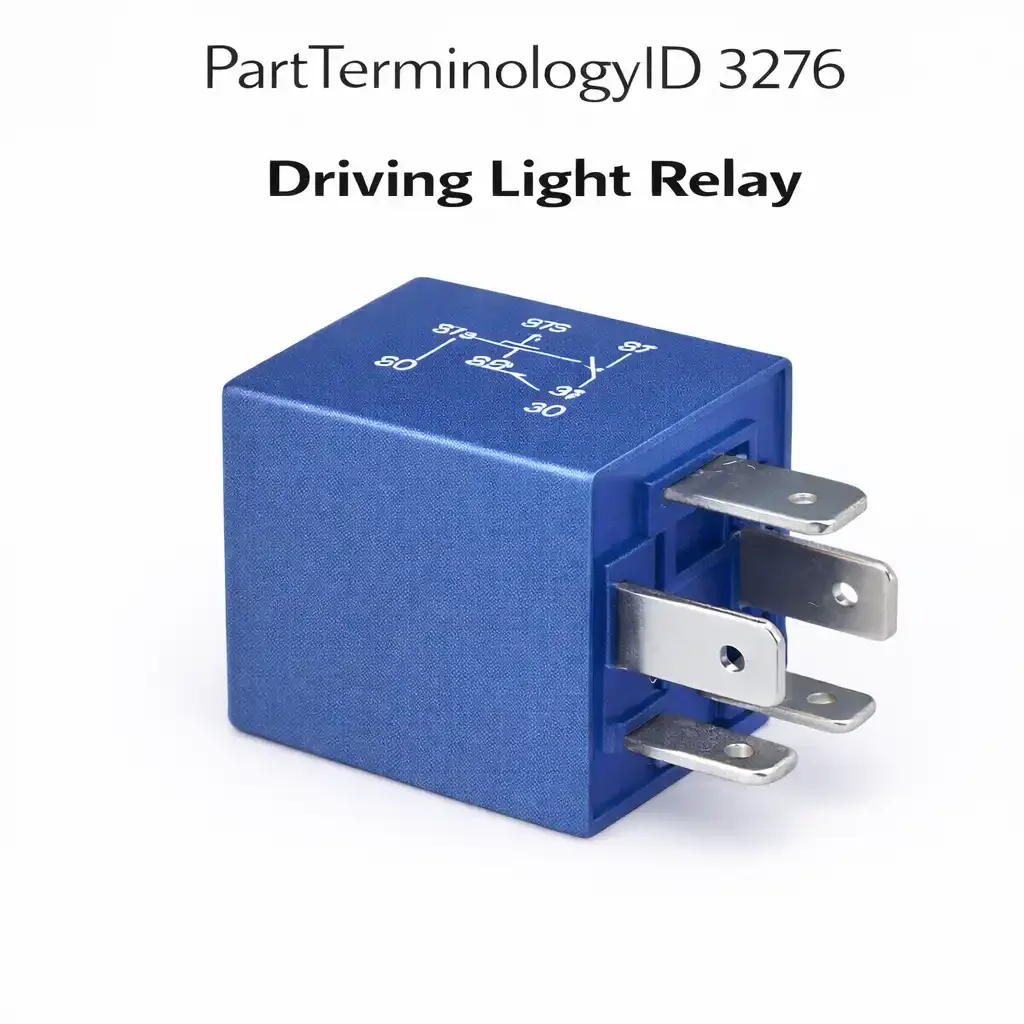
PartTerminologyID 3276, Driving Light Relay, is the relay that controls power delivery to auxiliary driving lights, typically high-output forward-facing lamps that supplement the vehicle's primary headlight system for improved forward visibility at highway speeds. That definition identifies the driving light relay's power delivery function and leaves unresolved the three attributes that determine whether a replacement restores correct driving light operation: the total wattage of the auxiliary lamp array that determines the relay's required contact current rating; the enabling condition logic that controls when the relay is activated, whether it operates only with high beam selected, with parking lights on, with the ignition in run, or through a dedicated driver-operated switch; and whether the relay serves an OEM-installed driving light system with a specific wiring harness and relay center position or an aftermarket system installed by a previous owner with a custom relay location that may not correspond to any OEM relay center diagram position.
The driving light relay carries one of the highest contact current loads of any relay in the vehicle's lighting system. Auxiliary driving lamps range from 55-watt halogens at approximately 4.5 amperes each to 100-watt high-output halogens at approximately 8.5 amperes each to HID systems at significantly higher effective current during the ignition phase. A four-lamp driving light array with 100-watt halogens draws up to 34 amperes through the relay contacts. A relay with a 20-ampere contact rating in this position will fail within a single season from contact overload. The contact current rating is not a reference specification for this component. It is the primary selection criterion.
What the Driving Light Relay Does
Enabling condition logic and high beam interlock
OEM driving light systems on most platforms activate the driving lights only when the headlights are on high beam, using the high beam activation signal as the enabling condition for the driving light relay coil. This interlock prevents driving lights from being active when the headlights are in low beam configuration, which would create an illegal forward lighting combination that exceeds the maximum permitted forward illumination under low beam conditions in most jurisdictions. A replacement relay that does not respect this interlock architecture, for example one with a different coil activation wiring that enables the lights with parking lights or ignition-on signals, will activate the driving lights outside the legally permitted conditions on vehicles designed with the high beam interlock.
Some OEM systems use a two-stage enabling condition where the driving lights are active only when both high beam is selected and a dedicated driving light switch is in the on position. This two-condition architecture allows the driver to use high beams without the driving lights in conditions where full driving light illumination is excessive, such as in lightly fogged rural conditions where high beam is still useful but driving light supplementation is not. The relay coil on these systems requires both enabling signals to be present simultaneously before it energizes, which is implemented through series-connected switches in the coil activation circuit rather than through a relay with special logic. A replacement relay that has an identical housing and contact configuration to the original but whose coil activation circuit is wired differently will accept only one of the two enabling signals and activate the lights under conditions the driver did not select.
Aftermarket system relay identification and wiring variability
Driving light systems installed by previous owners introduce a specific challenge for replacement relay diagnosis: the relay is typically mounted in an aftermarket relay holder, not in the OEM relay center, and its location, wiring, and specifications are determined by the installation rather than by any OEM documentation. Buyers who present the symptom of non-functioning driving lights on a vehicle with aftermarket lamps may find no OEM relay center position corresponding to their driving light relay, and the part number cross-reference from OEM fitment data does not apply. The relay specification for an aftermarket installation must be determined from the installed relay's markings or from the lamp wattage and activation circuit rather than from OEM fitment data. Listings under PartTerminologyID 3276 that are based on OEM fitment data must state clearly that aftermarket driving light system relay specifications are determined by the installation, not by the year, make, and model fitment range.
Contact current rating calculation and lamp count
Calculating the required contact current rating for a driving light relay requires knowing the total wattage of all lamps in the array. Dividing total wattage by system voltage gives the steady-state current draw, but the relay must also survive the inrush current spike that occurs when cold halogen filaments first receive power. Cold halogen filament resistance is approximately one-tenth of hot resistance, creating an inrush current of approximately ten times the steady-state value for the first few milliseconds of each lamp activation. A relay with adequate steady-state contact rating but marginal inrush tolerance will experience progressive contact damage from repeated inrush events and fail prematurely. Relay contact current ratings are typically stated as steady-state values, and the inrush capability must be confirmed from the relay's full specification sheet rather than from the nominal current rating alone.
Top Return Scenarios
Scenario 1: "Driving lights come on with parking lights, not just high beam"
The replacement relay has a coil activation circuit that is wired to the parking light circuit rather than the high beam circuit. The driving lights activate whenever the parking lights are on, which is incorrect for an OEM high-beam interlock system. The wrong relay position was specified in the fitment data, or the wiring harness connection was made to the wrong terminal during installation.
Prevention language: "Enabling condition: [high beam only / high beam and driving light switch]. This relay activates the driving lights only when the specified enabling condition is met. Confirm the relay coil activation wire connects to the high beam circuit, not the parking light circuit, during installation."
Scenario 2: "Relay overheats and fails within one summer"
The replacement relay is a standard 20-ampere ISO relay installed on a four-lamp 100-watt halogen driving light array drawing 34 amperes. The contact overheats from the sustained overcurrent load during each driving light activation period. Progressive contact degradation causes intermittent operation before complete failure within the first season of use.
Prevention language: "Contact current rating: [X] amperes minimum for this application. The total driving light load on this vehicle is [X] watts / [X] amperes. Do not install a relay rated below [X] amperes. Undersized contacts on driving light applications fail from sustained overload in high ambient temperature operation."
Scenario 3: "Driving lights do not turn off when switching from high to low beam"
The replacement relay contacts have welded in the closed position from inrush current damage during an earlier high-current event. The relay coil de-energizes correctly on low beam selection but the welded contacts maintain the driving light circuit regardless of coil state.
Prevention language: "Contact welding on driving light relays indicates the relay contact rating was insufficient for the lamp inrush current. When replacing a welded contact relay, verify the replacement contact rating covers the full inrush load of the lamp array, not just the steady-state draw."
Scenario 4: "Aftermarket driving lights, cannot find relay"
The vehicle has aftermarket driving lights installed by a previous owner. The relay is mounted in an aftermarket relay holder attached to the firewall rather than in the OEM relay center. The buyer cannot find the relay by searching OEM relay center diagrams because the installation is non-factory.
Prevention language: "Aftermarket driving light systems: relay location and specifications are determined by the installation. For aftermarket systems, identify the relay by its mounting location near the lamp wiring harness, read the specifications from the relay markings, and replace with a relay of matching or higher contact current rating, coil voltage, and coil resistance."
Listing Requirements
PartTerminologyID: 3276
contact current rating (mandatory, stated in amperes)
enabling condition: high beam only, switch only, or combined (mandatory)
OEM versus aftermarket system note (mandatory)
inrush current tolerance note for high-wattage lamp arrays (recommended)
OEM part number cross-reference (mandatory)
Catalog Checklist for ACES/PIES Teams
PartTerminologyID = 3276
require contact current rating in every listing (mandatory)
require enabling condition disclosure (mandatory)
require OEM versus aftermarket system note (mandatory)
differentiate from Fog Light Relay (PartTerminologyID 3352): fog lights are forward-facing low-beam supplemental lamps with different beam pattern and different enabling logic; driving lights supplement high beam
differentiate from Headlight Relay (PartTerminologyID 3400): headlight relay powers primary headlamps; driving light relay powers auxiliary supplemental lamps
prevent contact current rating misspecification by confirming lamp wattage for each application in the fitment range
FAQ (Buyer Language)
What is the difference between driving lights and fog lights?
Driving lights are high-output auxiliary forward-facing lamps designed for long-range illumination at highway speeds. They typically operate with high beams only and project a long, narrow beam pattern for maximum forward distance. Fog lights are lower-mounted wide-angle lamps designed for short-range illumination in reduced visibility conditions. They are typically designed to operate with low beams only and their enabling relay (PartTerminologyID 3352) has different interlock logic from the driving light relay.
My driving lights stopped working. Is the relay always the cause?
Not always. Before replacing the relay, confirm that the enabling condition is met by checking whether the high beam signal is present at the relay coil terminal when the driving lights should be active. If the coil activation signal is absent, the problem is in the enabling circuit, which includes the multifunction switch, the high beam relay, and the wiring between these components and the driving light relay. Also check the fuse in the driving light circuit before replacing the relay, since a blown fuse produces the same symptom as a failed relay.
Can I use a relay with a higher current rating than the original?
Yes. A relay with a higher contact current rating than the minimum required will function correctly and will have longer service life from lower contact thermal stress. A relay with a lower contact current rating than the minimum required will fail prematurely. Always replace with equal or higher contact current rating.
Why do driving light relays fail more often than other relays?
Driving light relays carry some of the highest sustained current loads in the vehicle's lighting system, combined with repeated inrush current spikes from cold halogen filament activation. This combination of high steady-state current and repeated inrush events accelerates contact wear and welding faster than relays serving lower-current or lower-cycle-rate applications. High underhood temperatures in the relay center location add thermal stress that further reduces contact service life below what the rated current alone would suggest.
What Sellers Get Wrong About PartTerminologyID 3276
The most common error is listing a driving light relay without specifying the contact current rating. The contact current rating is the primary specification for this component. A driving light relay without a stated current rating gives buyers no way to verify that the replacement will survive the lamp load on their specific installation. Buyers who install an undersized relay do not immediately know the relay is undersized because it functions correctly at initial installation. The failure arrives within one to two seasons, generating a warranty return with a failed relay that the buyer correctly identifies as having failed too quickly without understanding why. The current rating must be in every listing.
The second error is failing to distinguish OEM from aftermarket driving light systems in the fitment data. OEM driving light systems have fixed relay locations, fixed wiring harness configurations, and established part number cross-references. Aftermarket systems have none of these. A fitment database entry that maps a driving light relay to a year, make, and model applies only to the OEM system. If the vehicle has aftermarket driving lights, the fitment data is irrelevant and the buyer must determine the relay specification from the installation. Listing copy that does not clarify this distinction generates returns from aftermarket system owners who ordered based on vehicle fitment data and received a part that does not match their installation because their installation never matched the OEM architecture.
The third error is omitting the enabling condition disclosure. Buyers who do not know whether their driving lights should operate with high beam only, with a dedicated switch only, or with a two-condition combination may diagnose a correctly functioning relay as failed when the enabling condition is simply not being met during their test procedure. A listing that explains the enabling condition allows buyers to verify the condition is met before concluding the relay is the fault.
Cross-Sell Logic
Fog Light Relay (PartTerminologyID 3352): for forward auxiliary lighting faults on fog light circuits; different beam pattern, different enabling logic, different relay position from driving lights
Headlight Relay (PartTerminologyID 3400): the main headlight supply relay; if the enabling condition for the driving light relay depends on high beam being active, a failed headlight relay may prevent driving light activation by preventing the enabling signal from being generated
Driving Lamp Fuse: blown fuse produces the same symptom as a failed relay; check the fuse before ordering the relay to avoid unnecessary replacement
Application Range and Fitment Guidance for PartTerminologyID 3276
OEM driving light system applications are concentrated on truck and SUV platforms from approximately 1985 through the present, with the highest density of standalone relay-based OEM systems on domestic full-size trucks and European luxury sedans and wagons where driving lights were standard or optional equipment. Scandinavian market vehicles have included OEM driving lights as standard equipment since the 1970s due to daylight running light requirements in those markets, and Nordic-market vehicles exported to North America often include OEM driving light relay positions that are not present on US-market versions of the same model. Import vehicles from Swedish manufacturers, specifically Volvo and Saab, consistently include OEM driving light relay positions across their full model range from the mid-1970s onward. These platforms represent the most reliable source of OEM driving light relay applications because the component was standard equipment rather than optional.
Domestic applications are more variable because driving lights were frequently optional equipment tied to specific trim packages or appearance groups. A fitment claim on a domestic truck must specify whether it applies to models with the factory auxiliary lamp group or factory driving light option, because the base trim without the option has no relay socket and no wiring harness for driving lights. Publishing the fitment range at the trim level and option level for domestic platforms prevents the returns from base-trim buyers who find no relay socket when the claimed fitment applies only to the optioned trim.
Final Take for PartTerminologyID 3276
Driving Light Relay (PartTerminologyID 3276) is the high-current auxiliary lighting relay where contact current rating, enabling condition logic, and OEM versus aftermarket system clarity are the three listing attributes that determine whether a replacement survives the lamp load, operates under the correct conditions, and reaches buyers who have the right architecture to install it. The contact current rating is the primary specification and must appear in every listing without exception. An undersized relay will fail, but not immediately, creating delayed warranty returns that damage seller reputation more than immediate fitment returns because buyers cannot understand why a correct-fitting relay failed so quickly. The enabling condition note prevents misdiagnosis by buyers who test driving lights under the wrong conditions and conclude the relay is failed when it is simply not enabled. The OEM versus aftermarket system note prevents fitment returns from buyers whose vehicles have aftermarket driving light installations that do not correspond to any OEM relay position. Sellers who specify all three in every driving light relay listing provide buyers with complete functional guidance and eliminate the return patterns specific to this PartTerminologyID.
What Sellers Get Wrong About PartTerminologyID 3276 (Extended)
A fourth error specific to HID driving light applications is applying the same contact current rating calculation used for halogen lamps to HID ballast circuits. HID ballasts draw a very high inrush current during the ignition phase, typically three to five times the steady-state operating current, and this inrush lasts significantly longer than the sub-millisecond halogen inrush. A relay rated for halogen steady-state current only, without margin for HID ignition inrush, will experience contact damage on every HID ignition event. HID driving light applications require relay contact specifications that are confirmed against the ballast manufacturer's inrush current specification, not estimated from the steady-state lamp wattage. Listings that do not address HID-specific inrush requirements and extend their fitment range to include vehicles with HID driving light options will generate premature failure returns from HID lamp users who installed a relay specified for halogen loads.
A fifth error is failing to disclose the legal status of driving lights in jurisdictions where high-beam auxiliary lamps are subject to specific regulations. In some states and Canadian provinces, auxiliary driving lights that operate with high beam are legal only when the total forward light output does not exceed specific candela limits, and some OEM driving light systems were designed with power levels that comply with these limits while aftermarket high-wattage lamp upgrades may not. While compliance with lighting regulations is ultimately the buyer's responsibility, a listing that presents auxiliary driving lamp hardware without any note that local regulations vary makes it easier for buyers to unknowingly purchase hardware that creates legal exposure. This is not a catalog accuracy requirement but a best-practice disclosure that reduces buyer dissatisfaction when they discover the regulatory context after purchase.
Driving Light Relay Symptom Summary
For buyers diagnosing driving light faults from symptoms, the following framework covers the most common presentations. Driving lights that are completely inoperative when the enabling condition is met indicate either a failed relay, a blown fuse, or an open in the power supply circuit between the fuse and the relay. Confirming fuse integrity and supply voltage at the relay input terminal eliminates the fuse and supply wiring before the relay is replaced. Driving lights that operate correctly initially but fail after a period of continuous operation indicate contact overheating from an undersized relay or a marginal electrical connection that generates resistance heating. Driving lights that operate intermittently and correlate with vehicle vibration indicate a loose relay seating or a marginal relay socket contact, not a failed relay element. Driving lights that come on under the wrong conditions, such as with parking lights instead of high beam, indicate the relay coil activation circuit is connected to the wrong enabling source, which is an installation error rather than a relay fault. Working through these symptom patterns before ordering a replacement relay eliminates the cases where the relay is functional and the fault is elsewhere in the driving light circuit.