
Door Open Warning Relay (PartTerminologyID 3272): Where Warning Circuit Type, Door Switch Input Count, and BCM Architecture Determine Correct Fitment
Written by Arthur Simitian | PartsAdvisory
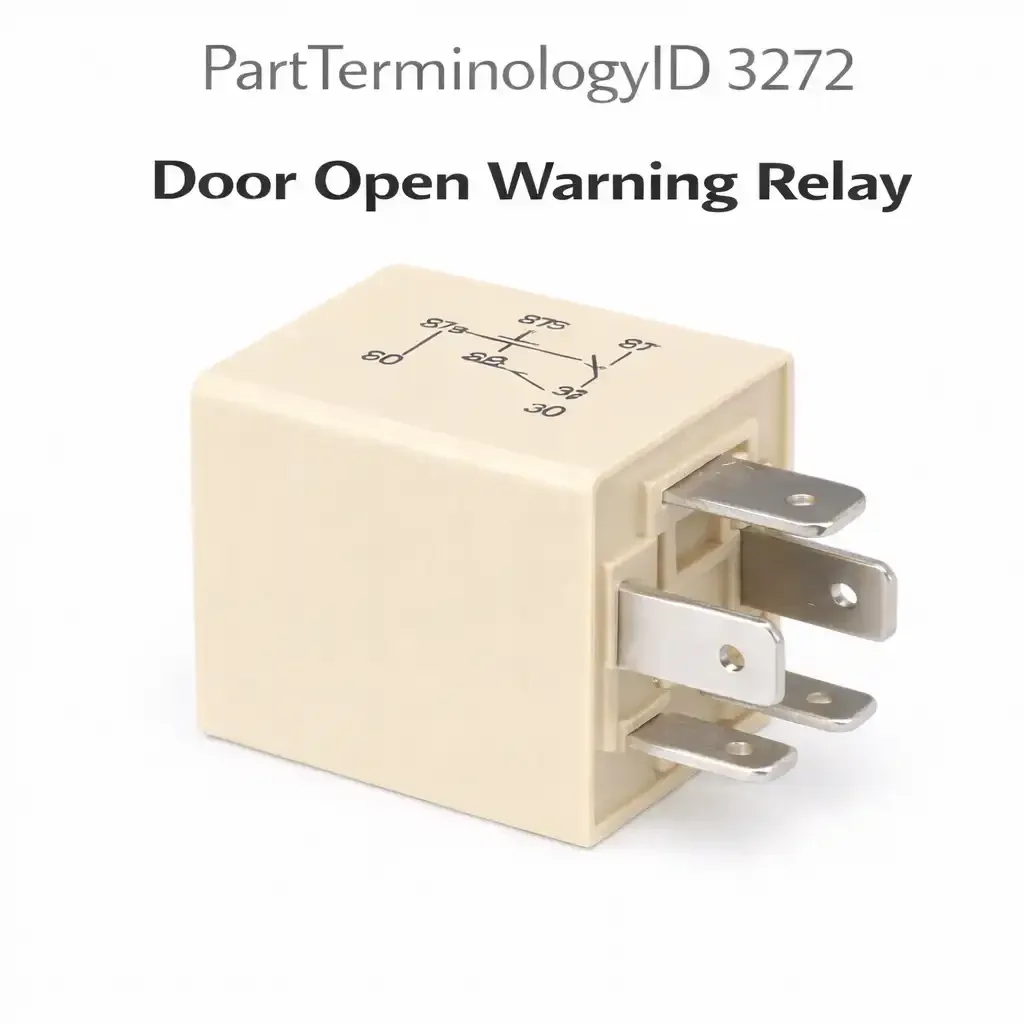
PartTerminologyID 3272, Door Open Warning Relay, is the relay that activates the door ajar warning indicator, chime, or buzzer when one or more vehicle doors are not fully latched while the ignition is on or the vehicle is in motion. That definition identifies the door open warning relay's alert function and leaves unresolved the three attributes that determine whether a replacement restores correct warning behavior: which warning output circuit the relay controls, whether it activates a dashboard indicator lamp, an audible chime, a buzzer, or a combination of these; how many door switch inputs the relay processes, whether it responds to any single door switch input independently or requires a logical combination of inputs before activating; and whether the warning function is served by a standalone relay or is integrated into the BCM's door monitoring software, which drives the warning outputs directly without a separate relay stage.
What the Door Open Warning Relay Does
Warning output types and circuit function
The door open warning relay activates one or more alert outputs when a door switch signals an unlatched condition. The simplest architecture uses a single relay that closes when any door switch grounds the circuit, illuminating a dashboard indicator lamp. More complex architectures add an audible buzzer or chime output that operates alongside or instead of the visual indicator, particularly on vehicles where the door ajar warning is intended to alert the driver during low-speed operation when the dashboard may not be in the driver's field of view. On some applications the relay controls both the visual and audible outputs simultaneously through separate contact paths on a multi-circuit relay. On others the visual and audible outputs are controlled by separate relays that operate in parallel. The listing must identify which output type the relay controls because a buyer who needs the audible warning circuit restored and receives only the visual indicator relay will find the symptom unchanged after installation.
Door switch input architecture and false-trigger prevention
Door ajar warning systems process switch inputs from all vehicle doors through a common circuit or through individual inputs to a central relay or module. On vehicles with a common-ground door switch architecture, all door switches share a single ground circuit that is connected to the relay activation input. Any door switch that grounds the circuit activates the relay. A failed door switch that is permanently grounded will activate the door ajar warning continuously regardless of door position. Before replacing the door open warning relay for a continuously active warning, all door switches must be tested for a permanent ground fault. A relay replacement on a system where a door switch is permanently grounded will not resolve the continuous warning because the relay is functioning correctly and the activation signal from the faulted switch is continuously present.
BCM-integrated door monitoring and relay absence
From approximately 1995 onward, door ajar monitoring was progressively integrated into the BCM on most vehicle platforms. The BCM monitors each door switch input individually, processes the latching status, and drives the warning indicator and chime outputs directly from its output drivers without an intermediate relay stage. On these applications, a door ajar warning fault is a BCM input fault, a BCM output fault, a door switch fault, or a wiring fault, not a relay fault. Listings under PartTerminologyID 3272 that extend into post-1995 applications must confirm that a standalone door open warning relay exists in the circuit before publishing fitment claims, because the majority of post-1995 passenger car and light truck applications have no such relay.
Top Return Scenarios
Scenario 1: "Door warning stays on even with all doors closed"
A door switch is permanently grounded due to a failed switch or a chafed wire grounding the switch circuit. The relay is activated continuously by the permanent ground signal. Replacing the relay does not resolve this symptom because the activation signal is continuously present from the door switch fault.
Prevention language: "Before replacing this relay, test each door switch for a permanent ground by disconnecting the door switch connectors one at a time while the warning is active. If disconnecting a specific door switch connector extinguishes the warning, that switch is the failed component, not the relay."
Scenario 2: "No relay position found, BCM-controlled vehicle"
The buyer orders a door open warning relay for a post-1998 vehicle where the BCM monitors door switches and drives warning outputs directly. No relay socket exists in the relay or fuse center for this function.
Prevention language: "Architecture: standalone relay present [yes/no, applicable year range]. This part applies to applications with a dedicated door open warning relay. On BCM-integrated vehicles, door ajar warnings are controlled by BCM software outputs. Confirm the relay center diagram shows a door open warning relay position before ordering."
Listing Requirements
PartTerminologyID: 3272
warning output type: visual indicator, audible chime/buzzer, or combined (mandatory)
architecture: standalone relay versus BCM-integrated (mandatory)
door switch pre-check note for continuous warning symptoms (mandatory)
application year range with architecture confirmation (mandatory)
OEM part number cross-reference (mandatory)
Catalog Checklist for ACES/PIES Teams
PartTerminologyID = 3272
require warning output type in every listing (mandatory)
require architecture confirmation before publishing post-1995 fitment claims (mandatory)
require door switch pre-check note for continuous warning symptom (mandatory)
prevent fitment claims on BCM-integrated door monitoring applications without standalone relay socket
differentiate from Alarm Chime Relay (PartTerminologyID 2976): the alarm chime relay covers key-in ignition and seatbelt chimes; this relay covers door ajar warnings specifically
require OEM relay position label reference (strongly recommended)
FAQ (Buyer Language)
My door ajar light stays on with all doors closed. Is the relay the problem?
Possibly, but a stuck door switch is far more common. Disconnect each door switch connector individually and observe whether the warning extinguishes. If disconnecting one specific connector resolves the warning, that door switch is the failed component. If disconnecting all door switch connectors resolves the warning but no single connector causes it, the wiring harness has a ground fault. Only if the warning persists with all door switch connectors disconnected is the relay itself the likely source of the continuous activation.
Does my 2005 vehicle have a door open warning relay?
Most 2005 model year vehicles use BCM-integrated door monitoring without a standalone relay. Check your fuse and relay center diagram for a position labeled door ajar, door warning, or similar. If no such position appears, the function is BCM-controlled and relay replacement is not the appropriate repair path.
The door warning chime works but the indicator light does not. What does that mean?
On systems where the chime and indicator are controlled by separate relay outputs or separate circuits, one output can fail while the other continues to function. A failed indicator lamp is the most common cause of this symptom pattern and should be checked before the relay. On systems where both outputs are controlled by the same relay, both should fail together; if one works and the other does not, the fault is downstream of the relay in the specific output circuit that is not working.
What Sellers Get Wrong About PartTerminologyID 3272
The most common error is listing the door open warning relay without confirming the standalone relay architecture and then allowing the fitment range to extend into post-1995 BCM-integrated applications. This error generates a predictable volume of returns from buyers with modern vehicles who find no relay socket. The architecture confirmation step must be completed for each application in the fitment range before the listing is published. Assuming the architecture from the presence of a similar relay listing on an adjacent model year is insufficient because architecture transitions within a model nameplate were common across refresh cycles.
The second error is omitting the door switch pre-check guidance. The continuously active door warning is the most common symptom that drives buyers to this listing, and the most common cause of a continuously active door warning is a door switch fault, not a relay fault. A listing that does not include the door switch pre-check note sends buyers through a relay replacement on a correctly functioning relay, resulting in a return of a functional part and an unresolved symptom. This is one of the highest-frequency preventable returns across all warning indicator relay categories.
Cross-Sell Logic
Door Jamb Switch: the most common cause of a continuously active door warning; should always be tested before the relay is ordered
Alarm Chime Relay (PartTerminologyID 2976): for key-in and seatbelt chime faults that may be confused with door warning faults on vehicles where the chime module serves multiple alert functions
Body Control Module: for BCM-integrated door monitoring applications where the door ajar warning output has failed and relay replacement is not the appropriate repair path
Final Take for PartTerminologyID 3272
Door Open Warning Relay (PartTerminologyID 3272) is the safety alert relay where architecture confirmation, warning output type identification, and door switch pre-check guidance are the three listing attributes that determine whether the replacement resolves the buyer's symptom or generates a return of a functional part on a system whose actual fault is a door switch. The standalone relay architecture for this function is concentrated in a legacy application window, and most modern vehicles route door monitoring through the BCM without a separately replaceable relay. Every listing under this PartTerminologyID must confirm the relay exists before claiming fitment, and every listing must include the door switch pre-check guidance that prevents the single most common misdiagnosis in this category. Sellers who provide both attributes eliminate the two highest-frequency return scenarios for this component.
Application Range and Fitment Guidance for PartTerminologyID 3272
Standalone door open warning relay applications are primarily concentrated in vehicles from approximately 1975 through 1998, with the highest density on domestic full-size trucks and passenger cars that used discrete warning relay modules in the instrument panel or underhood relay center. General Motors full-size trucks and SUVs from 1988 through 1995 commonly used a standalone door warning relay in the underhood relay center that is separately replaceable. Ford full-size trucks from the same era frequently integrated the door warning function into a multi-function warning module rather than a discrete relay, making PartTerminologyID 3272 inapplicable to those applications despite the similar symptom set. Chrysler applications from the late 1980s through the mid-1990s varied by platform, with some using standalone door relays and others integrating the function into the body electronics module.
Import applications from Japanese manufacturers made the transition to BCM-integrated door monitoring earlier than domestic platforms, with most Toyota, Honda, and Nissan applications using module-integrated door monitoring from approximately 1990 onward. European applications vary significantly by manufacturer and platform vintage, with German manufacturers generally integrating door monitoring into the central electronics module by the mid-1980s while some Italian manufacturers retained standalone relay architectures through the late 1990s. Fitment claims for any non-domestic application under this PartTerminologyID require individual platform verification against the wiring diagram rather than broad model-range assumptions, because the architecture transition timeline is not consistent across import manufacturers.
What Sellers Get Wrong About PartTerminologyID 3272 (Extended)
A third error specific to this PartTerminologyID is failing to identify whether the vehicle uses individual door switch inputs or a common ground door switch architecture. On individual-input systems, the relay or BCM monitors each door switch on a separate input circuit. A fault on one door switch affects only that door's monitoring. On common-ground systems, all door switches share a single ground path to the relay activation input, and a ground fault anywhere in the shared circuit activates the warning for all doors simultaneously. Buyers on common-ground systems who describe a door warning that shows all doors open when only one is actually open are describing a common-ground architecture where one switch fault activates the shared circuit. The relay in this scenario is functioning correctly, and the warning behavior is the expected output of a common-ground system with one grounded switch. Listing copy that explains the common-ground architecture prevents buyers from replacing a correctly functioning relay because the warning pattern appears anomalous to them without understanding the circuit design.
Door Open Warning Relay Symptom Summary
Buyers approaching this component from a symptom rather than a confirmed relay test benefit from a brief symptom-to-cause mapping. A door warning indicator that is never active, even with a door physically open, indicates either a failed relay stuck open, a failed door switch that is not grounding the activation circuit, or an open in the wiring between the door switch and the relay input. Confirming that at least one door switch grounds the relay input circuit eliminates the wiring and switch as causes before relay replacement. A door warning indicator that is always active regardless of door position most commonly indicates a door switch stuck in the grounded position or a chafed wire grounding the switch circuit, not a relay fault. Confirming that disconnecting the door switch connectors one by one removes the activation signal is the fastest path to identifying whether the relay or a switch is the active fault. A door warning indicator that works intermittently or that activates only on rough roads most commonly indicates a loose door switch connector or a marginal door switch contact, not a relay fault.