
Fuel Cut-Off Relay (PartTerminologyID 3244): Where Trigger Condition, Inertia Switch Architecture, and Fail-Safe Contact Configuration Determine Correct Fuel Shutoff Fitment
Written by Arthur Simitian | PartsAdvisory
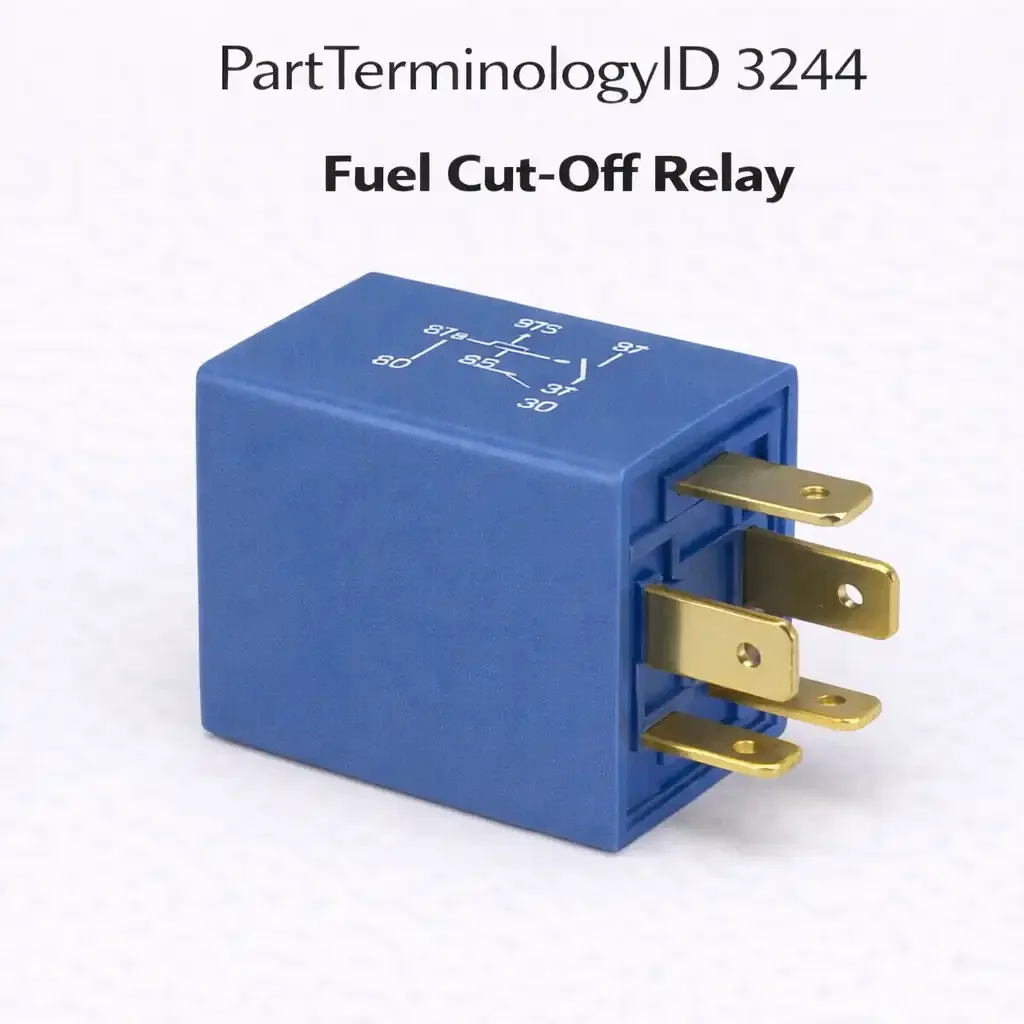
PartTerminologyID 3244, Fuel Cut-Off Relay, is the relay that interrupts fuel delivery to the engine under defined trigger conditions, cutting off fuel pump operation or fuel injector power when the trigger condition is met. That definition correctly identifies the fuel cut-off relay's shutoff function and leaves unresolved the three attributes that determine whether a replacement actually restores correct fuel shutoff and resume behavior: which trigger condition activates the relay, whether the trigger is a collision inertia signal, an ECM overspeed signal, an anti-theft system signal, or an engine-off oil pressure drop; whether the relay is a standalone electromechanical relay or whether the cut-off function is integrated into the inertia switch module itself; and whether the relay contact configuration is normally closed, cutting fuel on de-energization, or normally open, cutting fuel on energization, which determines the fail-safe behavior of the system when the relay loses power unexpectedly.
The safety consequence of a fail-safe configuration error is significant. A normally closed fuel cut-off relay that fails open or is replaced with a normally open relay inverts the fail-safe behavior. The original design may have been intended to cut fuel if the relay loses power from a collision that disables the vehicle electrical system. Replacing this normally closed relay with a normally open relay means a power loss now leaves fuel flowing rather than cutting it. This is not a performance error. It is a safety architecture inversion that a buyer cannot detect from normal vehicle operation after installation.
What the Fuel Cut-Off Relay Does
Trigger condition types and their diagnostic implications
Fuel cut-off relay trigger conditions divide into four distinct types across the application range. Collision-triggered cut-off relays receive their trigger signal from an inertia switch that mechanically trips under the deceleration forces of a collision, cutting fuel to prevent post-crash fires. These relays require a manual reset after tripping and must not be replaced simply because the vehicle will not start after a minor impact: the inertia switch reset button must be pressed first. ECM overspeed cut-off relays receive their trigger from the ECM when vehicle speed exceeds a calibrated threshold, preventing fuel delivery during uncontrolled acceleration events. Anti-theft cut-off relays receive their trigger from the vehicle security system, cutting fuel when the anti-theft system detects an unauthorized start attempt. Oil pressure cut-off relays receive their trigger from the oil pressure switch, cutting fuel when oil pressure drops below a safe operating threshold to prevent engine damage from running without lubrication.
Each trigger type has a different diagnostic approach. A collision-triggered relay that is not restoring fuel after an impact requires an inertia switch reset before relay diagnosis. An ECM overspeed relay that is not restoring fuel after a high-speed event requires an ECM fault code check before relay replacement. An anti-theft cut-off relay that is blocking fuel start requires a security system reset before relay replacement. Listing copy that does not identify the trigger condition sends buyers through the wrong diagnostic sequence for their application, which typically results in relay replacement on a system whose relay is functioning correctly and whose actual failure is in the trigger circuit.
Contact configuration and fail-safe direction
The contact configuration of the fuel cut-off relay determines the direction of fail-safe operation. A normally closed relay delivers fuel in the de-energized state and cuts fuel when energized by the trigger signal. This is the collision-triggered architecture: the relay is normally de-energized and fuel flows normally; a collision trips the inertia switch, energizes the relay, and the normally closed contacts open, cutting fuel. A normally open relay cuts fuel in the de-energized state and delivers fuel only when energized. This is the anti-theft architecture: the relay is energized by the security system when an authorized start is confirmed and fuel flows through the closed contacts; a theft attempt prevents relay energization and fuel is cut by the open contacts. Substituting a normally closed relay for a normally open relay in an anti-theft architecture means fuel is delivered in the non-energized state, which is the exact condition an anti-theft system is designed to prevent.
Top Return Scenarios
Scenario 1: "Vehicle still will not start after relay replacement"
The buyer replaced the fuel cut-off relay after a minor collision because the vehicle would not start. The inertia switch was tripped by the impact and its reset button was not pressed before relay replacement. The new relay is installed in a system whose inertia switch is still in the tripped position. The vehicle still will not start because the fuel cut-off signal is still present from the tripped switch, not because the relay was failed.
Prevention language: "Inertia switch reset: Before replacing this relay, locate the inertia switch reset button (typically in the trunk or under the dash on the driver side) and press it firmly to reset the switch after any collision event. If the vehicle will not start after a collision, try the reset button before ordering this relay."
Scenario 2: "Wrong contact configuration, fuel flows after anti-theft trigger"
The buyer replaced a normally open anti-theft fuel cut-off relay with a normally closed relay sourced from a different application. Fuel now flows in the de-energized state. The anti-theft system no longer cuts fuel because the new relay passes fuel without requiring an energization signal from the security system.
Prevention language: "Contact configuration: [normally open / normally closed]. This relay uses [NO/NC] contacts. Verify the replacement matches the original contact configuration. Substituting a normally closed relay in a normally open application, or vice versa, inverts the fail-safe direction and disables the cut-off function."
Listing Requirements
PartTerminologyID: 3244
trigger condition type: collision inertia, ECM overspeed, anti-theft, oil pressure (mandatory)
contact configuration: normally open or normally closed (mandatory)
inertia switch reset note for collision-triggered applications (mandatory)
fail-safe direction explanation for safety-critical applications (recommended)
OEM part number cross-reference (mandatory)
Catalog Checklist for ACES/PIES Teams
PartTerminologyID = 3244
require trigger condition type in every listing (mandatory)
require contact configuration (NO/NC) in every listing (mandatory)
require inertia switch reset note on collision-triggered applications (mandatory)
prevent normally closed / normally open substitution by explicitly stating configuration mismatch consequences
differentiate from Fuel Pump Relay (PartTerminologyID 3380): the fuel pump relay supplies power to the pump under normal operating conditions; the cut-off relay interrupts fuel under abnormal trigger conditions
require OEM part number cross-reference (mandatory)
FAQ (Buyer Language)
My car will not start after a fender bender. Is the fuel cut-off relay the problem?
Possibly, but the inertia switch is the more likely cause. Find the inertia switch reset button, usually in the trunk, under the rear seat, or behind a kick panel on the driver side. Press it firmly until it clicks. Then try starting the vehicle. If it starts, the relay was not failed; the switch simply needed resetting. Replace the relay only if the reset does not restore starting.
What is the difference between the fuel cut-off relay and the fuel pump relay?
The fuel pump relay (PartTerminologyID 3380) provides continuous power to the fuel pump during normal engine operation. The fuel cut-off relay interrupts fuel delivery under specific abnormal trigger conditions like a collision, theft attempt, or overspeed event. Both may be present in the same system. A failed fuel pump relay prevents the engine from running at all. A failed fuel cut-off relay may prevent the engine from running if the relay is stuck in the cut-off position, or may prevent fuel shutoff if the relay fails to actuate under trigger conditions.
Can I bypass the fuel cut-off relay to get my vehicle running?
Bypassing a collision-triggered fuel cut-off relay to restore starting after an impact removes a safety function designed to prevent post-crash fires. This is not recommended. The correct procedure is to inspect the vehicle for damage, reset the inertia switch, and replace the relay only if it tests failed. Bypassing the relay permanently removes the collision fuel shutoff protection from the vehicle.
What Sellers Get Wrong About PartTerminologyID 3244
The most common error is listing the fuel cut-off relay without identifying the trigger condition type. Buyers who reach this listing are almost universally working from a no-start symptom after a specific event, either a collision, a theft attempt, or an unexpected cutout. The trigger condition is the diagnostic entry point. A listing that does not identify the trigger condition forces buyers to determine independently whether their no-start symptom matches a cut-off relay failure or a trigger input failure, which requires circuit knowledge that most buyers do not have. The inertia switch reset note alone prevents a large share of the returns on collision-triggered applications where the relay is functional but the switch needs resetting.
The second error is omitting the contact configuration. The contact configuration is a safety-critical specification on this component, not a secondary attribute. A normally closed relay shipped to an application requiring a normally open relay inverts the fail-safe behavior of the fuel system. This error does not generate an immediate return because the vehicle will appear to operate normally until the trigger condition is met, at which point the inverted relay behavior becomes apparent. These delayed-discovery returns are more difficult to diagnose and more damaging to seller reputation than immediate fitment returns.
Cross-Sell Logic
Fuel Pump Relay (PartTerminologyID 3380): for buyers whose no-start is a continuous fuel supply fault rather than a trigger-event cutoff; the fuel pump relay is the more common no-start cause and should be checked first
Inertia Switch: for collision-triggered applications; the inertia switch is the trigger device and may need replacement after a collision even after the relay is reset
Anti-Theft System Module: for anti-theft triggered cut-off applications where the relay tests good but the security system is not authorizing fuel delivery
Final Take for PartTerminologyID 3244
Fuel Cut-Off Relay (PartTerminologyID 3244) is the safety-function relay where trigger condition identification, contact configuration, and inertia switch reset guidance are the three listing attributes that prevent the most consequential errors in this category. The trigger condition routes buyers to the correct diagnostic sequence. The contact configuration prevents fail-safe inversion. The inertia switch reset note prevents relay replacement on systems where the relay is functional and the switch is the actual issue. A listing that omits any of these three attributes will generate returns from buyers who replaced a functional relay, installed the wrong configuration, or bypassed the safety function to restore starting without understanding what they removed. Sellers who include all three in every fuel cut-off relay listing provide buyers with safety-critical information that extends beyond catalog accuracy into real-world outcome prevention.
Application Range and Fitment Guidance for PartTerminologyID 3244
Fuel cut-off relay applications divide into two broad eras with different dominant trigger conditions. Applications from approximately 1983 through 1995 primarily use inertia-triggered and oil pressure-triggered architectures on domestic platforms. Ford Motor Company was the earliest and most consistent adopter of the inertia switch-triggered fuel cut-off system in the North American market, integrating the fuel cut-off relay with an inertia switch module in underhood relay centers across a wide range of platforms from the early 1980s onward. General Motors applications from the same era used oil pressure switching as the primary fuel delivery control method on fuel pump circuits, with the oil pressure switch de-energizing the fuel pump relay on engine shutdown rather than a standalone cut-off relay in most configurations. Chrysler domestic applications generally did not use a standalone fuel cut-off relay architecture in the same period, relying instead on the ASD relay for fuel system control.
Applications from approximately 1995 onward increasingly moved the fuel cut-off function into the anti-theft and immobilizer system, where the cut-off relay is triggered by the security module rather than by a mechanical inertia switch or an oil pressure signal. These anti-theft cut-off relay applications require a security system reset before the relay can be diagnosed, because the security module may be actively holding the relay in the triggered state if an unauthorized start attempt occurred before the diagnostic. A relay replacement on a system where the security module is holding the cut-off signal will result in a vehicle that still does not start, and the buyer will return the part as defective when the relay is actually functioning correctly but the security module has not been reset.
What Sellers Get Wrong About PartTerminologyID 3244 (Extended)
A third error specific to this PartTerminologyID is conflating the fuel cut-off relay with the fuel pump relay (PartTerminologyID 3380) in fitment data. These two relays often share the same underhood relay center in a parallel circuit architecture, and on some applications they use identical relay housings and contact ratings. A catalog that maps both to the same relay part number without confirming they serve different circuit functions will send buyers to the fuel pump relay when they need the cut-off relay and vice versa. The functional distinction must be maintained in the fitment data separately for each PartTerminologyID, and the listing copy must explain the functional difference to buyers who do not know which relay circuit their symptom originates from.
A fourth error is omitting guidance on the post-replacement test procedure for cut-off relay applications. After installing a fuel cut-off relay, the buyer must confirm that the trigger circuit is not actively signaling the new relay before attempting a start. On inertia switch applications, the switch must be confirmed in the reset position. On anti-theft applications, the security system must be confirmed in the authorized state. On oil pressure applications, the oil pressure circuit must be confirmed to be above the switch activation threshold before cranking. Listing copy that provides a brief post-installation verification checklist prevents the returns that arrive when a correctly installed relay is still not restoring start because a trigger condition remains active.