
Cruise Control Switch Relay (PartTerminologyID 3236): Where Command Input Circuit Identification and Switch Signal Compatibility Determine Correct Diagnosis
Written by Arthur Simitian | PartsAdvisory
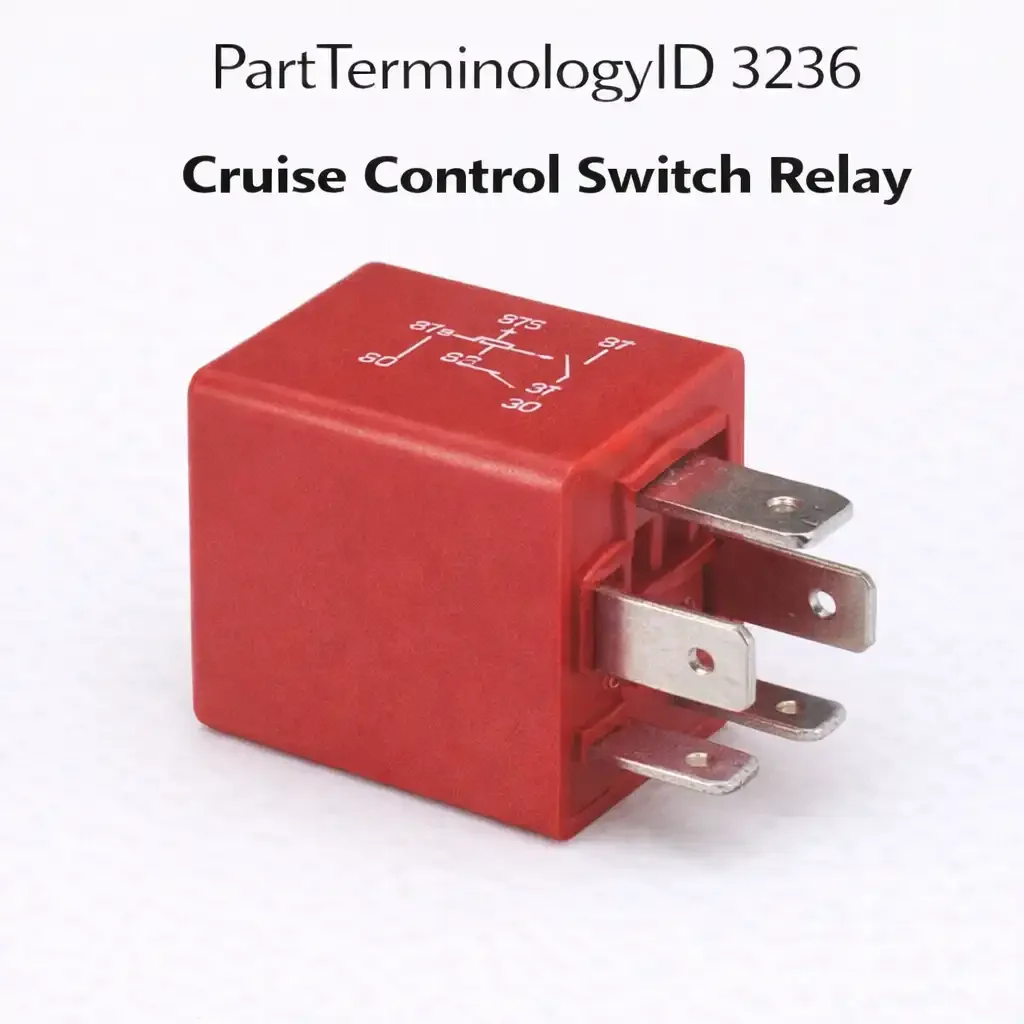
PartTerminologyID 3236, Cruise Control Switch Relay, is the relay that serves the driver command input circuit of the cruise control system, processing set, resume, cancel, and master on/off switch signals and passing them to the cruise control module or ECM cruise function. That definition identifies the switch relay's role in the command signal path and leaves unresolved the circuit architecture that determines whether this relay is a discrete component or whether the switch inputs feed the module directly without an intermediate relay stage. Understanding this distinction is essential before any listing is published under this PartTerminologyID.
The cruise control switch relay is not present on all vehicles that use a cruise control relay under PartTerminologyID 3232. Some cruise control architectures route the driver switch inputs directly to the cruise module or to the ECM's cruise input pins without an intermediate relay in the command signal path. A separate switch relay exists only on architectures where the switch input circuit is relay-switched, typically to provide voltage isolation between the driver controls and the module input circuitry or to allow a single master relay to gate all switch inputs simultaneously when the master on/off switch is operated. Listings must confirm this relay exists in the underhood or interior relay center before publishing fitment claims.
What the Cruise Control Switch Relay Does
Command input gating and master switch interaction
On architectures with a dedicated switch relay, the relay energizes when the cruise master switch is placed in the on position and de-energizes when the master switch is placed in the off position. In the energized state, the relay connects the set, resume, and cancel switch inputs to the module's command input terminals. In the de-energized state, these inputs are disconnected regardless of what the individual command switches do. This architecture allows the driver to disable all cruise command inputs with a single master switch action by de-energizing the switch relay, rather than requiring each individual command switch to be in the off position. A failed switch relay that is stuck open prevents all cruise command inputs from reaching the module even when the master switch is in the on position. The symptom is a cruise system that powers up but does not respond to set, resume, or cancel commands.
Differentiation from the main cruise control relay
The symptom profile of a failed switch relay differs from a failed main cruise relay. A failed main cruise relay (PartTerminologyID 3232) prevents the cruise module from receiving power, resulting in a completely inoperative system with no indicator light response and no response to any switch input. A failed switch relay allows the cruise module to power up and the indicator light to respond to the master switch but prevents set, resume, and cancel commands from being processed. Buyers who describe a system that powers up but will not engage are describing switch relay failure behavior, not main relay failure behavior. A listing under PartTerminologyID 3236 that does not communicate this symptom distinction sends buyers to the wrong part when they are diagnosing by symptom rather than by confirmed relay test.
Top Return Scenarios
Scenario 1: "Cruise indicator light works but cannot set speed"
The buyer replaced the main cruise relay (PartTerminologyID 3232) because the cruise system appeared non-functional. The master switch indicator light came on with the new relay, but the set function still does not work. The switch relay is the failed component, not the main relay. The listing under PartTerminologyID 3232 did not include symptom guidance distinguishing command input failure from total power failure.
Prevention language: "Symptom guidance: The switch relay (PartTerminologyID 3236) serves the set, resume, and cancel input circuit. If the cruise indicator responds to the master switch but the system will not accept set or resume commands, the switch relay is the more likely failed component. This listing (PartTerminologyID 3232) serves the main power circuit; if the indicator does not respond at all, start here."
Scenario 2: "No switch relay position on this vehicle"
The buyer orders a cruise control switch relay for a vehicle where the switch inputs connect directly to the ECM's cruise control input pins without an intermediate relay stage. No relay socket exists in the relay center for this function. The delivered part cannot be installed.
Prevention language: "Architecture: dedicated switch relay present in relay center [yes/no]. Confirm your vehicle's relay center diagram includes a switch relay position for the cruise control command input circuit before ordering. On applications where switch inputs connect directly to the ECM, no switch relay socket exists and this part is not applicable."
Listing Requirements
PartTerminologyID: 3236
circuit function: command input relay (mandatory)
architecture confirmation: dedicated switch relay socket present (mandatory)
symptom profile: system powers up but commands not processed (recommended)
differentiation from PartTerminologyID 3232 main relay (mandatory in cross-reference)
OEM part number cross-reference (mandatory)
Catalog Checklist for ACES/PIES Teams
PartTerminologyID = 3236
require architecture confirmation before publishing fitment (mandatory)
require symptom differentiation from PartTerminologyID 3232 in listing copy (mandatory)
prevent fitment claims on vehicles where switch inputs connect directly to ECM without relay stage
differentiate from PartTerminologyID 3232: main relay fails with zero system response; switch relay fails with indicator present but no command response
require OEM relay position label reference (strongly recommended)
FAQ (Buyer Language)
How do I know if my cruise problem is the switch relay or the main relay?
Turn on the cruise master switch and observe whether the indicator light illuminates. If no indicator response occurs, the main power relay (PartTerminologyID 3232) or the master switch itself is the likely failure point. If the indicator illuminates but pressing set does not engage cruise, the switch relay or the set/resume switches are the likely failure points. Test the switches before replacing the relay.
Does every vehicle with cruise control have a switch relay?
No. Many vehicles route the cruise command switches directly to the ECM or cruise module without an intermediate relay. The switch relay is present only on specific architectures, primarily from the 1980s through the late 1990s on domestic platforms. Confirm the relay center diagram before ordering.
Can I test the switch relay without removing it?
On most applications, the switch relay can be tested with a standard relay test procedure: remove the relay, apply 12 volts to the coil terminals, and confirm continuity across the contact terminals with a multimeter. If the relay coil does not pull in at 12 volts or the contacts do not close, the relay is failed. If the relay tests good, the switch input symptoms are caused by the switches, wiring, or module rather than the relay.
What Sellers Get Wrong About PartTerminologyID 3236
The most common error is listing the cruise control switch relay without confirming the relay exists as a discrete component on the specified application. The switch relay is present on a narrower range of applications than the main cruise relay. Sellers who build fitment ranges from main relay applications without verifying that a switch relay socket exists on each included vehicle generate a high volume of uninstallable parts. The relay center diagram for each application must be checked individually rather than assumed from the presence of a main relay listing.
The second error is omitting the symptom differentiation guidance. Buyers who reach the switch relay listing are almost always working from a symptom rather than a confirmed relay failure. The symptom profile distinction between a failed switch relay and a failed main relay is the critical information that routes buyers to the correct part. A listing that does not include this guidance relies on buyers having already made the correct diagnosis, which is not a safe assumption for a component that requires understanding the relay architecture to test correctly.
Cross-Sell Logic
Cruise Control Relay (PartTerminologyID 3232): the main power relay; both may be present in the same system and should be listed together with symptom guidance distinguishing their failure modes
Cruise Control Switches (set, resume, cancel): the most common cause of command input failure on systems where the switch relay tests good; buyers should test switches before replacing relay
Brake Light Switch: brake switch faults prevent cruise engagement and may be misdiagnosed as a switch relay fault if the brake cancel input circuit is not verified separately
Final Take for PartTerminologyID 3236
Cruise Control Switch Relay (PartTerminologyID 3236) is the command input relay where architecture confirmation, symptom differentiation from the main cruise relay, and fitment verification against the relay center diagram are the three requirements that determine whether the listing routes buyers to the correct part or generates uninstallable returns. The switch relay exists on a more limited application range than the main cruise relay and is more frequently absent from late-model vehicles. Every listing under this PartTerminologyID must confirm the relay socket exists before claiming fitment. The symptom distinction between a failed switch relay and a failed main relay is not obvious to buyers who have not tested both components, and listing copy that provides this guidance eliminates a significant share of the misdiagnosis-driven returns in this category.
Sellers who confirm architecture, state the symptom profile, and differentiate from PartTerminologyID 3232 in every switch relay listing provide buyers with the functional context needed to order confidently and install correctly the first time.
Application Range and Fitment Guidance for PartTerminologyID 3236
The cruise control switch relay is present on a narrower application range than the main cruise relay. Its use is concentrated in domestic truck and passenger car applications from approximately 1982 through 1998 where the cruise control system used a master on/off switch that gated all command inputs through a relay stage. General Motors applications from this era commonly used a switch relay configuration in the underhood relay center labeled cruise or speed control, distinct from the engagement relay position. Ford applications during this period varied by platform, with some using a dedicated switch relay and others routing the master switch directly to the module input. Chrysler applications from the late 1980s through the mid-1990s generally used a single relay architecture for cruise control without a separate switch relay stage, making PartTerminologyID 3236 inapplicable to most Chrysler platforms despite being listed under compatible relay specifications.
Import applications require individual verification against the relay center diagram because Japanese domestic market vehicles sold in the US market varied significantly in whether a switch relay stage was included in the cruise command circuit. Honda applications from this era frequently routed cruise command inputs through the main control module directly without a switch relay. Toyota applications varied by trim level, with higher-trim cruise control systems sometimes including a switch relay and base systems omitting it. Nissan applications from the late 1980s through the mid-1990s commonly used a switch relay on applications with stalk-mounted cruise controls and omitted it on dash-switch applications, creating a model-year-level fitment distinction that cannot be resolved from year, make, and model alone without confirming the switch type and relay center layout.
What Sellers Get Wrong About PartTerminologyID 3236 (Extended)
A third error specific to the switch relay listing is failing to provide guidance on switch testing before relay replacement. The cruise control switches, particularly the set and resume functions, are the most common source of command input failure in the cruise control system. These switches are operated repeatedly throughout vehicle use, accumulate contact wear, and are exposed to the thermal cycling of the steering column and stalk mounting location. A failed set switch and a failed switch relay produce identical symptoms from the driver's perspective: the master indicator illuminates but the set command does not engage cruise. Buyers who replace the relay without testing the switches will install a functional relay on a system whose command input failure is in the switch, not the relay. A listing that includes the instruction to test the set, resume, and cancel switches before purchasing the relay not only prevents this specific return but communicates to the buyer that the seller understands the diagnostic context of this component, which builds credibility for the listing as a whole.
A fourth error is omitting the wiring diagram reference for switch relay polarity. The switch relay on some applications uses a normally closed contact configuration in the command input path, not a normally open configuration. A normally closed switch relay passes all command inputs in the de-energized state and interrupts them only when energized by the master switch off signal. This is the inverse of the normally open architecture where the relay must be energized to pass command inputs. Substituting a normally open relay in a normally closed application, or vice versa, results in a cruise system where command inputs work only when the master switch is off, which is the exact opposite of intended behavior. The contact configuration must be confirmed from the relay center diagram or OEM relay specification before listing hardware under this PartTerminologyID.