
Written by Arthur Simitian | PartsAdvisory
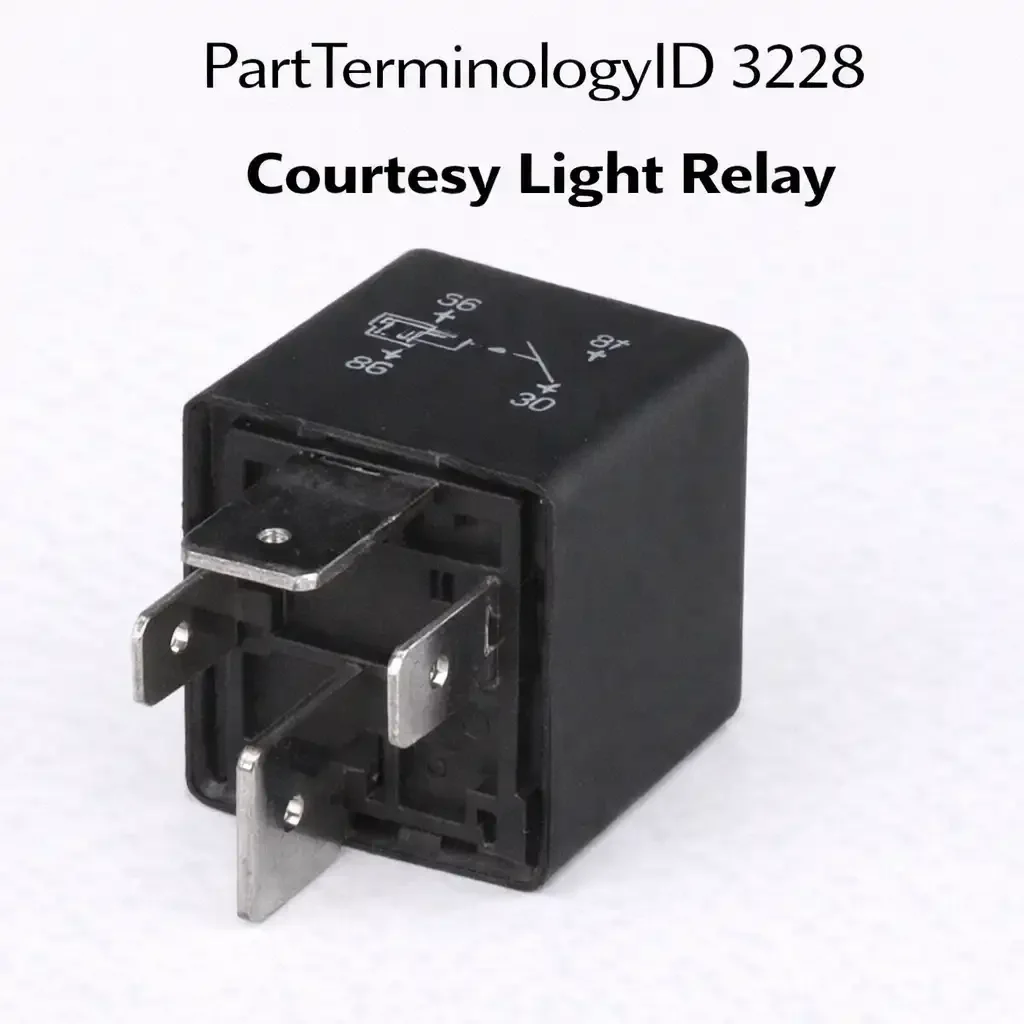
PartTerminologyID 3228, Courtesy Light Relay, is the relay that switches power to the vehicle's interior courtesy lighting circuits, activating the dome lamp, map lamps, door sill lamps, footwell lamps, and other interior ambient lamps when a door is opened, when the interior lamp switch is activated manually, when the unlock command is received from the key fob, or when the ignition is turned off and the BCM activates a courtesy illumination sequence for occupant exit. That definition covers the interior courtesy lighting circuit switching function correctly and leaves unresolved whether the relay switches all interior courtesy circuits through a single contact, individual lamp groups through separate relay outputs, the lamp supply circuit or the lamp ground path, the activation sources which may include any combination of door switches, BCM unlock output, key fob command, and manual switch, and the exit illumination timer interval that holds the lamps on after all doors are closed following an occupant exit sequence.
For sellers, PartTerminologyID 3228 is the interior lighting relay PartTerminologyID that most frequently generates overlap with the Accessory Delay Relay (PartTerminologyID 2940) and the Battery Saver Relay (PartTerminologyID 3080) in buyer searches, because all three relays affect interior lighting duration after door close events. The courtesy light relay activates the lamps at the triggering event and provides a basic illumination function. The accessory delay relay holds the circuit energized for a brief exit interval. The battery saver relay provides the long-interval protection against extended lamp drain. All three may be active simultaneously on a fully equipped vehicle, and a fault in any one of them produces a distinct interior lighting behavior change that the buyer may attribute to the wrong relay.
What the Courtesy Light Relay Does
The courtesy light relay is the primary switching relay for interior illumination. It closes on any activation event, door open, unlock command, or manual switch, and opens when all activation conditions have cleared. On vehicles where the courtesy light timer function is integrated into the BCM, the relay receives a timed output from the BCM that extends the lamp-on period for the exit illumination interval. On vehicles with a standalone courtesy light timer module, the timer module commands the relay through a timed output signal.
A failed courtesy light relay produces a complete absence of interior lamp activation regardless of door position, switch operation, or key fob command. This symptom distinguishes a relay fault from individual lamp failures, since all lamps in all interior zones fail simultaneously when the relay fails, rather than a single lamp or zone going dark as would occur with an individual bulb or socket fault. The simultaneous multi-zone failure pointing to a single relay is the most important diagnostic indicator for this PartTerminologyID.
Dome override switch and the relay bypass mode
Vehicles with a dome light override switch allow the driver to lock the interior lights in the on or off position regardless of door position. When the override switch is in the continuous-on position, the courtesy light circuit bypasses the door switch input and keeps the interior lamps illuminated. When the override is in the off position, the interior lamps remain dark even when doors are opened. A buyer who encounters a vehicle with the override switch in the off position may assume the courtesy light relay has failed when the dome switch setting is preventing lamp activation. Checking the dome override switch position before any relay diagnosis prevents this misidentification of a switch setting as a relay fault.
Simultaneous zone failure as relay fault indicator versus BCM output fault
All interior zones going dark simultaneously points to a shared circuit element: either the courtesy light relay, the fuse, or the BCM output driver. Distinguishing among these three requires testing the relay coil terminal for activation voltage with a door open. Coil voltage present but no contact output voltage confirms a relay contact fault. No coil voltage with a door open and the fuse confirmed good confirms a BCM output driver fault. The BCM output driver test requires measuring at the BCM output pin rather than at the relay socket if the wiring between the BCM and the relay socket has an open fault that produces the same result as a BCM driver fault at the relay socket terminal.
Why This Part Generates Returns
Buyers return courtesy light relays because the battery saver relay is the actual cause of the interior lamps cutting off before the buyer expects and the courtesy relay is functional, the BCM exit illumination timer parameter has been reset and the lamps cut off sooner than the buyer remembers from before a battery disconnect event, a single lamp zone is dark from a failed bulb or socket and the buyer incorrectly attributes it to the relay rather than the individual lamp, and the relay is activated by the BCM and the BCM has a door switch input fault that prevents the BCM from commanding relay activation even after the relay is replaced.
Status in New Databases
PIES/PCdb: PartTerminologyID 3228, Courtesy Light Relay
PIES 8.0 / PCdb 2.0: No change.
Listing Requirements
PartTerminologyID: 3228
circuit switched: all zones through single contact or individual zone outputs (mandatory)
activation sources: door switch, BCM unlock, manual switch, key fob (mandatory)
timer integration: BCM-managed interval or standalone timer module (mandatory)
simultaneous multi-zone failure symptom as relay diagnostic indicator (mandatory)
differentiation from Accessory Delay Relay (2940) and Battery Saver Relay (3080) (mandatory)
coil resistance for BCM-controlled applications (mandatory)
OEM part number cross-reference (mandatory)
FAQ (Buyer Language)
None of my interior lights work at all. Is it the relay?
A complete failure of all interior lamps simultaneously points to the courtesy light relay or its fuse as the most likely single cause before investigating individual lamps. Check the fuse first, then the relay. Individual lamp failures produce zone-specific outages rather than complete interior darkness.
My interior lights turn off too quickly after I close the door. Is that the relay?
Probably not. Lamp timing after door close is controlled by the BCM exit illumination parameter or the battery saver relay, not the courtesy light relay. The courtesy relay activates and deactivates the lamps at the triggering event. A timing issue points to the BCM timer setting or the battery saver relay rather than the primary courtesy relay.
How do I confirm the relay is the fault when all interior lights are out?
Check the courtesy light fuse first. A blown fuse produces an identical symptom to a failed relay and is a faster and less expensive repair. With the fuse confirmed good, measure voltage at the relay coil terminal with a door open. Coil voltage present at the relay coil terminal confirms the BCM is commanding the relay. If the coil is energized but no voltage appears at the contact output terminal, the relay contact has failed open. If no coil voltage is present with the door open, the BCM is not commanding the relay due to a door switch fault or a BCM output fault, and the relay is correctly non-activated rather than failed.
Exit illumination timer and the BCM parameter note
The duration that the courtesy lights remain on after all doors are closed is a BCM software parameter that may be reset to a shorter or different value after a battery disconnect event on some vehicles. A buyer who notices the interior lights extinguishing sooner than expected after a battery change or jump start may attribute the changed behavior to the relay when the BCM timer parameter has actually been reset to a shorter value. Performing a BCM parameter reset or dealer programming procedure to restore the original timer value resolves this symptom without any relay replacement.
Top Return Scenarios
Scenario 1: "All interior lights out simultaneously, relay replaced, all zones restore"
The buyer finds no interior lights activate when any door is opened or when the key fob unlocks the vehicle. All lamp zones are dark simultaneously. The courtesy light relay is confirmed as the fault because the simultaneous multi-zone failure pattern points to a shared circuit fault rather than individual lamp failures. Relay replacement restores all interior lighting zones simultaneously, confirming the relay as the single fault source. This is the textbook presentation of a failed courtesy light relay and the most straightforward diagnosis in the interior lighting fault category.
Prevention language: "All interior light zones going dark simultaneously indicates a relay fault rather than individual lamp failures. Individual lamp or zone failures affect only the specific lamp or zone. Replace the courtesy light relay when all interior zones are dark simultaneously with the fuse confirmed good."
Scenario 2: "Interior lights work but exit illumination timer changed after battery replacement"
The buyer replaces the vehicle battery. After battery replacement the interior lights now extinguish much sooner after the door closes than before the battery change. The buyer replaces the courtesy light relay. The timer behavior does not change. The BCM exit illumination timer parameter was reset to a shorter default value during the battery disconnect event. The courtesy light relay was not the fault. Restoring the BCM parameter to the original value corrects the timer behavior without any relay replacement.
Prevention language: "A shorter interior light duration after a battery replacement indicates a BCM timer parameter reset, not a relay fault. Perform the BCM parameter restore procedure or dealer programming to return the exit illumination timer to the original value before replacing the relay."
Cross-Sell Logic
Door Jamb Switch: for buyers where the relay coil receives no activation voltage because the door jamb switch has corroded and is not sending a door-open signal to the BCM
Accessory Delay Relay (PartTerminologyID 2940): for buyers where the exit illumination timer is the fault rather than the basic courtesy light activation relay
Battery Saver Relay (PartTerminologyID 3080): for buyers where the interior lights remain on indefinitely rather than extinguishing after the timer interval, indicating a battery saver relay fault
Catalog Checklist for ACES/PIES Teams
PartTerminologyID = 3228
require circuit: all zones through single contact or individual zone outputs (mandatory)
require activation sources: door switch, BCM unlock, manual switch, key fob (mandatory)
require timer integration: BCM-managed or standalone timer module (mandatory)
require simultaneous multi-zone failure as relay diagnostic indicator (mandatory)
require coil resistance for BCM-controlled applications (mandatory)
require dome override switch note to prevent switch-setting misdiagnosis as relay fault
differentiate from Accessory Delay Relay PartTerminologyID 2940 and Battery Saver Relay PartTerminologyID 3080: all three relays affect interior lighting behavior and buyers frequently confuse them; the courtesy relay controls whether interior lamps activate at all from a triggering event; the accessory delay relay holds the circuit energized for the exit illumination interval after door close; the battery saver relay provides long-interval protection against extended parasitic drain; all three may be active simultaneously and a fault in any one produces a distinct interior lighting behavior change that buyers may attribute to any of the three
Final Take for PartTerminologyID 3228
Courtesy Light Relay (PartTerminologyID 3228) is the interior illumination primary relay where the simultaneous multi-zone failure symptom is the key diagnostic indicator distinguishing relay failure from individual lamp failure, and differentiation from the Accessory Delay Relay (2940) and Battery Saver Relay (3080) is required context for buyers whose interior lighting timing complaints may originate from those relays rather than the primary courtesy relay. When all interior zones go dark simultaneously from any trigger condition, the courtesy light relay is the single most likely cause and should be the first component tested. When interior lighting activates but extinguishes too quickly or too slowly, the fault is in the delay or saver relay, not the courtesy relay. The listing must state the multi-zone simultaneous failure symptom and differentiate the relay's function from the timing relays to direct each buyer to the correct component for their specific symptom.