
Written by Arthur Simitian | PartsAdvisory
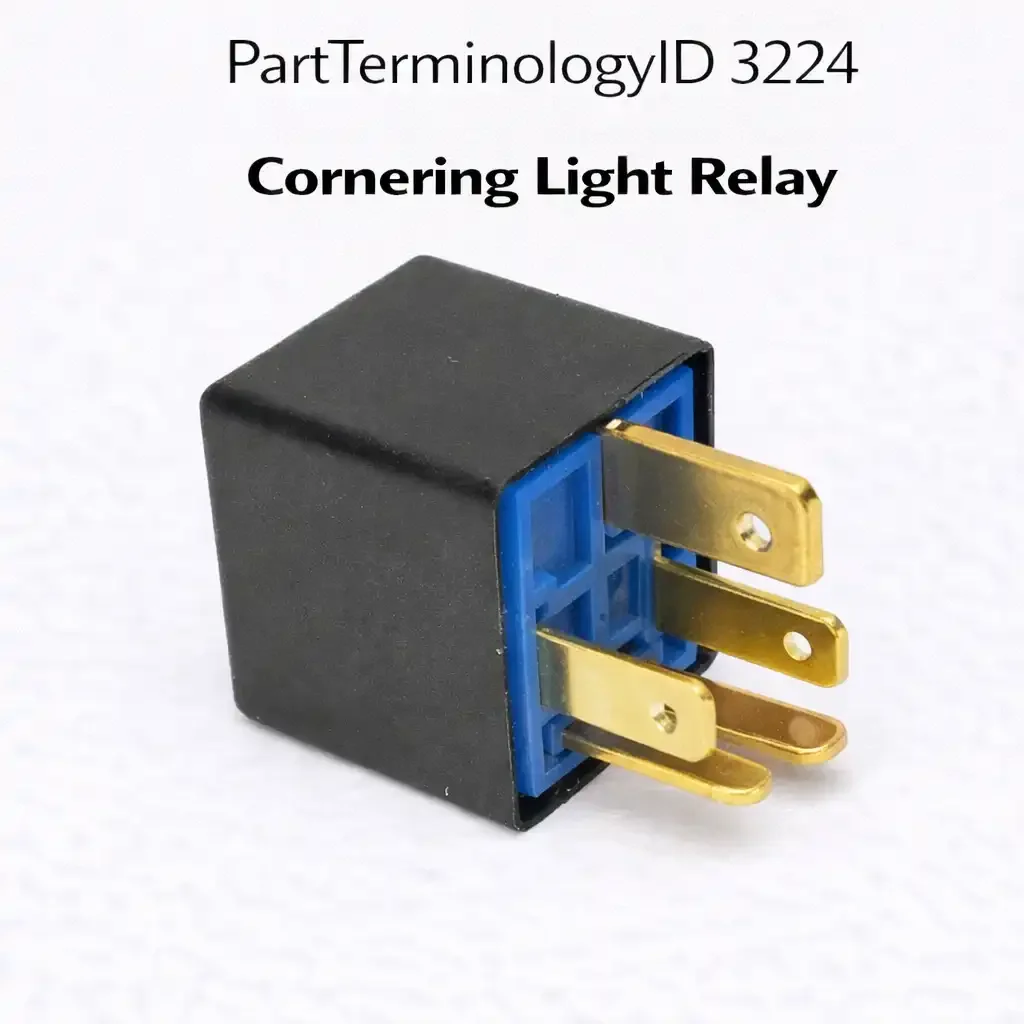
PartTerminologyID 3224, Cornering Light Relay, is the relay that activates a supplemental forward-facing lamp positioned at the front corner of the vehicle to illuminate the area into which the vehicle is turning, switching on when the turn signal is activated or when the steering angle exceeds a programmed threshold, providing additional illumination in the direction of the turn beyond what the fixed low-beam headlamps can illuminate through the vehicle's corner. That definition covers the cornering illumination circuit switching function correctly and leaves unresolved whether the relay activates from the turn signal circuit directly, the steering angle sensor signal processed by the BCM, or both inputs simultaneously, whether the relay controls a dedicated cornering lamp assembly or activates a fog lamp as a cornering function, and whether the system is a passive cornering lamp that switches on with the turn signal or an adaptive driving beam system that steers the lamp beam with steering angle.
For sellers, PartTerminologyID 3224 is a lighting relay PartTerminologyID where the activation source distinguishes two architectures with different relay specifications. Turn-signal-activated cornering systems use a relay wired to the turn signal lamp circuit, activating from the same pulsed signal that flashes the turn indicator. Steering-angle-activated systems use a BCM output that activates when the steering angle sensor reports a turn in progress, providing continuous illumination during the turn rather than the flashing illumination that would result from a turn-signal-derived activation. The pulsed versus continuous activation behavior must be specified in the listing because a continuous-activation relay in a pulsed-signal circuit will cycle with the turn signal rather than provide steady cornering illumination.
What the Cornering Light Relay Does
The cornering light illuminates the area inside the vehicle's turning path, reducing the dark zone that fixed headlamps leave at the near corner. On highway driving with large-radius curves this dark zone is a safety concern for pedestrians and cyclists in the path of the turn. On tight low-speed turns in parking lots and intersections the additional illumination helps the driver see obstacles in the immediate turning path.
A failed cornering light relay eliminates supplemental corner illumination without affecting the headlamp, turn signal, or any other primary lighting function. The failure may not be noticed immediately by the driver because the primary lighting remains functional. A periodic check of cornering lamp operation during a turn, particularly after replacing any lighting relay, is the verification step that confirms the cornering relay is functional.
Turn-signal-activated versus steering-angle-activated architecture distinction
Turn-signal-activated cornering systems wire the relay coil directly to the turn signal flasher output, so the cornering lamp flashes with the same frequency and duty cycle as the turn indicator. The relay operates as an on-off switch that follows the flasher module's pulsed output. Steering-angle-activated systems use a BCM output that closes when the steering angle sensor reports a turn in progress exceeding the programmed threshold, producing a steady cornering lamp rather than a flashing one. A buyer who installs a pulsed-signal relay in a steering-angle-activated circuit receives a flashing cornering lamp instead of a steady one. A buyer who installs a steady-output relay in a turn-signal-activated circuit receives a cornering lamp that stays on continuously for the duration of the turn signal activation rather than flashing with the turn indicator. Both are incorrect behaviors that the buyer may attribute to a defective relay rather than to a relay type mismatch.
Fog lamp used as cornering lamp and the dual-function circuit
On vehicles where the front fog lamp is used as the cornering light when the steering angle threshold is exceeded, the cornering relay activates the fog lamp circuit independently of the fog lamp switch. The fog lamp may be off because the driver has not activated the fog lamp switch, but the cornering relay can still activate the fog lamp circuit through a parallel activation path. A buyer who finds the fog lamp activating unexpectedly when turning may not recognize this as the cornering system functioning correctly. The listing must note the dual-function fog lamp architecture where it applies so buyers understand the fog lamp activation during turns is the cornering system operating, not a wiring fault.
Activation threshold and low-speed versus high-speed cornering behavior
Steering-angle-activated cornering systems typically apply the cornering light function only below a certain vehicle speed threshold, commonly 40 to 60 kilometers per hour, because at highway speeds the headlamp beam already illuminates the corner and the cornering lamp provides no additional useful illumination. Above the speed threshold the BCM inhibits the cornering relay command regardless of steering angle. A buyer who tests the cornering lights at parking lot speeds and confirms correct operation but finds no activation at higher city speeds is observing the intended BCM speed-threshold inhibit behavior rather than an intermittent relay fault. The speed threshold must be disclosed in the listing so buyers understand the operational envelope of the cornering function.
Cornering lamp circuit load and LED retrofit considerations
Factory cornering lamps use incandescent bulbs whose current draw is matched to the relay's contact rating and the BCM's load monitoring expectations. Retrofitting LED cornering lamps into the factory circuit reduces the current draw significantly, which may fall below the BCM's minimum load detection threshold on systems that monitor lamp current to detect burned-out bulbs. The BCM may store a lamp-out fault code for the cornering circuit after an LED retrofit because the LED current draw is below the minimum threshold the BCM expects for a functioning lamp. Adding a load resistor in parallel with the LED lamp restores the expected current draw and prevents the false lamp-out fault code without requiring a relay change.
Why This Part Generates Returns
Buyers return cornering light relays because the activation source distinction between turn-signal-pulsed and steering-angle-continuous is not specified and the wrong architecture relay is delivered, the fog lamp that serves as the cornering lamp has failed and the relay replacement does not restore cornering illumination because the bulb is burned out, and the steering angle sensor has failed and the BCM does not receive the steering input required to command the relay on steering-angle-activated systems.
Status in New Databases
PIES/PCdb: PartTerminologyID 3224, Cornering Light Relay
PIES 8.0 / PCdb 2.0: No change.
Listing Requirements
PartTerminologyID: 3224
activation source: turn signal circuit or steering angle sensor BCM output (mandatory)
activation behavior: pulsed or continuous (mandatory)
lamp type: dedicated cornering assembly or fog lamp cornering function (mandatory)
coil resistance for BCM-controlled applications (mandatory)
steering angle sensor diagnosis note for BCM-activated systems (mandatory)
OEM part number cross-reference (mandatory)
FAQ (Buyer Language)
Should the cornering light flash with the turn signal or stay on steady?
On turn-signal-activated systems the cornering lamp flashes with the turn indicator. On steering-angle-activated systems the lamp provides steady illumination while the wheel is turned, independent of turn signal operation. Identify which system the vehicle uses before ordering to confirm the activation behavior matches.
How do I diagnose a failed steering angle sensor versus a failed cornering relay?
On steering-angle-activated cornering systems, confirm the steering angle sensor is producing a valid signal by checking for the sensor's output in the BCM or chassis module data with a scan tool while turning the steering wheel. If the sensor reports a valid steering angle signal but the cornering relay does not activate, measure for BCM output voltage at the relay coil terminal during a turn that exceeds the activation threshold. Coil voltage present with no lamp activation confirms the relay contact has failed. No coil voltage during a valid steering angle signal confirms a BCM output driver fault or a cornering function configuration issue rather than a relay fault.
Can the cornering relay be used to add cornering lights to a vehicle that did not originally have them?
On vehicles where the BCM supports a cornering light output but the original build did not include cornering lamps, the cornering relay circuit may exist in the wiring harness as an unpopulated option. Installing the correct relay and cornering lamp assemblies may activate the function through the existing BCM output. Confirm the BCM software includes the cornering light enable parameter before attempting this conversion, as some BCM versions require a software configuration change to enable the output even when the hardware is present.
Top Return Scenarios
Scenario 1: "Cornering lights flash with turn signal instead of staying steady, wrong relay type installed"
The buyer installs a replacement relay. The cornering lights now flash with the turn signal cadence instead of providing steady illumination during the turn. The vehicle has a steering-angle-activated cornering system that requires a relay compatible with a steady BCM output signal. A pulsed-signal relay designed for turn-signal-activated systems was installed. The relay follows the turn signal's flash rate rather than holding closed continuously for the steering-angle command duration. The correct relay for steady-activation architecture holds the contact closed for the duration of the BCM output signal without cycling.
Prevention language: "Verify the vehicle's cornering light activation architecture before ordering. Steering-angle-activated systems require a relay that holds closed continuously during the BCM's steady output. Turn-signal-activated systems require a relay compatible with a pulsed turn signal input. Installing a pulsed relay in a steady-activation circuit produces flashing cornering lights instead of steady illumination."
Scenario 2: "Cornering lights never activate, steering angle sensor fault code present"
The buyer replaces the cornering light relay. The cornering lights still do not activate during turns. A scan tool retrieves a steering angle sensor fault code. The BCM is not commanding the cornering relay because the steering angle sensor data is invalid due to the stored fault. The relay replacement had no effect because the BCM was inhibiting cornering relay activation in response to the sensor fault.
Prevention language: "Retrieve chassis and BCM fault codes before replacing the cornering relay. A steering angle sensor fault prevents the BCM from commanding cornering relay activation. The relay receives no command signal and appears inoperative when the sensor fault is the actual cause."
Cross-Sell Logic
Steering Angle Sensor: for buyers where a steering angle sensor fault code is inhibiting BCM cornering relay activation
Cornering Light Assembly: for buyers where the relay is confirmed functional but the cornering lamp has burned out or the housing has failed
Body Control Module: for buyers where the relay coil receives no activation voltage despite a valid steering angle signal, indicating a BCM output driver fault
Catalog Checklist for ACES/PIES Teams
PartTerminologyID = 3224
require activation source in title: turn signal circuit or steering angle sensor BCM output (mandatory)
require activation behavior: pulsed or continuous (mandatory)
require lamp type: dedicated cornering assembly or fog lamp cornering function (mandatory)
require coil resistance for BCM-controlled applications (mandatory)
require speed threshold disclosure for BCM-activated systems (mandatory)
prevent pulsed relay substitution for continuous-activation relay: produces flashing cornering light instead of steady illumination
prevent relay order before steering angle sensor fault code retrieval: retrieve chassis and BCM fault codes before ordering the cornering relay because a steering angle sensor fault code prevents the BCM from generating valid cornering relay activation commands regardless of the relay contact condition; the relay appears inoperative when the BCM is withholding the activation signal due to invalid sensor data
Final Take for PartTerminologyID 3224
Cornering Light Relay (PartTerminologyID 3224) is the supplemental turning illumination relay where activation source and pulsed versus continuous behavior are the two attributes that distinguish the two relay architectures and must be stated in every listing.