
Written by Arthur Simitian | PartsAdvisory
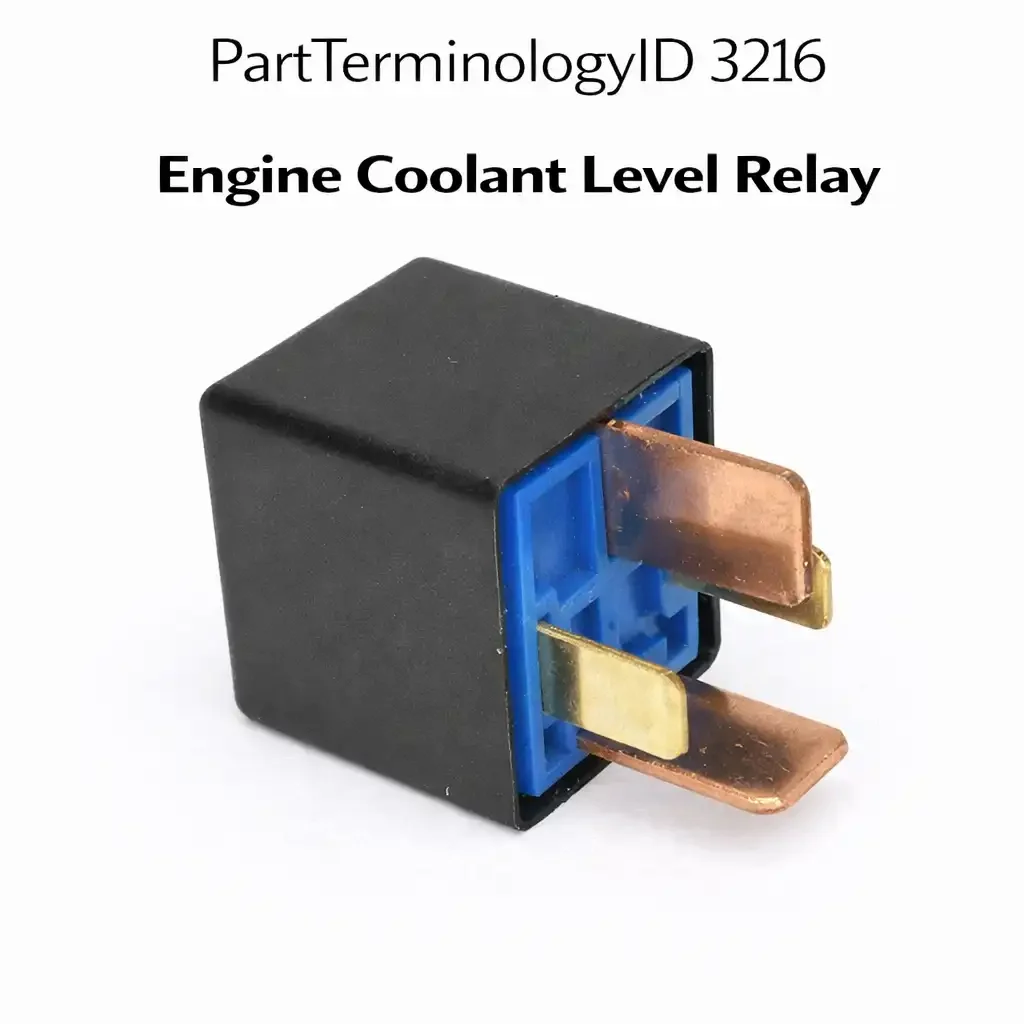
PartTerminologyID 3216, Engine Coolant Level Relay, is the relay that switches the power supply to the low coolant level warning indicator lamp or activates an audible alert when the coolant level sensor in the reservoir or radiator detects a coolant level below the minimum operating threshold, warning the driver of a potential coolant loss that may lead to engine overheating if not addressed. That definition covers the low coolant warning circuit switching function correctly and leaves unresolved whether the relay is activated by the coolant level sensor directly or by a BCM output that processes the sensor signal, the sensor type whether a float switch, a conductivity probe, or an optical sensor, and whether the relay is a standalone warning relay or shares a circuit with the temperature warning system.
For sellers, PartTerminologyID 3216 is a warning system relay where the sensor fault diagnosis before relay replacement is the most important listing attribute. A low coolant warning light that stays on when the coolant level is verified full is more likely caused by a failed coolant level sensor than a failed relay. The sensor reports low level regardless of actual coolant level, and the relay correctly illuminates the warning lamp in response to the sensor's erroneous signal. A buyer who replaces the relay without testing the sensor installs a new relay that immediately illuminates the warning lamp again because the sensor is still reporting low level.
What the Engine Coolant Level Relay Does
The coolant level sensor output changes state when the coolant drops below the sensor's detection point, sending a signal to the relay coil circuit or the BCM. The relay closes and completes the warning lamp circuit. On vehicles with a BCM-processed coolant level signal the BCM activates the relay output to illuminate the lamp and may simultaneously generate a message on the instrument cluster display and store a fault code accessible by scan tool. A relay failure in the lamp circuit produces either a permanently illuminated warning lamp if the relay fails closed, or a warning lamp that never illuminates even during genuine low coolant conditions if the relay fails open.
The open failure consequence is the safety-relevant failure mode because a driver with no coolant level warning may continue operating the vehicle with dangerously low coolant until the engine overheats. The listing must note this safety consequence to motivate prompt relay replacement when a failed open coolant level relay is identified.
Coolant level sensor types and false-low signal causes
Three sensor types are used for coolant level detection depending on the vehicle architecture. Float switches use a buoyant float that rises with coolant level and opens or closes the circuit at the minimum level position. Conductivity probes detect the presence of coolant at the sensor tip by measuring electrical conductivity between two electrodes, which changes when air replaces coolant at the sensor position. Optical sensors detect the refractive index change at the sensor tip between coolant and air. Each type fails in a characteristic way: float switches corrode and stick in the low-level position producing a persistent false-low signal. Conductivity probes accumulate coolant deposits that bridge the electrodes and produce false-level readings at elevated temperatures. Optical sensors cloud over from coolant additives on the optical surface and report false-low when the optical path is obscured by contamination rather than by actual low level.
Coolant level relay circuit and warning lamp architecture
On BCM-integrated coolant level monitoring systems the BCM processes the sensor signal and commands the warning lamp relay through a dedicated output driver. A BCM output driver fault produces the same warning lamp symptom as a relay contact fault because both result in no lamp activation or a permanently illuminated lamp depending on the failure mode. Testing for BCM output driver activation voltage at the relay coil terminal distinguishes a relay contact fault from a BCM output fault: coil voltage present with lamp not illuminating confirms the relay contact has failed open. No coil voltage with the sensor correctly reporting low level confirms a BCM output driver fault that requires BCM diagnosis rather than relay replacement.
Coolant level relay circuit topology and the lamp activation path
The coolant level relay receives its coil activation from the coolant level sensor switch, which closes when the coolant level drops below the sensor position. The relay contact then completes the warning lamp circuit, illuminating the indicator. On BCM-integrated systems the BCM reads the sensor signal digitally and commands the relay through an output driver rather than connecting the sensor directly to the relay coil. The BCM integration adds the ability to store a fault code for the sensor circuit and to apply warning inhibit logic during the first few seconds after ignition-on when coolant level may not yet be accurately measured due to coolant circulation beginning. A buyer who sees a low coolant warning that extinguishes after 10 seconds of engine operation is observing the BCM's warm-up inhibit logic removing the initial false-low reading, not a relay fault.
Coolant additives and conductivity probe sensor degradation
Conductivity probe sensors used for coolant level detection rely on the electrical conductivity of the coolant to complete a circuit at the probe tip. Over time, coolant additive depletion reduces the coolant's conductivity, causing the probe to report a low-level reading at a coolant level that is actually within range because the conductivity has dropped below the sensor's detection threshold. This produces a false-low warning that appears identical to genuine low coolant level but is actually a coolant chemistry fault. Testing the coolant's conductivity with a refractometer or replacing the coolant with fresh OEM-specification coolant resolves the false-low warning from a conductivity probe without any relay or sensor replacement.
Why This Part Generates Returns
Buyers return coolant level relays because the coolant level sensor has failed and the new relay correctly illuminates the warning lamp in response to the sensor's continued false-low signal, the relay is part of the instrument cluster circuit and cannot be replaced as a separate component, and the coolant level is genuinely low and refilling the coolant extinguishes the warning light without any relay replacement being necessary.
Status in New Databases
PIES/PCdb: PartTerminologyID 3216, Engine Coolant Level Relay
PIES 8.0 / PCdb 2.0: No change.
Listing Requirements
PartTerminologyID: 3216
sensor type and activation source (mandatory)
open failure safety consequence: no low-coolant warning (mandatory)
coolant level sensor diagnosis before relay replacement (mandatory)
contact current rating for warning lamp load (mandatory)
OEM part number cross-reference (mandatory)
FAQ (Buyer Language)
My low coolant light is on but the coolant is full. Is it the relay?
Probably not. A low coolant light with full coolant level indicates a failed coolant level sensor sending a false-low signal. The relay is illuminating the lamp correctly in response to the sensor signal. Replace the coolant level sensor rather than the relay.
What happens if the coolant level relay fails open?
The warning lamp cannot illuminate even when the coolant level is genuinely low. The driver receives no warning of coolant loss. The engine may overheat before the driver notices the absence of a coolant warning light that was not functioning.
How do I test the coolant level sensor before replacing the relay?
With the coolant level confirmed full by visual inspection, disconnect the coolant level sensor connector and measure the sensor output signal. A float switch should show the open or closed resistance corresponding to the full level position for its switch logic. A conductivity probe should show the resistance corresponding to coolant present at the probe tip. If the sensor output matches the full-level specification with coolant confirmed full, the sensor is functioning correctly and the relay is receiving an accurate signal. If the sensor output matches a low-level reading with coolant confirmed full, the sensor has failed and is sending a false-low signal. Replace the sensor rather than the relay.
Top Return Scenarios
Scenario 1: "Low coolant light on with coolant full, relay replaced, light still on, sensor failed"
The buyer verifies the coolant reservoir is full and the radiator has no low-coolant indication. The low coolant warning lamp is illuminated. The relay is replaced. The lamp remains on. Testing confirms the coolant level sensor is sending a low-level signal despite confirmed full coolant. The sensor has failed and reports low level regardless of actual coolant level. The relay is correctly illuminating the warning lamp in response to the sensor's erroneous low-level signal. Sensor replacement extinguishes the lamp immediately.
Prevention language: "Before replacing the relay, confirm the coolant level sensor is sending an accurate signal. A low coolant warning lamp with confirmed full coolant level indicates a failed sensor rather than a relay fault. Replace the sensor rather than the relay when the coolant level is verified full."
Scenario 2: "Relay replaced, low coolant warning absent, coolant loss not detected, engine overheats"
The buyer notices the low coolant warning lamp has not illuminated for an extended period. The relay has failed open and the warning lamp circuit is broken. A slow coolant leak has progressively reduced the coolant level below the minimum sensor threshold, but no warning is received because the relay contact cannot complete the lamp circuit. The engine overheats from low coolant before the driver receives any electrical warning. This scenario illustrates the safety consequence of a failed-open relay and must be described in the listing to motivate prompt replacement of a failed-open relay rather than continuing operation without the warning function.
Prevention language: "A failed-open coolant level relay prevents the low coolant warning lamp from illuminating when coolant level drops below minimum. Without this warning, slow coolant loss from a leak may go undetected until the engine overheats. Replace a failed-open relay promptly to restore the coolant level warning function."
Cross-Sell Logic
Coolant Level Sensor: for buyers where the sensor is sending a false-low signal with confirmed full coolant level
Radiator Cap: for buyers where the coolant level is genuinely low due to a cap that is not maintaining system pressure and is allowing slow coolant loss
Body Control Module: for buyers where the relay coil receives no activation voltage from the BCM output despite a confirmed low-level sensor signal
Catalog Checklist for ACES/PIES Teams
PartTerminologyID = 3216
require sensor type and activation source (mandatory)
require open-failure safety consequence disclosure (mandatory)
require coolant level sensor diagnosis before relay replacement (mandatory)
require contact current rating for warning lamp load (mandatory)
prevent relay order before sensor output verification: false-low sensor signal causes replacement relay to illuminate warning lamp immediately after installation
require BCM warm-up inhibit note for BCM-integrated systems: the BCM on many vehicles applies a warm-up inhibit to the coolant level warning during the first 10 to 30 seconds after ignition-on while coolant circulation begins and the level sensor stabilizes; a warning lamp that illuminates at key-on and extinguishes within 30 seconds without any driver action is observing the BCM warm-up inhibit function correctly rather than a relay fault
Final Take for PartTerminologyID 3216
Engine Coolant Level Relay (PartTerminologyID 3216) is the coolant warning relay where the sensor-first diagnosis redirect prevents the most common misorder and the open-failure safety consequence motivates prompt replacement when the relay is genuinely identified as failed. A low coolant warning lamp that illuminates with a verified full coolant level is a failed coolant level sensor reporting low level to a correctly functioning relay, not a relay that has failed closed. Replacing the relay in this scenario installs a new relay that illuminates the warning lamp immediately because the sensor is still reporting a false low-level condition. The sensor must be tested and replaced first. When the relay has genuinely failed open, the driver receives no warning of actual coolant loss, which can result in undetected engine overheating and catastrophic engine damage from a fault the relay was designed to prevent.