
Written by Arthur Simitian | PartsAdvisory
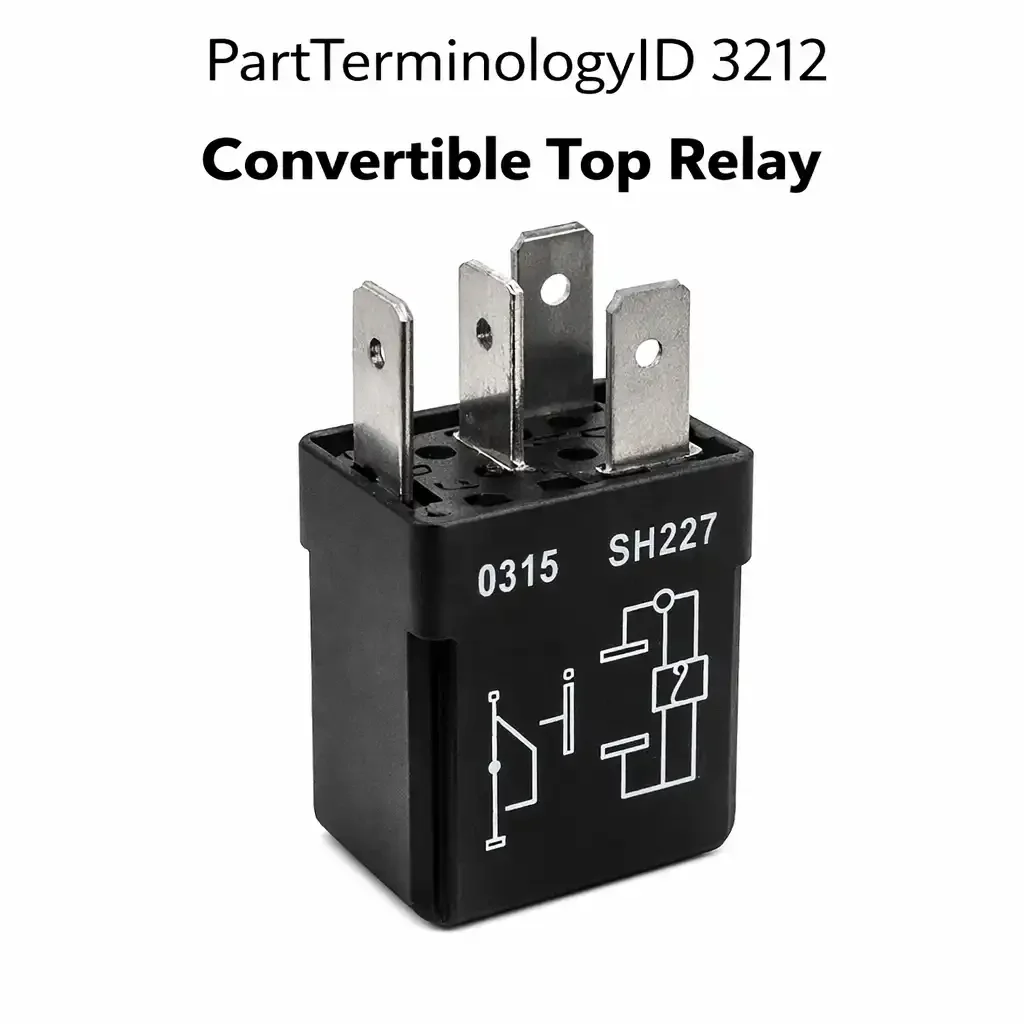
PartTerminologyID 3212, Convertible Top Relay, is the relay that switches power to the convertible top's hydraulic pump motor or electric actuator motor, enabling the top control module or switch circuit to command raising or lowering of the convertible roof system and coordinating power operation of the top with related mechanisms including the rear window defogger disconnect, the trunk lid auto-open for top storage, and the side window drop sequence that lowers the windows to clear the door frame during roof movement. That definition covers the convertible top motor power switching function correctly and leaves unresolved whether the relay switches the hydraulic pump motor that provides hydraulic pressure for hydraulic-cylinder-actuated top mechanisms, the direct electric actuator motor for electrically actuated top systems, the contact current rating relative to the pump or motor inrush current under load, how many relays the top system uses and what role each plays in the raise versus lower sequence, and whether the relay is commanded by a dedicated top control module or directly by the top switch.
For sellers, PartTerminologyID 3212 is the convertible top relay PartTerminologyID where the multi-relay sequence architecture is the most return-generating source of buyer confusion. A complete convertible top operation cycle typically uses three to six relays in a coordinated sequence: pump relay for hydraulic pressure, directional control relays for raise versus lower, window drop relays for door glass lowering, and trunk lid relays for storage position. A buyer who needs the pump motor relay and receives a directional control relay has a part that installs in a different socket and controls a different function in the sequence. Every relay in the top sequence must be listed with its specific sequence function, not merely as a convertible top relay without a function qualifier.
What the Convertible Top Relay Does
Hydraulic versus electric actuator architecture and the motor current requirement
Hydraulic convertible top systems use a reversible hydraulic pump motor to pressurize hydraulic cylinders that move the top's structural components. The pump motor draws 15 to 40 amperes under load depending on the system design and the ambient temperature, which affects hydraulic fluid viscosity. Cold hydraulic fluid at low ambient temperatures significantly increases pump motor current because the high-viscosity fluid requires more motor torque to pressurize. A relay sized for warm-temperature pump current may be marginal at cold ambient temperatures where the same motor draws 30 to 50 percent more current through cold, thick hydraulic fluid.
Electric actuator convertible top systems use one or more electric motors driving screwjacks or cables to move the top structure directly without hydraulic intermediaries. These motors also draw high inrush current at startup and high sustained current during the full mechanical travel of the top operation. The contact current rating for the actuator relay must account for the maximum current draw at the most mechanically disadvantaged point of the top travel, which may be at the beginning of the raise cycle when the top fabric is taut and the structural linkage geometry provides minimum mechanical advantage.
Sequence relay coordination and the window drop integration
The window drop sequence is critical to preventing damage during top operation. The side windows must lower below the door frame seal level before the top begins its raise or lower movement. If the window drop relay fails and the windows remain at full height, the top structure contacts the window glass during movement, potentially cracking the glass or damaging the top fabric at the door frame. The top control module typically monitors the window position signal before authorizing pump or actuator relay activation, so a failed window drop relay produces a top that refuses to operate rather than one that operates with the windows up.
A buyer whose convertible top does not respond to the switch may have a failed window drop relay rather than a failed pump or actuator relay. The symptom, no top movement, is identical from the driver's perspective. Identifying which relay in the sequence has failed requires either an OBD scan tool that can read the top control module's fault codes or a systematic voltage trace through the sequence relay sockets to find which relay is not activating.
Why This Part Generates Returns
Buyers return convertible top relays because the sequence function is not identified and the wrong relay in the sequence is delivered, the hydraulic pump motor has seized and the locked-rotor current welds the pump relay contact immediately on installation, the top control module has faulted and none of the sequence relays receive activation signals until the module fault is cleared, and the relay is delivered without the correct harness connector for the top module's relay bank mounting position.
Status in New Databases
PIES/PCdb: PartTerminologyID 3212, Convertible Top Relay
PIES 8.0 / PCdb 2.0: No change.
Top Return Scenarios
Scenario 1: "Wrong sequence relay, pump relay delivered for window drop application"
The buyer's top does not move. The window drop relay is failed and the module will not authorize pump activation without window confirmation. The listing covers convertible top relay without specifying sequence function. The pump relay is delivered. The window drop socket receives a pump-rated relay that cannot activate the window drop actuator at the correct current level.
Prevention language: "Sequence function: [hydraulic pump motor / raise directional / lower directional / window drop / trunk lid release / top latch]. This relay covers the [function] in the top operation sequence. Identify which sequence step is faulted by checking for module fault codes or tracing activation voltage through each relay socket in sequence before ordering."
Scenario 2: "Seized pump, locked-rotor current welds relay contact immediately"
The hydraulic pump motor has seized from hydraulic fluid contamination or bearing failure. At relay closure the pump draws locked-rotor current. The relay contact welds within 10 seconds. The buyer returns the relay as defective. The pump must be replaced or freed before any relay survives the circuit.
Prevention language: "Pump motor check: Before installing the replacement relay, verify the hydraulic pump motor rotates freely. Apply 12 volts directly to the pump motor terminals and confirm the motor runs. A pump that draws high current and does not rotate is seized and will weld the replacement relay immediately."
Listing Requirements
PartTerminologyID: 3212
sequence function: pump, raise, lower, window drop, trunk, or latch (mandatory, in title)
actuator type: hydraulic pump or electric actuator (mandatory)
contact current rating: running, inrush, and cold-fluid pump note (mandatory)
top control module fault diagnosis note (mandatory)
pump or motor seizure pre-check note (mandatory)
OEM part number cross-reference (mandatory)
Catalog Checklist for ACES/PIES Teams
PartTerminologyID = 3212
require sequence function in title (mandatory)
require actuator type: hydraulic pump or electric motor (mandatory)
require contact current rating including inrush and cold-fluid pump note (mandatory)
require top control module fault code check note (mandatory)
require pump or motor seizure pre-check note (mandatory)
prevent wrong sequence relay: convertible top systems use three to six relays in sequence; delivering the pump relay when the window drop relay is faulted produces no change in behavior; sequence function must match the faulted step
prevent cold-fluid pump relay failure: hydraulic fluid viscosity increases sharply below freezing, raising pump startup current substantially above warm-fluid inrush; contact rating must account for cold-ambient operation in regions with winter temperatures
Scenario 3: "Top control module fault code, relay replaced, no change"
The convertible top does not operate. The buyer replaces the hydraulic pump relay because the pump is the most visible actuator. The top still does not operate. The top control module has a stored fault code indicating a position sensor fault from a hood switch that has not properly confirmed the top closed position. The module inhibits all relay activation because it cannot confirm the safety sequence has completed correctly. The pump relay was functional. The module fault must be cleared and the position sensor circuit verified before any relay activation is possible.
Prevention language: "Module fault check: Before ordering any convertible top relay, check the top control module for fault codes. The module inhibits all relay activation if any safety or position sensor fault is stored. A relay replacement will produce no change when the module has an active inhibit condition. Clear module faults and verify all position sensors before diagnosing individual relay failures."
Scenario 4: "Cold weather pump startup failure, contact rated for warm-fluid inrush only"
The convertible top operated normally through summer and fall. In winter the top fails to operate on cold mornings but operates normally after the vehicle has warmed up. The hydraulic fluid's viscosity at low ambient temperature increases the pump startup torque requirement. The pump motor draws substantially more current at cold startup than at warm startup, and the replacement relay's contact is rated for the warm-fluid inrush current only. The contact fails under cold-startup inrush, welding closed or opening under the excess current. The system works after warm-up because the fluid has thinned to its normal operating viscosity.
Prevention language: "Cold-weather operation: Hydraulic pump motor inrush current increases significantly at low ambient temperatures due to hydraulic fluid viscosity changes. In climates with winter temperatures below freezing, the contact current rating must be evaluated against cold-startup inrush, not warm-fluid inrush alone. Verify the relay contact rating includes a cold-ambient derating margin for winter operation."
FAQ (Buyer Language)
My convertible top won't move at all. Is it the relay?
Possibly, but the top control module inhibits all relay activation if any sequence step is faulted. Check the module for fault codes first. A failed window drop relay, a failed position sensor, or a module fault all produce complete top non-response that appears identical to a pump relay failure from the driver's seat.
How many relays does my convertible top system use?
Most systems use three to six relays. Each relay handles one function in the operating sequence. Identify the specific faulted sequence step before ordering. Replacing one relay when a different relay in the sequence is faulted leaves the system non-functional.
How do I identify which relay in the sequence has failed?
Connect an ABS-capable or body-capable scan tool to the top control module. The module stores fault codes that identify the specific sequence step where activation failed. A code identifying the window drop circuit points to the window drop relay. A code identifying the pump motor circuit points to the pump relay. Ordering before reading the fault codes results in a random relay replacement with a low probability of resolving the specific faulted step.
Why does my top work in summer but fail in cold weather?
Hydraulic fluid viscosity increases at low temperatures, requiring more pump motor torque to move fluid through the hydraulic lines. If the pump relay contact has a marginal connection or is rated only for warm-fluid inrush current, the cold-startup current spike can open or weld the contact. The symptom appears only in cold weather because warm-fluid viscosity keeps startup current below the failing contact's threshold. Replace the relay with a unit rated for cold-ambient inrush before the cold season begins.
Can I test each relay without a scan tool?
You can test relay coil activation by measuring for activation voltage at each relay socket's coil terminals during a top operation attempt. A relay socket with supply voltage but no coil activation voltage indicates the module is not commanding that relay. A socket with coil activation voltage but no contact output voltage indicates a failed relay contact. This test method requires access to the relay center and a multimeter, but identifies failed contacts without a scan tool on systems where the module does not store individual relay circuit fault codes.
What Sellers Get Wrong About PartTerminologyID 3212
The most common error is listing a convertible top relay without identifying the sequence function. A listing titled only "Convertible Top Relay" for a vehicle that uses five relays in its operating sequence provides no guidance to a buyer who knows the window drop step is faulted. The buyer cannot determine from the listing whether it covers the window drop relay, the pump relay, the raise directional relay, the lower directional relay, or the latch relay. Without that determination, every buyer who orders based on vehicle fitment alone risks receiving the wrong relay in the sequence. Sequence function identification in the title is the single attribute that converts a useless fitment listing into an actionable diagnostic guide.
The second most common error is omitting the cold-weather pump inrush note for hydraulic systems in northern markets. Aftermarket listings routinely specify warm-fluid motor inrush as the contact current rating. In California and other warm climates this is adequate. In Michigan, Minnesota, and Canada, where ambient temperatures regularly fall below freezing, the pump motor cold-startup current may exceed the warm-fluid inrush by 50 percent or more. A relay contact rated at 20 amperes continuous and 30 amperes inrush for warm-fluid operation may face 45-ampere cold-startup inrush on a minus-10-degree morning. The listing must state the cold-ambient inrush requirement for northern-market vehicles, and the replacement relay must be selected against the cold-fluid specification, not the warm-fluid specification.
Cross-Sell Logic
Convertible Top Hydraulic Pump Motor: for buyers where the pump relay is confirmed activating but no hydraulic pump noise is heard and the top does not move, indicating a seized pump motor rather than a relay fault
Top Position Sensors: for buyers where the top control module stores position sensor fault codes that prevent relay activation; position sensors that fail to confirm sequence completion block all relay activation through module inhibit logic
Top Control Module: for buyers where multiple relays in the sequence are confirmed functional at the coil voltage level but the module stores persistent fault codes indicating a module output driver failure rather than individual relay failures
Window Regulator Motor: for buyers where the window drop relay is confirmed activating but the window does not lower during the sequence, indicating a failed window regulator motor that blocks the sequence
Why Catalog Data Quality Matters for PartTerminologyID 3212
Convertible top relay listings that omit sequence function identification generate returns at a higher rate than almost any other relay PartTerminologyID because the buyer cannot determine which relay in the sequence to order without it. A vehicle with five relays in the operating sequence has a one-in-five chance of the buyer ordering the correct relay by guessing, and the buyer who orders incorrectly has no listing language to guide them toward the correct relay for their specific faulted sequence step. Adding sequence function to the title converts the listing from a 20-percent-accuracy guessing exercise into a targeted diagnostic tool. Combined with the module fault code check note that prevents the order when a module fault is inhibiting all sequence relays, the two additions reduce return exposure for this PartTerminologyID more than any other improvement a seller can make to a convertible top relay listing.
Application Range and Fitment Guidance for PartTerminologyID 3212
Convertible top relay applications are concentrated in two-door roadster, coupe, and cabriolet body styles across domestic, European, and Japanese manufacturers from approximately the early 1990s when electronic convertible top control modules became standard through the present. Earlier convertible top mechanisms used mechanical latches and manual folding without electronic relay control. The transition to electrically controlled tops introduced the relay architecture that PartTerminologyID 3212 covers.
The number of relays in a convertible top system ranges from three to six depending on the manufacturer's sequence design. A simple system may use three relays: one for the hydraulic pump in each direction and one for the window drop. A complex system may use five or six relays covering pump operation, directional valves, window drop for front and rear, top latch motor, and boot cover release. A fitment database that covers all convertible top relays under a single listing without sequence function differentiation is unusable for buyers who know which sequence step has failed. Sequence function differentiation is not optional for any listing that aspires to functional accuracy under this PartTerminologyID.
Hydraulic versus electric actuator architectures divide the convertible top relay population into two distinct contact current requirement classes. Hydraulic pump relays must handle cold-fluid pump startup inrush in northern markets. Electric actuator relays must handle motor startup inrush under maximum mechanical load. Applying a hydraulic pump relay specification to an electric actuator application, or vice versa, is an error that cannot be detected by physical fitment check alone because both relay types may use the same ISO footprint and connector. The actuator type must be specified in the listing as a matching attribute independent of physical fitment.
Final Take for PartTerminologyID 3212
Convertible Top Relay (PartTerminologyID 3212) is the multi-relay sequence system where sequence function identification in the title is the single most important attribute. A listing without sequence function identification cannot be evaluated by any buyer who knows which step in the top operation sequence has failed. The module fault code check before relay ordering is the pre-order diagnostic step that prevents the most common return scenario: replacing a functional relay when a different relay in the sequence is the actual fault. Cold-weather inrush rating and pump seizure inspection before installation are the two attributes that prevent the two most expensive post-installation failure scenarios. All four attributes can be stated in the listing in under 100 words, and their presence converts a generic fitment listing into a return-prevention document that serves buyers at every step from symptom identification through installation verification.
Sequence function in the title, module fault code check before ordering, and cold-weather inrush rating are the three attributes that define whether a convertible top relay listing is actionable or generic.