
Written by Arthur Simitian | PartsAdvisory
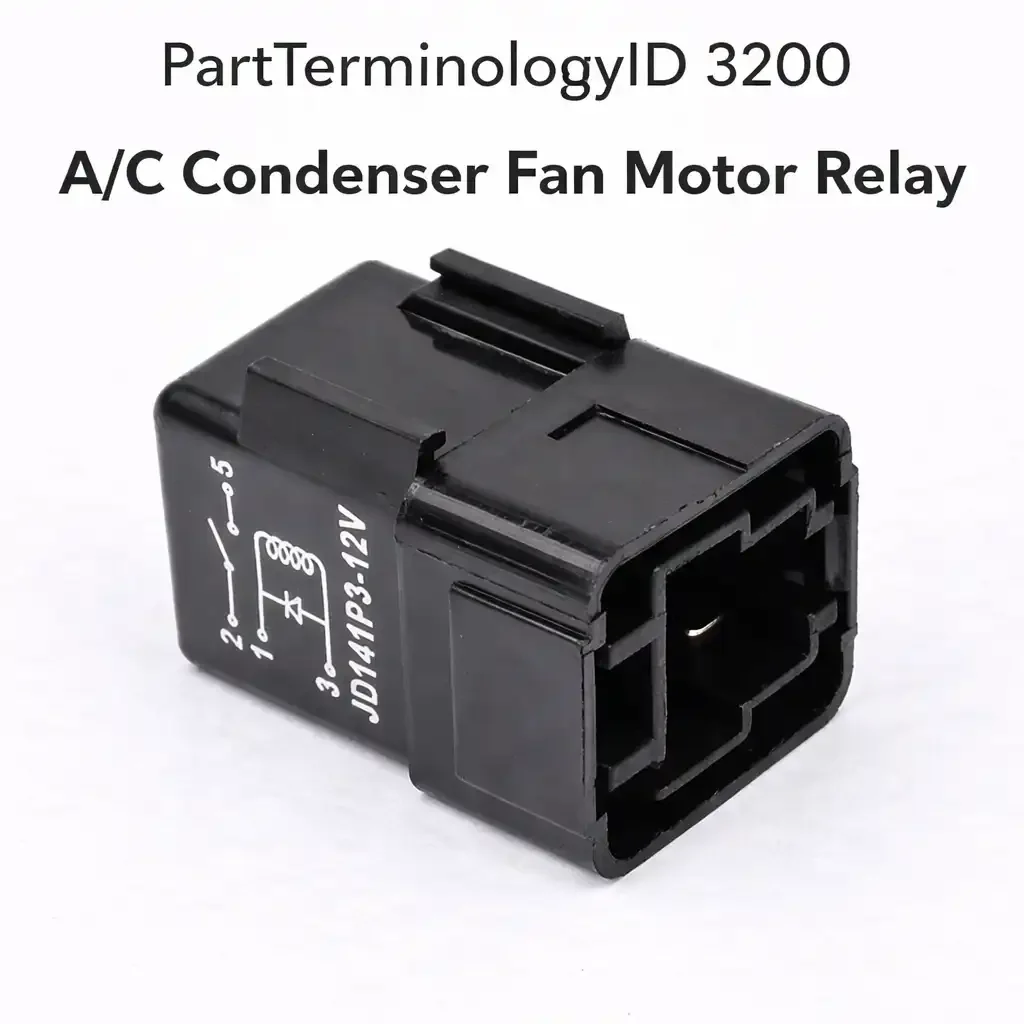
PartTerminologyID 3200, A/C Condenser Fan Motor Relay, is the relay that switches power to the electric fan motor positioned in front of the A/C condenser to pull or push air through the condenser coils, enabling the A/C system to reject heat from the refrigerant to ambient air regardless of vehicle speed and providing supplemental airflow at low vehicle speeds when ram air through the grille is insufficient for adequate condenser heat rejection. That definition covers the condenser fan motor activation function correctly and leaves unresolved whether the relay controls the condenser fan independently from the engine radiator cooling fan or whether the condenser fan and radiator fan are served by the same motor or the same relay, the contact current rating relative to the fan motor's startup inrush current, whether the vehicle uses a single-speed condenser fan relay or a two-speed architecture with separate high and low speed relays for the condenser fan, the relay's activation sources which typically include the A/C clutch engagement signal and a condenser pressure signal, and whether a failed relay produces no condenser cooling at any speed or the absence of one speed stage only.
For sellers, PartTerminologyID 3200 is the A/C condenser fan relay PartTerminologyID that most frequently generates catalog confusion with the Auxiliary Engine Cooling Fan Relay (PartTerminologyID 3060) because on many vehicles the condenser fan and the auxiliary engine cooling fan are the same physical fan motor served by a single relay. On these combined-function vehicles, PartTerminologyID 3200 and PartTerminologyID 3060 reference the same relay from two different system perspectives: the A/C system perspective calls it the condenser fan relay and the engine cooling perspective calls it the auxiliary cooling fan relay. The listing must identify whether the vehicle uses a dedicated condenser-only fan or a combined condenser and engine cooling fan, and must cross-reference the applicable PartTerminologyID for the combined architecture to prevent duplicate orders.
What the A/C Condenser Fan Motor Relay Does
Condenser fan activation logic and the refrigerant pressure threshold
The condenser fan relay receives activation commands from two primary sources: the A/C clutch engagement signal and the A/C high-side pressure sensor or switch. When the A/C clutch engages, the PCM immediately activates the condenser fan relay to ensure airflow through the condenser before refrigerant pressure builds. When the high-side pressure rises above a threshold, typically 200 to 250 psi on R-134a systems, the PCM activates the condenser fan at high speed if a two-speed architecture is present. This high-speed activation prevents the high-side pressure from rising further and triggering the high-pressure cutout that disables the compressor entirely.
A failed condenser fan relay allows the high-side pressure to rise unchecked during low-speed or stationary vehicle operation because no fan is pulling air through the condenser. The high-pressure cutout switch disables the A/C compressor clutch as a protection response. The buyer's symptom is an A/C system that cools normally at highway speeds where ram air provides adequate condenser airflow, but cuts out during city driving or idling. This speed-dependent A/C performance symptom is a strong diagnostic indicator of condenser fan relay failure and should be included in the listing as a symptom-based buyer redirect to confirm the relay before examining the compressor or refrigerant charge.
Two-speed condenser fan architecture and the high-pressure speed stage
Two-speed condenser fan systems use separate relays for low and high fan speed to provide proportional cooling capacity matching the A/C system's heat rejection demand. The low-speed relay activates whenever the A/C clutch is engaged, providing minimum airflow for normal operating conditions. The high-speed relay activates when condenser pressure exceeds the high-pressure threshold, providing maximum airflow to prevent high-pressure cutout during heavy A/C load conditions such as high ambient temperature or prolonged idling. A failed high-speed relay leaves the condenser fan operating at low speed only, which is insufficient for maximum heat rejection under heavy load conditions. The system operates normally at moderate loads but cuts out during peak demand periods.
Why This Part Generates Returns
Buyers return A/C condenser fan motor relays because the condenser fan motor has seized and the locked-rotor current welds the replacement relay contact within minutes, the fan is shared with the engine auxiliary cooling function and is cataloged under PartTerminologyID 3060 on this vehicle producing a duplicate order, the high-speed relay is delivered for a low-speed fault leaving the fan operating at one speed only, and the relay is confirmed activating but the condenser fan motor itself has failed and draws no current.
Status in New Databases
PIES/PCdb: PartTerminologyID 3200, A/C Condenser Fan Motor Relay
PIES 8.0 / PCdb 2.0: No change.
Top Return Scenarios
Scenario 1: "Speed-dependent A/C cutout, high-speed relay failed"
The buyer's A/C works on the highway but cuts out at idle. The condenser fan low-speed relay is functional. The high-speed relay has failed. At idle and low speed the fan cannot move enough air at low speed to prevent high-pressure cutout under full A/C load. Replacing only the low-speed relay produces no change.
Prevention language: "Symptom note: A/C that cools at highway speed but cuts out at idle indicates a failed condenser fan high-speed relay allowing high-side pressure to exceed the cutout threshold. Identify which speed stage relay is faulted before ordering. The high-speed relay is the more common failure point on two-speed condenser fan architectures."
Scenario 2: "Combined condenser and engine cooling fan, wrong PartTerminologyID"
The buyer orders the condenser fan relay. The vehicle uses a combined condenser and engine auxiliary cooling fan. The relay is cataloged under PartTerminologyID 3060 on this vehicle. The delivered relay under PartTerminologyID 3200 is a duplicate order for the same component under a different ID.
Prevention language: "Fan architecture: [dedicated condenser-only fan relay / combined condenser and engine cooling fan relay also covered under PartTerminologyID 3060]. Verify which architecture the vehicle uses to avoid duplicate orders under both IDs."
Listing Requirements
PartTerminologyID: 3200
fan architecture: dedicated condenser or combined condenser and engine cooling (mandatory)
speed stage: single, low, or high (mandatory)
contact current rating: running and motor inrush (mandatory)
activation sources: clutch signal and pressure threshold (mandatory)
speed-dependent symptom note (mandatory)
cross-reference to PartTerminologyID 3060 for combined fan applications (mandatory)
fan motor seizure inspection note (mandatory)
OEM part number cross-reference (mandatory)
Catalog Checklist for ACES/PIES Teams
PartTerminologyID = 3200
require fan architecture: dedicated condenser or combined (mandatory)
require speed stage identification in title (mandatory)
require contact current rating including motor inrush (mandatory)
require fan motor seizure inspection note (mandatory)
require combined fan cross-reference to PartTerminologyID 3060 (mandatory)
prevent wrong speed stage: high-side A/C pressure cutout at idle indicates failed high-speed relay; low-side temperature rise at moderate load indicates failed low-speed relay; speed stage symptom matching is mandatory listing content
prevent combined fan duplicate orders: some vehicles use one physical fan for both engine cooling and A/C condenser cooling; orders under both 3200 and 3060 may reference the same relay
Scenario 3: "A/C pressure switch the actual fault, relay confirmed activating, compressor still cuts out"
The buyer replaces the condenser fan relay. The fan confirmed running after replacement. The A/C still cuts out at idle. The high-pressure cutout switch has failed and is cutting out the compressor at normal system pressure. The condenser fan relay was not the cause of the high-side pressure cutout. Replacing the relay restored fan operation but did not address the cutout switch fault. The buyer returns the relay believing it did not solve the problem, but the fan relay did solve the fan problem. The cutout switch is the second fault.
Prevention language: "Refrigerant system diagnosis: If the A/C still cuts out at idle after condenser fan relay replacement and the fan is confirmed running, measure high-side pressure to determine whether the cutout is due to residual high-side pressure or a failed high-pressure cutout switch. A compressor that cuts out at normal system pressure with the fan running has a separate cutout switch fault."
Scenario 4: "Refrigerant undercharge, A/C still cuts out at idle after relay replacement"
The condenser fan relay has failed. The vehicle also has a refrigerant undercharge from a slow leak. Replacing the relay restores fan operation but the A/C still does not cool adequately at idle. The buyer returns the relay believing it was the wrong part. The relay was correct and has solved the fan problem. The refrigerant undercharge is a separate fault that the relay replacement was not expected to address. The listing must note that A/C performance issues after relay replacement may reflect refrigerant charge or other system faults independent of the relay.
Prevention language: "A/C system scope: The condenser fan relay controls the fan motor only. It does not regulate refrigerant charge, compressor operation, or expansion device function. Continued A/C performance complaints after relay replacement should be diagnosed at the system level including refrigerant charge, compressor output, and expansion valve operation."
FAQ (Buyer Language)
Why does my A/C work on the highway but not at a red light?
A failed condenser fan relay prevents the fan from pulling air through the condenser at low vehicle speeds. High-side pressure rises until the cutout switch disables the compressor. At highway speed, ram air provides enough condenser airflow even without the fan. Replace the condenser fan relay and confirm the motor runs before diagnosing refrigerant charge or compressor issues.
Is the condenser fan relay the same as the auxiliary cooling fan relay?
On vehicles with a combined condenser and engine cooling fan, yes. The same relay serves both functions. On vehicles with a dedicated condenser fan separate from the engine auxiliary fan, they are different relays. Verify the fan architecture before ordering under either PartTerminologyID.
How do I know if my condenser fan motor is seized before installing the relay?
With the ignition off, manually spin the condenser fan blade. It should rotate freely with minimal resistance. Significant drag or inability to rotate indicates bearing seizure. A seized motor draws locked-rotor current that will weld the replacement relay contact closed within seconds of first activation. Replace a seized motor before installing any relay.
My A/C only fails on very hot days. Could the condenser fan relay be the cause?
Yes. On hot days the ambient temperature raises the baseline high-side pressure. A condenser fan relay that is failing intermittently from a high-resistance contact may activate the fan normally at moderate ambient temperatures but fail to close reliably when the relay socket itself is hot from engine bay heat. The higher baseline pressure combined with inadequate fan activation causes high-side cutout only under peak thermal load conditions. An intermittently failing relay that causes hot-weather-only A/C cutout is a common precursor to complete relay failure.
What Sellers Get Wrong About PartTerminologyID 3200
The most common error is listing a condenser fan relay without identifying the fan speed stage. Two-speed condenser fan systems use two separate relays with different contact current ratings and different activation logic. The high-speed relay activates when the A/C demand is high or when ambient temperature is elevated. The low-speed relay activates during moderate A/C demand. A listing that covers the entire condenser fan relay category without identifying which speed stage generates returns from buyers who receive the wrong relay for the faulted stage. The speed stage must be identified from the fault symptom: A/C failure at idle with good performance at speed indicates high-speed relay failure; A/C that fails only under peak load indicates low-speed stage absence.
The second error is failing to note the combined condenser and engine cooling fan architecture. On vehicles where both cooling functions share one motor and one relay, a buyer searching for the condenser fan relay and a buyer searching for the engine cooling fan relay are both looking for the same component. A listing under PartTerminologyID 3200 that does not cross-reference PartTerminologyID 3060 leaves the buyer uncertain about whether they have found the correct listing. The cross-reference confirms the two IDs reference the same relay on this application and prevents the buyer from ordering under both IDs believing they cover different components.
Cross-Sell Logic
A/C Condenser Fan Motor: for buyers where the relay is confirmed delivering voltage to the motor but the fan does not spin, indicating a seized motor bearing, open winding, or brushed motor commutator failure
A/C High Pressure Switch: for buyers where the condenser fan relay is confirmed functional and the fan runs but the A/C still cuts out at idle, indicating a failed high-pressure cutout switch triggering at normal system pressure
Auxiliary Engine Cooling Fan Relay (PartTerminologyID 3060): on combined fan architecture vehicles where both PartTerminologyIDs reference the same relay; cross-reference prevents buyer confusion about which PartTerminologyID governs the correct specification
A/C Compressor Clutch Relay: for buyers who replace the condenser fan relay and find the fan restores but the compressor still does not engage, indicating a separate compressor clutch relay fault
Why Catalog Data Quality Matters for PartTerminologyID 3200
The A/C condenser fan relay is the component that buyers most commonly misdiagnose as a compressor or refrigerant fault because the symptom of A/C cutting out at idle looks identical to a low refrigerant charge or a compressor fault from the driver's perspective. A listing that includes the speed-dependent symptom note redirects these buyers toward the relay before they schedule a refrigerant recharge service or a compressor diagnosis. The redirect saves the buyer a diagnostic cost and converts a service appointment into a relay order. Listings that omit the symptom note leave the buyer to reach the correct diagnosis independently, which they may not do before spending money on the wrong service. The symptom note is not a diagnostic tool - it is a sales tool that routes correctly diagnosing buyers to the correct product.
Application Range and Fitment Guidance for PartTerminologyID 3200
A/C condenser fan motor relay applications cover virtually all vehicles equipped with mechanical A/C compressors from approximately the mid-1970s through the present. The relay architecture evolved from simple pressure-switch-controlled relays in early R-12 systems through BCM and PCM-controlled multi-speed fan management in modern R-134a and R-1234yf systems. Modern applications integrate condenser fan speed control with engine cooling fan management, radiator outlet temperature sensing, and ambient temperature compensation in the PCM's cooling strategy module.
Two-speed condenser fan architectures became common beginning in the late 1990s as A/C system efficiency requirements and ambient noise regulations pushed manufacturers toward variable fan speed rather than constant full-speed operation. The high-speed relay in a two-speed system typically carries a higher contact current rating than the low-speed relay because full-speed fan motor inrush is the peak current event in the system. A fitment database that applies a single condenser fan relay specification across both speed stage positions on a two-speed vehicle will generate returns from buyers who receive a low-speed contact rating in a high-speed socket or vice versa.
Combined condenser and engine cooling fan architectures span a significant portion of the current vehicle population, particularly in front-wheel-drive vehicles where packaging constraints led manufacturers to use a single electric fan for both cooling functions. Fitment data for these applications must cross-reference both PartTerminologyID 3200 and PartTerminologyID 3060 to prevent buyers from ordering under one ID while their vehicle's relay is cataloged under the other. Both IDs reference the same physical relay on these vehicles, and the catalog entry under each ID should note the cross-application explicitly.
Final Take for PartTerminologyID 3200
A/C Condenser Fan Motor Relay (PartTerminologyID 3200) is the refrigeration system airflow relay where the speed-dependent A/C cutout symptom is the most reliable buyer-facing diagnostic indicator, the combined fan architecture cross-reference prevents duplicate orders, and fan motor seizure inspection prevents immediate repeat relay failure from locked-rotor current. Speed stage identification is the mandatory first attribute in the listing title because it determines which symptom pattern corresponds to the faulted relay and because two-speed systems use non-interchangeable relays at different sockets with different current ratings. A/C systems that fail only at idle with normal performance at highway speed have a high-speed fan relay fault in nearly all cases. A/C systems that fail only under peak load have a low-speed stage fault. The listing that identifies speed stage and symptom pattern allows buyers to match their symptom to the correct relay before ordering, reducing returns from buyers who receive the wrong speed stage.
The speed-dependent A/C symptom note is the single piece of listing content that most directly converts buyers who are considering a refrigerant recharge or compressor diagnosis into buyers who are ordering the correct relay. A buyer who understands that A/C that works on the highway but fails at idle is a condenser fan relay symptom will order the relay first and eliminate the more expensive diagnostic path. The relay order at a fraction of the refrigerant recharge cost serves the buyer's budget. The symptom note that redirects this buyer to the correct diagnosis is worth including in every listing under this PartTerminologyID.
Sellers who include the speed-dependent A/C symptom note, the fan motor seizure check, and the combined fan architecture cross-reference in every listing under this PartTerminologyID have addressed the three highest-frequency return drivers before any buyer places an order.
Together, these three notes convert the listing from a vehicle-fitment form into a diagnostic guide that serves the buyer's repair need from symptom identification through successful installation and post-replacement A/C performance verification.
Speed stage and fan architecture identification in the listing title are the two attributes that define whether a buyer can evaluate this listing at all before ordering.