
Written by Arthur Simitian | PartsAdvisory
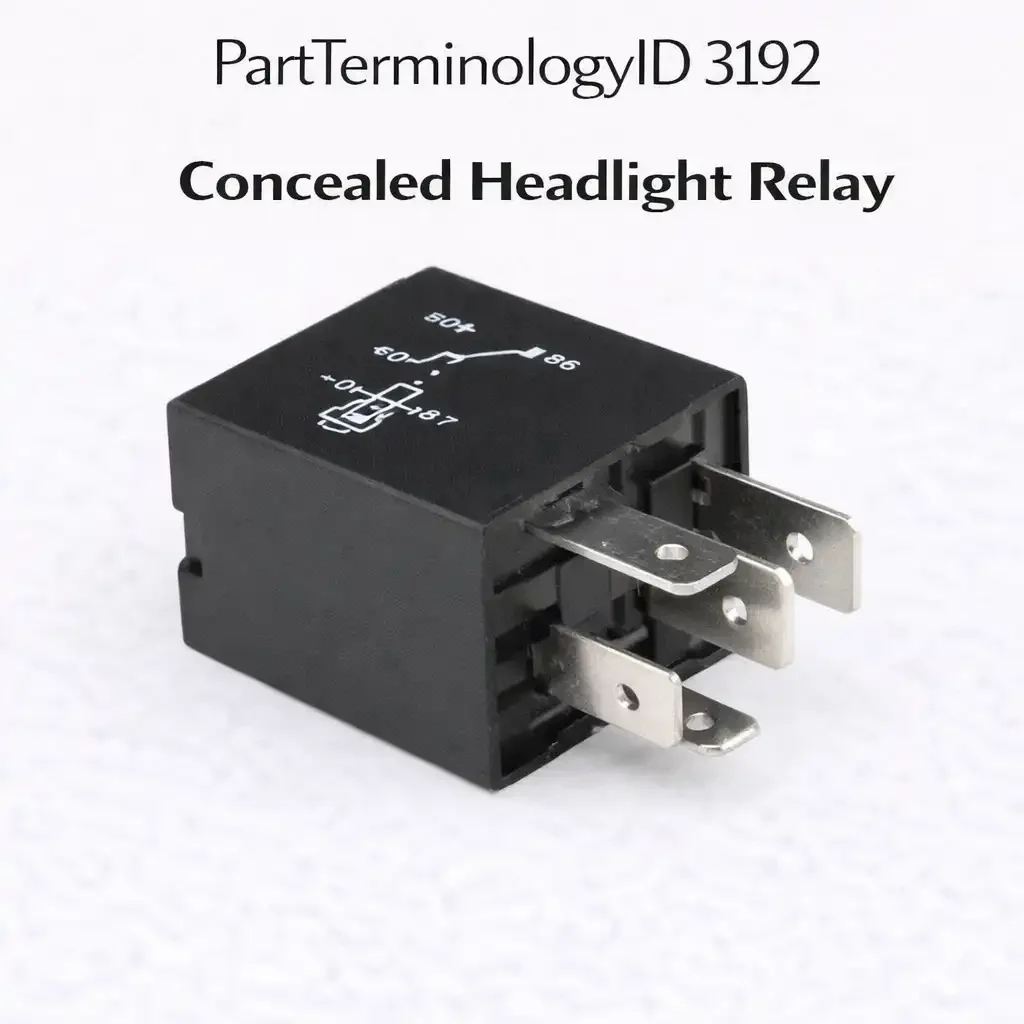
PartTerminologyID 3192, Concealed Headlight Relay, is the relay that switches power to the retractable headlight pod motor, enabling the headlamp switch or BCM to command the pop-up headlight assembly to open its pod to the operating position when the headlamps are switched on and to retract to the closed position when the headlamps are switched off. That definition covers the retractable headlight motor control function correctly and leaves unresolved whether the relay is a single relay that drives the motor in one direction with a separate switch or relay providing reverse polarity for retraction, a reversing relay pair that provides bidirectional motor control, the contact current rating relative to the pod motor's stall current at the open and closed mechanical travel limits, and whether the relay is activated directly by the headlamp switch or through a BCM output on vehicles where the headlamp switch is an input to the BCM rather than a direct circuit switch.
For sellers, PartTerminologyID 3192 is a limited-application relay associated with pop-up headlight designs used primarily from the mid-1960s through the mid-1990s on sports cars and performance vehicles before aerodynamic and pedestrian safety regulations effectively eliminated retractable headlight designs from new vehicle production. The listing must state the specific vehicle make and model application clearly since this relay has no universal application and covers a small set of vehicles with distinctly identifiable retractable headlight systems.
What the Concealed Headlight Relay Does
The retractable headlight pod motor requires bidirectional control to open and close the pod. Two relays with reversing contact arrangements provide forward drive for pod opening and reverse drive for pod closing. A timer relay on some implementations provides an automatic retraction command if the headlamps are switched off while the pod is mid-travel, preventing the pod from stalling in a partially open position that would expose the headlamp assembly to weather without completing the close cycle.
The pod motor stall current at the travel limit, when the motor reaches the mechanical stop and the circuit has not yet been interrupted by the limit switch, is the highest current the relay must handle. A relay whose contact rating is sized only for running current will experience contact stress at each travel limit stall event. On vehicles where the retract position limit switch has degraded and allows the motor to run against the mechanical stop for longer than the design limit, the accumulated stall current events accelerate contact erosion significantly. The listing must identify the relay's role, open drive or close drive, and must note the stall current rating requirement.
Limit switch integration and the travel stop protection function
Each pop-up headlight pod has mechanical travel limit switches at the fully open and fully closed positions that interrupt the motor circuit when the pod reaches the end of its travel. These limit switches prevent the motor from running against the mechanical stop and drawing stall current continuously. A failed limit switch allows the motor to run past the design stop position and stall against the mechanical limit, drawing locked-rotor current for as long as the relay remains closed. A relay contact already marginally degraded from accumulated switching events may weld closed under the sustained locked-rotor current. Confirming that both travel limit switches are functional before replacing the relay prevents the replacement from welding immediately on a seized or over-traveled pod.
Manual override and the relay bypass mode
Most retractable headlight systems include a manual override knob or access point that allows the pod to be rotated open manually when the motor or relay has failed, providing headlamp function while the electrical fault is being diagnosed. The manual override position is important context for the buyer because it allows safe nighttime driving after a relay failure without requiring immediate electrical repair. The listing must note the manual override availability for the specific application so buyers understand that a failed relay does not leave them without headlamp function until the repair is completed.
Relay connector and bracket fitment for vintage applications
Pop-up headlight relays on vintage vehicles from the 1970s through the 1990s use vehicle-specific relay mounting brackets and connector configurations that differ from modern ISO relay form factors. A relay that is electrically compatible may not physically fit the original bracket or may not mate with the original connector shell. Confirming the connector configuration and mounting bracket compatibility alongside the electrical specifications is mandatory for vintage pop-up headlight applications where non-ISO relay formats are common.
Four-relay architecture and the direction-specific fault identification
A complete pop-up headlight system uses four relays: open-left, close-left, open-right, and close-right. Each relay controls one motor in one direction. On vehicles where the headlights retract when the headlight switch is turned off, a failed close relay for one pod leaves that pod stuck in the open position while the other pod retracts normally. A failed open relay for one pod leaves that pod retracted while the other pod opens normally. The asymmetric behavior, where one pod moves correctly and the other does not, is the primary diagnostic indicator of a single relay fault rather than a module or switch fault that would affect both pods simultaneously. Identifying which pod and which direction are affected from the symptom narrows the fault to a single specific relay in the four-relay array.
Motor control module versus discrete relay architecture
Later production pop-up headlight systems replaced the discrete four-relay array with an integrated motor control module that manages both pod motors and all four direction functions internally. Vehicles with an integrated motor control module have no discrete relay positions for the pod motors. A buyer who searches the fuse center for four pop-up headlight relays on a vehicle with an integrated module will find no relay sockets for this function. Identifying whether the vehicle uses a discrete relay array or an integrated module from the service manual determines whether relay replacement or module replacement is the correct repair approach.
Why This Part Generates Returns
Buyers return concealed headlight relays because one relay of a reversing pair is delivered when the other direction relay is the faulted component, the limit switch has failed and the motor runs against the mechanical stop continuously until the relay contact welds, and the relay is delivered without the correct connector configuration for the specific vehicle's relay mounting bracket.
Status in New Databases
PIES/PCdb: PartTerminologyID 3192, Concealed Headlight Relay
PIES 8.0 / PCdb 2.0: No change.
Listing Requirements
PartTerminologyID: 3192
motor direction controlled: open, close, or reversing pair (mandatory)
contact current rating: running and stall (mandatory)
specific vehicle make and model application (mandatory)
limit switch interaction note (mandatory)
OEM part number cross-reference (mandatory)
FAQ (Buyer Language)
Why does only one headlight pod open?
Each pod has its own relay or each direction has its own relay. A single failed relay affects only one pod or only one movement direction. Identify which pod and which direction is non-functional before ordering to ensure the correct relay is replaced.
How do I test the limit switch before replacing the relay?
Disconnect the limit switch from the motor circuit and measure its resistance at the open and closed pod positions. The switch should show near-zero resistance in the position where the motor is allowed to run and open-circuit resistance in the travel-stop position. A switch that shows open-circuit resistance in the mid-travel position is failed and allows the motor to run past the intended stop. Replace the limit switch before installing the replacement relay to prevent locked-rotor current from welding the new contact.
Top Return Scenarios
Scenario 1: "One pod opens, one stays closed, open relay replaced, both now work"
The buyer's driver-side headlight pod does not open when the headlights are switched on. The passenger-side pod opens normally. The driver-side open relay has failed. Replacement of the driver-side open relay restores both pods to synchronized operation. This is the most common concealed headlight relay failure pattern: a single relay failure affects only one pod in one direction because each pod has independent relay control.
Prevention language: "Each headlight pod uses independent relays for the open and close directions. A single failed relay affects only the pod and direction served by that relay. Identify which pod and direction are inoperative and order the relay for that specific function rather than replacing all four relays."
Scenario 2: "Pod opens but does not close, relay replaced, pod still open"
The buyer's headlight pod opens but does not close when the headlights are switched off. The close relay is replaced. The pod still does not close. Testing confirms the relay coil receives no close command because the pod's open limit switch has failed in the open position and is preventing the close command from being generated. The relay replacement had no effect because the relay was never receiving a close activation command.
Prevention language: "Before replacing the close relay, confirm the relay coil receives activation voltage when the headlights are switched off. No coil voltage at the close relay indicates a limit switch fault rather than a relay fault. The limit switch at the open position may have failed and is preventing the close command from being generated."
Cross-Sell Logic
Headlight Pod Motor: for buyers where the relay is confirmed delivering voltage to the motor terminal but the pod does not move, indicating a seized motor
Travel Limit Switch: for buyers where repeated relay failures indicate a degraded limit switch allowing stall current events at the pod travel stops
Headlight Pod: for buyers where the motor and relay are confirmed functional but the pod mechanism has seized from corrosion and requires pod assembly replacement
Catalog Checklist for ACES/PIES Teams
PartTerminologyID = 3192
require motor direction in title: open, close, or reversing pair (mandatory)
require contact current rating for running and stall current (mandatory)
require specific vehicle make and model application (mandatory)
require limit switch interaction note (mandatory)
require manual override availability note (mandatory)
prevent relay order before limit switch confirmation: degraded limit switch allows stall current that welds replacement relay contact
require connector and bracket compatibility note for non-ISO relay formats on vintage applications: pop-up headlight relays on vehicles from the 1970s through the early 1990s frequently use vehicle-specific relay brackets and multi-pin connector housings that differ from modern ISO relay form factors; a relay that is electrically compatible must also physically mate with the original connector shell and bracket mounting position to complete a functional installation
Final Take for PartTerminologyID 3192
Concealed Headlight Relay (PartTerminologyID 3192) is a vehicle-specific relay for pop-up headlight systems where motor direction identification, stall current rating, and limit switch fault diagnosis are the three attributes that prevent the most common return scenarios on these vintage applications. Motor direction is the attribute that most frequently generates returns because the open relay and the close relay are installed in separate sockets that are specific to each direction of pod travel. A buyer who receives the open-direction relay when the close-direction relay is faulted has a relay that installs in the wrong socket and cannot be tested in the circuit position where the fault was observed. The specific direction, open or close, must appear in the listing title. Stall current rating prevents the second most common failure: a contact sized for running current only that arcs and fails at the pod travel limit where the motor stalls against the mechanical stop before the limit switch interrupts the circuit. Both attributes require the specific vehicle make, model, and headlight pod architecture before any fitment claim is verifiable.