
A/C Compressor Control Relay (PartTerminologyID 3184): Where Circuit Function Differentiation From the Clutch Relay Determines Whether
Written by Arthur Simitian | PartsAdvisory
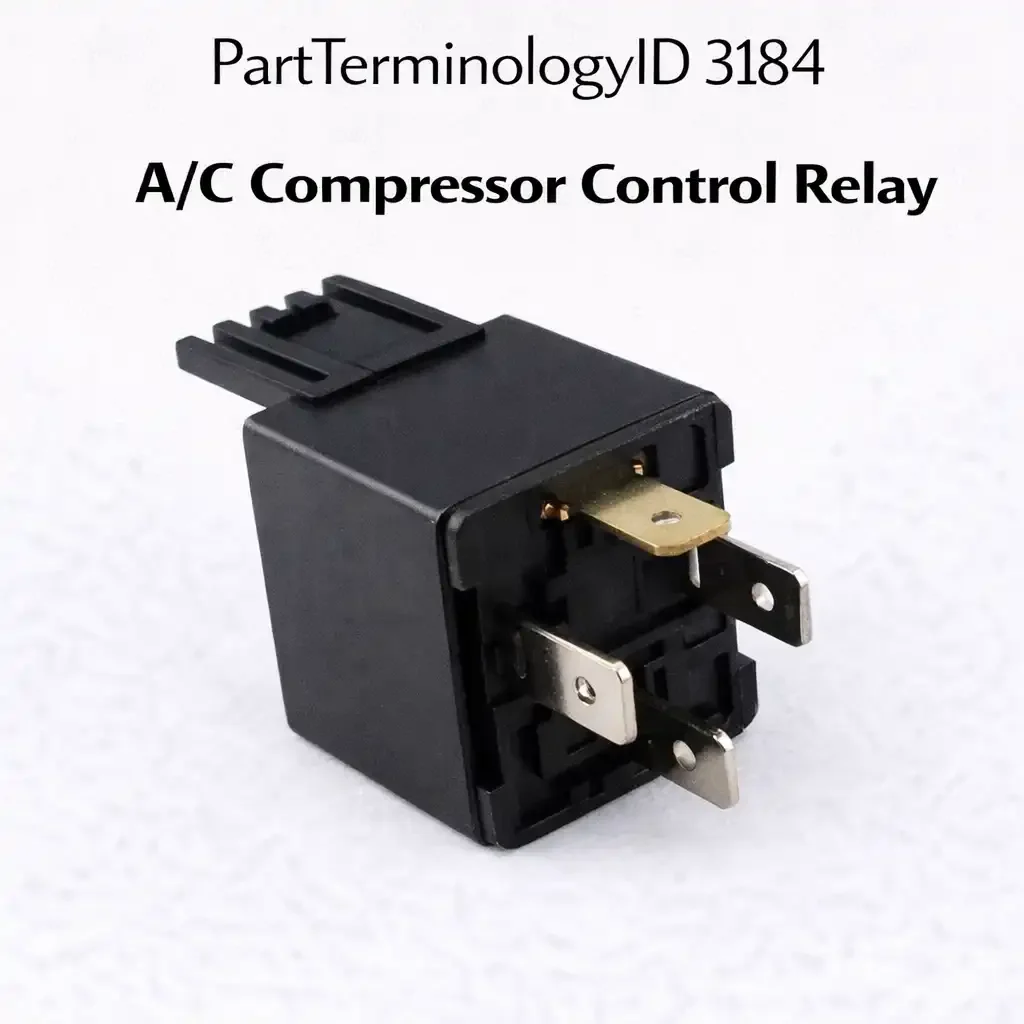
PartTerminologyID 3184, A/C Compressor Control Relay, is the relay that manages the broader compressor enable circuit, providing switched power to A/C system control components beyond the clutch coil itself, including the compressor control solenoid on variable displacement compressors, the A/C system's electronic expansion valve controller, or a compressor protection module that monitors suction and discharge pressures before enabling compressor operation. That definition covers the compressor control circuit switching function and must be differentiated from PartTerminologyID 3152, A/C Clutch Relay, which specifically engages the electromagnetic clutch. On vehicles where both PartTerminologyIDs appear in the catalog, the clutch relay directly engages the clutch coil and the control relay enables the broader compressor control circuit. On vehicles where only one relay is present, the single relay may be cataloged under either ID depending on its specific circuit role on that platform.
For sellers, PartTerminologyID 3184 is the compressor system relay that most frequently generates buyer confusion with PartTerminologyID 3152 when both are present on the same vehicle. The A/C system does not cool with either relay failed, because both are required for complete compressor operation on multi-relay A/C architectures. A buyer who replaces the compressor control relay without also confirming the clutch relay is functional will find the A/C system may still not cool if both relays have failed, or if the compressor control relay was not the fault and the clutch relay is the actual failed component.
What the A/C Compressor Control Relay Does
On variable displacement compressor architectures the compressor control relay supplies power to the displacement control solenoid that varies the compressor stroke between minimum and maximum displacement based on the A/C system's demand. The relay enables the solenoid's power supply and must be energized for the PCM to command displacement changes. A failed control relay locks the compressor at its default displacement, which is typically minimum displacement for safety, resulting in little or no refrigeration output even though the compressor is mechanically running.
On systems with compressor protection modules the control relay enables the protection module, which monitors suction pressure, discharge pressure, and oil circulation signals before allowing the PCM to command clutch engagement. A failed control relay prevents the protection module from receiving power and therefore prevents the protection module from issuing the clutch engagement enable signal. The symptom is an A/C system that produces no cooling despite the refrigerant charge being correct, the compressor turning, and the clutch relay apparently functioning, because the clutch relay receives its enable signal from the now-unpowered protection module rather than directly from the PCM.
Variable displacement compressor control and relay function
On variable displacement compressor architectures the compressor control relay supplies the displacement control solenoid that varies the compressor's stroke between minimum and maximum based on the A/C system's cooling demand. The relay enables this solenoid power supply and must be energized for the PCM to command displacement changes. A failed control relay locks the compressor at its default displacement, which is typically minimum displacement as a failsafe, resulting in little or no refrigeration output even though the compressor is mechanically running and the clutch relay is functional. The symptom is an A/C system that appears to have its compressor engaged but produces no cooling because the compressor is operating at minimum displacement without variation control.
Protection module power supply and the clutch enable chain
On systems with compressor protection modules the control relay enables the protection module, which monitors suction pressure, discharge pressure, and oil circulation before issuing a clutch engagement enable signal to the PCM. The PCM does not command clutch relay closure until it receives the enable signal from the protection module. A failed control relay prevents the protection module from receiving power and therefore prevents the module from issuing the enable signal. The clutch relay receives no command from the PCM because the protection module is unpowered, not because the PCM has detected a fault. The symptom is an A/C system with no clutch engagement and no fault codes because the PCM is waiting for a protection module enable signal that never arrives rather than detecting an active fault in a monitored circuit.
PCM enabling conditions and the control relay activation chain
The PCM commands the compressor control relay only after confirming a series of system enabling conditions: refrigerant pressure within range, coolant temperature below the compressor protection threshold, and the A/C request signal active from the HVAC control head. On variable displacement compressor systems the PCM additionally monitors the displacement control solenoid feedback before commanding the control relay. A buyer who finds the A/C system not cooling with no compressor operation may assume the control relay has failed when the PCM is correctly withholding the relay command because a pressure sensor is reporting out-of-range refrigerant pressure. Measuring relay coil activation voltage at the relay socket confirms whether the PCM is attempting to activate the relay or whether an upstream enabling condition is preventing the command.
Control relay coil current compatibility with PCM output driver
The PCM's A/C control relay output driver is designed for a specific coil resistance range. Standard ISO relays have coil resistances of 70 to 120 ohms at room temperature depending on the coil specification. If the replacement relay has a coil resistance below the PCM driver's minimum threshold, the driver output is overloaded and the PCM may record an output driver fault code. If the coil resistance is above the maximum threshold, the PCM's driver voltage is insufficient to reliably energize the coil at elevated temperatures when coil resistance increases with temperature. The coil resistance must be within the PCM driver's specified range for reliable activation across the full temperature operating range of the A/C system.
Why This Part Generates Returns
Buyers return A/C compressor control relays because the clutch relay (PartTerminologyID 3152) is the actual failed component and the control relay is functional, the compressor protection module has failed and the control relay replacement does not restore compressor enable because the protection module is still offline from its own fault, and the listing covers both clutch and control relay functions under a single part number on some platforms but only the control relay function on others without distinguishing the coverage.
Status in New Databases
PIES/PCdb: PartTerminologyID 3184, A/C Compressor Control Relay
PIES 8.0 / PCdb 2.0: No change.
Listing Requirements
PartTerminologyID: 3184
circuit controlled: displacement solenoid, protection module power, or EXV controller (mandatory)
differentiation from A/C Clutch Relay (PartTerminologyID 3152) (mandatory)
contact current rating for specific control circuit load (mandatory)
coil resistance within PCM driver tolerance (mandatory)
protection module interaction note where applicable (mandatory)
OEM part number cross-reference (mandatory)
FAQ (Buyer Language)
What is the difference between the A/C compressor control relay and the A/C clutch relay?
The clutch relay directly engages the electromagnetic clutch that mechanically connects the compressor to the drive belt. The compressor control relay enables the broader compressor control circuit including the displacement control solenoid or protection module. Both must be functional for correct compressor operation on multi-relay A/C systems.
How do I distinguish a failed control relay from a failed clutch relay on a variable displacement system?
Measure voltage at the displacement control solenoid supply terminal with the A/C requested. If no voltage is present, trace back to the control relay contact output terminal. No voltage at the contact output with the relay coil energized confirms a failed control relay contact. Voltage at the contact output but not at the solenoid terminal indicates an open circuit between the relay and the solenoid. If the control relay circuit is confirmed functional but the compressor produces no cooling, the clutch relay or the PCM enable signal is the next diagnostic step.
Can the A/C compressor control relay and the A/C clutch relay be the same component on some vehicles?
On some vehicles a single relay serves both the clutch engagement and compressor control functions in a combined circuit. On these vehicles only one relay is present and it is covered under the PartTerminologyID that corresponds to its primary circuit function. On multi-relay A/C architectures the two relays are distinct components in separate relay sockets. Confirming the vehicle's relay architecture from the service manual before ordering prevents ordering a separate control relay for a vehicle that uses a single combined relay.
Top Return Scenarios
Scenario 1: "A/C not cooling, control relay replaced, still not cooling, clutch relay also failed"
The buyer replaces the compressor control relay. The A/C system still does not cool. Testing confirms the control relay is now functional but the clutch relay has also failed and is not engaging the compressor clutch. On multi-relay A/C architectures both relays must be functional for the system to cool. The buyer returns the control relay as defective when it is actually functioning correctly but the separate clutch relay fault is preventing compressor engagement.
Prevention language: "On systems with separate compressor control and clutch relays, both relays must be functional for A/C operation. If A/C cooling does not restore after replacing the control relay, test the clutch relay independently. A/C system failure with the control relay confirmed functional indicates a clutch relay fault or PCM clutch enable signal fault."
Scenario 2: "A/C runs but produces no cooling, variable displacement compressor locked at minimum"
The buyer replaces the compressor control relay on a variable displacement compressor system. The compressor clutch engages and the compressor runs. The A/C system produces little or no cooling. The variable displacement solenoid is receiving no control signal because the replacement relay has a coil resistance outside the PCM driver tolerance and the PCM's driver output is overloaded. The PCM inhibits solenoid control to protect its output circuit and the compressor remains at minimum displacement.
Prevention language: "Verify the replacement relay coil resistance matches the PCM driver output tolerance. A coil resistance outside the PCM tolerance causes the PCM driver to overload and may inhibit solenoid control signals, locking the variable displacement compressor at minimum displacement."
Cross-Sell Logic
A/C Clutch Relay (PartTerminologyID 3152): confirm clutch relay operation alongside compressor control relay on multi-relay A/C systems
A/C Compressor: for buyers where both relays are confirmed functional but the compressor mechanism has failed and requires replacement
PCM: for buyers where the relay coil receives no activation voltage because the PCM has detected a protecting fault and inhibited relay activation
Catalog Checklist for ACES/PIES Teams
PartTerminologyID = 3184
require circuit controlled in title: displacement solenoid, protection module power, or EXV controller (mandatory)
require differentiation from A/C Clutch Relay PartTerminologyID 3152 (mandatory)
require contact current rating for specific control circuit load (mandatory)
require coil resistance within PCM driver tolerance (mandatory)
require protection module interaction note where applicable (mandatory)
prevent relay order before PCM enabling condition verification: PCM withholds relay command when enabling conditions are not met
prevent single relay replacement without confirming companion relay is functional: on multi-relay A/C architectures the compressor control relay and the clutch relay are both required for complete system operation; replacing one while the other has also failed leaves the system non-functional and the buyer returns the first replacement as also defective when the actual fault is the second relay
Final Take for PartTerminologyID 3184
A/C Compressor Control Relay (PartTerminologyID 3184) is the compressor control circuit relay where circuit function differentiation from PartTerminologyID 3152 is the mandatory first listing attribute. Buyers who do not understand the distinction between these two relays will replace the wrong one on multi-relay A/C systems.