
Written by Arthur Simitian | PartsAdvisory
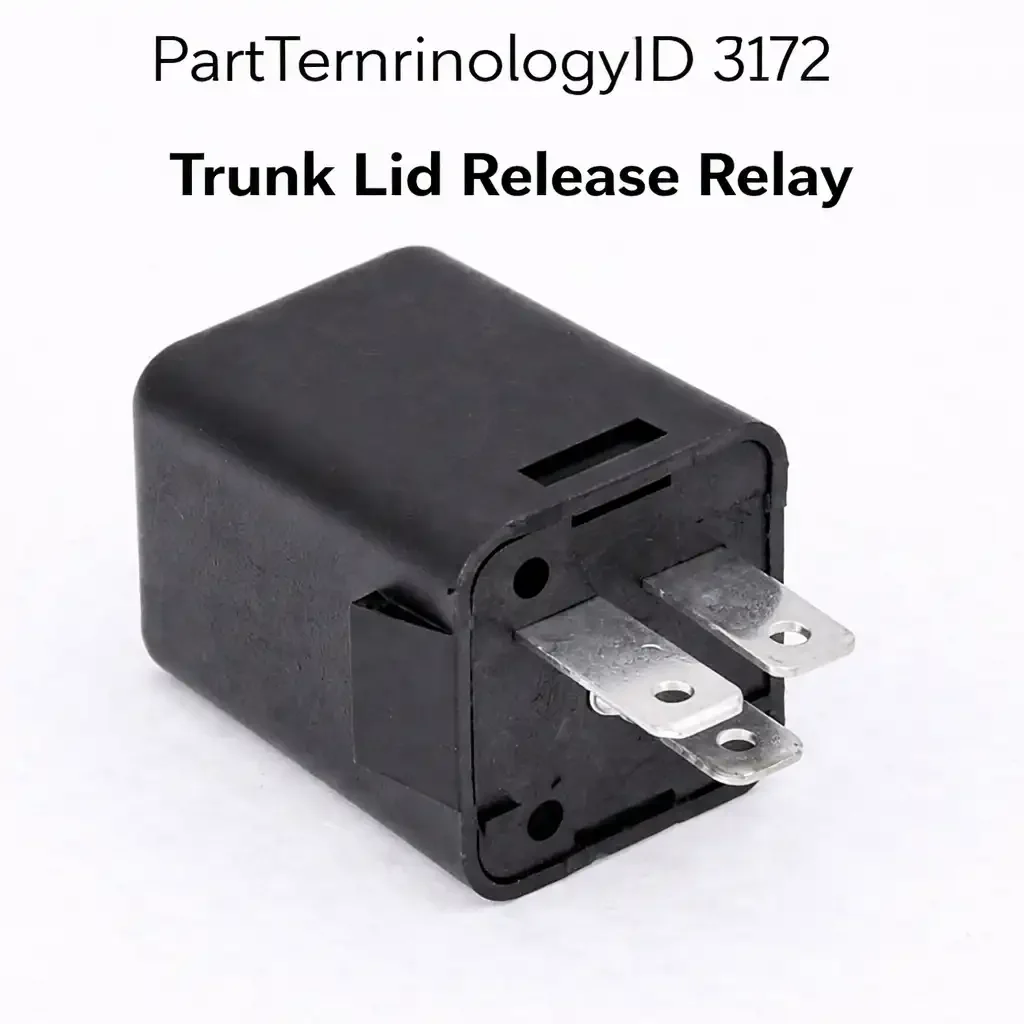
PartTerminologyID 3172, Trunk Lid Release Relay, is the relay that switches power to the trunk lid release solenoid or actuator motor, enabling the BCM, a dashboard release switch, a key fob remote release command, or a proximity sensor to activate the trunk lid latch release mechanism and open or pop the trunk lid. That definition covers the trunk release actuation switching function correctly and leaves unresolved whether the release mechanism is a solenoid that retracts a latch pin electrically, a motor that drives a cable-pull mechanism, or an electric striker release actuator, the relay's activation sources and the priority logic among multiple simultaneous activation paths, whether the relay is a normally-open contact that pulses briefly to release the latch or a relay that holds the actuator circuit closed for a longer dwell period, the BCM coil resistance tolerance requirement, and whether the relay is shared with the fuel door release circuit on vehicles where both releases share a common relay switched by separate BCM outputs.
For sellers, PartTerminologyID 3172 is the trunk release relay where the activation source priority logic is the most return-generating architectural attribute, because the BCM manages multiple trunk release inputs simultaneously and must give priority to the correct source under each operating condition. A key fob release command while the vehicle is moving at speed may be inhibited by a BCM speed lockout that prevents remote trunk release above a threshold vehicle speed. A dashboard release switch may be inhibited when the vehicle is in drive on automatic transmission vehicles. A proximity sensor release on kick-to-open or push-to-open systems may require a second confirmation signal from the sensor to prevent accidental release from a single sensor event. All of these conditions may produce no trunk release response that appears to be a relay fault when the relay is actually correctly non-activated by the BCM inhibit logic.
What the Trunk Lid Release Relay Does
Solenoid versus motor actuator and the dwell time requirement
Trunk lid release solenoids require a brief current pulse, typically 200 to 500 milliseconds, to retract the latch pin and release the lid. The relay must close, deliver the solenoid energization current, and open after the dwell interval. Some relay implementations use a timer circuit to ensure consistent dwell time regardless of how long the activation switch is held. Others rely on the BCM to command a timed output pulse of the correct duration. If the BCM output duration is too short, the solenoid does not fully retract the pin and the lid does not release. If it is too long, the solenoid overheats from sustained energization above the duty cycle it was designed for.
Motor-driven trunk releases use a geared motor to drive a cable or direct actuator through a fixed release travel. The motor relay must close for the complete motor travel duration, which may be 0.5 to 2 seconds depending on the mechanism design. A relay with a marginal contact that opens intermittently during the motor travel produces a partial release: the actuator moves partway through its travel range and stalls, leaving the latch partially released but the lid not popped. The driver may force the lid open from a partially released state, which can damage the latch mechanism. The listing must note the dwell time requirement and must confirm the replacement relay contact maintains closure for the full required dwell period.
BCM inhibit conditions and the non-activated relay misdiagnosis
The BCM inhibits trunk release relay activation under several operating conditions depending on the manufacturer's security and convenience architecture. Speed lockout prevents remote release above typically 8 to 15 km/h to prevent accidental trunk opening during vehicle movement. Gear position lockout prevents dashboard release switch activation when the transmission is not in park on some implementations. Anti-theft state lockout prevents trunk release when the alarm system is in the armed-and-triggered state. Child safety lockout on some platforms prevents rear compartment access releases from the interior when the child safety mode is activated.
A buyer who cannot open the trunk from the key fob at parking lot speed because the vehicle is crossing a speed bump may be above the speed lockout threshold. A buyer who cannot open the trunk from the dashboard switch because the transmission is in neutral rather than park may be triggering the gear position lockout. Both scenarios produce a no-release symptom that the buyer attributes to a relay fault when the relay is correctly inhibited. The listing must identify the BCM inhibit conditions applicable to the specific vehicle so buyers can rule out inhibit conditions before ordering a relay replacement.
Why This Part Generates Returns
Buyers return trunk lid release relays because the BCM inhibit condition is active and the relay correctly receives no activation signal, the trunk release solenoid has seized and draws excess current that welded the original relay contact and will weld the replacement if the solenoid is not replaced first, the key fob battery is discharged and the remote release command is not reaching the BCM, the relay is shared with the fuel door release and a fuel door release fault code is indicating the relay when the fuel door actuator is the actual failed component, and the relay is integrated into the BCM assembly with no separate replaceable relay socket on this vehicle.
Status in New Databases
PIES/PCdb: PartTerminologyID 3172, Trunk Lid Release Relay
PIES 8.0 / PCdb 2.0: No change.
Top Return Scenarios
Scenario 1: "BCM speed inhibit active, relay not activated, no release above threshold speed"
The buyer's trunk does not open from the key fob. The vehicle was moving slowly across a parking lot speed bump when the release was attempted. The vehicle speed exceeded the BCM's release inhibit threshold. The relay received no coil voltage. The buyer replaces the relay. The inhibit condition is still active at speed. No change in behavior.
Prevention language: "BCM inhibit conditions: Trunk release is inhibited by the BCM under the following conditions: [vehicle speed above X km/h / transmission not in park / alarm triggered / child safety mode active]. Verify none of these conditions are present before diagnosing a relay fault. A relay that receives no coil voltage during an inhibited condition is functioning correctly."
Scenario 2: "Seized solenoid, excess current welds relay contact, replacement welds immediately"
The trunk release solenoid has seized. When the relay closes, the solenoid draws locked-current. The relay contact welds in the closed position within seconds. The buyer returns the relay as defective. The solenoid must be replaced before any relay will survive the circuit.
Prevention language: "Solenoid fault check: Before installing the replacement relay, verify the trunk release solenoid resistance is within specification, typically 8 to 20 ohms. A solenoid with resistance below 2 ohms or measuring short to ground will draw excess current that welds the replacement relay contact immediately. Replace a faulty solenoid before installing a new relay."
Listing Requirements
PartTerminologyID: 3172
actuator type: solenoid or motor (mandatory)
activation sources and BCM inhibit conditions (mandatory)
dwell time requirement (mandatory)
contact current rating: solenoid inrush and holding (mandatory)
coil resistance within BCM driver tolerance (mandatory)
shared fuel door relay note where applicable (mandatory)
solenoid resistance pre-check note (mandatory)
OEM part number cross-reference (mandatory)
Catalog Checklist for ACES/PIES Teams
PartTerminologyID = 3172
require actuator type: solenoid versus motor (mandatory)
require BCM inhibit conditions listed explicitly (mandatory)
require solenoid resistance pre-check note (mandatory)
require dwell time specification (mandatory)
prevent BCM inhibit misdiagnosis: speed inhibit and alarm inhibit conditions prevent relay activation; a relay that is not activating during an inhibit condition is functioning correctly; inhibit conditions must be listed to redirect buyer diagnosis before hardware order
prevent solenoid fault relay destruction: seized solenoid welds relay contact at installation; solenoid resistance check is a mandatory pre-installation step
note shared fuel door relay applications where applicable: fuel door release and trunk release may share a single relay on some platforms
Scenario 3: "Fuel door release also stopped working, shared relay not identified"
The buyer's trunk does not release. After relay replacement the trunk restores. The fuel door also stops releasing within a week and the buyer orders another relay believing the replacement has failed. On this vehicle the trunk release relay and the fuel door release solenoid share the same relay contact. The replacement relay's contact has failed from the combined solenoid inrush of both actuators operating simultaneously. The listing did not note the shared fuel door load. The contact current rating was specified for trunk release only.
Prevention language: "Shared load note: On this application the trunk release relay also powers the fuel door release solenoid. The combined solenoid current draw is [X] amperes. The relay contact rating must accommodate both solenoids operating simultaneously. A relay rated for trunk release current only is undersized for the combined load on shared-relay applications."
Scenario 4: "Motor actuator application, solenoid relay delivered, actuator does not move"
The trunk uses an electric motor actuator rather than a solenoid. The listing covers trunk lid release relays without distinguishing actuator type. A solenoid-rated relay is delivered with a contact current rating sized for a solenoid's 3 to 8 ampere inrush. The motor actuator draws 8 to 15 amperes at startup. The relay activates but the contact voltage drop under motor inrush is sufficient to prevent full actuator travel. The trunk moves slowly and fails to latch or opens partially. The buyer returns the relay as defective.
Prevention language: "Actuator type: [solenoid / electric motor]. This relay is rated for the [type] actuator. Solenoid and motor actuator relays are not interchangeable. Motor actuator relays require higher contact current ratings than solenoid relays for the same trunk release application."
FAQ (Buyer Language)
Why does my trunk not open from the key fob but opens from the switch inside?
The key fob command passes through the BCM's remote release logic, which includes speed and alarm inhibit conditions. The interior switch may use a different activation path with fewer inhibit conditions. Confirm the vehicle is stationary and the alarm is not triggered before diagnosing a relay fault in the remote release circuit.
How do I check the trunk release solenoid before replacing the relay?
Measure resistance across the solenoid terminals. A reading of 8 to 20 ohms is normal. Below 2 ohms or a short to ground indicates a failed solenoid that will weld any relay contact it is connected to. Replace the solenoid before installing a new relay.
Why does my trunk open but not stay open after relay replacement?
The dwell time of the replacement relay may be shorter than the original. The dwell time is the duration the relay contact stays closed after the activation command. A solenoid that requires 200 milliseconds to fully retract the latch may receive only 100 milliseconds of activation from a replacement relay with a shorter dwell calibration. The latch begins to retract but does not fully clear the striker before the contact opens. Match the replacement relay's dwell specification to the original before installation.
Can the BCM itself cause the trunk release relay to stop working?
Yes. The BCM's output driver pin for the trunk release relay coil can fail open internally, producing no coil activation voltage at the relay socket regardless of key fob command. Confirming the presence of coil activation voltage at the relay socket before ordering a relay prevents a wasted relay replacement when the BCM driver is the actual fault source.
What Sellers Get Wrong About PartTerminologyID 3172
The most common error is omitting the BCM inhibit conditions from the listing. The trunk release relay does not activate when the BCM has inhibited release due to vehicle speed, alarm status, or child safety mode. A relay that receives no coil activation voltage during an inhibited condition is functioning correctly, and replacing it produces no change in behavior. Buyers who replace the relay during an inhibit condition return it as defective because they found no change after installation. The listing that names the inhibit conditions and directs the buyer to confirm the vehicle is in a release-enabled state before diagnosing a relay fault prevents this scenario entirely. It also educates the buyer that the relay is a correctly designed safety feature, not a design flaw causing intermittent release failures.
The second error is omitting the solenoid resistance check note. The locked-current scenario from a seized solenoid destroys the replacement relay within seconds of installation. It generates a return of a physically damaged relay whose contact is visibly welded. Without the resistance check note, the buyer has no way to know that the solenoid caused the relay failure rather than the relay being defective on arrival. Adding the resistance check note as an explicit pre-installation step converts this return scenario into a solenoid replacement order rather than a relay return.
Cross-Sell Logic
Trunk Release Solenoid: for buyers where the relay is confirmed delivering voltage to the solenoid terminals but the trunk does not release, indicating a failed solenoid plunger or seized latch mechanism
Body Control Module: for buyers where the relay coil receives no activation voltage from the BCM despite confirmed normal vehicle state, indicating a BCM output driver fault
Trunk Latch Assembly: for buyers where the solenoid and relay are both confirmed functional but the latch does not release, indicating a failed latch pawl or corroded latch mechanism
Fuel Door Release Relay: on shared-relay applications where both the trunk and fuel door share the same relay; when one fails both fail; both components should be confirmed before concluding only one circuit is affected
Why Catalog Data Quality Matters for PartTerminologyID 3172
Trunk lid release relay returns cluster around two scenarios that are both fully preventable with listing language: the BCM inhibit misdiagnosis and the seized solenoid relay destruction. The inhibit misdiagnosis generates returns because the buyer replaced a correctly functioning relay and found no change. The seized solenoid generates returns because the buyer found a physically destroyed relay contact and assumed the part was defective on arrival. Neither scenario reflects a product defect. Both reflect missing listing information. The BCM inhibit condition list takes fewer words to write than a product description paragraph. The solenoid resistance check note takes one sentence. Both are more effective return prevention investments per word than any other content in the listing.
Application Range and Fitment Guidance for PartTerminologyID 3172
Trunk lid release relay applications are concentrated in vehicles produced from approximately the mid-1980s when electronic trunk release became a common convenience feature through the present. The relay architecture evolved from simple key fob receiver relay applications in the late 1980s through BCM-integrated release logic with speed and security inhibit conditions common from the mid-1990s onward. Early applications used standalone receiver relays with no inhibit logic. Current applications use BCM-controlled relay activation with multiple conditional checks before release authorization.
The shared fuel door relay architecture is concentrated in vehicles from several European and Japanese manufacturers where packaging constraints led to combining the trunk and fuel door release circuits through a single relay with dual contact or dual coil design. Listings for these applications must identify the shared architecture and the combined solenoid load current. Vehicles that share the trunk and fuel door through a relay rated only for one solenoid at a time and then operate both simultaneously will fail the relay contact under the combined load.
Motor actuator versus solenoid actuator architectures are both common in the current vehicle population. Luxury and premium segment vehicles increasingly use electric motor actuators for soft-close and power-release functionality that solenoid actuators cannot provide. These applications require higher contact current ratings than traditional solenoid release applications. A fitment claim that applies a solenoid-rated relay to a motor actuator application will appear to fit the socket but will underperform under motor actuator startup current.
Final Take for PartTerminologyID 3172
Trunk Lid Release Relay (PartTerminologyID 3172) is the convenience access relay where BCM inhibit condition disclosure and solenoid pre-check are the two attributes that prevent the two most common return scenarios. Every listing without BCM inhibit condition guidance sends buyers through a relay replacement that changes nothing because the relay was correctly inhibited, not failed. Every listing without the solenoid resistance check note risks a relay returned with a welded contact from a seized solenoid that the buyer did not know to check. Actuator type, dwell time, and shared fuel door load complete the attributes that make every order under this PartTerminologyID correctly specified before installation. All five attributes require one sentence each in the listing. All five are absent in most aftermarket listings for this PartTerminologyID.
The BCM inhibit conditions list and the solenoid resistance check note together address the two scenarios that individually account for the majority of returns under this PartTerminologyID. Inhibit condition misdiagnosis generates the frustrated-buyer return where the relay was functional and nothing changed. Solenoid fault relay destruction generates the damaged-part return where the buyer assumes the relay was defective on arrival. Adding both notes to the listing converts both return scenarios into either correct orders or correct prior diagnoses that prevent the order entirely. Both conversions serve the buyer's actual need more effectively than processing the return.
Actuator type and dwell time complete the set of attributes that ensure every buyer under this PartTerminologyID receives a relay that matches their circuit's functional requirements before installation begins.
Together with BCM inhibit conditions and solenoid resistance pre-check, these five attributes make every listing under this PartTerminologyID complete.