
Written by Arthur Simitian | PartsAdvisory
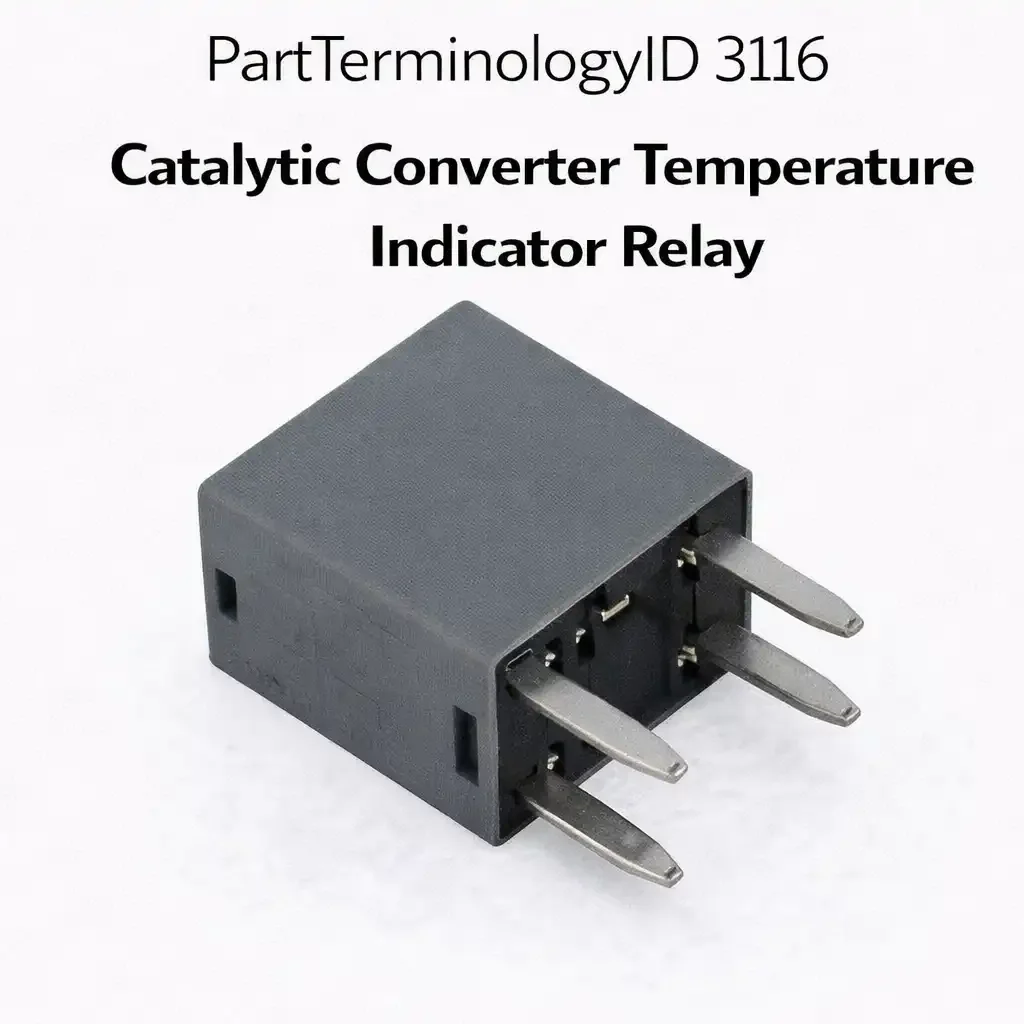
PartTerminologyID 3116, Catalytic Converter Temperature Indicator Relay, is the relay that controls the power supply to the catalytic converter overtemperature warning indicator circuit, activating a dashboard warning lamp when a temperature sensor on or near the catalytic converter reports a temperature above the threshold that indicates catalyst overheating from excessive unburned fuel entering the exhaust stream. That definition covers the catalyst overheat warning circuit switching function and leaves unresolved the sensor type and temperature threshold, the indicator lamp circuit configuration, and whether the relay is activated by the sensor directly or by a PCM output that processes the sensor signal.
For sellers, PartTerminologyID 3116 is a warning indicator relay associated primarily with vehicles from the 1970s through the early 1990s that used standalone temperature-sensing circuits separate from the PCM for catalyst protection. Modern vehicles integrate catalyst temperature monitoring into the PCM's sensor processing and generate a check engine light fault code rather than a separate catalyst overheat indicator. The listing must note the vintage application window and the specific sensor and threshold for the exact application.
Listing Requirements
PartTerminologyID: 3116
sensor type and temperature threshold (mandatory)
activation source: direct sensor or PCM output (mandatory)
application window note: primarily 1970s through early 1990s standalone indicator systems (mandatory)
inapplicability note for modern PCM-integrated catalyst monitoring (mandatory)
OEM part number cross-reference (mandatory)
FAQ (Buyer Language)
Does my modern vehicle use this relay?
No. Modern vehicles monitor catalyst temperature through the PCM and illuminate the check engine light for catalyst overtemperature faults. This relay applies to older vehicles with standalone catalyst temperature indicator circuits separate from the engine management system.
What the Catalytic Converter Temperature Indicator Relay Does
The catalytic converter temperature indicator relay activates a dashboard warning lamp when a thermistor or thermocouple sensor mounted on or near the catalytic converter reports a temperature above the threshold indicating catalyst overheating from excessive unburned fuel entering the exhaust stream. The relay is part of a standalone temperature-sensing circuit that operates independently of the PCM on older vehicles where the engine management system lacked the processing capability to integrate catalyst temperature monitoring into its fault code logic. When the sensor signal crosses the overheat threshold, it triggers the relay coil, which closes the contact and illuminates the catalyst overtemperature warning lamp in the instrument cluster.
On modern vehicles all catalyst monitoring is performed by the PCM through the rear oxygen sensor's output, which detects catalyst efficiency degradation before thermal overtemperature occurs, and stores a fault code that illuminates the check engine light rather than a dedicated catalyst lamp. The standalone catalyst temperature relay circuit described by PartTerminologyID 3116 was rendered obsolete by PCM-integrated OBD II catalyst monitoring on vehicles produced after approximately 1996. Any buyer with a post-1996 vehicle reporting a catalyst-related fault will have a check engine light and a stored fault code, not a dedicated catalyst overtemperature lamp, and requires PCM diagnostics rather than relay replacement.
Why This Part Generates Returns
Buyers return catalytic converter temperature indicator relays because the vehicle is a post-1996 OBD II application with PCM-integrated catalyst monitoring and no dedicated catalyst temperature relay circuit exists on the vehicle, and the sensor has failed and continues to report an overtemperature signal regardless of actual catalyst temperature causing the replacement relay to correctly illuminate the warning lamp immediately after installation.
Final Take for PartTerminologyID 3116
Catalytic Converter Temperature Indicator Relay (PartTerminologyID 3116) is a legacy application relay associated with vehicles from the 1970s through the early 1990s that used standalone catalyst temperature warning circuits before OBD II PCM-integrated monitoring became standard. The application window disclosure and inapplicability to post-1996 PCM-integrated systems are the mandatory first attributes in every listing. The sensor type, temperature threshold, and activation source follow as the secondary attributes that determine correct fitment within the covered application window. Without the application window disclosure, this listing consistently attracts orders from post-1996 vehicle buyers who need scan tool diagnosis and PCM fault code resolution rather than a physical relay replacement.
Listing Requirements
PartTerminologyID: 3116
sensor type: thermistor or thermocouple (mandatory)
temperature threshold specification (mandatory)
activation source: direct sensor or PCM output (mandatory)
application window: approximately 1970s through early 1990s standalone indicator systems (mandatory)
inapplicability note for post-1996 PCM-integrated catalyst monitoring (mandatory)
OEM part number cross-reference (mandatory)
My check engine light came on with a catalyst code. Is this the relay?
No. A check engine light with a catalyst code on an OBD II vehicle indicates a PCM-detected catalyst efficiency fault stored as a diagnostic trouble code. The PCM-integrated system on your vehicle has no separate catalyst temperature relay. The check engine light and DTC require scan tool diagnosis and resolution of the underlying catalyst or oxygen sensor fault.
How does the standalone catalyst temperature circuit work on older vehicles?
A thermistor or thermocouple sensor bolted to the catalyst housing changes its electrical output in proportion to catalyst temperature. When the sensor reports a temperature above the overheat threshold, typically caused by raw unburned fuel igniting inside the catalyst from a misfiring cylinder or a flooded engine, the sensor signal crosses the relay activation threshold, the relay closes, and the dashboard catalyst overtemperature lamp illuminates as a warning to the driver to reduce load or stop the vehicle before catalyst damage progresses. When the sensor reports a temperature above the overheat threshold, typically from unburned fuel igniting inside the catalyst, the sensor signal crosses the relay's activation threshold, the relay closes, and the dashboard catalyst overtemperature lamp illuminates. Clearing the condition and allowing the catalyst to cool returns the sensor signal below threshold and the relay de-energizes, extinguishing the lamp.