
Written by Arthur Simitian | PartsAdvisory
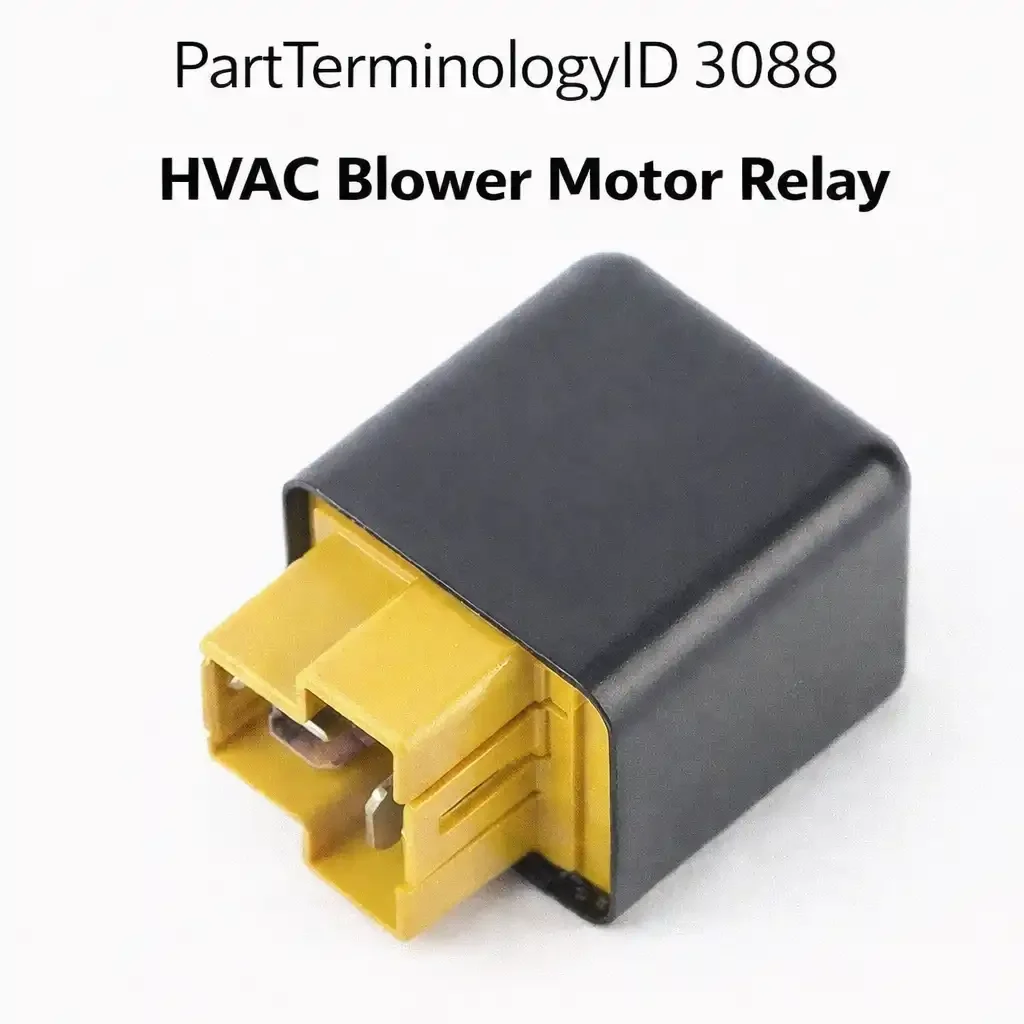
PartTerminologyID 3088, HVAC Blower Motor Relay, is the relay that provides the direct power switching function for the HVAC blower motor's drive circuit, enabling the blower motor controller, HVAC module, or manual blower switch to command motor operation by switching the motor's supply or ground circuit under the control signal. That definition covers the motor direct drive relay function correctly and leaves unresolved how this relay differs in circuit role from the HVAC Blower Relay (PartTerminologyID 3084) on vehicles that use both, whether the motor relay switches the motor supply side or the motor ground side on ground-switched blower motor architectures, the contact current rating for the full motor current at maximum speed, whether the relay is a high-side switch or a low-side switch in the motor control circuit, and whether the motor relay is a standalone ISO component or is integrated into the blower motor controller module that cannot be replaced separately.
For sellers, PartTerminologyID 3088 requires the same catalog discipline as PartTerminologyID 3084 regarding their distinction, but with an additional circuit role nuance: the blower motor relay may switch the motor's ground circuit rather than its supply circuit on ground-switched blower motor architectures. A buyer who installs a supply-side relay in a ground-switched application, or vice versa, will find the motor does not respond because the relay is switching the wrong side of the motor circuit. This is a rare but real return scenario on platforms that use ground-switched motor control, and the listing must identify the switched circuit side as a mandatory attribute to prevent it.
What the HVAC Blower Motor Relay Does
High-side versus low-side motor switching and the ground-switched architecture
Most HVAC blower motor relays switch the positive supply voltage to the motor, connecting the motor's positive terminal to battery voltage when the relay closes. This is high-side switching. The motor's ground circuit is a direct permanent connection to chassis ground that does not go through the relay. High-side switching is the conventional architecture and is compatible with standard normally-open relay contact configurations.
Some blower motor architectures use low-side switching, where the relay switches the motor's ground circuit. The motor's positive terminal has permanent battery voltage through a fuse, and the relay closes the ground path to complete the circuit and start the motor. Low-side switching is used on some architectures to protect the control circuit from motor back-EMF by keeping the high-voltage motor supply away from the control module. A standard normally-open relay works in both architectures as long as it is installed in the correct circuit position. A buyer who reverses the relay installation between the supply and ground sides has a permanently energized motor if the relay is now in the normally-closed side of the circuit, or no motor function if the relay interrupts the wrong circuit element. Circuit side identification is mandatory for ground-switched blower motor applications.
Blower motor controller integration and module-internal relay architecture
Electronic automatic climate control systems increasingly integrate the blower motor relay function inside the blower motor controller module rather than using a separate discrete relay. The controller module receives a speed command from the HVAC control head or BCM and uses an internal transistor or MOSFET to switch the motor's supply current at the commanded level. In these architectures there is no separate blower motor relay to replace. A buyer whose vehicle uses an integrated blower motor controller reporting a relay fault code in the HVAC system may need the complete controller module rather than a discrete relay. The listing must note the integrated controller architecture where it applies and must direct buyers to the controller module listing rather than a discrete relay listing for these vehicles.
Contact current rating and the full-speed maximum load
The blower motor relay must carry the motor's full maximum-speed current through its contact. Unlike a relay that switches a moderate steady load, the blower motor relay switches a motor that draws its maximum current at the highest speed setting selected most frequently during summer cooling operation. A relay rated for 20 amperes on a motor that draws 22 amperes at maximum speed will operate within the contact rating at lower speed settings but will exceed it during maximum speed use. The contact erosion accumulates preferentially during maximum speed operation, producing a relay that operates normally at medium speeds but cuts out intermittently at maximum speed as the contact resistance grows above the threshold that causes the motor supply voltage to drop below the motor's minimum operating voltage.
The intermittent maximum-speed cutout symptom is the degradation failure mode that most frequently causes buyers to replace the blower motor believing the motor has failed, when the actual cause is a relay contact that is failing under the maximum-speed load. A relay contact resistance measurement above 0.1 ohms with the relay closed and energized confirms excessive contact wear that justifies relay replacement before the motor is condemned.
Why This Part Generates Returns
Buyers return HVAC blower motor relays because the relay is integrated into the blower motor controller module and no separate relay exists on this vehicle, a supply-side relay is delivered for a ground-switched motor architecture producing a permanently inoperative motor, the relay is the correct type but the blower motor itself has failed and the relay replacement does not restore blower operation because the motor draws no current from a confirmed-good relay supply, the contact current rating is below the full-speed motor draw producing intermittent cutout at maximum speed that recurs after a short operation period with the new relay, and the relay coil resistance is outside the HVAC module's driver tolerance generating a module output fault that prevents relay activation from the control head.
Status in New Databases
PIES/PCdb: PartTerminologyID 3088, HVAC Blower Motor Relay
PIES 8.0 / PCdb 2.0: No change.
Top Return Scenarios
Scenario 1: "Integrated controller module, no separate relay on this vehicle"
The buyer orders a discrete blower motor relay. The vehicle uses an integrated blower motor controller module with no separate relay socket. The delivered relay cannot be installed. The controller module is the required replacement.
Prevention language: "Component architecture: [discrete relay in fuse center / integrated blower motor controller module]. On this vehicle the blower motor relay function is [architecture]. Verify the relay exists as a separate component before ordering. Integrated controller module vehicles require controller module replacement, not a discrete relay."
Scenario 2: "Intermittent maximum-speed cutout, contact rating below full-speed load"
The replacement relay operates normally at low and medium blower speeds. At maximum speed the blower cuts out after 3 to 5 minutes of operation. The relay contact temperature rises under the maximum-speed load until the thermal expansion of the contact surface increases resistance above the motor's operating threshold. The blower restores when the relay cools and the contact resistance drops back below threshold.
Prevention language: "Contact rating: [X amps]. Verify the motor's full-speed current draw does not exceed the contact rating. Intermittent maximum-speed cutout that self-restores after cooling indicates a relay contact that is marginally undersized for the full-speed load. Use a relay rated for at least 25 percent above the motor's measured maximum-speed current."
Scenario 3: "Motor failed, relay replacement does not restore blower"
The buyer confirms the relay is not activating. Relay replacement restores relay activation confirmed by test lamp. Blower still does not run. The motor has failed and draws no current from the confirmed-good relay supply. The motor requires replacement independent of the relay.
Prevention language: "Motor fault diagnosis: After relay replacement, if the relay closes but the blower does not run, measure current at the motor supply terminal. No current draw with the relay confirmed closed indicates a motor open circuit fault. Measure motor winding resistance to confirm motor failure before replacing additional components."
Listing Requirements
PartTerminologyID: 3088
circuit side switched: high-side supply or low-side ground (mandatory)
contact current rating: continuous at full-speed motor load (mandatory)
discrete relay versus integrated controller module (mandatory)
coil resistance within HVAC module driver tolerance (mandatory)
motor fault diagnosis note after relay replacement (mandatory)
differentiation from HVAC Blower Relay (PartTerminologyID 3084): circuit role distinction (mandatory)
OEM part number cross-reference (mandatory)
Catalog Checklist for ACES/PIES Teams
PartTerminologyID = 3088
require circuit side switched in listing (mandatory)
require contact current rating for full-speed motor load (mandatory)
require discrete versus integrated architecture verification (mandatory)
require motor fault diagnosis note (mandatory)
prevent PartTerminologyID 3084 versus 3088 conflation: on vehicles with both relays, circuit role distinguishes them; both listings must state their specific circuit role explicitly
prevent integrated controller module mis-listing: vehicles with integrated controllers have no discrete motor relay; the listing must exclude these applications or direct to the controller module
FAQ (Buyer Language)
What is the difference between the blower relay and the blower motor relay?
On vehicles with both, the blower relay enables the blower circuit supply and the blower motor relay drives the motor directly in a separate circuit role. Both must be functional for the blower to operate. Fault code or voltage test results identify which relay's circuit has failed.
Why does my blower cut out only at maximum speed?
The relay contact rating is likely below the motor's full-speed current draw. The contact overheats under the maximum-speed load, increasing resistance until the motor supply voltage drops below the operating threshold. Replace with a relay rated above the motor's measured full-speed current.
Does my vehicle have a separate blower motor relay?
Not always. Electronic climate control systems frequently integrate the relay function inside a blower motor controller module. Verify whether a separate relay socket exists in the fuse center before ordering a discrete relay.
My blower runs at all speeds except maximum speed. Could the relay be the cause?
A blower relay fault eliminates all blower operation rather than a single speed. Maximum-speed-only loss while other speeds function points to the blower resistor or blower speed controller module rather than the relay. A relay controls the entire circuit simultaneously. Individual speed selection is managed by the resistor network or controller module downstream of the relay.
How do I test the blower motor relay before ordering?
Remove the relay and check for battery voltage at the contact supply terminal with the ignition on. If supply voltage is absent, the fault is upstream of the relay in the fuse or wiring. If supply voltage is present, measure for coil activation voltage at the coil terminal when the blower is switched on. If coil voltage is present and the relay does not click, the relay coil has failed open. If coil voltage and contact supply voltage are both present but the blower does not run, jump the contact terminals momentarily. If the motor runs, the relay contact has failed.
Scenario 4: "High-side versus low-side architecture mismatch, relay installs but motor does not respond"
The replacement relay switches the high side of the motor circuit, providing positive supply. The original relay switched the low side, completing the motor ground path. On the low-side architecture the relay contact completes the motor's ground return, and the supply is always present at the motor's positive terminal. A high-side relay installed in a low-side position connects a supply where a ground was expected, which may not damage components but will not activate the motor correctly. The motor requires both the supply and ground to be correctly connected, and the relay type must match the circuit architecture.
Prevention language: "Circuit side: [high-side: relay provides positive supply to motor / low-side: relay provides ground return for motor]. This relay switches the [side]. High-side and low-side blower motor relays are architecturally distinct and must match the vehicle's specific blower circuit design."
Application Range and Fitment Guidance for PartTerminologyID 3088
HVAC blower motor relay applications are concentrated in vehicles with dual-relay blower architectures, where a supply relay and a motor drive relay serve the blower circuit in series. This architecture is more common on European platforms and on North American premium vehicles with sophisticated climate control systems than on base-trim domestic vehicles where a single relay handles the full blower circuit under PartTerminologyID 3084.
The integrated blower motor controller architecture has displaced discrete motor relay applications in a significant portion of modern vehicles. From approximately 2005 forward, many manufacturers transitioned from discrete relay-based blower speed control to integrated pulse-width-modulated controller modules. These modules contain the relay function internally as a solid-state switching element. Fitment data for PartTerminologyID 3088 must exclude vehicles with integrated controller architectures or explicitly note that those vehicles require controller module replacement rather than a discrete relay.
Contact current requirements for this PartTerminologyID reflect the full motor load rather than a partial circuit load because the motor drive relay carries the complete motor current directly. The maximum-speed motor current on a full-size truck or SUV may reach 25 to 35 amperes. The relay's contact must be rated for this sustained current plus an inrush margin at motor startup. Fitment data that does not specify contact current by vehicle application and relies on a single rating across a mixed-load range will underspecify the relay for the highest-load vehicles in the fitment range.
What Sellers Get Wrong About PartTerminologyID 3088
The most common error is listing a blower motor relay without verifying the relay exists as a discrete component on the vehicle. A significant portion of modern vehicles use integrated blower motor controller modules with no discrete relay socket. A buyer with an integrated-controller vehicle who orders under this PartTerminologyID receives a relay with no socket to install it into. The architecture verification is a mandatory pre-publication step, and the listing must either explicitly exclude integrated-controller vehicles from the fitment range or note that those vehicles require module replacement.
The second error is publishing a contact current rating that reflects the manufacturer's nameplate specification rather than the worst-case operating current on the specific vehicle. Nameplate ratings and real operating currents diverge on older vehicles with worn brushes, increased bearing friction, or degraded armature insulation. A replacement relay specified to match the OEM nameplate may have adequate margin for a new motor but insufficient margin for the aging motor it is replacing. Specifying a contact rating with a derating margin above the nameplate current provides a buffer for the real-world motor condition that the replacement relay will actually encounter.
The third error is omitting the motor fault diagnosis note after relay replacement. A relay that closes correctly but finds no motor response has solved the relay fault while exposing the motor fault that the relay failure was masking or accompanying. The buyer who replaces the relay and finds the blower still not running assumes the relay is defective and returns it. The motor fault note converts this return into a motor diagnosis step that identifies the motor as the second fault and redirects the buyer toward the correct repair.
Final Take for PartTerminologyID 3088
HVAC Blower Motor Relay (PartTerminologyID 3088) is the motor direct drive relay where high-side versus low-side circuit identification, discrete versus integrated controller architecture verification, and full-speed contact current rating are the three attributes that prevent the three most distinct return scenarios. The motor fault diagnosis note after relay replacement prevents a relay that is correctly restoring its circuit from being returned as defective when the blower's non-response is actually a motor failure. Architecture verification prevents the relay order on integrated-controller vehicles where no socket exists. Circuit side identification prevents the wrong-architecture relay from being installed in a circuit that expects the opposite switching logic. Contact current rating at full motor load prevents the degradation mode failure that generates airflow complaints before complete relay failure. All four attributes require verification before any fitment claim under this PartTerminologyID is accurate and actionable.