
Written by Arthur Simitian | PartsAdvisory
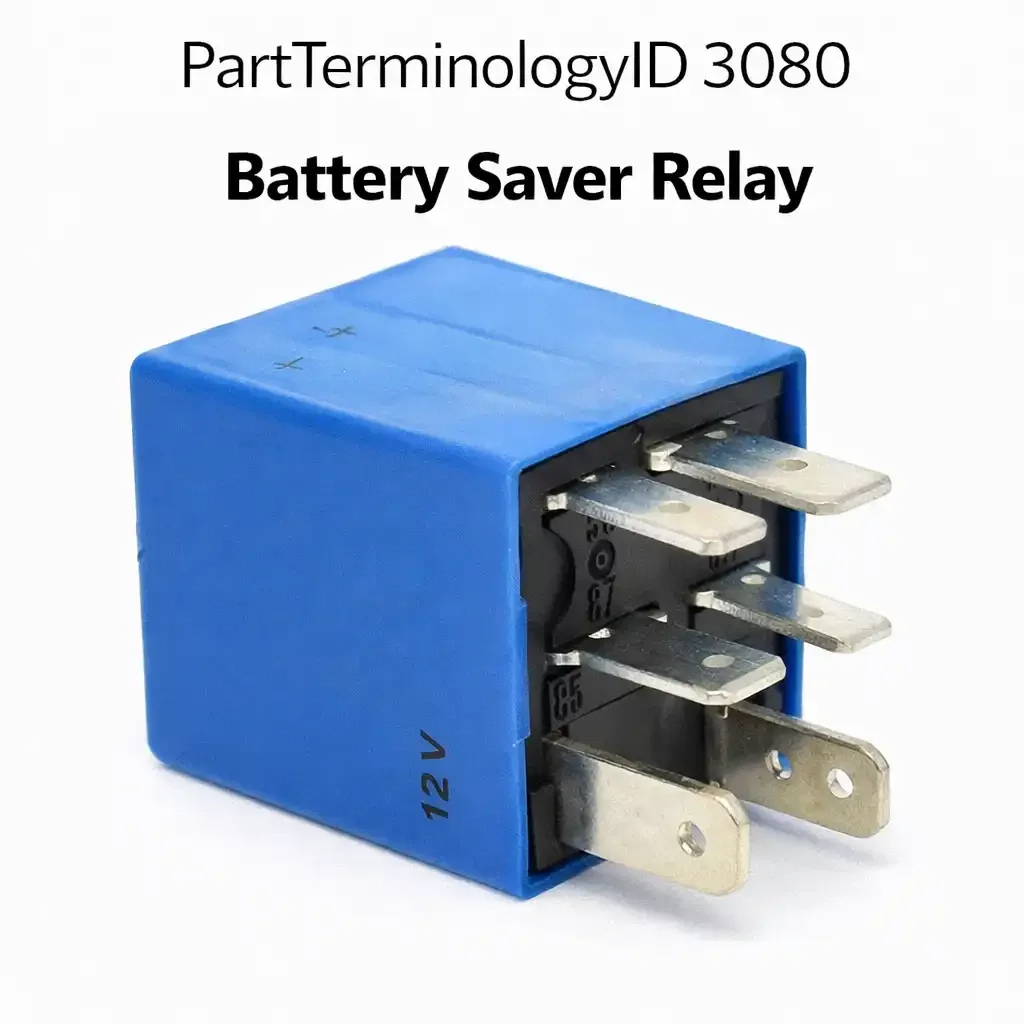
PartTerminologyID 3080, Battery Saver Relay, is the relay that automatically de-energizes one or more accessory circuits after a programmed timer interval when the ignition is off and the vehicle is parked, preventing parasitic battery drain from accessory loads that were left active when the driver exited the vehicle. That definition covers the automatic accessory load timeout function correctly and leaves unresolved the specific circuits the relay de-energizes at timeout, whether it covers interior lighting only, all accessory-position circuits simultaneously, individual circuit groups separately, or specific high-drain loads such as the rear defroster or ventilation blower, the timeout interval duration calibrated into the relay's timer circuit, whether the relay is a standalone timer-relay module containing the timing logic internally or a BCM-output relay whose timeout logic resides in the BCM's software, and the reset behavior that allows the timer to restart if a door is opened or a switch is operated during the timeout countdown.
For sellers, PartTerminologyID 3080 shares structural similarities with the Accessory Delay Relay (PartTerminologyID 2940) and must be differentiated clearly in every listing. The accessory delay relay holds circuits active after ignition removal for a short interval designed to allow occupant exit, typically 30 seconds to 10 minutes. The battery saver relay extends the protection window significantly longer, typically 10 minutes to several hours, and targets a different failure mode: not the brief window between key removal and door close but the extended drain from a dome light left on, a ventilation blower that was never turned off, or a rear defroster that continued running after the occupant exited. The distinction between these two relay types is not always obvious from the relay housing or mounting location, and the listing must state the timeout duration explicitly to allow buyers to confirm the relay covers the intended protection window for their application.
What the Battery Saver Relay Does
Circuit scope and the drain load targeting logic
The battery saver relay targets circuits whose parasitic drain is large enough to deplete the battery during an overnight parking event if left continuously active. Interior lighting circuits at 10 to 30 watts draw 0.8 to 2.5 amperes. A rear window defroster at 200 to 300 watts draws 16 to 25 amperes. A ventilation blower on medium speed at 100 to 150 watts draws 8 to 12 amperes. Any of these loads left active overnight on a moderate-capacity battery will prevent starting the next morning. The battery saver relay de-energizes these circuits after the programmed interval regardless of switch state, preventing the drain without requiring the driver to manually verify all switches are off before exiting.
The circuit scope of the battery saver relay determines which loads are protected and which are left to the driver's manual control. A relay that covers only the interior lighting circuit does not protect against a forgotten rear defroster. A relay that covers all accessory-position circuits simultaneously may conflict with intentional extended accessory use such as a remote start system that needs accessory circuits active without the key in the ignition. The listing must identify the specific circuits covered by the relay to allow buyers to verify that the timeout protection matches their specific drain risk.
Timeout duration and the battery capacity calculation
The timeout duration is calibrated to allow sufficient time for intended accessory use after engine shutoff while still protecting the battery before drain becomes critical. A 10-minute timeout is appropriate for vehicles where the only intended post-ignition accessory use is occupant exit with interior lights. A 30-minute timeout accommodates vehicles where the owner may listen to the radio briefly after parking. A 2-hour timeout on some European vehicles accommodates extended stationary use without engine running. The timeout duration must match the intended use pattern because a timeout that is too short interrupts legitimate accessory use and generates driver complaints that the battery saver relay is malfunctioning when it is actually functioning as calibrated for a different use pattern than the owner expects.
BCM-integrated versus standalone timer module architecture
On BCM-integrated battery saver implementations the timeout logic is a BCM software function that commands a standard ISO relay after the programmed interval. The BCM monitors door switch events and resets the timer if a door is opened during the countdown, extending the timeout from each door event to allow additional time for occupant activity. The ISO relay in this architecture is replaceable with any ISO-footprint relay of the correct coil resistance for the BCM driver output. The timeout duration is a BCM calibration parameter that cannot be changed by relay replacement. On standalone timer-relay module architectures the timeout duration is fixed by the RC timing network inside the module housing and cannot be adjusted without replacing the module with a different calibration value.
Why This Part Generates Returns
Buyers return battery saver relays because the timeout interval is 10 minutes in the replacement and the original had a 30-minute interval, causing the radio and accessories to shut off sooner than expected and generating owner complaints that the relay is faulty, the standalone timer module is delivered for a BCM-integrated application where only an ISO relay is needed and the standalone module has no corresponding activation circuit in the BCM wiring, the relay de-energizes the rear defroster and the owner believes the defroster has failed when it is the battery saver timeout function operating correctly, and the relay is not resetting its timer on door events because the door switch input wire is not connected to the replacement module producing a single timeout that cannot be extended by door activity.
Status in New Databases
PIES/PCdb: PartTerminologyID 3080, Battery Saver Relay
PIES 8.0 / PCdb 2.0: No change.
Top Return Scenarios
Scenario 1: "Wrong timeout duration, accessories cut off at 10 minutes instead of 30"
The replacement has a 10-minute timeout. The original had 30 minutes. The radio, rear defroster, and accessories all cut off after 10 minutes of parked operation. The owner believes the relay is faulty. The relay is functioning correctly at its calibrated interval.
Prevention language: "Timeout interval: [X minutes]. This relay de-energizes covered circuits after [X] minutes of ignition-off operation. Verify the original relay's timeout interval before ordering. A replacement with a shorter interval than the original cuts circuits off sooner than expected."
Scenario 2: "Door switch input not connected, timer does not reset on door events"
The door switch input wire is not connected to the replacement module during installation. The timer runs to completion once and the covered circuits cut off. Opening and closing doors does not restart the timer because the door switch reset input is absent.
Prevention language: "Door switch input: Required connection. The door switch input wire must be connected to the module's door input terminal for the timer to reset on door open and close events. Without this connection the timer runs once and covered circuits remain de-energized until the ignition is cycled."
Listing Requirements
PartTerminologyID: 3080
timeout interval duration (mandatory, in title)
circuits covered at timeout (mandatory)
relay architecture: standalone timer module or BCM-controlled ISO relay (mandatory)
door switch reset input requirement (mandatory for timer modules)
differentiation from Accessory Delay Relay (PartTerminologyID 2940): battery saver covers longer intervals targeting overnight drain; delay relay covers short exit intervals (mandatory)
OEM part number cross-reference (mandatory)
Catalog Checklist for ACES/PIES Teams
PartTerminologyID = 3080
require timeout interval in title and description (mandatory)
require circuits covered at timeout (mandatory)
require standalone module versus BCM-controlled architecture disclosure (mandatory)
require door switch input connection note for standalone timer modules (mandatory)
prevent confusion with PartTerminologyID 2940 Accessory Delay Relay: both cut circuits after ignition-off but serve different drain-protection windows; differentiation is mandatory in every listing
prevent timer-module listing on BCM-integrated vehicles: no standalone module socket exists; BCM programming is the timeout adjustment path, not hardware replacement
Scenario 3: "BCM-controlled vehicle, module replacement ordered, no module socket"
The buyer orders a battery saver relay module because accessories cut off unexpectedly. The vehicle uses a BCM-integrated battery saver function with no standalone timer module in the relay center. The BCM manages the timeout through software. No module socket exists. The delivered hardware cannot be installed. The BCM's timeout programming is the adjustment path on this vehicle.
Prevention language: "Architecture: [standalone timer module with dedicated socket / BCM-integrated timeout with no separate module]. On this vehicle the battery saver function is [architecture]. BCM-integrated vehicles adjust timeout through BCM programming, not hardware replacement."
Scenario 4: "Interval mismatch, accessory delay relay ordered instead of battery saver relay"
The buyer's radio cuts off 10 minutes after the ignition is removed while they are cleaning the vehicle interior. They order an Accessory Delay Relay (PartTerminologyID 2940) expecting to extend the radio timeout. The vehicle's radio is controlled by the battery saver relay with a 10-minute interval. The accessory delay relay serves a different circuit with a 2-minute exit window. Neither relay is faulted. The 10-minute interval is the battery saver relay's calibrated timeout, and the buyer needs a replacement calibrated to a longer interval, not the accessory delay relay.
Prevention language: "Interval differentiation: The Battery Saver Relay (3080) controls longer-interval drain protection typically 10 minutes to several hours. The Accessory Delay Relay (2940) controls short exit-window intervals typically under 10 minutes. Both may be present on the same vehicle. Identify which interval covers the circuit that cut off before ordering under either PartTerminologyID."
FAQ (Buyer Language)
What is the difference between the battery saver relay and the accessory delay relay?
The accessory delay relay holds circuits active for a short interval, typically under 10 minutes, to allow occupant exit after key removal. The battery saver relay protects against longer parasitic drain from forgotten loads, with timeouts typically from 10 minutes to several hours. Both may be present on the same vehicle serving different protection windows.
Can I change the timeout duration?
On standalone timer modules, no. The timeout is fixed by internal components. Replace the module with the correct interval calibration. On BCM-integrated systems, the timeout may be adjustable through BCM programming, but the relay hardware itself is not the timeout source.
Why do my accessories cut off while I am still in the car?
The door switch input is likely disconnected on the replacement module. Without the door switch reset signal, the timer runs once without resetting. Connect the door switch input wire to restore the timer-reset-on-door-activity behavior.
How do I confirm whether my vehicle uses a standalone battery saver module or a BCM-integrated timeout?
Check the underhood relay center diagram for a relay or module position labeled battery saver, interior timer, or accessory timeout. If no such position appears, the timeout function is integrated into the BCM. On BCM-integrated vehicles the timeout interval is a programmable parameter accessible through a scan tool with BCM access, not a hardware component that can be replaced to change the interval.
Which circuits does the battery saver relay typically cover?
The circuits covered vary by manufacturer. Common circuits include the radio, interior lighting, power windows, heated seats, rear defroster, and accessory power outlets. The battery saver relay does not typically cover circuits needed for vehicle security. The listing must identify the specific circuits covered on the application because buyers who find a circuit still active after timeout often assume the relay is defective rather than that the circuit is intentionally excluded.
What Sellers Get Wrong About PartTerminologyID 3080
The most common error is listing the battery saver relay without specifying the timeout interval. The interval is the primary functional attribute of this component. A battery saver relay with a 10-minute timeout and one with a 45-minute timeout are completely different parts from the buyer's perspective, even if they use the same contact and coil specifications. A listing that specifies only year, make, and model tells the buyer nothing about whether the replacement will restore the original behavior. Buyers who install a shorter interval replacement find the complaint unchanged. Buyers who install a longer interval replacement find the complaint resolved but with a higher overnight drain risk. The interval must be stated. Every listing without it will generate returns from buyers who installed the wrong interval without knowing it.
The second error is omitting the door switch reset input note for standalone timer module applications. This is an installation-specific note that prevents a functional relay from appearing defective. A correctly installed battery saver module with a connected door switch input resets its timer on every door activity and behaves exactly as the original. The same module with the door switch input disconnected runs its timer once and cuts circuits off without resetting. The symptom of circuits cutting off while the owner is actively using the vehicle, which is caused by the disconnected door switch input, is indistinguishable from a module calibration fault unless the buyer knows to check the door input connection. The note prevents this return with a single installation step reminder.
What happens if I install a battery saver module with a longer timeout than the original?
The vehicle's accessories will remain active for longer after the ignition is removed before cutting off. This is not harmful if the vehicle is used daily and the battery is charged by each drive cycle. On vehicles that sit for extended periods, a longer timeout increases overnight drain risk because the relay allows a larger total energy drain before cutting the circuits. Match the timeout to the original calibration to preserve the factory drain protection behavior.
Cross-Sell Logic
Battery: for buyers whose battery was discharged from a failed battery saver relay that allowed extended accessory drain; the battery should be load-tested after the drain event before the relay is replaced
Accessory Delay Relay (PartTerminologyID 2940): the delay relay covers the short exit window; both relays serve different intervals and may both be present on the same vehicle
Body Control Module (PartTerminologyID 2888): for BCM-integrated battery saver implementations where a BCM software fault altered the timeout calibration
Application Range and Fitment Guidance for PartTerminologyID 3080
Battery saver relay applications span vehicles from approximately the mid-1980s when BCM-integrated power management became common on domestic and European platforms through the present. The timeout interval, circuit scope, and architectural implementation vary substantially across this range. A domestic truck from 1998 may use a standalone timer module with a 10-minute timeout covering only the interior dome light circuit. A European sedan from 2008 may use a BCM-integrated battery saver function with a 30-minute timeout covering the radio, climate control, power windows, and seat heaters. A domestic luxury vehicle from 2015 may use multiple BCM-controlled battery saver circuits with separate timeout intervals for different circuit groups.
Fitment ranges for this PartTerminologyID must be published at the VIN-level or trim-level granularity because the same model year and model name may use entirely different battery saver architectures on base and premium trim lines. A base-trim vehicle in the range may use a simple timer relay covering only the dome light, while the premium trim in the same year uses a BCM-integrated multi-circuit timeout with programmable intervals. Publishing the fitment range without noting the architecture differences within the range generates orders from buyers with an architecture that the listed part does not serve. Every fitment claim under this PartTerminologyID should be accompanied by the architecture type applicable to the covered vehicles.
Final Take for PartTerminologyID 3080
Battery Saver Relay (PartTerminologyID 3080) is the parasitic drain protection relay where timeout interval duration, covered circuit identification, and door switch reset input connection are the three attributes that determine whether the relay protects the battery correctly, matches the owner's accessory use expectations, and resets its timer on occupant activity as designed. Differentiation from the Accessory Delay Relay (PartTerminologyID 2940) by timeout duration is mandatory context in every listing. A listing that covers both PartTerminologyIDs under the same product description without distinguishing their intervals and covered circuits will generate returns from buyers who install the wrong part for their symptom. The battery drain scenario that a battery saver relay is designed to prevent begins with a single forgotten accessory load: a radio left playing, a rear defroster left active, an accessory outlet load left connected. The relay interrupts this load before it drains the battery below the engine cranking threshold. A relay with the wrong timeout interval either cuts the load off before the owner returns, which is annoying but protective, or allows the load to run until the battery depletes, which is the exact failure the relay was installed to prevent. The timeout interval is not a convenience specification. It is the functional specification for this component, and it must be correct.
The application range guidance for this PartTerminologyID reinforces that timeout interval and architecture type are not refinements that can be inferred from model year or model name. They must be researched per vehicle per trim level and stated explicitly in every listing before any buyer can evaluate whether the replacement meets their specific battery protection and accessory use requirements. A catalog that specifies only year and model and leaves interval and architecture to the buyer's independent research has provided a vehicle-level fitment claim with no functional guidance about whether the replacement will behave as expected after installation.
Sellers who specify interval, architecture, and circuit scope in every battery saver relay listing reduce return exposure for this PartTerminologyID to near zero.
Every listing that omits any of these three attributes will generate returns from buyers who installed the wrong timeout, the wrong architecture, or the wrong circuit scope.