
Written by Arthur Simitian | PartsAdvisory
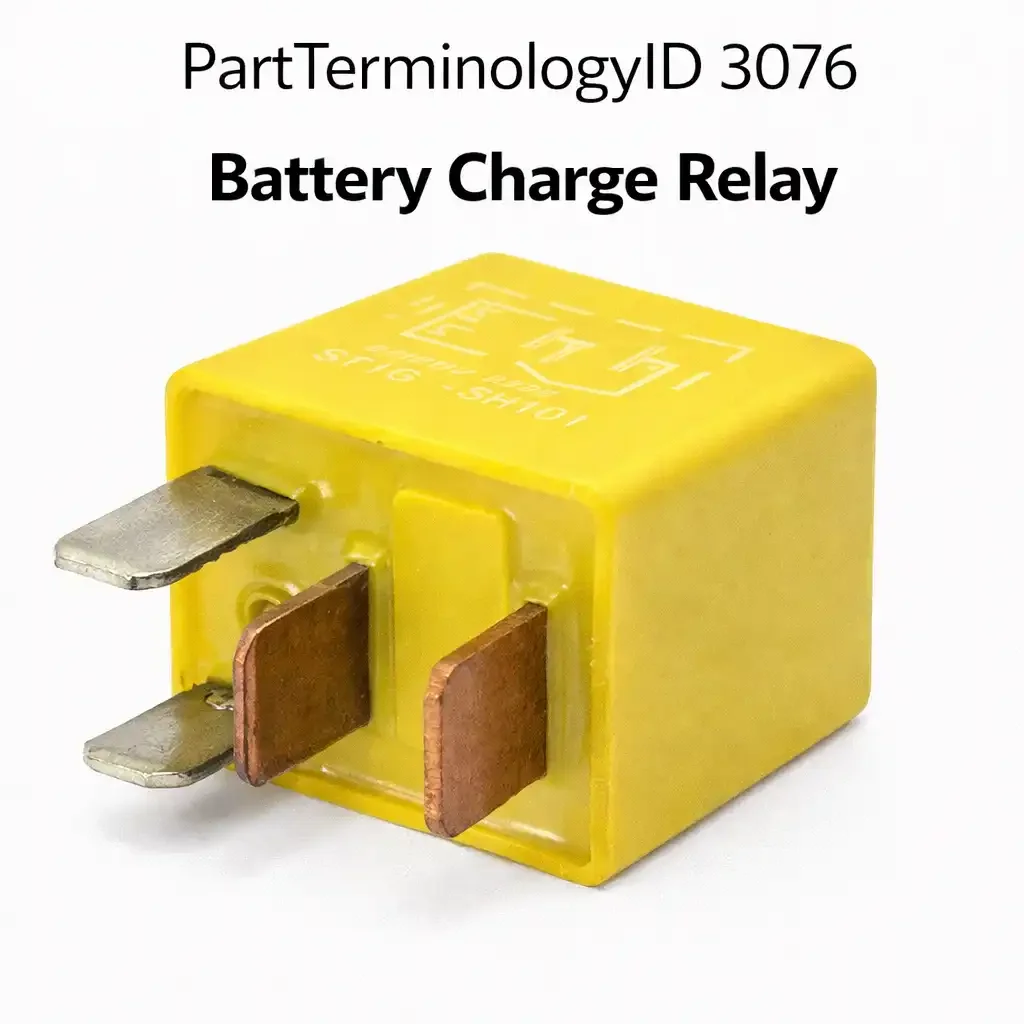
PartTerminologyID 3076, Battery Charge Relay, is the relay that connects the battery to the charging circuit, allowing alternator output current to flow to the battery for charging while providing the ability to disconnect the battery from the charge circuit when commanded by the battery management system, when a fault condition is detected in the charging circuit, or when the vehicle is placed in a transport or storage mode that requires charge circuit isolation. That definition covers the charge circuit connection and isolation function correctly and leaves unresolved the contact current rating for the full alternator charging current during bulk charge phase, whether the relay is a normally-closed contact that holds the battery connected in the de-energized state and opens only on a commanded isolation event, or a normally-open contact that must be commanded closed for charging to occur, and the relay's role in hybrid and electric vehicle high-voltage battery charge circuit isolation where the relay may be a high-voltage contactor rather than a conventional 12-volt relay.
For sellers, PartTerminologyID 3076 is the battery charging relay PartTerminologyID where the normally-open versus normally-closed contact configuration produces the most critical safety distinction. A normally-closed battery charge relay maintains the charging circuit connection without coil energization, defaulting to the connected state if the relay control circuit fails. A normally-open relay requires active coil energization to maintain the connection, defaulting to the isolated state if the control circuit fails. On a 12-volt conventional vehicle this distinction affects only charging behavior during a relay control fault. On a high-voltage hybrid battery pack, a normally-open main contactor that defaults open on control circuit failure is a deliberate safety design that isolates the high-voltage battery from the vehicle's circuits in the event of a control system fault or collision, preventing electrical contact with live high-voltage conductors during post-crash handling.
What the Battery Charge Relay Does
The battery charge relay connects the battery to the charging circuit, allowing alternator output current to flow to the battery for replenishment during engine operation. On conventional 12-volt vehicles the relay closes when the alternator begins producing voltage above the battery's resting voltage, completing the charging circuit. The relay opens when the engine stops or when the battery management system commands isolation during a charging fault or transport mode. The relay contact must carry the full charging current from the alternator to the battery, which on vehicles with high-output alternators and large battery capacity may reach 80 to 120 amperes during bulk charging immediately after a deeply discharged battery is reconnected to the system.
On hybrid vehicles with high-voltage battery packs the battery charge relay becomes the main contactor that connects the HV battery to the vehicle's high-voltage bus. These contactors operate at 200 to 400 volts DC and must be rated for the high-voltage arc energy at the moment of contact opening. A standard 12-volt ISO relay is not suitable for any high-voltage contactor application. The high-voltage safety note is mandatory in every listing that covers a hybrid battery contactor application to prevent a buyer from installing a 12-volt relay in a circuit that operates at hundreds of volts.
Normally-closed versus normally-open contact logic in charging applications
Battery charge relay applications vary between normally-open and normally-closed contact architectures depending on the fail-safe design intent of the charging circuit. A normally-open relay defaults to disconnected when the coil is de-energized, isolating the battery from the charging circuit if the control signal fails. This architecture protects against overcharging if the charging circuit control fails in the active state. A normally-closed relay defaults to connected when de-energized, ensuring the battery remains connected to the charging circuit even if the control signal fails. This architecture protects against charging interruption if the control signal has an intermittent fault. The fail-safe design intent determines which contact configuration is correct for the specific application, and installing the wrong configuration produces opposite behavior on a control circuit fault compared to what the system designer intended.
Why This Part Generates Returns
Buyers return battery charge relays because a 12-volt relay is delivered for a hybrid high-voltage contactor application, the normally-open and normally-closed contact configurations are confused and the replacement relay defaults to the wrong state on control circuit failure, the contact current rating is below the alternator's maximum output current and the relay contact overheats during bulk charging of a deeply discharged battery, and the relay is part of the battery management system module assembly and cannot be replaced as a discrete external component on this vehicle.
Status in New Databases
PIES/PCdb: PartTerminologyID 3076, Battery Charge Relay
PIES 8.0 / PCdb 2.0: No change.
Top Return Scenarios
Scenario 1: "Normally-open delivered for normally-closed application, relay defaults open on control fault"
The buyer's vehicle uses a normally-closed battery charge relay that defaults to the connected state if the control circuit fails, ensuring the battery continues charging even if the battery management system control output has an open circuit fault. A normally-open replacement defaults to isolated on the same control fault, leaving the battery unable to charge from the alternator whenever the control circuit has any intermittent fault. The listing must identify the contact configuration explicitly as the first specification.
Prevention language: "Contact configuration: [normally open / normally closed]. This relay defaults to the [state] position when the coil is de-energized. Verify the vehicle's required default state before ordering. Normally-open and normally-closed relays produce opposite behavior on a control circuit fault and are not interchangeable."
Scenario 2: "High-voltage hybrid contactor, 12V relay delivered, arc flash risk"
The vehicle is a hybrid with a 300-volt DC battery pack. The buyer searches for a battery charge relay. A standard 12-volt ISO relay is delivered. The buyer attempts installation. The contact gap on the ISO relay is not rated for the arc energy at 300 volts. At the moment of first contact opening under load the arc sustains across the contact gap and damages the relay internally within the first switching cycle.
Prevention language: "Voltage system: [12V DC conventional / High-voltage HV contactor]. This relay is rated for [voltage system]. HV hybrid battery contactors operate at 200 to 400 volts DC and require purpose-rated HV contactors. A standard 12-volt ISO relay must never be used in any HV battery circuit."
Listing Requirements
PartTerminologyID: 3076
contact configuration: normally open or normally closed (mandatory)
contact current rating: full alternator charging current (mandatory)
voltage system: 12-volt DC or high-voltage HV battery contactor (mandatory)
high-voltage safety note for HV contactor applications (mandatory)
OEM part number cross-reference (mandatory)
FAQ (Buyer Language)
Why is the battery charge relay normally closed on some vehicles?
A normally-closed relay maintains the charging connection without power, ensuring the battery charges even if the relay control circuit fails. On conventional 12-volt vehicles this is the preferred default because charging should continue unless actively commanded to stop. On high-voltage hybrid packs, normally-open contactors are used for the opposite reason: safety requires the pack to default to isolated if the control system loses power.
Cross-Sell Logic
Battery Management System Module: for vehicles where the charge relay fault code implicates the BMS module's control output driver rather than the relay contact itself
Alternator: for vehicles where the battery charge relay is confirmed operational but the battery is not receiving charging current because the alternator output has failed
Top Return Scenarios
Scenario 1: "Battery not charging, relay replaced, still not charging, alternator failed"
The buyer sees a low battery warning and replaces the battery charge relay. The battery continues to discharge. Testing confirms the relay is functional and the contact closes correctly. The alternator output voltage is below 13 volts at the alternator output terminal with the engine running. The alternator has failed and is not producing charging voltage. The relay was not the fault. The relay replacement had no effect because the charging fault is in the alternator, not the relay.
Prevention language: "Before replacing the battery charge relay, measure alternator output voltage at the alternator terminal with the engine running at 2,000 RPM. Below 13 volts indicates alternator failure. The relay is not the fault and replacement will not restore charging until the alternator is replaced."
Scenario 2: "12V relay ordered for hybrid HV battery contactor position"
The buyer searches for a battery charge relay for a hybrid vehicle. A standard 12-volt ISO relay is delivered. The hybrid battery contactor position requires a purpose-rated high-voltage contactor for the 300-volt DC battery circuit. The 12-volt relay contact gap is not rated for the arc energy at 300 volts. The buyer attempts installation and the relay arcs internally on first contact opening under the high-voltage circuit load.
Prevention language: "This relay covers [voltage system]. Hybrid vehicle high-voltage battery contactors operate at 200 to 400 volts DC and require purpose-rated HV contactors. Verify the circuit voltage before ordering. A standard 12-volt ISO relay must never be installed in any high-voltage battery circuit."
Cross-Sell Logic
Alternator: for buyers where the battery charge relay is confirmed functional but the battery is not receiving charge current because the alternator has failed
Battery Management System Module: for buyers where the relay coil receives no activation signal indicating a BMS output fault
Battery: for buyers where the battery has an internal fault that prevents it from accepting charge current even when the relay and alternator are both functional
Charge Light Relay (PartTerminologyID 3120): for buyers whose battery charge relay is confirmed failed open and whose charge warning lamp has also never illuminated during the fault period, indicating a concurrent charge lamp relay failure that concealed the charging fault from the driver
Catalog Checklist for ACES/PIES Teams
PartTerminologyID = 3076
require contact configuration: normally open or normally closed (mandatory)
require voltage system: 12V DC conventional or high-voltage HV contactor (mandatory)
require contact current rating at alternator maximum output (mandatory)
require high-voltage safety note for hybrid battery contactor applications (mandatory)
prevent 12V relay delivery for hybrid HV contactor applications: arc flash risk at HV circuit voltages
prevent relay order before alternator output voltage measurement: measuring below 13 volts at the alternator output terminal with the engine running at 2000 RPM confirms alternator failure as the charging fault rather than a relay fault; the relay is correctly connecting the battery to an alternator that is not producing adequate output voltage
differentiate from Auxiliary Battery Relay PartTerminologyID 3056: battery charge relay connects primary battery to charging circuit; auxiliary battery relay manages secondary battery isolation
Final Take for PartTerminologyID 3076
Battery Charge Relay (PartTerminologyID 3076) is the charging circuit relay where normally-open versus normally-closed contact configuration has direct safety implications for high-voltage applications and direct charging reliability implications for conventional applications. Both must be stated before any other relay specification. A normally-open relay that fails open in a conventional charging system leaves the alternator disconnected from the battery, draining the battery during operation without illuminating the charge warning lamp if the charge lamp relay is also failed. A normally-closed relay that fails open in a system where the relay's closed position connects the charging circuit defaults to a de-energized open state that disconnects the charging path when the relay coil loses its activation signal. On hybrid and electric vehicle auxiliary battery charging circuits, installing the wrong contact configuration can route current through a path that bypasses isolation protection, creating a shock hazard. Normally-open versus normally-closed must be confirmed as a primary matching attribute against the OEM part number before any installation under this PartTerminologyID.