
Written by Arthur Simitian | PartsAdvisory
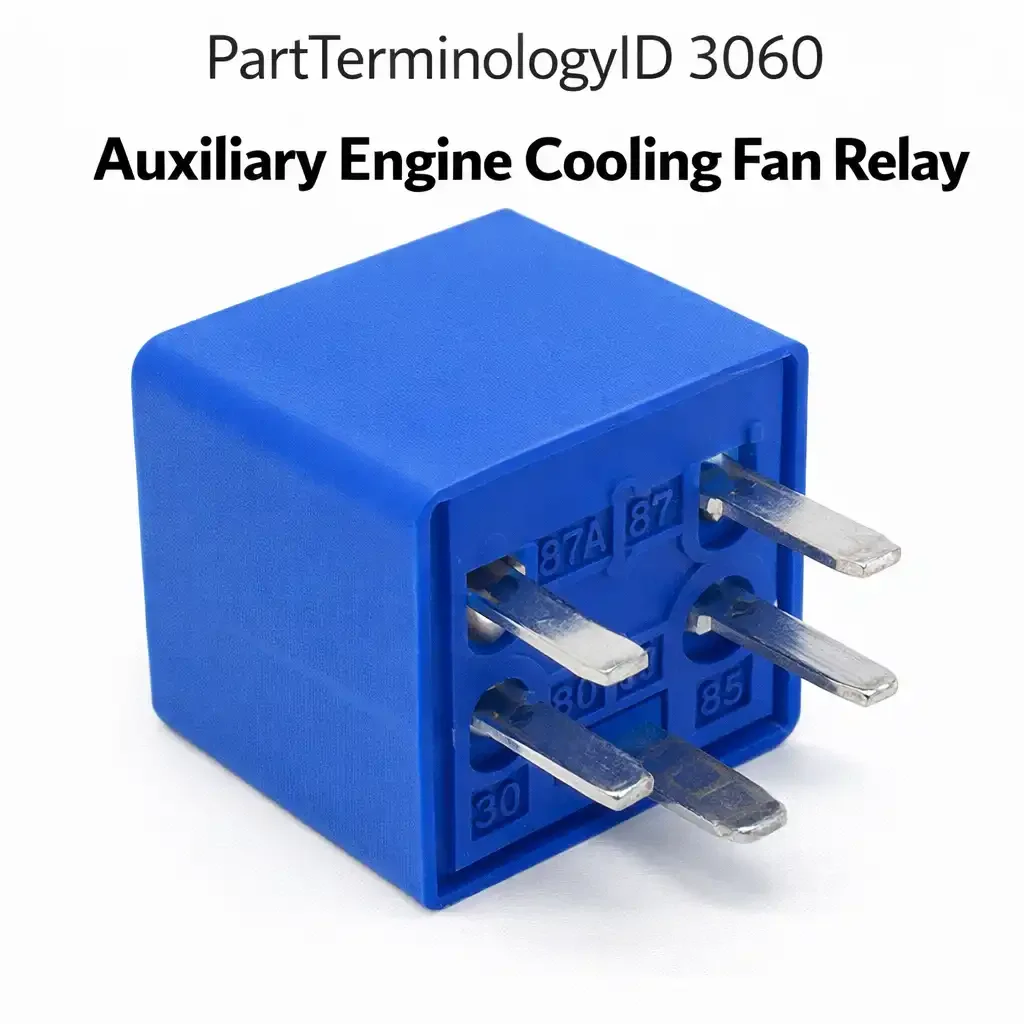
PartTerminologyID 3060, Auxiliary Engine Cooling Fan Relay, is the relay that switches power to an additional electric cooling fan that supplements the primary engine cooling fan when additional airflow is required through the radiator and condenser, typically activated when the A/C compressor is engaged, when coolant temperature exceeds a secondary threshold above the primary fan activation point, or when vehicle speed drops below a minimum threshold that reduces ram air flow through the grille. That definition covers the supplemental cooling fan power switching function correctly and leaves unresolved whether the relay activates the auxiliary fan at full speed, at a reduced speed through a resistor in the fan circuit, or as one stage of a multi-speed fan control architecture, the relay's contact current rating relative to the fan motor's locked-rotor current if the fan seizes while energized, whether the relay is a standard ISO relay in the engine compartment fuse center or is part of a fan control module that manages multiple fans and multiple speeds through integrated relay logic, and the activation sources which may be multiple simultaneous triggers including A/C pressure, coolant temperature, and vehicle speed.
For sellers, PartTerminologyID 3060 is the cooling system relay PartTerminologyID where the multi-speed fan architecture distinction is the most return-generating specification gap. Vehicles with two-speed cooling fans use separate relays for the low-speed and high-speed fan circuits. The low-speed relay routes current through a series resistor to reduce fan voltage and speed. The high-speed relay bypasses the resistor for full-voltage full-speed operation. A buyer who replaces only the high-speed relay when the low-speed relay is also failed will find the fan operates at full speed only, with no low-speed operation for normal A/C or moderate coolant temperature conditions. A buyer who replaces only the low-speed relay when the high-speed relay is failed will find the fan operates at reduced speed only, without the full-speed cooling capacity needed during maximum heat load conditions.
What the Auxiliary Engine Cooling Fan Relay Does
Multi-trigger activation and the relay's activation source complexity
The auxiliary cooling fan relay may have multiple independent activation sources that any one of which is sufficient to command relay closure. The A/C compressor engagement signal activates the auxiliary fan to ensure condenser airflow when the compressor is running, regardless of coolant temperature. The coolant temperature switch activates the auxiliary fan when coolant temperature exceeds a secondary setpoint above the primary fan's activation threshold, providing additional cooling capacity for heavy loads or hot ambient conditions. On some vehicles a vehicle speed input de-activates the auxiliary fan above a speed threshold where ram air provides sufficient natural airflow through the grille without powered fan assistance, saving alternator load and reducing noise.
A relay that fails open disables auxiliary fan operation from all activation sources simultaneously. A buyer who reports the auxiliary fan does not run with A/C engaged may have a failed relay, a failed A/C pressure switch that is not sending the A/C engagement signal to the relay coil, or a failed relay activation circuit from the PCM or BCM. Testing the relay coil activation voltage from each source before condemning the relay prevents replacing the relay when the activation signal is the actual fault. The listing must include the multi-source activation diagnosis note as a practical pointer before the buyer commits to a relay replacement order.
Fan motor seizure and the locked-rotor current risk
An auxiliary cooling fan motor that seizes while the relay is energized draws locked-rotor current continuously until the relay contact fails or the circuit fuse blows. Locked-rotor current for a typical 200-watt auxiliary cooling fan motor is 15 to 25 amperes, two to four times the motor's normal running current of 8 to 12 amperes. A relay whose contact is already marginally degraded from accumulated arc erosion may fail under locked-rotor current in minutes, producing a burned contact that leaves the relay welded closed and the motor circuit continuously energized even after the motor is replaced. The listing must note the fan motor seizure risk and must recommend inspecting the motor for seizure before energizing the circuit with the replacement relay.
Why This Part Generates Returns
Buyers return auxiliary engine cooling fan relays because the low-speed relay is delivered for a high-speed circuit application leaving the fan operating at reduced speed only, the fan motor is seized and the locked-rotor current welds the replacement relay contact closed within minutes of installation, the relay is integrated into a fan control module and no separate relay exists on this vehicle architecture, the A/C pressure switch rather than the relay is the actual fault source and the relay replacement does not restore A/C-triggered fan activation, and the multi-speed architecture requires replacing both the low-speed and high-speed relays as a set but only one was ordered.
Why Catalog Data Quality Matters for PartTerminologyID 3060
The engine cooling fan relay failure consequence that most frequently reaches the catalog without adequate disclosure is the overheating event that results from a failed low-speed relay during extended idling in traffic. The engine may cool correctly at highway speeds because ram air through the radiator supplements the non-running fan. The buyer who tests their vehicle after relay installation may take a short highway drive, observe normal temperature behavior, and consider the repair complete. The overheating event occurs two days later in stop-and-go traffic when the cooling load requires the low-speed fan stage that is still non-functional. The pre-delivery note about confirming both speed stages operational after replacement prevents this delayed failure discovery.
Status in New Databases
PIES/PCdb: PartTerminologyID 3060, Auxiliary Engine Cooling Fan Relay
PIES 8.0 / PCdb 2.0: No change.
Top Return Scenarios
Scenario 1: "Wrong speed stage, fan runs at one speed only after replacement"
The high-speed relay is delivered for a two-speed system where the low-speed relay is the faulted component. The fan runs at full speed whenever activated but has no low-speed operation. Coolant temperature rises gradually because the fan overshoots the normal moderate-load cooling point without a low-speed stage.
Prevention language: "Fan speed stage: [low-speed / high-speed / single-speed]. This relay covers the [stage]. Two-speed cooling fan systems use separate relays for low and high speed. Identify which speed stage is faulted before ordering. Replacing the wrong stage leaves the other stage non-functional."
Scenario 2: "Seized motor, locked-rotor current welds replacement relay contact"
The buyer replaces the relay because the fan is not running. The motor is seized from bearing failure. At relay closure the motor draws 20 amperes of locked-rotor current. The relay contact welds closed within two minutes. The buyer returns the relay as defective. The motor must be replaced before the replacement relay is installed.
Prevention language: "Fan motor check: Before installing the replacement relay, manually spin the fan blade to confirm the motor rotates freely. A seized motor draws locked-rotor current that will weld the replacement relay contact closed immediately. Replace a seized motor before installing a new relay."
Scenario 3: "Relay integrated in fan control module, no separate relay socket"
The buyer orders the auxiliary cooling fan relay. On this vehicle the relay function is integrated into a fan control module mounted near the radiator. No separate relay socket exists in the underhood relay center for the cooling fan circuit. The module contains both the relay function and the fan speed control electronics in a single housing. A discrete relay cannot be installed. The buyer must replace the fan control module as a complete assembly.
Prevention language: "Component architecture: [discrete relay in underhood relay center / integrated in fan control module]. On this application the relay function is [architecture]. Verify whether a separate relay socket exists before ordering. Fan control module applications require module replacement rather than relay replacement."
Scenario 4: "A/C pressure switch fault, relay correctly not activating, fan not running on A/C demand"
The buyer reports the auxiliary fan does not run when A/C is on. The relay is replaced. The fan still does not run on A/C demand. The A/C pressure switch that signals the ECM to activate the fan when refrigerant pressure is within range has failed and is not outputting an activation signal to the ECM. The ECM correctly does not command the relay to close because it has no signal that the A/C system is operating. The relay is functional. The pressure switch is the fault source.
Prevention language: "A/C fan activation diagnosis: Confirm the A/C pressure switch or A/C request signal is present at the relay activation circuit before replacing the relay. The relay activates only when the ECM receives an A/C demand signal from the pressure switch. A fan that does not run on A/C demand may have a failed pressure switch rather than a failed relay."
PartTerminologyID: 3060
fan speed stage: low, high, or single-speed (mandatory, in title)
contact current rating: running and locked-rotor (mandatory)
activation sources: A/C pressure, coolant temperature, vehicle speed (mandatory)
standalone ISO relay versus fan control module integrated (mandatory)
pair replacement recommendation for two-speed systems (mandatory)
fan motor seizure inspection note (mandatory)
OEM part number cross-reference (mandatory)
Listing Requirements
PartTerminologyID: 3060
fan speed stage: low-speed, high-speed, or single-speed (mandatory, in title)
contact current rating: continuous and motor inrush (mandatory)
activation source: ECM, A/C pressure switch, or combined (mandatory)
discrete relay versus fan control module integrated (mandatory)
combined condenser and engine cooling fan note where applicable (mandatory)
fan motor seizure inspection note (mandatory)
pair replacement note for two-speed systems (mandatory)
OEM part number cross-reference (mandatory)
Catalog Checklist for ACES/PIES Teams
PartTerminologyID = 3060
require fan speed stage in title (mandatory)
require contact current rating including inrush (mandatory)
require discrete versus module-integrated architecture (mandatory)
require combined condenser-engine cooling fan architecture note where applicable (mandatory)
require fan motor seizure pre-installation inspection note (mandatory)
prevent wrong speed stage: low-speed relay in high-speed socket eliminates high-speed cooling; speed stage must be identified from fault symptom before ordering
prevent locked-rotor relay destruction: seized motor welds relay contact at installation; motor must be confirmed free-spinning before relay is installed
differentiate from A/C Condenser Fan Motor Relay (PartTerminologyID 3200): on vehicles where condenser fan and engine cooling fan are the same motor, both PartTerminologyIDs reference the same relay; architecture note prevents duplicate or conflicting orders
FAQ (Buyer Language)
Why does my auxiliary fan only run at full speed after relay replacement?
The low-speed relay is still failed. Two-speed fans use separate relays. Full-speed operation from the high-speed relay is correct but the low-speed stage is absent until the low-speed relay is also replaced.
How do I check if my fan motor is seized before installing the relay?
Manually spin the fan blade with the ignition off. It should rotate freely with minimal resistance. Significant resistance or complete inability to rotate indicates bearing seizure. Replace the motor before installing the relay.
Why does my A/C cut out at idle after the fan relay was replaced?
The replacement relay may have a higher coil resistance than the A/C pressure switch or BCM output driver can activate reliably. If the A/C system uses condenser fan operation as an enabling condition for A/C clutch engagement, the fan must activate before the clutch closes. A relay that does not activate cleanly from the pressure switch output will prevent the fan from running, which prevents the A/C from engaging. Verify the relay coil resistance is within the activation circuit's drive capability.
My auxiliary fan runs continuously after relay replacement. What went wrong?
Either a normally-closed relay was installed where the original was normally-open, or the relay contact welded closed during installation on a seized motor. If the motor was seized when the relay was installed, locked-rotor current may have welded the contact immediately. Remove the relay and verify the contact opens when the coil is de-energized. If the contact remains closed with no coil voltage, the relay contact is welded and the relay must be replaced again after the motor is replaced.
Cross-Sell Logic
Auxiliary Cooling Fan Motor: for buyers where the relay is confirmed delivering voltage to the motor but the fan does not spin, indicating a failed motor bearing, open winding, or seized rotor
A/C Condenser Fan Motor Relay (PartTerminologyID 3200): for vehicles where the auxiliary cooling fan and A/C condenser fan are the same physical fan, to ensure the correct PartTerminologyID is used for the combined-function relay application
Engine Coolant Temperature Sensor: for buyers where the relay receives no activation signal from the ECM at high coolant temperature, which may indicate a failed coolant temperature sensor outputting a falsely low temperature reading
Fan Control Module: for vehicles where the relay function is integrated into a fan control module and no separate discrete relay exists at the fuse center
What Sellers Get Wrong About PartTerminologyID 3060
The most common error under PartTerminologyID 3060 is listing a cooling fan relay without identifying the fan speed stage. Two-speed cooling fan systems use two physically separate relays in two separate relay center sockets. The symptoms of a failed low-speed relay and a failed high-speed relay are different: a failed low-speed relay produces an overheating complaint at low speeds and idle because the fan does not activate at the light thermal load stage where low-speed cooling is sufficient, but the engine may cool normally at highway speeds where ram air supplements the non-running fan. A failed high-speed relay produces normal cooling under moderate loads but an overheating complaint during heavy loads or sustained towing where maximum fan speed is required. A listing that covers both speed stages without identifying which stage generates returns from buyers who receive the wrong speed relay after ordering based on vehicle fitment alone.
The second most common error is omitting the fan motor seizure inspection note. This note is not a standard safety precaution that can be inferred from context. It is a specific diagnostic step that prevents a specific consequence: locked-rotor current from a seized motor welding the relay contact closed immediately after installation, destroying the replacement relay within minutes of the first activation. Buyers who do not inspect the motor before installing the relay will return the replacement relay as defective without understanding that the motor caused the relay failure. The inspection note must appear in the listing as an explicit pre-installation instruction, not as a product FAQ answer that requires the buyer to seek it out after ordering.
The third error is failing to note the combined condenser-engine cooling fan architecture on vehicles where the A/C condenser fan and auxiliary engine cooling fan are the same physical motor. On these vehicles, PartTerminologyID 3060 and PartTerminologyID 3200 reference the same relay from two different system perspectives. A buyer who receives guidance from two separate relay listings with different contact current ratings and different activation source specifications for what is actually the same relay will be confused about which specification to match. The combined architecture note in both listings eliminates this confusion.
Final Take for PartTerminologyID 3060
Auxiliary Engine Cooling Fan Relay (PartTerminologyID 3060) is the cooling system relay where fan speed stage identification, fan motor seizure inspection, and pair replacement recommendation for two-speed systems are the three attributes that prevent the three most costly and most common return scenarios. A low-speed relay installed in a high-speed socket and a high-speed relay installed in a low-speed socket both produce fan operation that appears superficially correct on a bench test but fails to cool the engine or condenser under the specific thermal load condition that requires the absent speed stage. The motor seizure inspection is the single step that prevents a locked-rotor current event from destroying the replacement relay contact within minutes of installation. And the combined-function architecture note prevents buyers on vehicles where the condenser fan and engine cooling fan are the same physical motor from ordering under the wrong PartTerminologyID and receiving conflicting guidance about contact current rating and activation source. All three attributes require the vehicle's specific fan architecture to be confirmed before any fitment claim under this PartTerminologyID is actionable.
The pair replacement recommendation for two-speed systems deserves a specific note in the listing rather than a general suggestion. When one cooling fan relay fails, the other relay in the pair has been operating under the same thermal and electrical stress conditions for the same service interval. Its failure rate at this point is substantially elevated compared to a new relay. Many shops replace both relays simultaneously when the first one fails because the labor to access the relay center is the same whether one or two relays are replaced, and the cost of the second relay is small relative to a return service call when the second relay fails shortly after. The listing should state the pair replacement recommendation explicitly and note the available PartTerminologyID for the complementary speed stage relay to make the add-on order simple for the buyer.
The pair replacement note for two-speed systems converts a single-relay order into a two-relay order on every vehicle where both relays are the same service age. The buyer who replaces the failed low-speed relay alone and returns in three months for the high-speed relay has made two transactions where one would have served. The listing that recommends pair replacement and links to the complementary speed-stage relay listing serves the buyer's total repair need and the seller's total transaction value simultaneously.
Speed stage identification in the title is the single listing attribute with the highest return-prevention yield per word for this PartTerminologyID, and it costs one line.