
Written by Arthur Simitian | PartsAdvisory
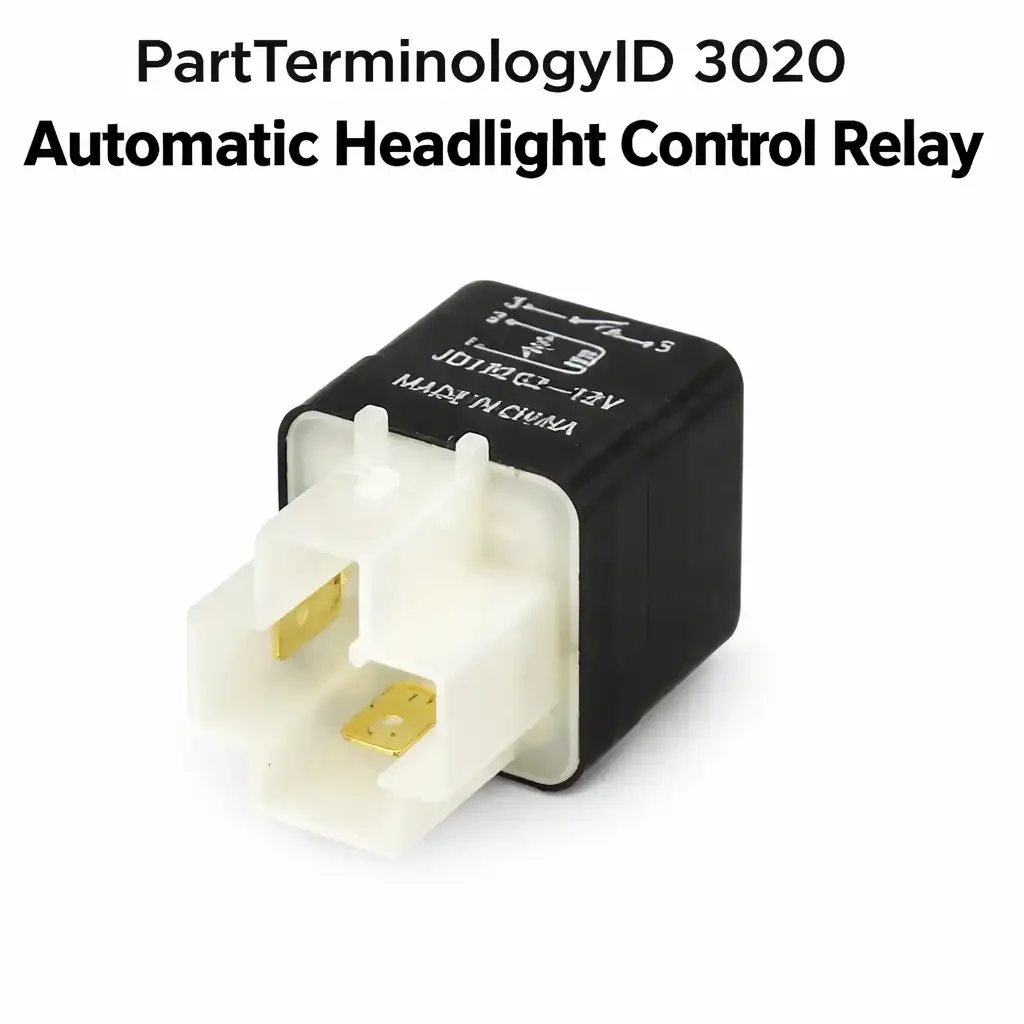
PartTerminologyID 3020, Automatic Headlight Control Relay, is the relay that switches the headlamp circuit on and off based on commands from the automatic headlamp control module or BCM, which uses an ambient light sensor to detect ambient illumination levels below a programmed threshold and automatically activates the headlamps without driver manual switch input and deactivates them when ambient light returns above the threshold. That definition covers the auto-headlamp switching function correctly and leaves unresolved whether the relay switches the low-beam headlamp circuit, the entire headlamp system circuit, or a signal circuit that commands the headlamp module to activate, whether the relay is a standalone unit in the fuse center or is integrated into the headlamp control module assembly, whether the vehicle uses a single relay for both low beam and DRL control or separate relays for each function, and whether a failed relay produces headlamps that are permanently off in auto mode, permanently on in all conditions, or intermittently cycling.
For sellers, PartTerminologyID 3020 is the headlamp control relay PartTerminologyID where the failure direction, open versus closed relay contact failure, produces opposite safety consequences that are equally urgent. A relay that fails open leaves the headlamps off in auto mode during darkness, creating an unilluminated vehicle invisible to oncoming traffic. A relay that fails closed leaves the headlamps on continuously regardless of ambient light, draining the battery when the vehicle is parked with the ignition off if the relay bypasses the ignition switch in its failed state. Both failure modes require prompt repair and both are distinguishable from each other and from a sensor fault based on the symptom pattern the driver reports.
What the Automatic Headlight Control Relay Does
Ambient light sensor integration and the threshold logic
The automatic headlamp system uses a photodiode or photoconductive sensor mounted at the top of the windshield or on the instrument panel facing upward through the glass to measure ambient illumination. The auto headlamp control module or BCM compares the sensor output to a programmed activation threshold, typically corresponding to late dusk or overcast daytime conditions, and commands the relay to close when illumination falls below the threshold and to open when it rises above it. The system introduces a hysteresis delay, typically 5 to 30 seconds depending on manufacturer design, to prevent rapid relay cycling during transitional lighting conditions such as passing under a bridge or entering a tunnel briefly.
A sensor failure produces a consistent fault in one direction: a shorted sensor output that reads permanently dark causes permanent headlamp activation; an open sensor output that reads permanently bright causes permanent headlamp deactivation in auto mode. A relay failure produces the same symptom in one direction regardless of sensor output, because the relay contact state is independent of the sensor measurement once the relay has failed. Distinguishing sensor failure from relay failure requires testing whether the relay contact responds to manual activation commands from the control module, which can be performed with a scan tool on BCM-integrated auto headlamp systems or by measuring voltage at the relay contact with the sensor covered to simulate darkness on standalone module systems.
Integration with DRL and the relay circuit overlap
On vehicles where the automatic headlamp relay controls the low-beam circuit that is also used for daytime running lights, a failed auto headlamp relay may affect both the auto headlamp activation and the DRL function simultaneously, because both share the low-beam circuit. A relay failure that eliminates low-beam operation in auto mode also eliminates DRL if DRL is implemented as reduced-voltage low-beam operation through the same circuit. The listing must note whether the auto headlamp relay circuit overlaps with the DRL circuit on the specific application, because a buyer reporting loss of both auto headlamps and DRL simultaneously may have a single relay failure rather than two separate component failures.
BCM programming and the sensitivity adjustment
On BCM-integrated auto headlamp systems, the activation threshold sensitivity is a BCM parameter that can be adjusted through scan tool programming. A relay replacement that is followed by a complaint that the headlamps activate too early or too late may reflect a BCM sensitivity setting that was changed by a previous programming event rather than a relay specification mismatch. The listing should note the BCM sensitivity parameter as a post-replacement adjustment option for buyers who find the replacement relay's apparent activation timing different from the original, because the timing is a BCM software parameter and not a relay hardware characteristic.
Why This Part Generates Returns
Buyers return automatic headlight control relays because the relay failed closed and the headlamps remain on continuously, the buyer replaces the relay and the headlamps still stay on because the ambient light sensor has failed short and commands the relay closed permanently, the relay is integrated into the headlamp control module and cannot be replaced separately, the replacement relay's coil resistance is outside the BCM output driver tolerance producing a BCM output fault rather than correct relay activation, and the DRL function is eliminated alongside auto headlamp function because both share the low-beam circuit through the same relay.
Why Catalog Data Quality Matters for PartTerminologyID 3020
The automatic headlamp system is a safety system that activates headlamps in conditions where the driver may not notice the need to switch them on manually, such as entering a tunnel during overcast daylight or driving at dusk on a tree-lined road where ambient light fades gradually rather than dropping suddenly. A failed-open relay in this system removes an automatic safety function without any warning indicator. The driver who parks the vehicle in late afternoon, returns after sunset, and finds no headlamps activating in auto mode has received no prior indication that the relay has failed. The listing's sensor diagnosis note is not merely a return-prevention tool. It is also the instruction that prevents a driver from parking a vehicle with a failed relay and returning to it after dark with no headlamp function.
Status in New Databases
PIES/PCdb: PartTerminologyID 3020, Automatic Headlight Control Relay
PIES 8.0 / PCdb 2.0: No change.
Top Return Scenarios
Scenario 1: "Sensor failed short, headlamps stay on after relay replacement"
The relay is replaced because headlamps are permanently on in auto mode. After replacement headlamps remain permanently on. The ambient light sensor is shorted and outputs a permanently dark signal regardless of actual illumination. The relay correctly responds to the sensor's permanent darkness command by remaining closed.
Prevention language: "Diagnosis note: Permanently on headlamps in auto mode may be caused by a failed ambient light sensor commanding permanent darkness rather than a stuck relay contact. Cover the sensor and verify the relay opens when the sensor input is blocked before replacing the relay. If the relay opens with the sensor covered, the sensor has failed, not the relay."
Scenario 2: "Relay integrated in headlamp module, no separate relay socket"
The buyer orders the auto headlamp relay. The vehicle's relay function is integrated into the headlamp control module housing. No separate relay socket exists. The module must be replaced as a complete unit.
Prevention language: "Component architecture: [separate relay in fuse center / integrated in headlamp control module]. On this vehicle the relay function is [architecture]. Verify whether a separate relay exists before ordering."
Scenario 3: "Coil resistance out of BCM tolerance, BCM stores relay circuit fault after new relay installed"
The buyer installs the replacement relay. The headlamps do not activate in auto mode. The BCM stores a relay circuit fault code. The BCM's internal relay monitoring circuit measures the coil current and compares it against a programmed window. A replacement relay with coil resistance outside this window draws more or less current than the BCM expects, and the BCM generates a relay circuit fault rather than activating the coil driver output. The symptom is indistinguishable from a relay failure at the symptom level. Only coil resistance measurement of the replacement relay confirms that the relay specification does not match the BCM's driver tolerance for this circuit.
Prevention language: "Coil resistance: [X] ohms. The BCM's relay driver output monitors coil current draw. A replacement relay with coil resistance outside the BCM's programmed monitoring window will generate a relay circuit fault code. Verify the replacement relay's coil resistance matches the OEM specification before installation."
Scenario 4: "DRL eliminated alongside auto headlamps, buyer orders separate DRL relay unnecessarily"
The buyer reports loss of both auto headlamps and daytime running lights after the auto headlamp relay fails. The buyer orders both an auto headlamp relay and a separate DRL relay, believing two components have failed simultaneously. On this vehicle DRL uses reduced-voltage low-beam operation through the same relay circuit as the auto headlamp function. Replacing the auto headlamp relay restores both functions. The separately ordered DRL relay is unnecessary and is returned.
Prevention language: "DRL circuit overlap: On this application, the DRL function uses the low-beam circuit controlled by this relay. Loss of auto headlamp function and DRL simultaneously is expected when this relay fails and does not indicate a separate DRL fault. Replacing this relay restores both functions."
Listing Requirements
PartTerminologyID: 3020
circuit switched: low-beam only, full headlamp system, or signal relay (mandatory)
separate relay versus module-integrated (mandatory)
DRL circuit overlap note (mandatory where applicable)
failure direction consequences: open versus closed failure modes (mandatory)
sensor diagnosis note: confirm sensor before relay replacement (mandatory)
BCM coil resistance tolerance (mandatory for BCM-controlled)
BCM sensitivity parameter note (mandatory)
OEM part number cross-reference (mandatory)
Catalog Checklist for ACES/PIES Teams
PartTerminologyID = 3020
require circuit identification: low-beam supply, full headlamp, or activation signal relay (mandatory)
require separate relay versus module-integrated architecture disclosure (mandatory)
require DRL circuit overlap note where low-beam circuit serves both auto headlamp and DRL (mandatory)
require ambient light sensor diagnosis note before relay replacement (mandatory)
require BCM coil driver tolerance specification for BCM-controlled applications (mandatory)
prevent relay listing on module-integrated applications: no separate relay socket exists; buyer receives component with nowhere to install it
prevent sensor misdiagnosis: permanently on or permanently off headlamps may reflect sensor failure rather than relay failure; sensor cover test must be noted as pre-order diagnostic step
prevent DRL misdiagnosis: loss of both auto headlamps and DRL simultaneously is expected from a single relay failure on circuits where DRL uses the same low-beam relay; note prevents unnecessary second component order
FAQ (Buyer Language)
Why are my headlamps always on even in daylight in auto mode?
Either the relay contact is welded closed or the ambient light sensor is outputting a permanently dark signal. Cover the sensor with tape. If the headlamps turn off, the sensor has failed. If they remain on, the relay contact is welded and the relay requires replacement.
Why are my headlamps never activating in auto mode at night?
Either the relay contact has failed open or the ambient light sensor is outputting a permanently bright signal. Check the relay contact with a test lamp at the relay socket with the sensor covered to simulate darkness. If the relay activates with the sensor covered but not in ambient darkness, the sensor has failed.
Does the auto headlamp relay also control DRL?
On vehicles where DRL uses the low-beam circuit, yes. A failed auto headlamp relay may eliminate both auto headlamp and DRL function simultaneously. Confirm whether both functions share the relay circuit before ordering.
Is it safe to drive without the automatic headlamp relay?
If the relay has failed open, the vehicle's headlamps will not activate automatically in low-light or nighttime conditions. The driver must remember to activate the headlamps manually in every low-light condition. On vehicles where the automatic headlamp system is the only headlamp activation circuit, a failed relay means no headlamps at all until the relay is replaced. The vehicle should not be operated at night or in poor visibility conditions with a confirmed failed-open auto headlamp relay.
What is the delay between ambient darkness detection and headlamp activation?
Most systems use a programmable time delay between the ambient light sensor detecting darkness and the BCM commanding the relay to close, typically 1 to 3 seconds. This delay prevents nuisance activation from briefly shadowed conditions such as passing under a bridge. If the headlamps activate immediately without delay or with excessive delay, the issue may be in the BCM's delay programming rather than the relay itself.
Cross-Sell Logic
Ambient Light Sensor: for buyers where the headlamps remain permanently on or permanently off after relay replacement, indicating the sensor is outputting a fixed signal regardless of actual light level
Body Control Module: for buyers where the relay coil receives no activation signal from the BCM in confirmed darkness, indicating a BCM output driver fault rather than a relay fault
Headlight Switch: for vehicles where the automatic headlamp function is integrated into the headlamp switch assembly and the relay is not a separately replaceable component
What Sellers Get Wrong About PartTerminologyID 3020
The most common catalog error under PartTerminologyID 3020 is publishing the listing without specifying whether the relay is a discrete component or is integrated into the headlamp control module. This omission generates returns from every buyer whose vehicle has the module-integrated architecture, which is increasingly common on vehicles produced after 2005. A listing that covers a model year range spanning both discrete and module-integrated architectures must identify which architecture applies to each year range within the coverage, because the two architectures require entirely different replacement approaches: a relay for the discrete architecture, and a headlamp control module for the integrated architecture.
The second most common error is omitting the ambient light sensor diagnosis note. The sensor-failed-short and relay-failed-closed symptoms are identical to the driver and produce the same complaint: headlamps permanently on in auto mode. Without the sensor diagnosis step in the listing, the buyer will order and install the relay before testing the sensor. When the headlamps remain on after relay replacement, the buyer returns the relay as defective. The sensor cover test takes 30 seconds and identifies whether the relay or the sensor is the fault source. Including this single diagnostic step in the listing eliminates the most common return scenario for this PartTerminologyID.
The third error is not noting the DRL circuit overlap. A buyer who reports simultaneous loss of auto headlamps and daytime running lights may believe two systems have failed at the same time. Without the DRL circuit overlap disclosure, the buyer orders both an auto headlamp relay and attempts to diagnose a DRL fault in parallel. The single relay replacement resolves both symptoms simultaneously, but without the disclosure the buyer cannot know this until after the relay is installed.
Final Take for PartTerminologyID 3020
Automatic Headlight Control Relay (PartTerminologyID 3020) is the headlamp control relay where both failure directions are safety-consequential, where the ambient light sensor must be diagnosed before the relay is condemned, and where DRL circuit overlap may produce a dual-function loss from a single relay failure. Circuit identification, sensor diagnosis note, and DRL overlap disclosure are the three attributes that prevent the three most distinct return scenarios in this PartTerminologyID. A failed-open relay that leaves the vehicle without headlamps at night is a safety hazard that requires immediate resolution. A failed-closed relay that leaves the headlamps permanently on is a battery drain risk on vehicles where the auto headlamp system does not integrate with the ignition-off timer. The relay is the correct first replacement candidate only after the ambient light sensor has been confirmed functional by the cover test described in the diagnostic section. Installing a new relay on a vehicle whose sensor is commanding permanent darkness will not restore correct automatic headlamp behavior. The sensor and the relay are both required to be functional for the system to operate correctly, and the listing must direct the buyer to test the sensor before ordering the relay.
The module-integrated architecture disclosure is equally critical. A listing that covers a model year range without confirming whether the relay is discrete or integrated will generate returns from buyers with module-integrated vehicles in every order cycle. The module-integrated architecture has no relay socket in the fuse center. There is no relay to remove and replace. The headlamp control module contains the relay function as an internal switching element. These buyers need a module, not a relay. A single sentence in the listing that states the architecture type and notes that module-integrated applications require module replacement eliminates this return category entirely. The sentence takes two minutes to research and write. Each return it prevents saves both the buyer and the seller the full transaction cost of an unnecessary order.
The sensor diagnosis note and the module-integrated architecture disclosure together cover the two return scenarios that individually account for the majority of returns under PartTerminologyID 3020. A buyer with a sensor-failed-short vehicle who receives a relay instead of a sensor returns the relay. A buyer with a module-integrated vehicle who receives a discrete relay returns it with a note that no socket exists. Both returns are attributable to missing listing attributes. Adding the sensor cover test instruction and the architecture type statement closes both return categories in a single listing revision.
Every auto headlamp relay listing that identifies the relay architecture type and directs the buyer to test the ambient light sensor first eliminates the two largest and most preventable return drivers under this PartTerminologyID before any order is placed.