
Written by Arthur Simitian | PartsAdvisory
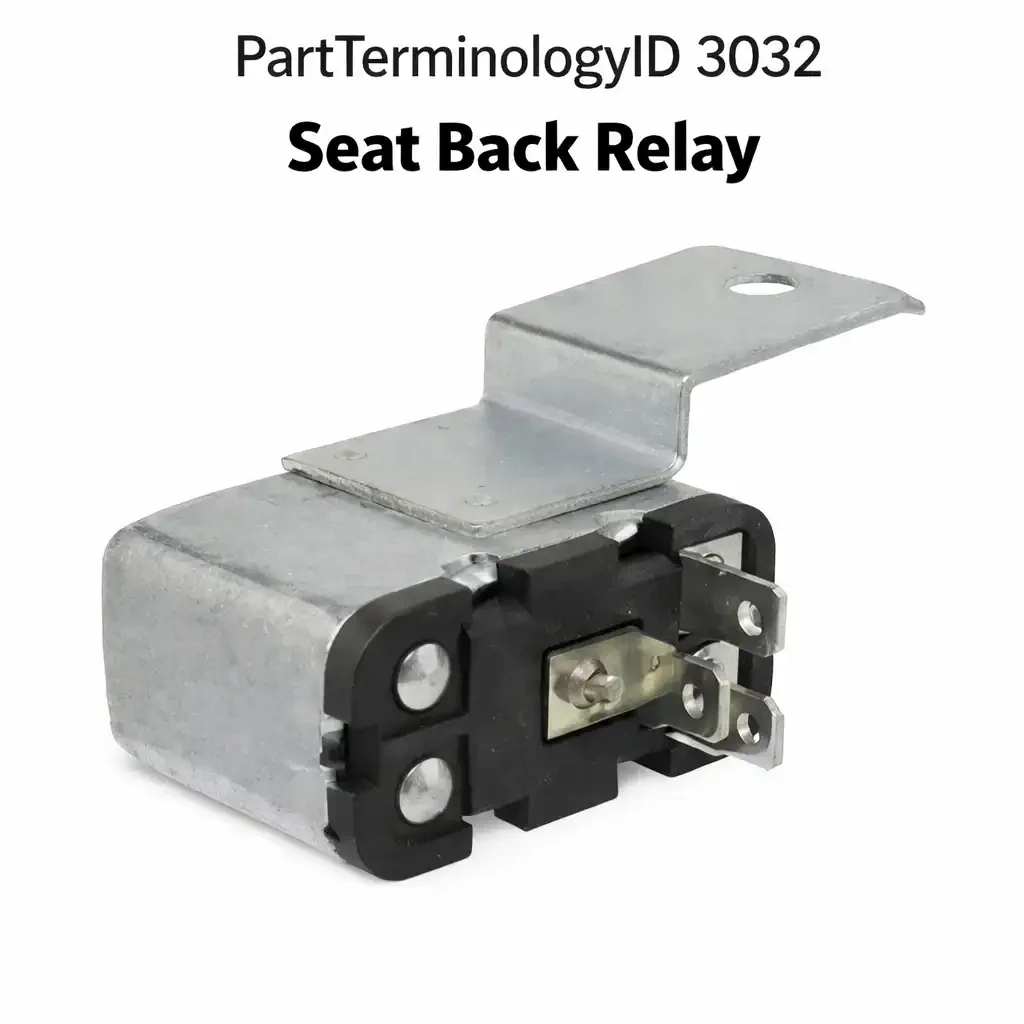
PartTerminologyID 3032, Seat Back Relay, is the relay that switches power to the power seat back recliner motor, enabling the seat control module or direct switch circuit to command forward and rearward reclining movement of the seat back under motor drive. That definition covers the seat back motor power switching function correctly and leaves unresolved whether the relay is a single bidirectional relay using a dual-contact reversing configuration or two separate relays providing forward and reverse motor drive direction independently, the contact current rating relative to the seat back motor's stall current when the seat back reaches its travel limit against the mechanical stop, the relay's activation source from a direct switch circuit or a seat memory module, and whether the relay is an ISO miniature relay in the fuse center or a purpose-built relay mounted at the seat base or seat control module.
For sellers, PartTerminologyID 3032 is the seat system relay PartTerminologyID where motor stall current at travel limit is the most critical contact rating specification. Seat back motors are geared low-speed high-torque motors that draw their highest current at the mechanical travel stop, where the motor stalls momentarily against the limit before the seat control circuit de-energizes the relay. A relay whose contact rating is sized only for the motor's running current will be stressed at each travel limit event and accumulate contact erosion with each seat adjustment cycle, producing intermittent seat back operation and eventual contact failure after a predictable number of adjustment cycles.
What the Seat Back Relay Does
Bidirectional motor control and the reversing relay configuration
Power seat back motors require bidirectional operation: the seat back must recline rearward and return forward under motor drive in both directions. The reversing relay configuration uses two relays whose contacts are arranged so that energizing one relay applies voltage to one motor terminal and ground to the other for forward drive, while energizing the other relay reverses the polarity for reverse drive. Both relays are de-energized in the neutral position to allow the motor to coast to a stop. Simultaneous energization of both relays creates a direct short across the power supply and is prevented by interlock logic in the seat control circuit that prevents both relays from being energized at the same time.
A listing for a seat back relay that covers one direction only must state clearly that two relays are required for complete bidirectional operation, and must identify whether the listing covers the forward relay, the reverse relay, or a matched pair. A buyer who orders a single relay believing it covers both directions will find the seat back operates in only one direction after installation. This is the most common return scenario for seat back relays listed without explicit directional coverage disclosure.
Seat memory module integration and relay activation logic
On vehicles with power seat memory systems, the seat back relay is controlled by a seat memory module that stores multiple position presets and drives the relay to move the seat back to a stored position at the press of a memory recall button. The seat memory module monitors position feedback from a potentiometer on the seat back drive mechanism and de-energizes the relay when the seat back reaches the stored position angle. A relay replacement for a memory-equipped seat must use the correct coil resistance for the seat memory module's relay driver output. A coil resistance outside the module's driver tolerance generates a relay circuit fault that prevents memory position recall while allowing manual switch operation to continue through a parallel direct-switch circuit on some architectures.
Stall current at travel limit and contact erosion accumulation
The seat back motor stalls momentarily at the mechanical travel limit in both the full-recline and full-upright positions. During the stall the motor draws its maximum current, which is typically two to four times the motor's running current, until the seat control circuit de-energizes the relay and stops the motor. On a well-maintained seat control circuit this stall event lasts 50 to 200 milliseconds. On a seat whose travel limit switches have degraded and allow the motor to run against the mechanical stop longer than the design limit, the stall current event extends to several seconds, substantially increasing the arc energy and contact erosion rate at the relay contact. A relay that fails in a seat with degraded travel limit switches will be replaced by a succession of relays that also fail at the travel limit until the limit switch degradation is identified and corrected.
Memory module architecture and learn procedure after relay replacement
Power seats with memory positioning store the relay's current supply circuit topology in the memory module's configuration. On some platforms a relay replacement requires the memory module to re-learn the seat position reference points before memory recall functions reliably. If the seat back position memory stores only relative position changes rather than absolute encoder counts, the memory recall may move the seat back to an incorrect position after relay replacement until a full memory re-learn sequence is performed. The listing must note the memory re-learn requirement where applicable to prevent buyers from returning the relay because memory recall is inaccurate after installation.
Seat back relay contact rating at full-recline stall current
The seat back motor draws its maximum stall current when the seat back reaches the fully reclined position and the motor runs against the mechanical stop. This stall event occurs on every recline operation until the limit switch or the seat control module de-energizes the relay. The duration of the stall event depends on the limit switch response time and the module's current cutoff timing, typically 50 to 300 milliseconds. A relay contact rated exactly at the stall current with no margin experiences the maximum stress on every recline operation, accumulating arc erosion at the contact surface with each event. Selecting a replacement relay with a contact rating above the stall current by a reasonable margin extends contact life significantly beyond the marginal-rated relay's service life.
Why This Part Generates Returns
Buyers return seat back relays because a single relay is delivered and two are required for bidirectional operation leaving the seat back operable in only one direction, the contact current rating is below the motor stall current at the travel stop producing contact erosion and intermittent operation within weeks of installation, the seat memory module requires a relay coil resistance within a specific tolerance and the replacement is outside tolerance generating a memory recall fault, and the relay is a purpose-built module-mounted unit and an ISO relay is delivered that cannot be mounted at the seat module location.
Status in New Databases
PIES/PCdb: PartTerminologyID 3032, Seat Back Relay
PIES 8.0 / PCdb 2.0: No change.
Listing Requirements
PartTerminologyID: 3032
directional coverage: forward only, reverse only, or bidirectional pair (mandatory, in title)
contact current rating: running and stall current (mandatory)
relay configuration: single reversing relay or two-relay bidirectional set (mandatory)
activation source: direct switch or seat memory module (mandatory)
coil resistance for memory module applications (mandatory)
mounting: ISO fuse center or module-mounted (mandatory)
OEM part number cross-reference (mandatory)
FAQ (Buyer Language)
Why does my seat back only move in one direction after relay replacement?
Power seat backs require two relays for bidirectional operation. If only one relay was replaced, the seat moves in the direction controlled by the new relay but not in the direction controlled by the still-failed original relay. Replace both direction relays as a set.
Why does the seat back memory recall stop working after relay replacement?
The replacement relay coil resistance is outside the seat memory module's driver tolerance. The module generates a relay circuit fault and disables memory-controlled relay activation. Manual switch operation may continue through a parallel circuit. Replace with a relay whose coil resistance matches the module specification.
How do I confirm which direction relay has failed?
Operate the seat back control in both directions and observe which direction has no movement. Activate the switch for the non-functional direction and measure voltage at the motor supply terminal. No voltage with the switch activated confirms the relay for that direction is not closing. Voltage present with no motor movement indicates the motor has failed rather than the relay. Each directional relay must be tested independently because a reversing pair shares the motor but uses separate relay contacts for each direction.
Do I need to replace both relays in a reversing pair or just the failed one?
Replace only the confirmed failed relay unless both are showing elevated contact resistance on measurement. However, because both relays in a reversing pair operate the same motor and experience the same stall current events at the same travel limits, their contact wear rates are similar. A relay that has failed after a certain number of adjustment cycles suggests the companion relay has accumulated similar contact erosion and may fail within the same service interval. Replacing both as a pair on high-mileage vehicles reduces the likelihood of a second repair within a short period.
Top Return Scenarios
Scenario 1: "Seat back moves in one direction only after relay replacement"
The buyer replaces one relay in the reversing pair. The seat back now moves in the replaced relay's direction. The companion relay in the opposite direction has also failed. Both relays in the pair have reached end of contact life from the same accumulated stall current events at the travel limits. The buyer returns the first replacement as covering only one direction when the fault is actually two separate relay failures requiring two separate replacements.
Prevention language: "The seat back uses a reversing relay pair with one relay for each direction. If the seat back does not move in either direction, both relays require individual diagnosis. A seat back that moves in one direction only after replacing one relay indicates the companion relay has also failed and requires separate replacement."
Scenario 2: "Memory recall inaccurate after relay replacement"
The buyer replaces the seat back relay. The seat back moves correctly in both directions with the manual switch. Memory recall moves the seat back to an incorrect position. The memory module's reference points were not re-learned after relay replacement on a platform that requires a re-learn sequence when the power supply to the seat motor circuit is interrupted. The buyer returns the relay as defective when the recall issue is a re-learn requirement.
Prevention language: "Some power seat memory systems require a re-learn sequence after relay replacement because the circuit power interruption causes the memory module to lose its position reference. Perform the seat position memory re-learn procedure from the service manual after relay installation before evaluating memory recall accuracy."
Cross-Sell Logic
Seat Back Motor: for buyers where the relay is confirmed delivering voltage to the motor terminal in both directions but the seat back does not move, indicating a failed motor
Seat Memory Module: for buyers where memory recall remains inaccurate after relay replacement and re-learn procedure
Travel Limit Switch: for buyers where repeated relay failures indicate a degraded limit switch allowing sustained stall current events at the travel stops
Final Take for PartTerminologyID 3032
Seat Back Relay (PartTerminologyID 3032) is the seat motor relay where directional coverage disclosure and motor stall current rating are the two attributes that prevent the two most common return scenarios. Pair replacement recommendation for bidirectional seat systems eliminates the single-direction operation complaint after single-relay replacement.