
Written by Arthur Simitian | PartsAdvisory
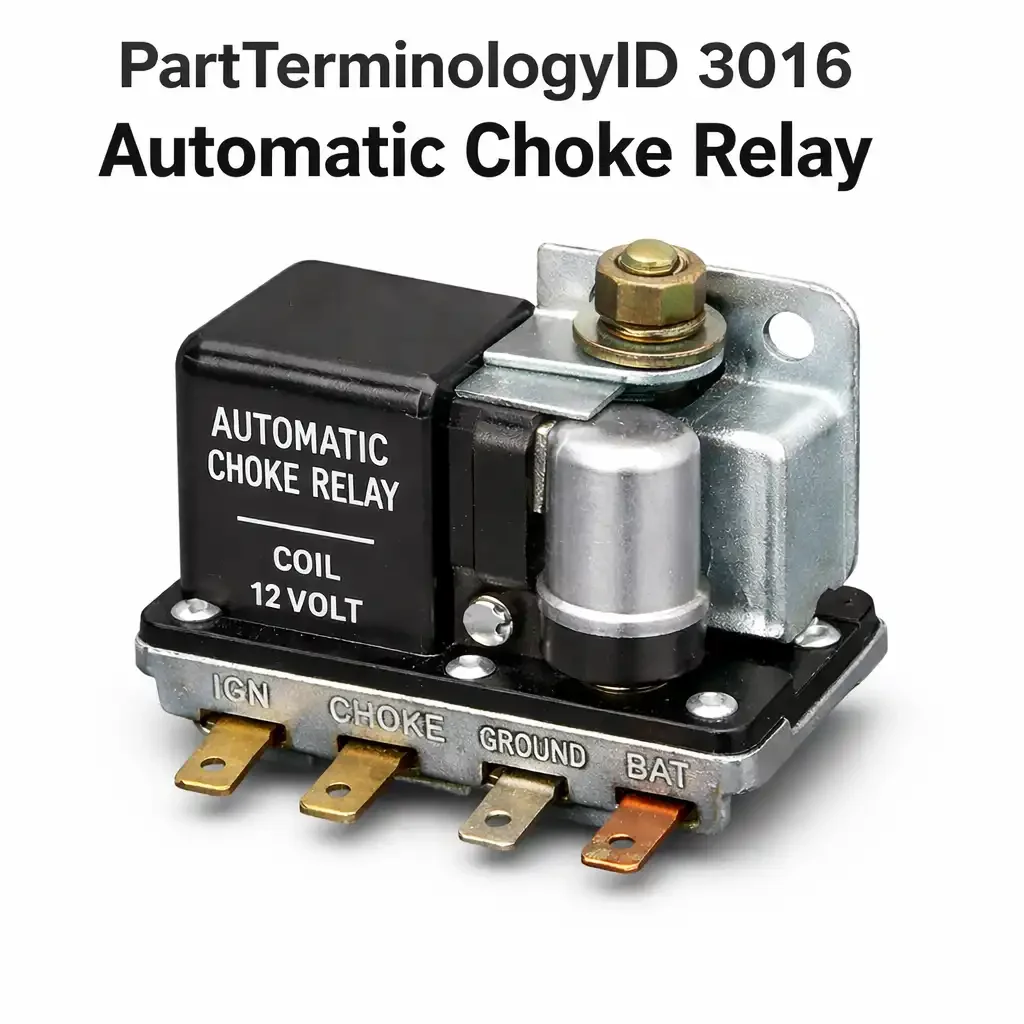
PartTerminologyID 3016, Automatic Choke Relay, is the relay that switches power to the automatic choke's electric heating element, which warms the bimetallic choke spring to progressively open the choke plate as the engine warms up, improving fuel atomization and reducing emissions during the cold-start warm-up phase on carbureted engines. That definition covers the choke heater power switching function correctly and leaves unresolved whether the relay activates from the ignition switch or from a dedicated engine warm-up timer circuit, the heater element wattage and corresponding relay contact rating, and the relay's deactivation threshold temperature or timer interval.
For sellers, PartTerminologyID 3016 is a legacy application relay associated with carbureted engines from approximately the mid-1960s through the late 1980s. Modern fuel-injected engines manage cold-start enrichment electronically through the ECM and do not use automatic choke systems. The listing must state the carbureted application window explicitly and must specify whether the relay activates from ignition power or from the choke's own thermostatic circuit.
What the Automatic Choke Relay Does
The automatic choke uses a bimetallic coil spring that contracts when cold to hold the choke plate partially closed, enriching the air-fuel mixture for cold starting. As the engine warms, the choke heater element warms the bimetallic spring, causing it to expand and progressively open the choke plate to lean the mixture toward normal operating ratio. The relay provides the switched power supply to this heater element. A failed relay that remains open prevents choke heater operation, causing the choke to open only from engine heat rather than the faster and more controlled heater element warming, producing an overly rich mixture for an extended warm-up period that increases fuel consumption and cold-start emissions.
Listing Requirements
PartTerminologyID: 3016
heater element wattage and contact current rating (mandatory)
activation source: ignition switch or thermostatic timer (mandatory)
deactivation threshold: temperature or timer interval (mandatory)
application window: carbureted engines approximately 1965 through late 1980s (mandatory)
inapplicability note for fuel-injected vehicles (mandatory)
OEM part number cross-reference (mandatory)
FAQ (Buyer Language)
What happens when the automatic choke relay fails?
The choke heater does not warm the bimetallic spring. The choke remains closed longer than normal during warm-up, causing an overly rich mixture, poor fuel economy, and elevated cold-start emissions until the choke opens from engine heat alone.
What the Automatic Choke Relay Does
The automatic choke relay switches power to the automatic choke's electric heating element, which warms the bimetallic spring that progressively opens the choke plate as the engine warms up from a cold start. The choke plate restricts airflow into the carburetor during cold start to create a rich mixture that compensates for poor fuel atomization in cold conditions. As the heating element warms the bimetallic spring, the spring tension changes and the choke plate gradually opens over the first few minutes of engine operation. A failed relay that stays open leaves the choke heating element unpowered and the choke plate fully or partially closed for longer than the design warm-up interval, causing rich running, black smoke, poor fuel economy, and elevated hydrocarbon emissions until the engine heat alone eventually opens the choke through the exhaust heat crossover in the intake manifold rather than through the electric heater.
A failed relay that welds closed leaves the heater element energized continuously, which can overheat the bimetallic spring assembly over repeated start-stop cycles and cause the spring to lose its calibrated tension. A spring that has lost tension opens the choke too quickly on cold starts, causing a lean stumble and hesitation during the initial warm-up phase. The relay's activation source is either the ignition switch run position for continuous activation whenever the key is on, or a thermostatic switch that activates only below a coolant temperature threshold to prevent unnecessary heater operation on a warm restart.
Why This Part Generates Returns
Buyers return automatic choke relays because the vehicle is a modern fuel-injected application with no automatic choke system, the activation source is a thermostatic switch on the buyer's vehicle and a direct ignition-switched relay is delivered that activates the heater regardless of engine temperature, and the relay is correct but the choke heating element has failed open and produces no warmth even with the relay confirmed delivering voltage to the element terminals.
Final Take for PartTerminologyID 3016
Automatic Choke Relay (PartTerminologyID 3016) is a carbureted-era relay covering vehicles from approximately the mid-1960s through the late 1980s. Heater element wattage and contact current rating, activation source distinguishing ignition-switched from thermostatic-switch-activated, deactivation threshold where applicable, and the carbureted application window inapplicability note for modern vehicles are the four mandatory listing attributes. The activation source distinction between continuous ignition-switched and thermostatic-controlled architectures is critical because the two relay specifications differ in coil activation circuit topology and are not interchangeable on applications that rely on the thermostatic switch for duty cycle management of the heater element.
Listing Requirements
PartTerminologyID: 3016
heater element wattage and contact current rating (mandatory)
activation source: ignition-switched or thermostatic switch (mandatory)
deactivation threshold: temperature or continuous (mandatory)
application window: carbureted engines approximately mid-1960s through late 1980s (mandatory)
inapplicability note for modern fuel-injected vehicles (mandatory)
OEM part number cross-reference (mandatory)
How do I confirm the choke heater element is working before replacing the relay?
Apply 12 volts directly to the heater element terminals and measure current draw. A functioning heater element draws current proportional to its wattage rating. No current draw indicates an open-circuit heater element that requires replacement regardless of relay condition. Correct current draw confirms the element is functional and the relay is the fault.