
Written by Arthur Simitian | PartsAdvisory
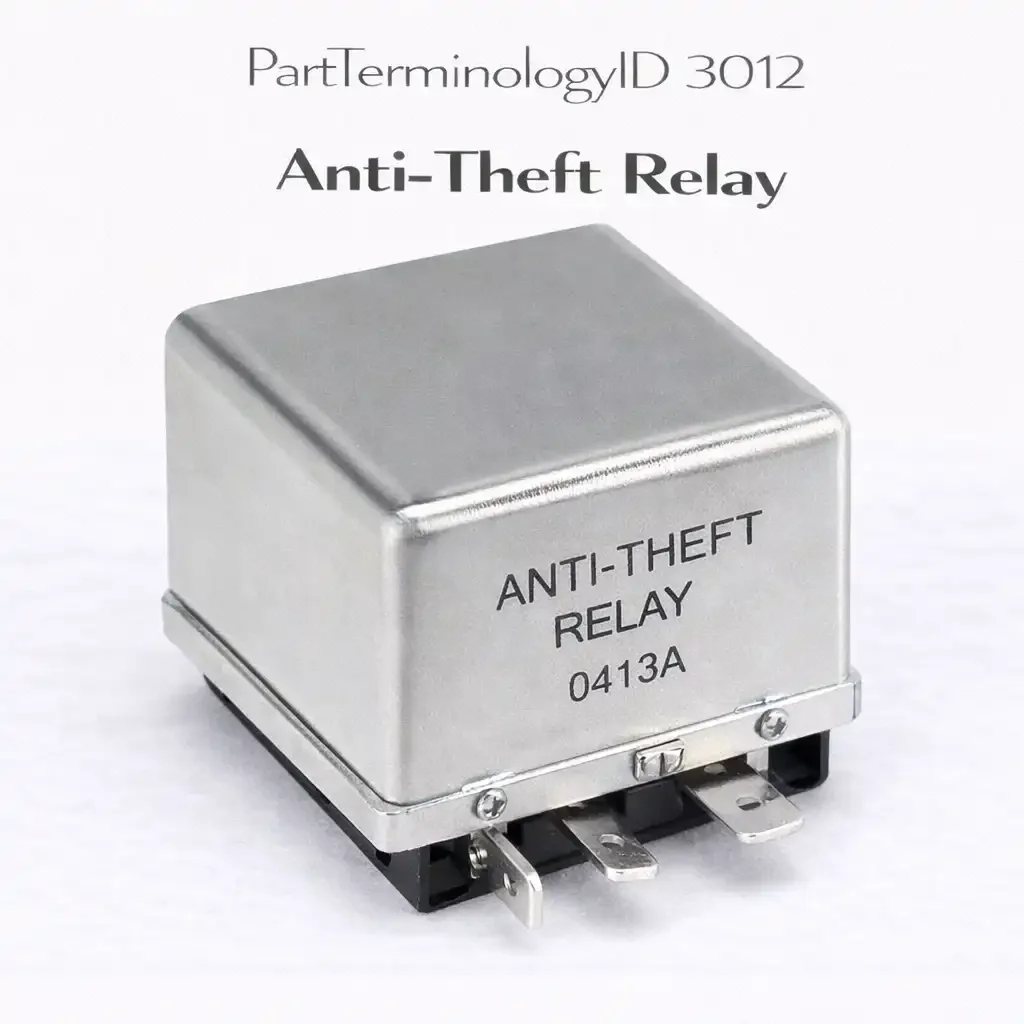
PartTerminologyID 3012, Anti-Theft Relay, is the relay controlled by the vehicle's anti-theft or immobilizer system that interrupts one or more critical vehicle operating circuits, typically the starter motor enable, the fuel pump supply, or the ignition coil primary, to prevent unauthorized engine starting when the immobilizer system has not received a valid key transponder code or when the alarm system is in the armed-and-triggered state. That definition covers the theft deterrent circuit interruption function correctly and leaves unresolved which specific circuit or circuits the relay interrupts on the specific vehicle, whether the relay is controlled by the BCM's immobilizer logic or by a standalone anti-theft module, whether a failed relay produces a no-start condition that the owner may misdiagnose as a fuel pump or starter failure rather than an immobilizer relay fault, whether the relay requires any programming or reset procedure after replacement, and whether the relay is mounted in the main fuse center, at the immobilizer module, or at the interrupted circuit component.
For sellers, PartTerminologyID 3012 is the anti-theft relay PartTerminologyID where the no-start symptom creates the highest misdiagnosis rate of any relay in the catalog. When the anti-theft relay fails in the open position, it interrupts the starter or fuel pump circuit continuously, producing a no-start condition that is identical in symptom to a failed starter, a failed fuel pump, a failed neutral safety switch, or a discharged battery. The owner may spend significant money replacing these components before the relay is identified as the actual fault. The listing must explicitly frame the anti-theft relay as a no-start cause that should be verified early in the no-start diagnostic sequence rather than after other components have been replaced.
What the Anti-Theft Relay Does
Circuit interruption architecture and the starter versus fuel pump choice
Different manufacturers implement the anti-theft relay at different points in the starting circuit based on their security architecture design. The starter enable implementation interrupts the starter motor control circuit so the engine cannot crank without a valid key code. The fuel pump implementation interrupts the fuel pump supply so the engine may crank but immediately stalls from fuel starvation without a valid key code. The ignition primary implementation prevents spark and fuel injection simultaneously by interrupting the ignition system power supply.
Each implementation produces a distinct no-start symptom. The starter interrupt produces a completely silent no-start where the engine does not crank at all. The fuel pump interrupt produces a crank-no-start where the engine cranks normally but does not fire. The ignition primary interrupt also produces a crank-no-start but with no spark at the plug. Knowing which circuit the anti-theft relay interrupts on the specific vehicle narrows the diagnostic scope significantly and prevents replacing components in the non-interrupted circuit. The listing must identify the interrupted circuit as a required attribute so the buyer can confirm the relay's role in their specific no-start symptom before ordering.
BCM-controlled versus standalone module relay architectures
On modern vehicles the anti-theft relay is typically controlled by a BCM output that commands relay de-energization when a valid transponder code is not received within the programmed window after ignition-on. The BCM monitors the key transponder, validates the code against its stored key data, and either enables or disables the relay based on code match status. A relay replacement on a BCM-controlled architecture requires only a relay with the correct coil resistance and contact configuration for the BCM output driver. No reprogramming of the relay itself is necessary because the key validation logic resides in the BCM, not the relay.
On older standalone anti-theft module architectures the relay is controlled by a dedicated anti-theft module separate from the BCM. This module may require a learn or reset procedure after relay replacement to confirm the relay circuit is intact and the system is in normal armed-and-ready state rather than fault state. A failed relay that caused the system to enter a fault state may require the anti-theft module to be reset using the key fob or a specific key turn sequence before the system reverts to normal armed operation after the relay is replaced. The listing must identify which architecture applies and must note any reset procedure required after relay installation.
Programming and immobilizer interaction
On vehicles where the anti-theft relay is integrated into the immobilizer circuit rather than the alarm system perimeter circuit, the relay may be part of the BCM's immobilizer hardware implementation. In these architectures, the relay is a discrete output of the BCM's immobilizer logic and its replacement follows the BCM relay replacement protocol without additional programming beyond confirming the circuit is intact. However, on vehicles where the immobilizer system was not functioning correctly before the relay failed, a relay replacement that restores power to the immobilizer circuit may expose previously masked immobilizer programming faults that require key re-registration before the engine will start through the now-functional immobilizer circuit.
This layered fault scenario, a relay fault masking an immobilizer programming fault, is rare but produces a confusing post-replacement symptom: the no-start continues after the relay is replaced but the symptom character changes from a complete absence of starting response to a crank-no-start that now indicates the immobilizer is active rather than the relay being open. The buyer may conclude the replacement relay is also failed when the actual remaining fault is an immobilizer key registration issue exposed by the relay restoration. The listing must note this scenario in the installation context so buyers are prepared for the possibility of a changed no-start character after relay replacement that requires immobilizer diagnosis rather than a second relay.
Why This Part Generates Returns
Buyers return anti-theft relays because the starter relay is delivered and the vehicle uses a fuel pump interrupt architecture, producing the same crank-no-start symptom from a relay that physically installs correctly but interrupts the wrong circuit, the relay requires a post-replacement module reset that the listing did not mention and the no-start continues until the reset procedure is performed, a BCM immobilizer programming fault is exposed after relay replacement and the buyer believes the second no-start is caused by a defective replacement relay rather than the newly exposed immobilizer fault, the relay is part of the BCM's internal circuit on this vehicle and no separate relay exists in the fuse center, and the relay failed from a voltage spike that also damaged the anti-theft module's relay control output driver requiring module replacement alongside the relay.
Status in New Databases
PIES/PCdb: PartTerminologyID 3012, Anti-Theft Relay
PIES 8.0 / PCdb 2.0: No change.
Top Return Scenarios
Scenario 1: "Wrong circuit interrupted, relay installs but wrong no-start type persists"
The buyer's vehicle uses a fuel pump interrupt anti-theft relay. The delivered relay is the starter enable interrupt type. It installs in the correct relay socket but interrupts the wrong circuit. The crank-no-start symptom is unchanged.
Prevention language: "Circuit interrupted: [starter enable / fuel pump supply / ignition primary]. This relay interrupts the [circuit]. Verify the interrupted circuit matches the vehicle's anti-theft architecture. Starter interrupt and fuel pump interrupt relays may share the same physical housing but interrupt different circuits."
Scenario 2: "Module reset required, no-start continues after relay replacement"
The replacement relay is installed. The anti-theft module is in fault state from the original relay failure event. The module holds the interrupt circuit open pending a reset confirmation. The no-start continues. The buyer returns the relay as defective.
Prevention language: "Post-replacement reset: After relay installation, the anti-theft module may require a reset using the key fob arm-disarm sequence or a specific key turn procedure to confirm relay circuit integrity and return to normal armed operation. Perform the reset procedure before concluding the replacement relay is defective."
Scenario 3: "Immobilizer fault exposed after relay replacement, no-start changes character"
The relay replacement restores starter engagement. The engine now cranks but does not start because the immobilizer is active from a key registration fault that was masked when the relay was open. The buyer observes a security indicator flashing and the engine cranking but not firing.
Prevention language: "Immobilizer note: If the engine cranks but does not start after relay replacement and the security indicator flashes, the immobilizer key registration requires attention separately from the relay. The relay replacement restored the starting circuit. The engine's failure to fire indicates an immobilizer fault requiring key re-registration."
Listing Requirements
PartTerminologyID: 3012
circuit interrupted: starter enable, fuel pump supply, or ignition primary (mandatory, in title)
relay control architecture: BCM-controlled or standalone anti-theft module (mandatory)
post-replacement module reset procedure note (mandatory)
immobilizer interaction note (mandatory for BCM-integrated immobilizer applications)
no-start early diagnosis note: anti-theft relay should be verified early in no-start diagnosis (mandatory)
coil resistance within module output driver tolerance (mandatory)
OEM part number cross-reference (mandatory)
Catalog Checklist for ACES/PIES Teams
PartTerminologyID = 3012
require circuit interrupted in title (mandatory)
require relay control architecture: BCM or standalone module (mandatory)
require post-replacement reset procedure note (mandatory)
require immobilizer interaction note (mandatory)
require no-start early diagnosis placement note (mandatory)
prevent wrong circuit relay: starter interrupt and fuel pump interrupt relays may share physical housing but interrupt different circuits; circuit identification prevents the most common wrong-relay return
prevent reset omission: anti-theft module fault state after relay failure may hold the circuit open pending a reset confirmation; a reset-required vehicle that does not receive the reset procedure returns the relay as defective
prevent immobilizer misdiagnosis: immobilizer fault exposed after relay replacement appears as a continued no-start but with a different character; distinguishing relay restored-but-immobilizer-active from relay still failed requires noting the security light behavior
Scenario 4: "BCM driver fault, relay correct, module output voltage absent"
The anti-theft relay coil receives no activation signal. The buyer replaces the relay. The new relay coil still receives no voltage. The BCM's output driver pin for the anti-theft relay coil has failed internally. The BCM is not commanding relay activation regardless of anti-theft system state. The relay is the wrong component to replace in this scenario. Only BCM driver output confirmation before ordering would have identified this scenario.
Prevention language: "BCM driver check: Before ordering, verify the relay coil terminal shows activation voltage during normal armed-and-disarmed vehicle operation. Absent coil voltage with the relay removed indicates a BCM driver output fault rather than a relay fault. Replacing the relay without confirming coil activation voltage present at the socket will not restore anti-theft circuit function."
Application Range and Fitment Guidance for PartTerminologyID 3012
Anti-theft relay applications span vehicles from approximately the early 1990s when factory-installed electronic anti-theft systems became common through the present. The circuit interrupted evolved from simple starter enable relays in early standalone module systems through fuel pump interrupt and ignition primary interrupt configurations that became common with BCM integration from the mid-1990s forward. The transition from standalone anti-theft modules to BCM-integrated anti-theft management with immobilizer functions occurred progressively across manufacturers between approximately 1996 and 2010.
Fitment data for this PartTerminologyID requires VIN-level or trim-level granularity because anti-theft relay applications within the same model year and model name may vary by whether the vehicle was equipped with the factory anti-theft package. A base-trim vehicle in the same model year as a security-package-equipped vehicle may not have an anti-theft relay at all. A catalog entry that covers the entire model year range without distinguishing equipped versus non-equipped vehicles will generate orders from buyers whose vehicles have no anti-theft relay socket. The security package identification, whether factory-installed standard equipment or dealer-installed optional, determines relay presence and must be specified in the fitment claim.
International market variants of the same vehicle platform may use different anti-theft relay architectures than the North American variant. European market vehicles in particular may use more sophisticated immobilizer integration that changes the relay's circuit position relative to the North American architecture. Fitment claims based on platform compatibility rather than VIN-specific data must be validated against the specific market variant's wiring diagram to confirm architecture match.
FAQ (Buyer Language)
Can a failed anti-theft relay cause a no-start?
Yes. A relay that fails open interrupts the starter or fuel pump circuit continuously, producing a no-start regardless of key or ignition condition. The anti-theft relay should be verified early in any no-start diagnostic sequence before other components are replaced.
Do I need to reset anything after replacing the relay?
On standalone anti-theft module architectures, a post-replacement reset using the key fob or a specific key sequence may be required before the system returns to normal operation. On BCM-controlled architectures no relay-level reset is typically required, but an immobilizer fault masked by the relay failure may require key re-registration after the relay restores the circuit.
Why does my engine still not start after relay replacement?
Two possibilities. First, the module requires a reset that was not performed. Second, the relay restoration exposed a pre-existing immobilizer programming fault. If the engine cranks but does not fire and the security light flashes, the fault is immobilizer-related, not relay-related.
How do I tell whether my no-start is caused by the anti-theft relay or by something else?
Check whether the security indicator lamp is illuminated or flashing during the no-start attempt. A continuously flashing security light during a crank-no-start or no-crank condition typically indicates the anti-theft system is actively interrupting the circuit. Test the relay by substituting a known-good relay of the correct specification. If the relay substitution restores starting, the original relay was the fault. If no change occurs with a known-good relay, the fault is upstream of the relay in the anti-theft control circuit or immobilizer system.
What is the difference between the anti-theft relay and the immobilizer?
The anti-theft relay is the output device that physically interrupts the starter or fuel pump circuit when the anti-theft system is armed and triggered. The immobilizer is the engine management security system that prevents the engine from starting unless a transponder-equipped key with the correct code is present. Both can produce a no-start, but through different mechanisms. The relay produces a no-start by interrupting a physical circuit. The immobilizer produces a no-start by preventing fuel injection or ignition system activation through the ECM. Both can be present simultaneously on the same vehicle and both must be evaluated in a no-start diagnosis.
What Sellers Get Wrong About PartTerminologyID 3012
The most common error is listing an anti-theft relay without specifying the interrupted circuit. A no-start diagnosis that leads a buyer to the anti-theft relay is almost always symptom-driven, meaning the buyer knows the anti-theft system is implicated but does not necessarily know whether their vehicle uses a starter enable, fuel pump interrupt, or ignition primary interrupt architecture. A listing that identifies the interrupted circuit in the title allows the buyer to match their vehicle's architecture against the relay's function before ordering. A listing that omits the interrupted circuit forces the buyer to guess, and a wrong-architecture relay that installs in the correct socket but interrupts the wrong circuit generates a return with a frustrated buyer who invested the labor of relay replacement without any diagnostic change in the no-start symptom.
The second error is omitting the post-replacement reset procedure note. This error is not a product specification error. It is an installation guidance error. The reset procedure is not obvious to a buyer who has replaced a relay for the first time. A buyer who installs the relay correctly and finds the vehicle still does not start has no way to know that the anti-theft module requires an arm-disarm confirmation sequence before authorizing the circuit through the replacement relay, unless the listing tells them. The reset note takes one sentence. Its absence generates one return per reset-required vehicle in the fitment range where the buyer does not discover the reset procedure independently.
The third error is not disclosing the immobilizer interaction. A no-start that persists after correct relay installation and correct reset procedure execution may not be a relay failure. It may be an immobilizer fault that was masked by the open relay circuit before replacement. The buyer who sees the engine now cranking but not firing after relay replacement and observes the security indicator flashing has a relay that is working correctly and an immobilizer that is denying fuel injection authorization. This is a successful relay replacement outcome obscured by a second independent fault. Without the immobilizer interaction note, the buyer concludes the relay is defective. With the note, the buyer recognizes the new symptom as a different fault requiring a different service.
Cross-Sell Logic
Body Control Module (PartTerminologyID 2888): for BCM-immobilizer vehicles where relay failure was caused by a BCM output driver fault; replacing the relay without addressing the driver fault will damage the replacement relay from the same cause
Key Fob Programming Service: for vehicles where relay replacement exposed a pre-existing immobilizer key registration fault; key re-registration must be completed before the engine will start
Fuel Pump: for vehicles with fuel pump interrupt anti-theft relays where the fuel pump was replaced before the relay was identified as the fault; the pump may be functional and the relay was the actual interruption cause
Starter Motor: for vehicles with starter enable interrupt anti-theft relays where the starter was replaced before the relay was identified as the fault; the starter motor is functional but was blamed for a no-crank caused by the relay's open contact
Final Take for PartTerminologyID 3012
Anti-Theft Relay (PartTerminologyID 3012) is the relay PartTerminologyID with the highest misdiagnosis cost of any in this series. A failed anti-theft relay that interrupts the starter or fuel pump circuit produces a no-start that drives hundreds of dollars of component replacement before the relay is tested. Circuit interruption identification, early diagnostic placement, post-replacement reset procedure, and immobilizer interaction disclosure are the four attributes that prevent the four most distinct and most costly return and misdiagnosis scenarios in anti-theft relay replacement. The buyer who reaches this listing with a confirmed anti-theft relay fault and confirmed circuit architecture identification is ready to order correctly with zero return risk. The buyer who reaches this listing from a no-start diagnostic path without circuit architecture confirmation is a potential incorrect order. The listing must serve both buyers simultaneously: confirming the correct order for the first buyer and redirecting the second buyer toward circuit architecture verification before the order is placed.