
Written by Arthur Simitian | PartsAdvisory
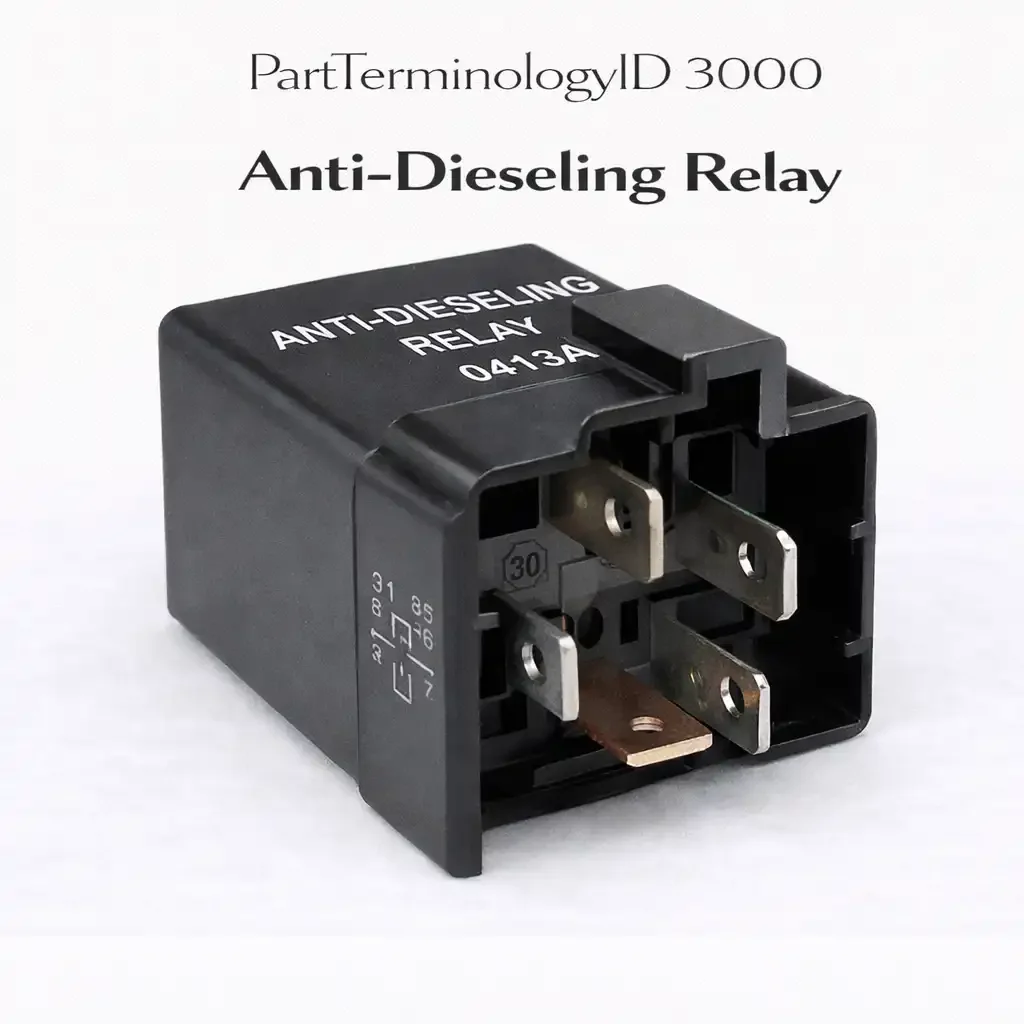
PartTerminologyID 3000, Anti-Dieseling Relay, is the relay that cuts the fuel supply or ignition to the engine at the moment the ignition key is turned off, preventing the engine from continuing to run on residual heat and compression after ignition power is removed, a condition known as dieseling or run-on that was common in carbureted engines with high idle speeds, elevated compression ratios, or carbon deposits in the combustion chamber. That definition covers the engine shutdown control function correctly and leaves unresolved the specific circuit the relay interrupts, whether it cuts power to the fuel solenoid on the carburetor, the ignition coil primary, or a dedicated engine shutdown solenoid, and the relay's activation logic which is typically de-energized at ignition-off to interrupt the circuit.
For sellers, PartTerminologyID 3000 is a legacy application relay associated with carbureted engines from approximately the late 1960s through the mid-1980s, particularly high-performance and high-compression applications where dieseling was a significant issue. Modern fuel-injected engines with electronic engine management do not use anti-dieseling relays because the ECM directly controls fuel injector operation and stops injection immediately at key-off without a separate anti-dieseling circuit. The listing must state the carbureted application window and the specific circuit interrupted to prevent orders from modern vehicle buyers and to ensure correct circuit matching.
Listing Requirements
PartTerminologyID: 3000
circuit interrupted: carburetor fuel solenoid, ignition coil primary, or engine shutdown solenoid (mandatory)
activation logic: normally closed energized in run, opens at key-off (mandatory)
application window: carbureted engines approximately 1968 through mid-1980s (mandatory)
inapplicability note for fuel-injected vehicles (mandatory)
OEM part number cross-reference (mandatory)
FAQ (Buyer Language)
What causes dieseling and how does this relay prevent it?
Dieseling occurs when a carbureted engine continues running after the key is off, ignited by hot carbon deposits or residual heat rather than a spark. The anti-dieseling relay cuts the carburetor fuel solenoid or ignition circuit at key-off, immediately starving the engine of fuel or ignition and stopping run-on.
Does my modern car need this relay?
No. Fuel-injected engines stop fuel delivery electronically at key-off without a separate relay. This relay applies to carbureted applications from the late 1960s through the mid-1980s.
What the Anti-Dieseling Relay Does
The anti-dieseling relay interrupts either the carburetor fuel solenoid circuit or the ignition primary circuit at the precise moment the ignition key is turned to the off position, cutting fuel or spark to the engine immediately and preventing the engine from continuing to run on residual heat and compression after ignition power is removed. This run-on condition, known as dieseling, occurs most commonly on high-compression or high-performance carbureted engines where the combustion chamber temperature is sufficient to auto-ignite the fuel-air mixture without a spark, particularly when low-octane or poor-quality fuel has left combustion deposits that retain heat. The relay achieves this by being normally closed when energized during engine operation and opening when the ignition removes the coil supply voltage at key-off.
The normally-closed-when-energized logic means the relay's default unpowered state is open, interrupting the fuel or ignition circuit. During normal operation with the ignition on and the engine running, the relay coil is energized and the contact holds closed, supplying the carburetor solenoid or ignition primary circuit. At key-off the coil loses power, the contact opens, and the fuel or spark supply is immediately interrupted. This activation logic is the opposite of most relay applications and must be verified when ordering a replacement, because installing a normally-open relay in an anti-dieseling circuit leaves the fuel or ignition circuit permanently interrupted with the engine running.
Why This Part Generates Returns
Buyers return anti-dieseling relays because the vehicle is a modern fuel-injected application with no carburetor fuel solenoid and no anti-dieseling circuit, the normally-closed contact logic is not specified and a normally-open replacement is installed producing a no-start condition because the fuel solenoid or ignition primary is now interrupted during engine operation, and the relay is correct but the carburetor fuel solenoid has seized open and continues to supply fuel despite the relay correctly opening at key-off because the solenoid is not responding to the de-energization command.
Final Take for PartTerminologyID 3000
Anti-Dieseling Relay (PartTerminologyID 3000) is a legacy relay with a well-defined application window covering carbureted engines from approximately the late 1960s through the mid-1980s. Circuit identification stating whether the relay interrupts the fuel solenoid or the ignition primary, the normally-closed contact logic disclosure, and the inapplicability note for modern fuel-injected vehicles are the three mandatory listing attributes. The normally-closed logic disclosure is especially critical because a normally-open replacement installed in this circuit converts a dieseling symptom into a no-start condition that appears unrelated to the original complaint.
Listing Requirements
PartTerminologyID: 3000
circuit interrupted: fuel solenoid or ignition primary (mandatory)
contact logic: normally closed when energized (mandatory)
coil activation source: ignition run circuit (mandatory)
application window: carbureted engines approximately late 1960s through mid-1980s (mandatory)
inapplicability note for modern fuel-injected vehicles (mandatory)
OEM part number cross-reference (mandatory)
How do I know if my vehicle uses a fuel solenoid or ignition cutoff for anti-dieseling?
Carburetors with idle fuel solenoids use the fuel solenoid cutoff method. Vehicles without an idle fuel solenoid use the ignition primary cutoff method. The carburetor model and manufacturer specification sheet identifies which approach is used. Most GM applications from the 1970s used the idle solenoid method. Ford and Chrysler applications varied by engine and carburetor model.
What happens if a normally-open relay is installed in place of the normally-closed anti-dieseling relay?
The carburetor fuel solenoid or ignition primary circuit is interrupted whenever the ignition is on and the relay is not energized. Because the relay is energized only when the ignition is on, this produces a no-start condition: the engine cranks but cannot start because the fuel or ignition circuit is open from the incorrectly configured relay contact logic.