
Written by Arthur Simitian | PartsAdvisory
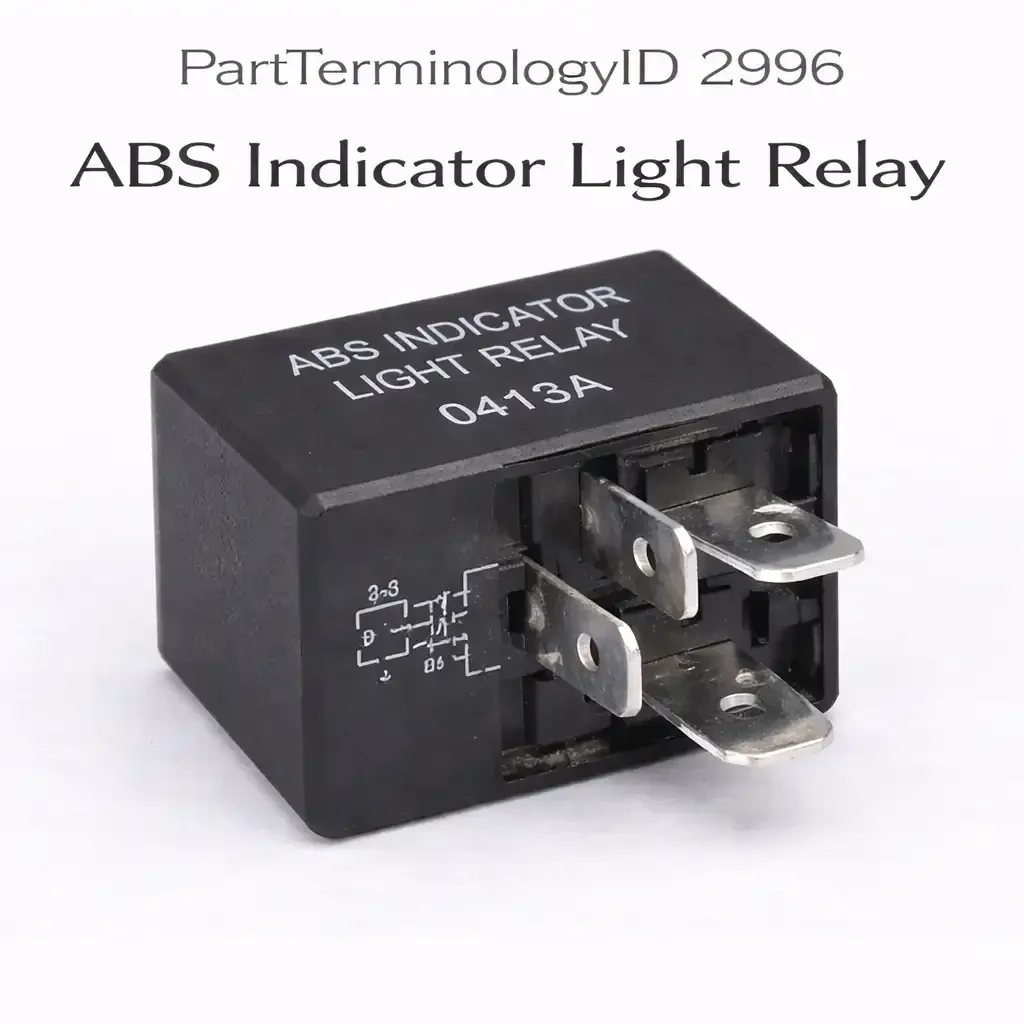
PartTerminologyID 2996, ABS Indicator Light Relay, is the relay that controls the power supply switching for the ABS warning indicator lamp in the instrument cluster, enabling the ABS control module to illuminate the warning light when an ABS system fault is detected and to extinguish it when the system self-test at ignition-on confirms no faults are present. That definition covers the indicator lamp circuit switching function correctly and leaves unresolved whether the relay switches the lamp supply voltage or the lamp ground path, whether the relay is part of the ABS module's internal circuitry or a discrete external relay in the instrument circuit, and whether a failed relay produces a permanently illuminated warning light, a permanently extinguished warning light, or a light that does not complete the ignition-on self-test flash sequence.
For sellers, PartTerminologyID 2996 is a relay PartTerminologyID where the failure direction, whether the relay fails open or closed, determines whether the safety consequence is an ABS warning light that never illuminates or one that never extinguishes. A relay that fails open prevents the ABS module from illuminating the warning light when a genuine ABS fault is present, eliminating the driver's primary indication that the ABS system is non-functional. This is the more safety-consequential failure mode because it conceals an ABS system fault from the driver. The listing must note both failure directions and their respective safety implications.
What the ABS Indicator Light Relay Does
At ignition-on, the ABS module commands the indicator light relay to illuminate the ABS warning lamp for a brief self-test interval, typically two to three seconds, confirming the lamp bulb is functional and the relay circuit is intact. After the self-test interval the module commands the relay to extinguish the lamp if no faults are present. If faults are present the module holds the lamp illuminated continuously through the relay.
The self-test flash at ignition-on is a mandatory FMVSS required function for ABS-equipped vehicles: the driver must receive a visible warning indication if the ABS system is non-functional. A relay that fails open prevents both the self-test flash and any fault illumination, leaving the driver without any indication of ABS system status. A vehicle with a failed open ABS indicator relay may have a non-functional ABS system from a separate ABS fault and the driver has no indication because the indicator circuit itself is also broken. The listing must frame this compounding failure risk as the primary reason the relay must be replaced promptly and confirmed functional with a post-replacement scan.
FMVSS self-test requirement and the ignition-on bulb check
Federal Motor Vehicle Safety Standard 135 requires the ABS warning lamp to illuminate briefly at ignition-on as a bulb test before extinguishing to confirm the lamp circuit is functional. This self-test flash is the most reliable diagnostic indicator for ABS indicator relay condition because it occurs on every ignition cycle and is immediately visible to the driver. A relay that fails open prevents the self-test flash, leaving the driver unable to confirm whether the ABS warning lamp circuit is functional. A relay that fails closed produces a permanently illuminated ABS warning lamp that eliminates the ability to use the lamp as a fault indicator because the lamp is always on.
Open relay failure and the concealed ABS fault scenario
The most safety-consequential failure scenario for the ABS indicator relay is the case where the relay fails open and a separate ABS fault is also present. The driver cannot receive the ABS warning because the indicator circuit is broken. The vehicle operates with non-functional ABS from the separate fault and no driver notification of the ABS system's compromised state. During a panic stop event on a wet surface the driver expects ABS intervention that does not occur. The ABS indicator relay's open failure mode directly compromises the safety notification function that federal standards require. This scenario must be described in the listing to explain why prompt replacement of a failed-open indicator relay is a safety priority.
Self-test sequence and the relay energization timing
During the ignition-on self-test the ABS module energizes the indicator relay for approximately two seconds to illuminate the lamp, then de-energizes the relay to extinguish the lamp if no faults are detected. The lamp should illuminate immediately when the ignition is turned to the on position and extinguish within two to four seconds once the module completes its internal self-check. A relay that is slow to close produces a delayed lamp illumination that may appear as a dim or flickering lamp during the self-test rather than the bright steady illumination that indicates a properly functioning relay contact. Delayed relay contact closure suggests elevated contact resistance from accumulated arc erosion at the contact surface.
Parallel warning system architecture on premium vehicles
On vehicles with integrated stability control the ABS indicator relay may also serve the electronic stability control warning lamp through a parallel circuit branch. A failed ABS indicator relay on these vehicles extinguishes both the ABS warning lamp and the stability control warning lamp simultaneously. The simultaneous loss of both warning indicators may be interpreted as a stability control system disablement rather than a relay failure, causing the buyer to search for stability control components when the relay is the single fault. Identifying that both warning lamps share the ABS indicator relay circuit points the diagnosis directly to the relay rather than to the stability control system.
Why This Part Generates Returns
Buyers return ABS indicator light relays because the ABS warning light remains on after relay replacement because a separate ABS fault is still present that the relay replacement did not address, and the relay is in the ABS module internal circuit and cannot be replaced as a separate external component on this vehicle architecture.
Status in New Databases
PIES/PCdb: PartTerminologyID 2996, ABS Indicator Light Relay
PIES 8.0 / PCdb 2.0: No change.
Listing Requirements
PartTerminologyID: 2996
lamp circuit switched: supply voltage or ground path (mandatory)
failure direction consequences: open relay conceals ABS faults from driver (mandatory)
external discrete relay versus ABS module internal circuit (mandatory)
post-replacement ABS scan and self-test verification (mandatory)
OEM part number cross-reference (mandatory)
FAQ (Buyer Language)
What happens if the ABS indicator relay fails open?
The ABS warning lamp cannot illuminate. The ignition-on self-test flash does not occur. Any ABS system fault that develops is hidden from the driver. The vehicle operates without any ABS warning indication regardless of actual ABS system status.
Why is my ABS light still on after replacing the relay?
The relay replacement resolved the relay circuit fault only. One or more additional ABS faults remain and continue to illuminate the warning lamp through the now-functioning relay circuit. Perform a complete ABS scan to identify and address all remaining faults.
How do I tell if the ABS indicator relay or the ABS module has failed?
Measure voltage at the relay coil terminal during the ignition-on self-test period. If the ABS module is commanding the relay to close for the self-test and the relay coil terminal shows voltage but the lamp does not illuminate, the relay contact has failed open. If no voltage appears at the relay coil terminal during the self-test period, the ABS module is not commanding the relay, indicating a module output fault rather than a relay contact fault. The voltage test at the coil terminal distinguishes module fault from relay contact fault.
Does the ABS indicator relay control only the ABS lamp or other warning indicators too?
On most vehicles the ABS indicator relay controls only the ABS warning lamp circuit. On some platforms the same relay controls the ABS lamp and the traction control lamp simultaneously because both lamps are powered through the same relay contact in a shared indicator circuit. A failed relay on these platforms extinguishes both the ABS and traction control warning lamps simultaneously, which may appear to indicate a fault code clearing rather than a relay failure. Confirm whether the platform uses a shared indicator relay before assuming a simultaneous lamp extinguishment indicates a fault resolution.
Top Return Scenarios
Scenario 1: "ABS light never illuminates at ignition-on, relay replaced, still no self-test flash"
The buyer notices the ABS warning lamp does not perform its ignition-on self-test flash. The relay is replaced. The self-test flash remains absent. Testing confirms the relay coil receives no activation voltage from the ABS module during the self-test period. The ABS module's output driver has failed and is not commanding the relay. The relay replacement had no effect because the relay was never receiving an activation command from the module.
Prevention language: "Measure voltage at the relay coil terminal during the ignition-on self-test period before ordering. No coil voltage during the self-test period indicates the ABS module output driver has failed, not the relay contact. Relay replacement will not restore the self-test flash until the module output fault is resolved."
Scenario 2: "ABS light permanently on, relay replaced, light still on"
The buyer sees a permanently illuminated ABS warning light and replaces the indicator relay. The light remains on after replacement. A scan tool retrieves a fault code for a wheel speed sensor or ABS module fault. The relay was correctly illuminating the lamp in response to the ABS module's commanded lamp-on output for the active fault code. Relay replacement had no effect on the stored fault code. The underlying fault must be resolved to extinguish the lamp.
Prevention language: "A permanently illuminated ABS warning light indicates an active ABS fault code stored in the ABS module. Retrieve the fault code with a scan tool before replacing the relay. The relay is illuminating the lamp correctly in response to the module's fault output. Relay replacement will not extinguish the lamp until the underlying fault is resolved and the code is cleared."
Cross-Sell Logic
ABS Module: for buyers where the relay coil receives no activation voltage during the self-test period indicating an ABS module output fault
Wheel Speed Sensor: for buyers where the scan tool retrieves a wheel speed sensor fault code as the cause of the permanently illuminated ABS warning light
ABS Relay (PartTerminologyID 3008): for vehicles with a combined ABS relay where the indicator relay function is integrated into the single ABS relay
Catalog Checklist for ACES/PIES Teams
PartTerminologyID = 2996
require lamp circuit: switched supply or switched ground (mandatory)
require open-failure safety consequence disclosure: open relay conceals ABS faults from driver (mandatory)
require coil resistance within ABS module driver tolerance (mandatory)
require FMVSS 135 self-test compliance note: Federal Motor Vehicle Safety Standard 135 requires the ABS warning lamp to illuminate at ignition-on as a bulb check confirming the lamp circuit is intact before the module extinguishes the lamp if no faults are detected (mandatory)
prevent relay order before scan tool fault code retrieval: permanently illuminated ABS lamp requires fault code diagnosis before relay replacement
differentiate from ABS Relay PartTerminologyID 3008: indicator relay controls only the warning lamp circuit; ABS relay controls the hydraulic and pump power supply circuits
Final Take for PartTerminologyID 2996
ABS Indicator Light Relay (PartTerminologyID 2996) is the ABS warning circuit relay where the open-failure safety consequence of concealed ABS faults is the most important listing disclosure, and post-replacement ABS scan verification is mandatory to confirm both the relay and the ABS system are functional. A relay that fails open does not illuminate the ABS warning lamp during a genuine ABS fault, leaving the driver with no indication that the anti-lock braking system is inoperative until a panic stop situation tests the system. The safety consequence of this failure direction must be stated explicitly in the listing, not left for the buyer to infer from a specification table.