
Written by Arthur Simitian | PartsAdvisory
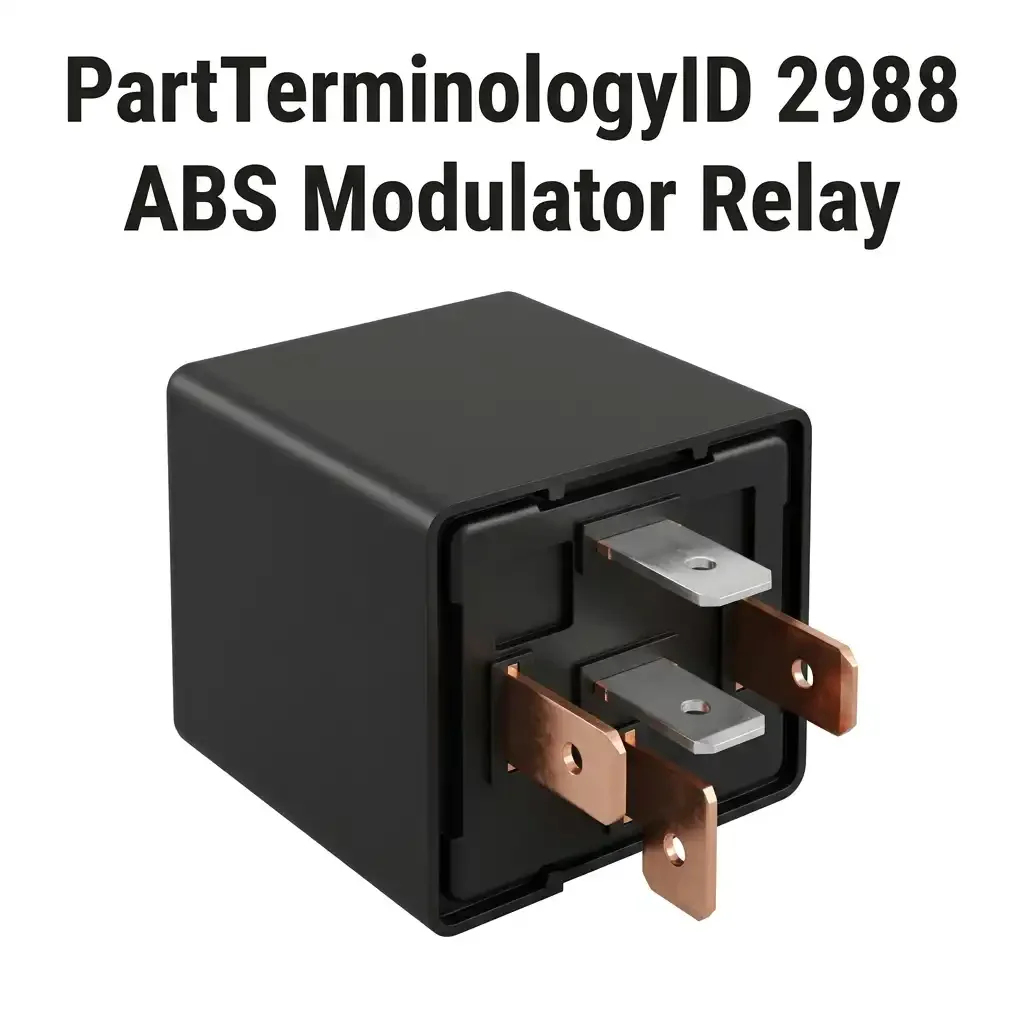
PartTerminologyID 2988, ABS Modulator Relay, is the relay that supplies switched battery voltage to the ABS modulator valve solenoids within the hydraulic control unit, enabling the ABS control module to command individual wheel brake pressure modulation during an ABS braking event by energizing the solenoids that open and close the hydraulic circuits for each wheel independently. That definition covers the modulator solenoid power supply function correctly and leaves unresolved the contact current rating relative to the combined simultaneous solenoid current draw of all modulator channels, whether the relay is a standalone unit or is integrated into the ABS control module assembly, whether the vehicle's ABS architecture separates the modulator relay from the pump and motor relay or combines both functions in a single relay, and the relay's mounting location in the underhood relay center versus on the ABS hydraulic control unit body.
For sellers, PartTerminologyID 2988 is a safety-critical relay PartTerminologyID because the ABS modulator relay directly enables the anti-lock braking function that prevents wheel lockup in emergency stops. A failed modulator relay disables ABS entirely on any vehicle where this relay is the sole power supply to the modulator solenoids. The ABS warning light illuminates to indicate the fault and the vehicle reverts to conventional non-ABS braking. The listing must frame the safety context clearly: ABS is disabled, not merely degraded, when this relay fails, and the vehicle should not be operated in conditions where ABS activation is likely until the relay is replaced.
What the ABS Modulator Relay Does
During normal braking the modulator relay remains energized and the solenoids remain in their default positions, allowing normal hydraulic pressure from the master cylinder to reach the wheel calipers. When the ABS control module detects wheel lockup from the wheel speed sensors, it commands the modulator solenoids to cycle through hold, reduce, and increase pressure phases at each affected wheel. The relay must supply stable voltage to all solenoids simultaneously during these rapid cycle sequences. A relay with marginal contact resistance produces a voltage drop across the contact during multi-solenoid simultaneous activation that reduces the solenoid actuation force and slows the hydraulic response, degrading ABS performance without triggering a fault code that would illuminate the ABS warning light.
This sub-threshold degradation mode is the most dangerous failure mode of a marginal ABS modulator relay. The ABS system appears functional because no fault code is stored and no warning light illuminates, but the modulator solenoids receive reduced voltage during simultaneous activation and the hydraulic response is slower than specification. In a real emergency stop the ABS performance is measurably degraded from the design specification. A replacement relay with contact resistance within specification restores full solenoid voltage and correct hydraulic response timing.
Modulator solenoid architecture and simultaneous activation current
The ABS modulator contains multiple solenoid valves that control hydraulic pressure in each wheel's brake circuit independently. During an ABS event the controller may activate several solenoids simultaneously to manage pressure in multiple wheel circuits at the same time. The modulator relay must supply sufficient current for all solenoids operating simultaneously without the contact voltage drop reducing solenoid actuation force below the minimum threshold for reliable valve movement. A relay with adequate current rating for one solenoid may produce a contact voltage drop that reduces actuation force when three or four solenoids are activated simultaneously, causing delayed or incomplete valve response without triggering a fault code because the voltage drop is below the ABS controller's fault detection threshold.
Voltage drop diagnosis and the sub-threshold degradation mode
The sub-threshold degradation mode is the most safety-critical failure pattern for the ABS modulator relay. Contact resistance above approximately 0.05 ohms produces a voltage drop that reduces solenoid actuation force during simultaneous multi-solenoid activation events. The ABS system appears functional in normal driving and during single-wheel slip events where only one solenoid activates at a time. The degraded performance only appears during the most demanding ABS events involving simultaneous multi-wheel slip, which are precisely the events where ABS performance matters most. Measuring relay contact resistance with a milliohm meter before condemning the ABS system for poor wet-road stopping performance is the diagnostic step that identifies this sub-threshold failure mode.
ABS modulator relay position in the circuit and the power supply architecture
The ABS modulator relay is the primary power supply enable relay for the modulator solenoid circuit. It connects the battery supply rail to the solenoid valve bank in the modulator body. When the ABS module commands the relay closed at the start of an ABS event, all solenoid valves in the modulator have their supply rail energized and the ABS module can then individually activate or de-activate each valve through separate ground-side drivers. The relay's position as the common supply enable means that a failed-open relay removes supply voltage from all solenoid valves simultaneously, disabling the entire modulator regardless of which individual valve circuit the ABS module is attempting to activate. The single relay controls whether the modulator can operate at all, not which specific valve is active at any moment.
Relay current rating specification for simultaneous valve activation
ABS modulator solenoid valves draw 1 to 3 amperes each depending on the valve design and operating voltage. A four-channel ABS system with eight solenoid valves drawing 2 amperes each requires a modulator relay rated for at least 16 amperes when all valves could theoretically be activated simultaneously, plus a margin above the rated simultaneous current. In practice not all valves are activated at the same instant, but the relay contact rating must reflect the maximum simultaneous draw rather than the average or typical draw. A relay rated for 10 amperes installed in a system with 16-ampere simultaneous valve demand will experience contact stress on every worst-case ABS event.
Why This Part Generates Returns
Buyers return ABS modulator relays because the relay is integrated into the ABS control module and cannot be replaced separately, the modulator relay and pump relay are combined in a single unit and the listing covers only the modulator function requiring separate purchase of the pump relay, and the ABS warning light remains on after relay replacement because a wheel speed sensor or ABS module fault is also present.
Status in New Databases
PIES/PCdb: PartTerminologyID 2988, ABS Modulator Relay
PIES 8.0 / PCdb 2.0: No change.
Listing Requirements
PartTerminologyID: 2988
safety criticality: ABS disabled when relay fails (mandatory)
contact current rating for simultaneous multi-solenoid load (mandatory)
standalone versus module-integrated: confirm separate relay exists (mandatory)
modulator-only versus combined modulator and pump relay (mandatory)
mounting location (mandatory)
post-replacement ABS scan verification note (mandatory)
OEM part number cross-reference (mandatory)
FAQ (Buyer Language)
Will replacing the ABS modulator relay fix my ABS warning light?
Only if the relay is confirmed as the fault source by ABS scan tool diagnosis. Other ABS faults including wheel speed sensor failures and ABS module faults produce the same warning light. Confirm the fault code points to the modulator relay circuit before ordering.
Is the modulator relay the same as the ABS pump relay?
Not always. Some vehicles use separate relays for the modulator solenoids and the pump motor. Others combine both in a single relay. Verify whether the vehicle uses separate or combined relays before ordering.
Does the ABS warning light always illuminate when the modulator relay fails?
Yes if the relay fails completely and the ABS module loses its power supply entirely. The ABS module detects the power loss and stores a fault code that illuminates the ABS warning light. However, a relay with elevated contact resistance that degrades ABS performance without completely interrupting the module power supply may not illuminate the ABS warning light because the ABS module continues to receive sufficient voltage to operate and does not detect a hard fault. The sub-threshold degradation mode produces impaired ABS performance with no warning light.
What is the post-replacement scan verification step?
After relay replacement, connect a scan tool and command ABS self-test or read the ABS module's current fault codes. Confirm no fault codes are stored for the modulator relay circuit or the modulator solenoid circuits. On vehicles where the ABS module stores non-volatile fault codes, clear the codes after relay replacement and verify no new codes set during a test drive that includes moderate braking on a dry surface to confirm ABS activation and deactivation cycle with the new relay.
Top Return Scenarios
Scenario 1: "ABS light on, relay replaced, ABS light still on"
The buyer sees the ABS warning light, replaces the modulator relay, and the light remains on. A scan tool retrieves a fault code for a wheel speed sensor or ABS module communication fault that is unrelated to the modulator relay. The relay was not the fault. The ABS light was triggered by the wheel speed sensor fault and the relay replacement had no effect on the stored code. The buyer returns the relay as defective when the relay was never the fault.
Prevention language: "Retrieve ABS fault codes with a scan tool before replacing any ABS component. The ABS warning light is triggered by fault codes that may indicate wheel speed sensors, ABS module faults, or pump relay faults rather than the modulator relay. Relay replacement does not clear fault codes caused by other system components."
Scenario 2: "ABS braking feels spongy at high demand, no warning light"
The buyer notices reduced ABS effectiveness on slippery surfaces with no ABS warning light. The modulator relay has elevated contact resistance producing a voltage drop that reduces solenoid actuation force during multi-solenoid simultaneous activation. The sub-threshold degradation does not trigger the ABS module's fault detection. Measuring relay contact resistance with a milliohm meter identifies the elevated resistance. Relay replacement with a new unit of full contact specification restores solenoid actuation force to specification.
Prevention language: "A modulator relay with elevated contact resistance degrades ABS performance without triggering the ABS warning light. If ABS braking effectiveness has declined, measure relay contact resistance before condemning the ABS module or hydraulic unit."
Cross-Sell Logic
ABS Pump and Motor Relay (PartTerminologyID 2992): confirm the pump relay is functional alongside the modulator relay on vehicles with separate relay architecture
Wheel Speed Sensor: for buyers where the ABS fault code identifies a wheel speed sensor fault rather than a relay fault
ABS Module: for buyers where the relay coil receives no activation voltage because the ABS module output driver has failed
Catalog Checklist for ACES/PIES Teams
PartTerminologyID = 2988
require contact current rating for simultaneous solenoid activation load (mandatory)
require coil resistance within ABS module driver tolerance (mandatory)
require back-EMF suppression specification: suppression diode or varistor across solenoid coils prevents arc erosion at relay contact on each solenoid de-energization event (mandatory)
require integrated versus discrete relay confirmation: some ABS units integrate the modulator relay inside the hydraulic control unit housing making the relay inaccessible as an external component (mandatory)
prevent relay order before scan tool fault code retrieval: ABS warning light requires fault code diagnosis before any component replacement
differentiate from ABS Pump and Motor Relay PartTerminologyID 2992: modulator relay switches solenoid supply; pump relay switches pump motor supply; different current requirements on vehicles with separate relay architecture
differentiate from ABS Relay PartTerminologyID 3008: combined relay applications require PartTerminologyID 3008; separate modulator relay applications require PartTerminologyID 2988
Final Take for PartTerminologyID 2988
ABS Modulator Relay (PartTerminologyID 2988) is a safety-critical relay where ABS-disabled operating guidance, standalone versus module-integrated verification, and post-replacement scan confirmation are mandatory listing attributes. The sub-threshold degradation mode makes contact resistance specification as important as contact current rating for this application.