
Written by Arthur Simitian | PartsAdvisory
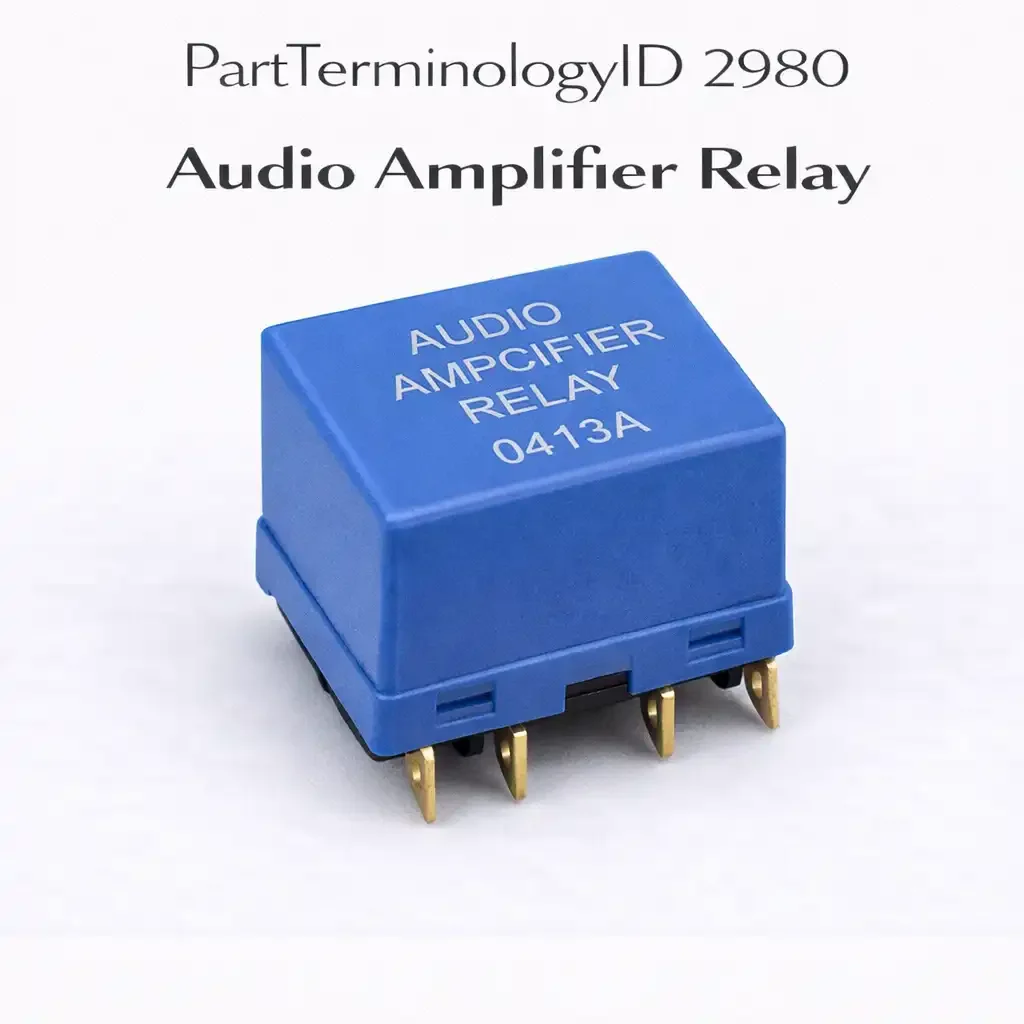
PartTerminologyID 2980, Audio Amplifier Relay, is the relay that switches the power supply to the vehicle's factory or aftermarket audio amplifier, enabling the BCM or head unit remote turn-on circuit to activate the amplifier when the audio system is in use and de-activate it when the audio system is off or when the vehicle enters a power management mode that shuts down non-essential high-current loads. That definition covers the amplifier power switching function correctly and leaves unresolved whether the relay switches the main B+ supply to the amplifier, the remote turn-on signal amplifier relay triggered by the head unit's remote output, the contact current rating relative to the amplifier's peak power draw, and whether the amplifier relay is a standalone unit at the amplifier mounting location or an ISO relay in the vehicle's fuse and relay center.
For sellers, PartTerminologyID 2980 is the audio system relay PartTerminologyID where the contact current rating is the most return-generating specification because audio amplifiers draw substantially higher peak current than their rated RMS output suggests. A 200-watt RMS four-channel amplifier may draw 25 to 35 amperes at peak output. A relay with a 20-amp contact rating will chatter and fail under the peak current demand of a moderately powered amplifier, producing intermittent audio cutout at high volume followed by relay failure.
What the Audio Amplifier Relay Does
Remote turn-on circuit and the relay's activation architecture
The audio amplifier relay operates from the head unit's remote turn-on output, a low-current 12-volt signal that the head unit activates when the audio system is powered on. This remote signal is too low in current to directly power the amplifier's main supply, so it energizes the relay coil, which closes the high-current main contact that applies battery voltage to the amplifier's B+ terminal. The relay provides the current amplification between the head unit's milliamp-level remote output and the amplifier's multi-ampere main supply requirement.
A failed relay in this architecture produces an amplifier that appears completely dead: no audio output, no power indicator, no response to any controls. The head unit plays normally through any speakers connected directly to it without the amplifier, but the amplifier-powered speakers or subwoofer produce nothing. This symptom pattern, normal head unit output with dead amplifier, identifies the relay, the amplifier fuse, or the amplifier itself as the fault scope, and the relay and fuse should be verified before the amplifier is condemned.
Contact current rating and amplifier peak demand
The contact current rating must account for the amplifier's peak current demand rather than its average or RMS demand. Amplifier peak current occurs during bass transients at high volume where the power supply instantaneously delivers maximum current to the output transistors. A relay sized for the amplifier's nominal operating current will experience contact stress during peak transients that is two to three times the nominal rating. Over hundreds of high-volume listening sessions, the accumulated peak current stress erodes the contact surfaces, increases contact resistance, causes voltage drop at the amplifier supply terminal, and eventually produces audible distortion from supply voltage sag before the relay fails completely.
Amplifier location and relay mounting position
The audio amplifier relay is typically mounted in the underdash fuse and relay center or in a dedicated amplifier power relay bracket near the amplifier's mounting location in the trunk, under-seat, or cargo area. On vehicles where the amplifier is mounted remotely from the main fuse center, the relay may be located in a small secondary relay bracket on the amplifier harness rather than in the main engine bay or underdash relay panel. A buyer who checks the main fuse center for the relay and finds no relay at that location may conclude incorrectly that the relay does not exist on the vehicle. Confirming the relay mounting location from the service manual before diagnosing the relay as absent prevents this misdiagnosis.
Head unit remote turn-on signal and the relay coil activation path
The relay coil activation path runs from the head unit's remote turn-on output terminal through the signal wire to the relay coil positive terminal. When the head unit powers on, it sends a low-current 12-volt signal on the remote turn-on wire that energizes the relay coil. A head unit that has failed internally may not produce the remote turn-on signal even though the head unit itself appears to power on normally with display and source selection functioning. The relay receives no coil activation and the amplifier remains off. Testing for coil activation voltage at the relay socket with the head unit powered on confirms whether the relay is receiving its command signal before the relay is condemned.
Peak current demand versus RMS rating and the relay contact sizing error
Aftermarket amplifier specifications are quoted in RMS watt output, but the relay contact rating must be matched to the amplifier's peak supply current draw, not the RMS output wattage. An amplifier rated at 200 watts RMS may draw 25 to 35 amperes from the 12-volt supply during musical peaks, depending on the power supply efficiency and the peak-to-average ratio of the audio signal. A buyer who divides the amplifier's watt rating by 12 volts and selects a relay based on that calculation underestimates the peak current by a factor of two or more on musical transient peaks. The relay contact must be rated above the peak supply current with a margin that accounts for the repeated thermal cycling of the contact material during sustained high-power listening sessions.
Relay mounting location and heat environment
Amplifier relays mounted in the engine bay fuse center experience temperatures that may reach 90 degrees Celsius on hot days with the hood closed. Relay contact current ratings are typically specified at 23 degrees Celsius ambient. At 90 degrees Celsius a relay rated at 30 amperes at room temperature may have an effective rating of 20 to 22 amperes due to the higher resistance of the contact material at elevated temperature. A relay operating near its rated current at room temperature operates above its effective rating in a hot engine bay. Buyers installing high-power amplifiers must account for the relay's mounting environment temperature when selecting the contact current rating to avoid a relay that is technically within its rating at room temperature but above its effective capacity in the vehicle's actual operating environment.
Why This Part Generates Returns
Buyers return audio amplifier relays because the contact current rating is below the amplifier's peak demand and the relay chatters at high volume before failing, the remote turn-on relay is delivered for an amplifier that uses a B+ switched relay architecture producing a permanently de-energized amplifier, and the relay is installed without resolving the root cause of the original failure such as a shorted output transistor that exceeded the relay contact rating and caused both the transistor failure and the relay failure simultaneously.
Status in New Databases
PIES/PCdb: PartTerminologyID 2980, Audio Amplifier Relay
PIES 8.0 / PCdb 2.0: No change.
Listing Requirements
PartTerminologyID: 2980
circuit switched: main B+ supply or remote turn-on amplification (mandatory)
contact current rating: continuous and peak (mandatory)
coil activation source: head unit remote output or BCM (mandatory)
amplifier power class compatibility note (mandatory)
mounting: amplifier location relay or fuse center ISO relay (mandatory)
OEM part number cross-reference (mandatory)
FAQ (Buyer Language)
Why is my amplifier completely dead but the head unit works?
The amplifier relay, the amplifier fuse, or the amplifier itself is the fault scope. Check the relay and fuse before condemning the amplifier. A dead relay produces a completely inert amplifier with no power indicator regardless of head unit operation.
What current rating do I need for my amplifier relay?
Use the amplifier's maximum fuse rating as the minimum relay contact rating. A 200-watt four-channel amplifier fused at 30 amperes requires a relay rated for at least 30 amperes continuous contact current, with 40 or higher recommended for adequate peak margin.
How do I confirm the relay is the fault before ordering?
With the head unit on and the remote turn-on signal present at the relay coil terminal, measure voltage at the relay contact output terminal. Coil voltage present but no contact output voltage confirms a failed relay contact. No coil voltage with the head unit on indicates the head unit remote turn-on output has failed and the relay is receiving no command signal. Jump the relay coil terminals directly to confirm the amplifier powers on before ordering a replacement relay.
Can I use a standard ISO relay as an audio amplifier relay?
Only if the contact current rating meets the amplifier's peak current demand and the coil resistance is compatible with the head unit's remote turn-on output. Standard ISO relays are available in 20, 30, and 40-amp contact ratings. Match the rating to the amplifier's peak supply current requirement rather than its rated RMS output. A 200-watt RMS amplifier may draw 30 or more amperes at peak, requiring a relay contact rated at a minimum of 30 amperes with a safety margin above the peak demand.
Top Return Scenarios
Scenario 1: "Amplifier completely dead, head unit works, fuse is good"
The buyer confirms the head unit plays audio through the front speakers powered by the head unit's internal amplifier. The external amplifier is silent. The dedicated amplifier fuse is intact. The relay is confirmed as the next diagnostic step. The buyer measures coil activation voltage at the relay socket with the head unit on and confirms the relay coil receives the remote turn-on signal. Contact output voltage is absent. The relay contact has failed open and is not delivering supply current to the amplifier. Relay replacement restores amplifier function immediately.
Prevention language: "Confirm coil activation voltage at the relay socket before ordering. A dead amplifier with the fuse intact and the head unit functioning indicates a relay contact failure when coil voltage is present but contact output voltage is absent. If no coil voltage is present, the head unit's remote turn-on output has failed and the amplifier relay is not the fault."
Scenario 2: "Relay replaced, amplifier still dead, relay coil gets no voltage"
The buyer replaces the relay. The amplifier remains silent. Testing confirms no coil activation voltage at the relay socket. The head unit's remote turn-on output has failed and is sending no signal. The relay replacement had no effect because the relay was never receiving an activation command. The fault is the head unit output, not the relay. A second relay is ordered and returned as also defective when the head unit output is the actual fault.
Prevention language: "Measure voltage at the relay coil terminal with the head unit powered on before ordering. No coil voltage indicates the head unit's remote turn-on output has failed. The relay is not at fault and replacement will not restore amplifier function until the head unit output fault is resolved."
Cross-Sell Logic
Head Unit: for buyers where the amplifier relay coil receives no activation voltage because the head unit's remote turn-on output has failed
Amplifier Wiring Harness: for buyers where the relay is functional but the amplifier supply wire has an open fault between the relay and the amplifier power input terminal
Inline Fuse Holder: for buyers adding aftermarket amplifiers to vehicles without a factory-fitted amplifier relay circuit
Final Take for PartTerminologyID 2980
Audio Amplifier Relay (PartTerminologyID 2980) is the audio system relay where contact current rating matched to amplifier peak demand and circuit type identification between remote turn-on relay and B+ supply relay are the two attributes that prevent the two most distinct return scenarios in the amplifier relay replacement market.