
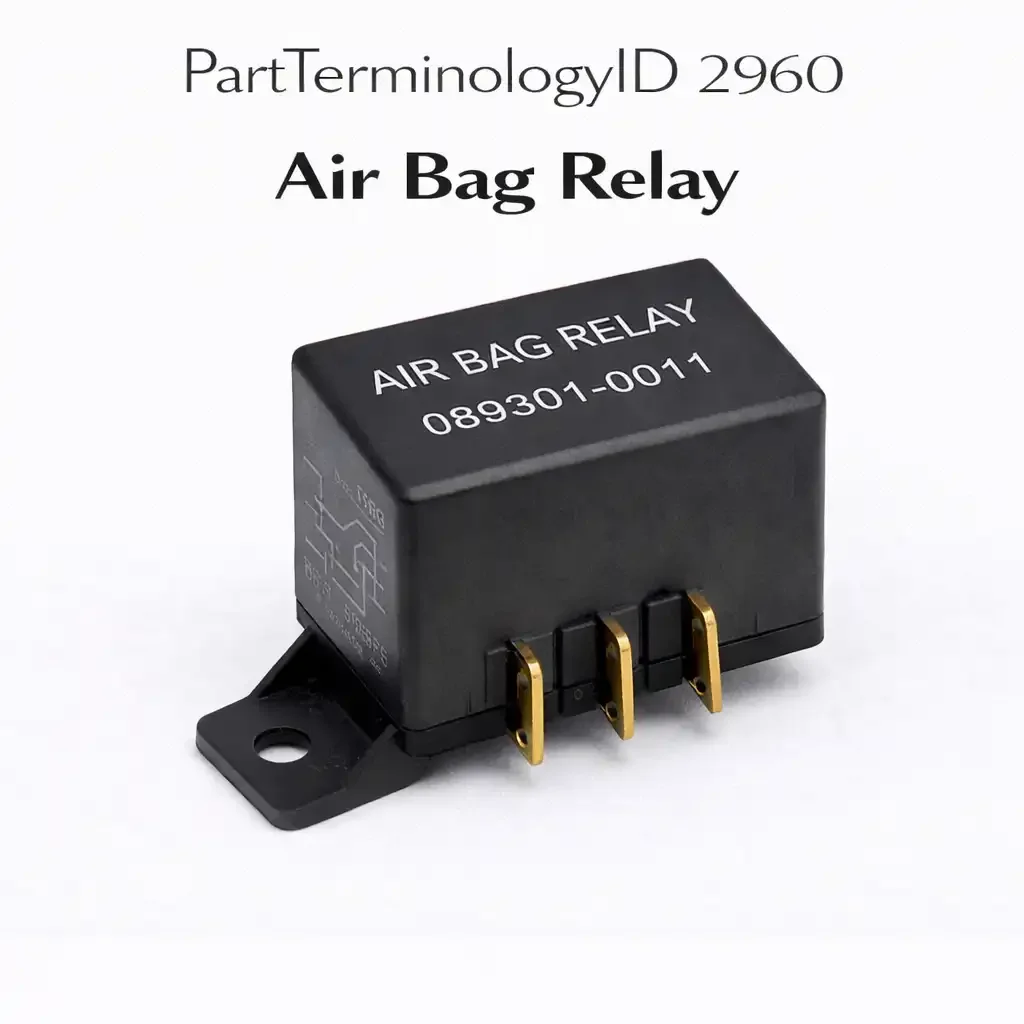
Written by Arthur Simitian | PartsAdvisory
PartTerminologyID 2960, Air Bag Relay, is the relay within the supplemental restraint system circuit that provides the power supply switching function for the airbag control module or the inflator squib circuits, allowing the SRS control module to command inflator deployment or to maintain the deployment circuit in a ready state depending on the relay's specific role in the SRS architecture. That definition covers the airbag circuit power switching function correctly and leaves unresolved the specific role the relay plays in the SRS circuit, whether it is the primary SRS power relay that supplies the control module, the deployment enable relay that arms the squib firing circuits, or the SRS diagnostic power relay that enables the self-test circuit at ignition-on, the safety criticality of this relay compared to any other relay in the vehicle's electrical system, the OEM part number requirement that must be matched exactly because SRS components are safety-critical parts where aftermarket substitution is not acceptable in most professional repair contexts, and the federal requirements for SRS component documentation and replacement traceability.
For sellers, PartTerminologyID 2960 is the most safety-critical relay PartTerminologyID in the catalog. The airbag relay is part of the supplemental restraint system, which is federally regulated under FMVSS 208 as a system whose correct function is directly required for occupant protection in a crash. An incorrect or non-functional SRS relay can prevent airbag deployment in a crash that would otherwise trigger deployment, eliminate the SRS self-test that warns of SRS faults, or in rare failure modes create conditions that enable inadvertent deployment. The listing must be unambiguous that only OEM-specification replacement relays are appropriate for this application, that aftermarket substitution for SRS components requires documented equivalence testing, and that any SRS relay replacement should be followed by an SRS system self-test using a scan tool to confirm the system reports ready status.
What the Air Bag Relay Does
SRS power relay architecture and deployment circuit role
The SRS system uses one or more relays at specific points in the deployment circuit architecture. The primary SRS power relay supplies battery voltage to the SRS control module and is one of the first components activated at ignition-on. The SRS module performs its self-diagnostic with power supplied through this relay. A failed SRS power relay prevents the SRS module from receiving power and causes the airbag warning light to illuminate continuously because the module cannot complete its self-test and confirm system ready status.
The deployment enable relay, where present in the architecture, arms the squib firing circuit after the SRS module has completed its self-test and confirmed system health. In the disarmed state the firing circuit cannot receive the deployment current even if the SRS module commands it, providing a fail-safe against inadvertent deployment during post-collision handling, rescue operations, and vehicle servicing when the airbag system should be disarmed. The enable relay is commanded to the armed state by the SRS module only after successful self-test completion and only during normal vehicle operation outside of the post-crash disarm window.
OEM replacement requirement and documentation
SRS components including the airbag relay are subject to stricter replacement standards than general automotive relays. Professional repair guidelines from manufacturer service procedures uniformly require OEM-specification replacement parts for SRS circuits, because the SRS system's deployment thresholds, timing, and circuit parameters are calibrated to specific component electrical characteristics. A relay with a coil resistance or contact resistance outside the SRS module's expected tolerance may prevent the module from confirming relay state, generate fault codes that prevent system ready status, or in worst-case scenarios affect deployment timing by introducing resistance into the squib firing circuit.
The listing must recommend OEM-specification parts for every SRS relay application and must include the SRS scan tool verification requirement as a mandatory post-installation step. A relay installed without subsequent SRS scan tool verification leaves the system in an unknown state that may not be detected by the driver until a crash event. The post-installation SRS system check is not optional context. It is a required safety verification step that belongs in the listing description before the buyer orders.
Why This Part Generates Returns
Buyers return air bag relays because the airbag warning light remains illuminated after relay replacement because a different SRS fault is present that the relay replacement did not address, the aftermarket relay's coil resistance is outside the SRS module's monitoring tolerance and the module reports a relay circuit fault after the new relay is installed, the relay was replaced as the sole response to an SRS fault code without a complete SRS system diagnosis and the fault code recurs from a different SRS component fault, and the buyer did not perform the post-installation SRS scan tool verification and does not know whether the system reports ready status.
Status in New Databases
PIES/PCdb: PartTerminologyID 2960, Air Bag Relay
PIES 8.0 / PCdb 2.0: No change.
Top Return Scenarios
Scenario 1: "Airbag light still on after relay replacement, different SRS fault present"
The buyer replaces the airbag relay for an SRS relay fault code. The airbag light remains on after replacement. A different SRS fault, a clock spring fault or a side curtain sensor fault, was also present and continues to illuminate the SRS warning light independently of the relay.
Prevention language: "SRS diagnostic note: After relay replacement, perform a complete SRS scan to confirm all fault codes are cleared and the system reports ready status. An SRS warning light that remains on after relay replacement indicates one or more additional SRS faults that must be addressed. Relay replacement resolves only relay-specific fault codes."
Scenario 2: "Aftermarket relay coil resistance out of tolerance, module reports relay fault"
The aftermarket relay has a coil resistance of 110 ohms. The SRS module monitors the relay coil circuit and expects 75 to 85 ohms. The module reports a relay circuit resistance fault. The SRS warning light illuminates. The original relay was within tolerance. The aftermarket replacement is not.
Prevention language: "OEM specification required: SRS relays must meet the SRS module's coil resistance tolerance. Use OEM-specification replacement parts only. Aftermarket relays with coil resistance outside the module's monitoring tolerance will generate SRS fault codes regardless of physical fit."
Listing Requirements
PartTerminologyID: 2960
SRS circuit role: primary power relay, deployment enable relay, or diagnostic power relay (mandatory)
OEM specification requirement and aftermarket equivalence documentation (mandatory)
coil resistance in ohms within SRS module tolerance (mandatory)
post-installation SRS scan tool verification requirement (mandatory)
complete SRS diagnosis before relay replacement note (mandatory)
FMVSS 208 safety criticality disclosure (mandatory)
OEM part number (mandatory)
FAQ (Buyer Language)
Is the airbag relay safety critical?
Yes. It is part of the federally regulated SRS system under FMVSS 208. Use only OEM-specification replacement parts. After installation, perform a complete SRS scan to confirm the system reports ready status before returning the vehicle to service.
Why is my airbag light still on after I replaced the relay?
The relay replacement resolved only the relay fault. One or more additional SRS faults are present and must be diagnosed and corrected. A complete SRS scan is required after every SRS component replacement.
Final Take for PartTerminologyID 2960
Air Bag Relay (PartTerminologyID 2960) is the safety-critical relay PartTerminologyID where OEM specification requirement, coil resistance tolerance, and post-installation SRS scan verification are not optional listing attributes. They are safety obligations. Every listing without these three elements is incomplete for an SRS component.