
Written by Arthur Simitian | PartsAdvisory
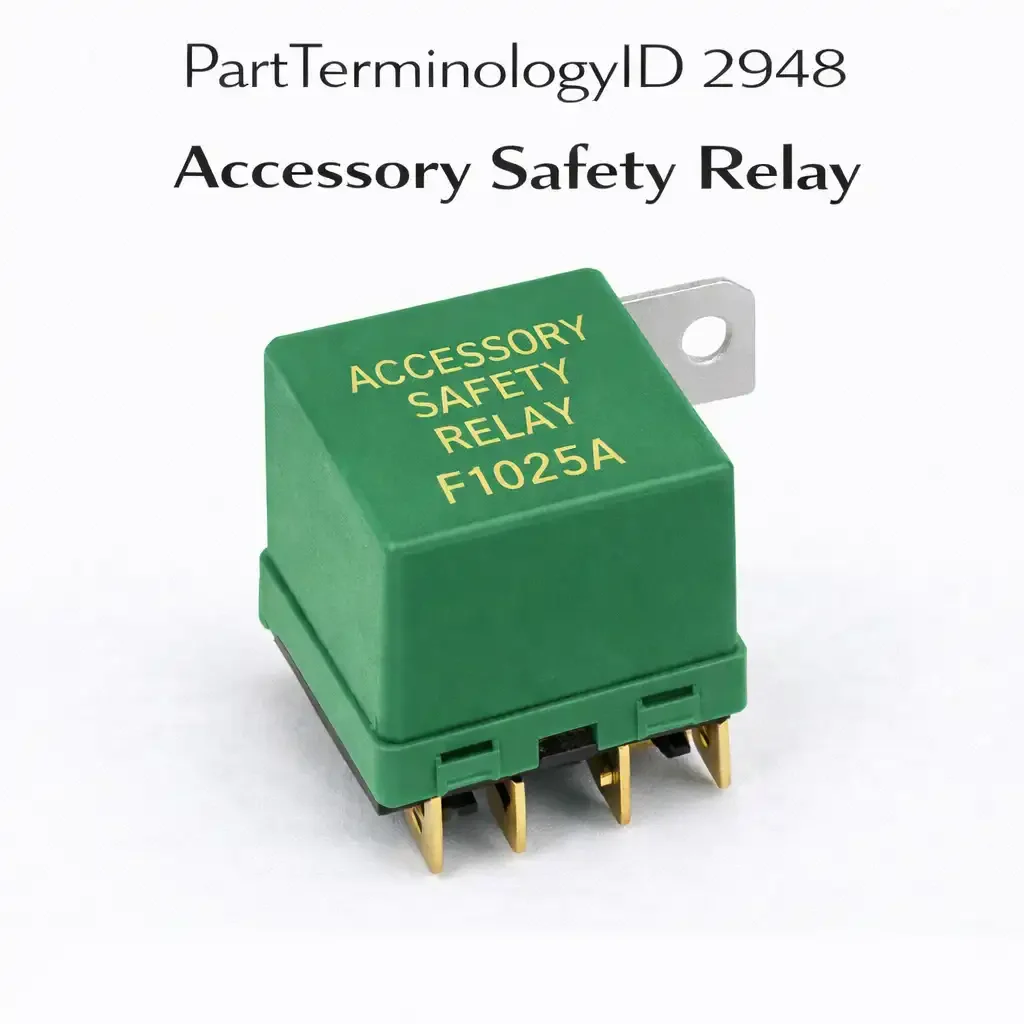
PartTerminologyID 2948, Accessory Safety Relay, is the relay that provides fail-safe or overcurrent protection switching in the vehicle's accessory circuit, de-energizing the accessory load circuit when a fault condition such as overcurrent, overvoltage, or a monitored system fault is detected, protecting the accessory components and wiring from damage that would result from continued operation under fault conditions. That definition covers the protective switching function correctly and leaves unresolved the specific fault condition the relay monitors, whether it is a current-sensing relay with an internal trip threshold or a relay driven by an external safety module that monitors the fault condition and commands relay de-energization, the reset behavior after a fault trip whether automatic reset after fault clearance or manual reset required, the contact current rating relative to the protected load, and whether the relay is a standalone component or is integrated into a combined relay and fuse assembly.
For sellers, PartTerminologyID 2948 is the relay PartTerminologyID where the reset behavior distinction is the most buyer-confusing attribute. A relay that requires manual reset after a fault trip will leave the accessory circuit dead after the fault condition is corrected until the driver performs the reset procedure. If the listing does not disclose the manual reset requirement, the buyer installs the replacement, restores the circuit momentarily, has the same fault trip the relay again, and returns the replacement believing it is also defective rather than recognizing that the root fault is still present and the relay has correctly tripped a second time.
What the Accessory Safety Relay Does
Trip condition, reset behavior, and fault diagnosis
The accessory safety relay's function is to remove power from the protected circuit when the monitored condition exceeds the relay's trip threshold. A current-sensing safety relay with a 30-amp trip threshold monitors the load current continuously and opens the contact when current exceeds 30 amperes for more than the relay's programmed time delay. This protects the wiring and accessory components from the sustained overcurrent that would otherwise cause insulation damage or component failure.
After a trip event, the relay's reset behavior determines the recovery process. An automatic-reset relay restores the circuit after the overcurrent condition clears and a cooling interval expires. A manual-reset relay remains open until the driver presses a reset button or removes and reinstalls the relay. The listing must state the reset behavior explicitly because the symptom of an accessory circuit that operates briefly and then cuts off, which is the signature of an automatic-reset relay repeatedly tripping on a persistent overcurrent, appears identical to the symptom of a failed relay that opens and never recovers, which is the signature of a relay that has failed open. Without the reset behavior disclosure, the buyer cannot distinguish a correctly functioning safety relay from a failed relay based on symptoms alone.
Why This Part Generates Returns
Buyers return accessory safety relays because the relay trips correctly on a persistent fault and the buyer believes the replacement is defective, the manual reset requirement is not disclosed and the buyer cannot restore the circuit after the root fault is corrected, the trip current threshold is calibrated for a lower accessory load than the buyer's modified vehicle now carries and the relay trips under normal operation, and the replacement relay's trip delay is shorter than the original causing nuisance trips during normal accessory inrush events.
Status in New Databases
PIES/PCdb: PartTerminologyID 2948, Accessory Safety Relay
PIES 8.0 / PCdb 2.0: No change.
Listing Requirements
PartTerminologyID: 2948
fault condition monitored: overcurrent, overvoltage, or system fault signal (mandatory)
trip threshold (mandatory)
reset behavior: automatic or manual with reset procedure (mandatory)
contact current rating (mandatory)
standalone versus integrated relay-fuse assembly (mandatory)
root fault diagnosis note: a tripped safety relay indicates a real fault; the fault must be identified and corrected before relay replacement (mandatory)
OEM part number cross-reference (mandatory)
FAQ (Buyer Language)
Why does my new safety relay keep tripping?
Because the fault that caused the original to trip is still present. The safety relay functions correctly by de-energizing the circuit when the fault condition recurs. Identify and correct the root fault before assuming the replacement relay is defective.
How do I reset a tripped safety relay?
Automatic-reset units restore themselves after the fault clears and a cooling period expires. Manual-reset units require pressing a reset button or cycling the relay. The reset behavior is stated in the listing. A relay that does not restore after apparent fault correction is either a manual-reset unit awaiting a reset action or a relay that has failed open from repeated tripping.
Why This Part Generates Returns
Buyers return accessory safety relays because the relay correctly tripped on an overcurrent condition and the buyer returned it as defective without identifying and resolving the root fault that caused the trip, the reset behavior is not disclosed and a manual-reset relay is installed then declared failed because the circuit does not restore automatically after the apparent fault clears, the trip threshold is lower than the buyer's actual accessory load and the relay trips repeatedly because the load exceeds the relay's protection rating rather than because the relay is defective, and the relay is integrated into the fuse box assembly on this vehicle and cannot be replaced as a discrete external component. Each of these return scenarios is preventable with a single line of listing text that addresses the specific scenario directly.
The overcurrent root fault scenario is the most consequential because it produces a cycle: the buyer's accessory circuit trips, the buyer replaces the relay, the circuit trips again within minutes, and the buyer returns the second relay as also defective. The accessory load that caused the original overcurrent is still present, and the replacement relay responds to it identically to the original. Resolving the overcurrent fault before ordering a relay replacement breaks this cycle. The listing must make the root fault diagnosis step explicit as the first action before replacement, not an afterthought buried in a FAQ answer.
Final Take for PartTerminologyID 2948
Accessory Safety Relay (PartTerminologyID 2948) is the protection relay where reset behavior disclosure and root fault diagnosis are the two attributes that prevent the two most common return scenarios. A manual-reset relay installed without disclosure will be returned every time the buyer finds the circuit does not restore automatically. A relay replaced without resolving the overcurrent fault will be returned every time the circuit trips again on the same persistent fault. Both scenarios are fully preventable with explicit listing language. The trip threshold and integrated versus discrete relay architecture are the supporting attributes that complete the fitment and installation scope for this PartTerminologyID.