
Written by Arthur Simitian | PartsAdvisory
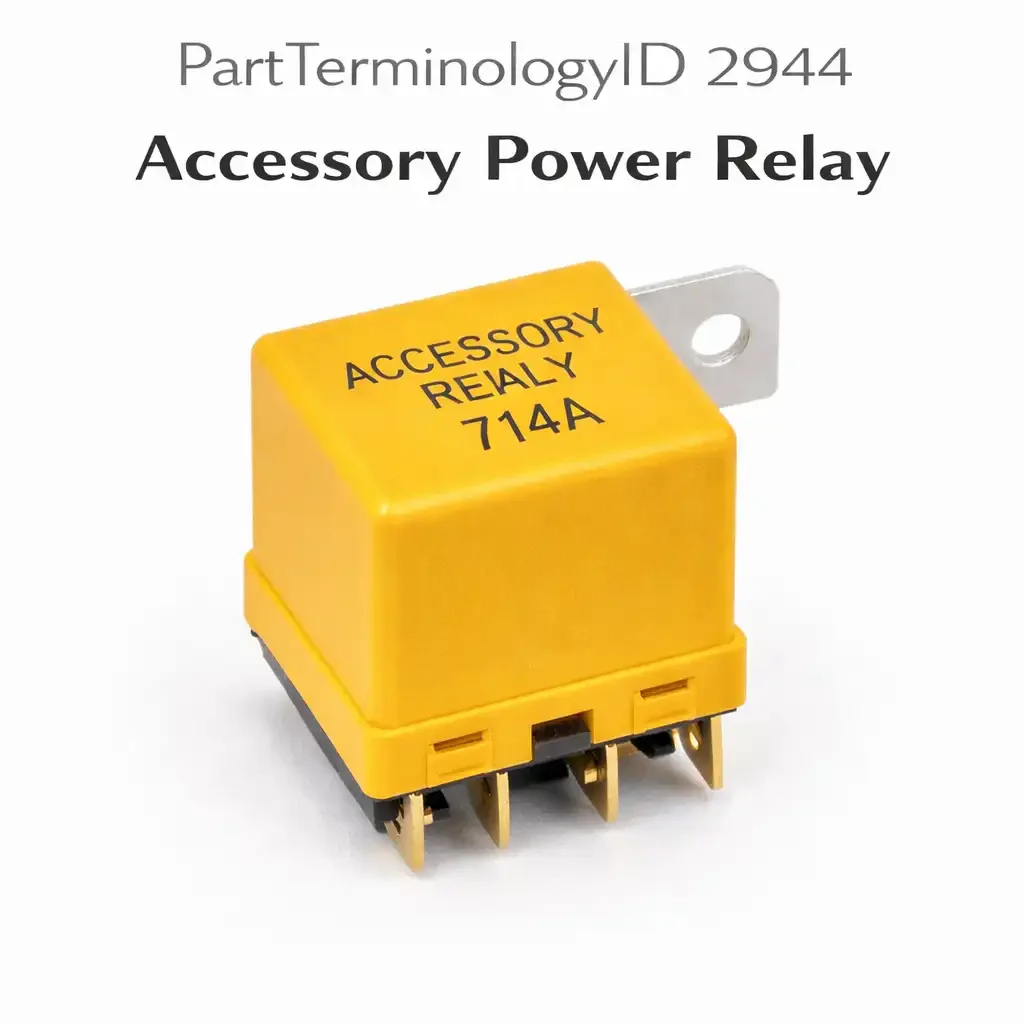
PartTerminologyID 2944, Accessory Power Relay, is the relay that switches battery or ignition-switched voltage to the vehicle's accessory circuits, providing a controlled power supply to loads such as the radio, power accessories, interior lighting groups, and auxiliary equipment that are enabled when the ignition is in the accessory or run position. That definition covers the accessory circuit power switching function correctly and leaves unresolved the ignition position that activates the relay coil, whether the relay is energized in the accessory position only, the run position only, or both, the contact current rating relative to the total combined load of all accessory circuits switched through it, whether the relay is a standard miniature ISO relay in the underhood or interior fuse center or a heavy-duty relay on a dedicated mounting bracket for high-current accessory loads, whether the vehicle uses a single accessory power relay covering all accessory circuits or multiple accessory power relays segregated by circuit group, and whether the relay provides battery-direct switched power or ignition-controlled switched power that cuts off when the key is removed.
For sellers, PartTerminologyID 2944 is the most broadly applied relay PartTerminologyID in the catalog because the accessory power relay is present on virtually every vehicle produced since the introduction of accessory-position ignition switches, and because the failure of this relay disables every circuit it powers simultaneously, producing a symptom cluster of radio inoperative, power accessories inoperative, and interior lighting inoperative that motivates rapid diagnosis and replacement. The breadth of the symptom cluster is the most important diagnostic context the listing can provide, because a buyer who has a dead radio, no power windows, and no interior accessories may not immediately identify the relay as the single cause rather than three separate component failures.
What the Accessory Power Relay Does
Ignition position switching and the accessory versus run position distinction
The ignition switch provides multiple switched outputs at different key positions. The accessory position activates a subset of vehicle circuits, typically radio, power outlets, and some interior accessories, without cranking the engine. The run position activates a broader set of circuits including the fuel pump, engine management, and all accessory circuits active in the accessory position. The accessory power relay may be energized from the accessory position output, the run position output, or both, depending on the vehicle's electrical architecture and the specific accessory circuits it powers.
A replacement relay must match the coil activation circuit of the original. A relay wired to activate only from the run position output will leave all its switched circuits dead in the accessory position. A relay intended to activate from both positions but wired to only one will produce a partial accessory function that confuses diagnosis. The listing must identify the coil activation source as either the accessory position output, the run position output, or both, to prevent a wiring mismatch during installation.
Contact current rating and the simultaneous load calculation
The accessory power relay's contact current rating must exceed the peak simultaneous current draw of all circuits it switches. When the ignition is turned to the accessory position, the radio amplifier, seat memory module, power window standby circuit, interior lighting power supply, and any other accessory-position loads all activate simultaneously. The peak inrush current from all these loads combined in the first 100 milliseconds after relay closure is typically two to three times the steady-state running current. A relay with a contact current rating matched only to steady-state accessory current may chatter or fail to hold closed during the inrush event, producing an intermittent no-accessory symptom that occurs consistently at key-on and resolves after a second key cycle.
High-current accessory loads such as aftermarket audio amplifiers, electric trailer brake controllers, and auxiliary compressors installed by the vehicle owner may exceed the original relay's contact current rating if they were added without a dedicated relay. A replacement relay for a vehicle with significant aftermarket accessory loads must be rated for the actual total load, which may require a higher-rated unit than the original OEM relay. The listing should note the maximum contact current rating clearly so buyers with modified vehicles can confirm the replacement is adequate for their actual accessory load.
Multiple relay architecture and the relay identification requirement
Many vehicles use multiple accessory power relays segregated by circuit group. A separate relay may power the radio and infotainment group, the power window and seat group, the exterior lighting accessory group, and the climate control accessory group, each with its own relay in the fuse center. When the accessory power relay for one group fails, only the circuits in that group are affected. The buyer may report that the radio works but the power windows do not, which in a single-relay architecture would point to a window-specific fault, but in a multi-relay architecture points to the accessory relay for the window group rather than the window components themselves.
The listing must identify which circuit group the relay powers and must note whether the vehicle uses a single accessory relay or a multi-relay architecture with separate relays per circuit group. A buyer who needs the window group relay and receives the radio group relay has the wrong relay for the circuit that is actually faulted, even though both are legitimately described as accessory power relays on the same vehicle.
Why This Part Generates Returns
Buyers return accessory power relays because the relay is wired for run-position activation and the vehicle's original was wired for accessory-position activation leaving all circuits dead at the accessory key position, the contact current rating is below the peak inrush current from simultaneous accessory loads and the relay chatters at key-on, the vehicle has a multi-relay architecture and the radio-group relay is delivered when the buyer needed the window-group relay, the heavy-duty bracket-mount relay is delivered and the buyer needed the miniature ISO relay in the fuse center, the coil resistance is outside the BCM's output driver tolerance on a BCM-controlled relay application and the BCM output pin overheats when driving the replacement coil, and the replacement relay has a different pin 87a position relative to pin 87 compared to the original causing normally-closed circuit behavior to appear where normally-open behavior was expected.
Status in New Databases
PIES/PCdb: PartTerminologyID 2944, Accessory Power Relay
PIES 8.0 / PCdb 2.0: No change.
Top Return Scenarios
Scenario 1: "Wrong activation position, circuits dead at accessory key position"
The replacement relay coil is wired to the run position output. The original activated from both accessory and run positions. With the key in the accessory position the replacement coil is not energized and the circuits are dead. At run position everything works normally.
Prevention language: "Coil activation: [accessory position / run position / both]. This relay activates from the [position] output. Verify the coil activation source matches the original before installation."
Scenario 2: "Multi-relay vehicle, wrong circuit group relay delivered"
The buyer's power windows stopped working. The vehicle uses separate accessory relays per circuit group. The listing covers the radio group relay. The delivered relay is installed and the power windows remain non-functional because the window group relay is a different relay in a different fuse center socket position.
Prevention language: "Circuit group: [radio and infotainment / power windows and seats / climate control / exterior lighting accessories]. This relay covers the [group] circuit. Verify which accessory circuit group is faulted before ordering. Multiple accessory power relays may be present on this vehicle."
Scenario 3: "Contact current below inrush, relay chatters at key-on"
The replacement relay has a 20-amp contact rating. The combined inrush from simultaneous accessory loads reaches 28 amperes in the first 100 milliseconds. The relay contacts chatter during the inrush interval before settling. The symptom appears as a rapid clicking sound at key-on followed by normal operation. The relay contacts erode from repeated inrush events and fail within months.
Prevention language: "Contact rating: [X amps continuous, [X] amps inrush]. Verify the combined inrush current of all accessory circuits switched through this relay does not exceed the stated contact rating. Aftermarket accessory loads not present at the time of vehicle manufacture may exceed the original relay's contact rating."
Listing Requirements
PartTerminologyID: 2944
relay type: ISO miniature or heavy-duty bracket-mount (mandatory)
coil activation: accessory position, run position, or both (mandatory)
contact current rating: continuous and inrush (mandatory)
circuit group powered where multi-relay architecture exists (mandatory)
coil resistance in ohms for BCM-controlled applications (mandatory)
pin assignment: normally-open and normally-closed contact identification (mandatory)
mounting location and ISO footprint (mandatory)
OEM part number cross-reference (mandatory)
Catalog Checklist for ACES/PIES Teams
PartTerminologyID = 2944
require coil activation position (mandatory)
require contact current rating with inrush note (mandatory)
require circuit group for multi-relay architectures (mandatory)
require coil resistance for BCM-controlled relays (mandatory)
prevent activation position mismatch: wrong coil activation source leaves all switched circuits dead at the expected key position
prevent circuit group conflation: multiple accessory power relays on the same vehicle serve different groups; circuit group is a mandatory matching attribute
differentiate from Accessory Delay Relay (PartTerminologyID 2940): the delay relay holds circuits after key removal; the power relay switches supply voltage at key-on; different timing functions, similar housing
differentiate from Accessory Safety Relay (PartTerminologyID 2948): the safety relay provides overcurrent protection or fail-safe switching; the power relay provides general supply switching without safety logic
FAQ (Buyer Language)
What does the accessory power relay do?
It switches battery or ignition voltage to the vehicle's accessory circuits when the key is in the accessory or run position. A failed relay disables all circuits it powers simultaneously, producing a multi-system outage that may appear to be several separate failures.
Why do my accessories work in run but not in accessory position?
The replacement relay coil is likely wired for run-position activation only. If the original activated from both positions, the replacement will leave all circuits dead in the accessory position. Verify the coil activation source before installation.
Does my vehicle have more than one accessory power relay?
Many vehicles segregate accessory circuits into groups with a separate relay per group. If only one circuit group is faulted, identify which group relay serves those circuits before ordering. A relay for the wrong group will not resolve the fault.
Cross-Sell Logic
Fuse (accessory circuit fuse): a failed accessory power relay frequently trips the accessory fuse from the inrush or fault current that caused the relay failure; inspect and replace the fuse alongside the relay
Ignition Switch: on vehicles where the ignition switch's accessory position output has failed rather than the relay itself; confirm the coil activation voltage is present at the relay socket before replacing the relay
Body Control Module (PartTerminologyID 2888): on BCM-controlled accessory relay applications; a BCM output fault produces the same no-accessory symptom as a failed relay; verify BCM output before relay replacement
Fuse versus relay fault diagnosis in the accessory power circuit
The accessory power relay and its associated fuse produce identical symptoms when either fails: no power at the accessory output circuits. A blown fuse restores with fuse replacement. A failed relay does not restore with fuse replacement and requires relay replacement. Checking the fuse before the relay is the correct diagnostic sequence because fuse replacement is faster and less expensive than relay replacement. The listing must note the fuse-first diagnosis step to prevent relay orders for blown-fuse faults.
Final Take for PartTerminologyID 2944
Accessory Power Relay (PartTerminologyID 2944) is the relay PartTerminologyID with the broadest symptom-generating failure and the most buyer confusion between a relay failure and multiple simultaneous component failures. Coil activation position, circuit group identification in multi-relay architectures, and contact current rating relative to actual load are the three attributes that prevent the three most distinct return scenarios and give every buyer the context they need to order the correct relay for the circuit group that is actually faulted.