
Written by Arthur Simitian | PartsAdvisory
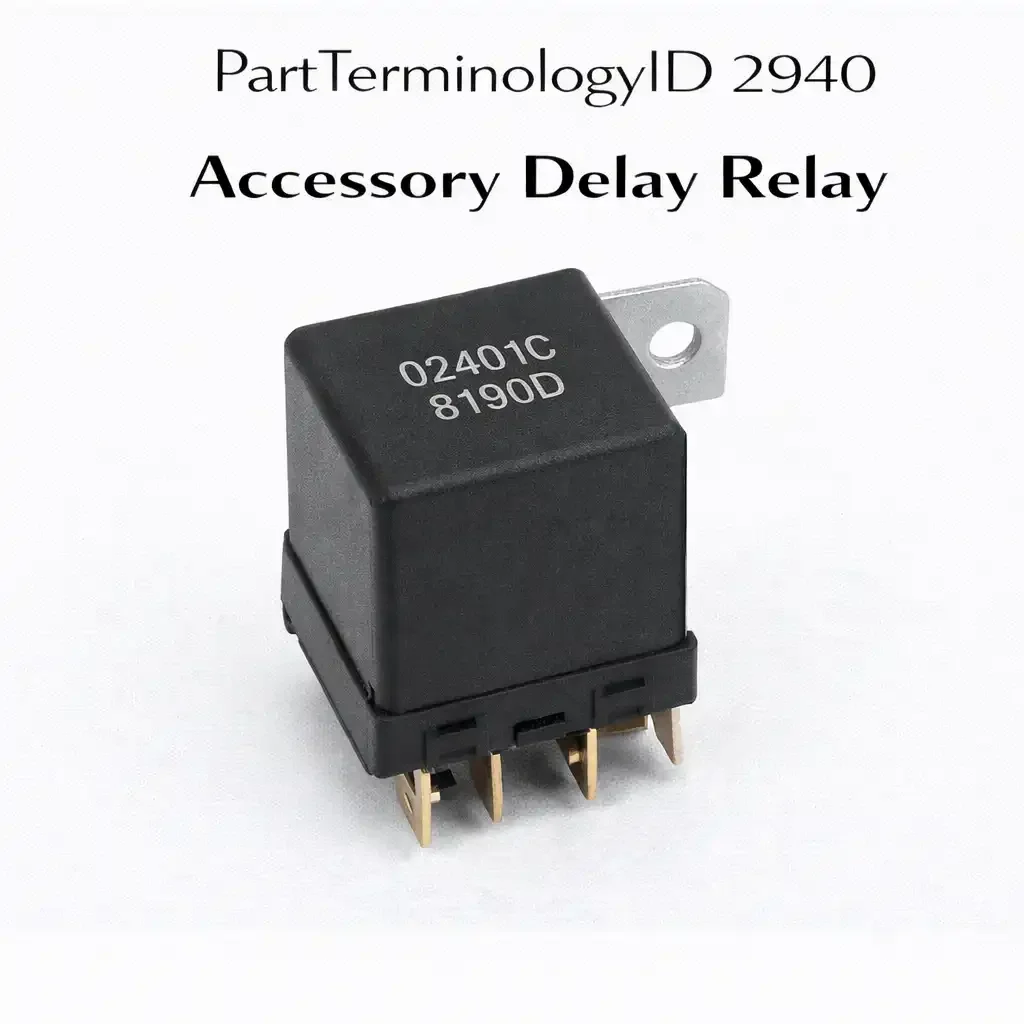
PartTerminologyID 2940, Accessory Delay Relay, is the relay that holds the vehicle's accessory circuits energized for a programmed interval after the ignition key is removed, allowing components such as the power windows, power sunroof, ventilation blower, and radio to remain operational during the interval required for occupants to exit the vehicle without restarting the engine. That definition covers the post-ignition accessory hold function correctly and leaves unresolved the specific accessory circuits the relay controls on the specific vehicle, the delay interval in seconds or minutes calibrated into the relay's timer circuit, whether the relay is a standalone timer-relay unit or a relay driven by a BCM-controlled output that manages the delay logic in software, whether the relay is a miniature ISO relay in a standard fuse and relay center or a purpose-built module at a dedicated mounting location, and whether the relay coil voltage and contact current rating match the circuit requirements for all accessory loads it switches simultaneously.
For sellers, PartTerminologyID 2940 is the relay PartTerminologyID where the BCM-integrated versus standalone architecture distinction most frequently generates returns, because on vehicles where the BCM manages the accessory delay logic in software and controls a standard ISO relay to implement it, the relay itself is a generic miniature relay whose replacement requires only the correct ISO footprint and current rating. On vehicles where a standalone timer-relay module contains the delay logic circuit internally, the module must match the specific delay interval calibration for the application. A standard ISO relay installed in place of a timer-relay module eliminates the delay function entirely, leaving all accessory circuits cutting off immediately at key removal.
What the Accessory Delay Relay Does
Delay interval and the occupant exit logic
The accessory delay function was introduced as a convenience feature to address the frustration of power windows that stop mid-travel when the key is removed, requiring the occupant to restart the engine to close the window. The relay holds the window, sunroof, and blower circuits active for a period typically ranging from 30 seconds to 10 minutes depending on the manufacturer's design intent. During the delay interval, each circuit remains active until either the delay timer expires or the occupant door is opened and closed, which some implementations use as the signal to terminate the delay immediately rather than waiting for the full timer duration.
On BCM-integrated implementations the delay logic is a software function: the BCM monitors the ignition state, door switch inputs, and the timer and drives the accessory relay output through a standard ISO relay controlled by a BCM output pin. The ISO relay is replaceable with any ISO-footprint relay of the correct coil voltage and contact current rating. On standalone timer-relay implementations the delay circuit is a dedicated RC timing network or electronic timer circuit inside the relay module housing, and the delay interval is fixed at the factory calibration. A replacement module must match the original's delay interval because a module with a longer or shorter interval produces a behavior change that owners notice and frequently attribute to a defective replacement.
Contact current rating and the multi-circuit load
The accessory delay relay switches the supply voltage to multiple accessory circuits simultaneously. The combined current of all circuits switched through the relay at the moment of activation is the contact current that the relay must be rated to interrupt cleanly. A relay with a contact current rating below the combined accessory load may arc at the contacts during the switching event, producing contact erosion, intermittent operation, and eventual contact welding in the closed position. A welded relay contact is the failure mode that prevents the accessory delay from terminating, leaving accessory circuits energized continuously and draining the battery when the vehicle is parked. The listing must state the contact current rating and must note the welded-contact battery drain risk as a failure mode that buyers should be aware of when diagnosing a no-timer-termination complaint.
Why This Part Generates Returns
Buyers return accessory delay relays because a standard ISO relay is delivered for a timer-relay module application and the accessory delay function is eliminated entirely after installation, the timer-relay module has a 45-second delay and the replacement has a 5-minute delay producing a noticeably different behavior, the relay contact current rating is below the combined accessory circuit load and the contacts arc and fail within weeks, the BCM-integrated vehicle receives a standalone timer-relay module that has no corresponding control circuit in the BCM wiring and cannot be activated, and the relay is mounted in the fuse center and the replacement has the correct ISO footprint but the wrong pin assignment for the specific fuse center socket on this vehicle.
Status in New Databases
PIES/PCdb: PartTerminologyID 2940, Accessory Delay Relay
PIES 8.0 / PCdb 2.0: No change.
Top Return Scenarios
Scenario 1: "Standard ISO relay replaces timer module, delay function eliminated"
The buyer's vehicle has a standalone timer-relay module. The listing covers the year, make, and model without distinguishing relay type. A standard ISO relay is delivered. After installation all accessory circuits cut off immediately at key removal. The delay function is gone.
Prevention language: "Relay type: [standalone timer-relay module with [X]-second delay / BCM-controlled ISO relay]. This listing covers the [type]. A standard ISO relay cannot replace a standalone timer-relay module because the timer circuit is inside the module housing. Verify the relay type before ordering."
Scenario 2: "Wrong delay interval, 5-minute module for 45-second application"
The replacement module has a 5-minute delay. The original had 45 seconds. Occupants must wait 5 minutes for the accessories to shut off or manually open and close a door. The behavior change is immediately noticed.
Prevention language: "Delay interval: [X seconds / X minutes]. Verify the original module's delay interval before ordering. A module with a different delay interval produces a noticeable behavior change that owners will attribute to a defective replacement."
Listing Requirements
PartTerminologyID: 2940
relay type: standalone timer-relay module or BCM-controlled ISO relay (mandatory)
delay interval in seconds or minutes (mandatory for timer modules)
contact current rating in amperes (mandatory)
coil voltage (mandatory)
ISO footprint and pin assignment (mandatory for ISO relay listings)
mounting location (mandatory)
welded-contact battery drain failure mode note (mandatory)
OEM part number cross-reference (mandatory)
Catalog Checklist for ACES/PIES Teams
PartTerminologyID = 2940
require relay type distinction: timer module versus BCM-controlled ISO relay (mandatory)
require delay interval for timer modules (mandatory)
require contact current rating (mandatory)
prevent timer module versus ISO relay conflation: the two are not interchangeable; relay type is a mandatory matching attribute
differentiate from Accessory Power Relay (PartTerminologyID 2944): the power relay switches accessory supply without a timer; the delay relay holds the circuit after ignition removal for a timed interval; different function despite similar housing
FAQ (Buyer Language)
What does the accessory delay relay do?
It holds power windows, sunroof, and blower circuits active for a programmed time after the key is removed so occupants can close windows and exit without restarting the engine.
Why did my accessories stop working immediately after I replaced the relay?
A standard ISO relay was likely installed in place of a timer-relay module. The timer circuit is inside the module. A plain relay has no timer and cuts circuits off immediately at de-energization.
Can a stuck relay drain the battery?
Yes. A welded relay contact holds the accessory circuits energized continuously. The battery drains over hours with the vehicle parked. If accessories remain active long after key removal and door operation, suspect a welded relay contact.
Cross-Sell Logic
Power Window Motor: for buyers whose delay relay failure left windows open and the motor was subsequently overworked attempting to close against an obstacle during the extended delay period
Battery: for buyers who experienced battery drain from a welded relay contact before diagnosis; a deep-discharged battery should be load-tested after the relay is replaced
Body Control Module (PartTerminologyID 2888): on BCM-integrated delay implementations, a BCM fault may produce an accessory delay fault code; confirm BCM health before replacing the relay
Final Take for PartTerminologyID 2940
Accessory Delay Relay (PartTerminologyID 2940) is the relay PartTerminologyID where relay type and delay interval are the two attributes that prevent the two most common return scenarios. A listing that distinguishes standalone timer module from BCM-controlled ISO relay, states the delay interval for timer modules, and notes the welded-contact battery drain failure mode gives every buyer population what they need to order correctly the first time.