
Written by Arthur Simitian | PartsAdvisory
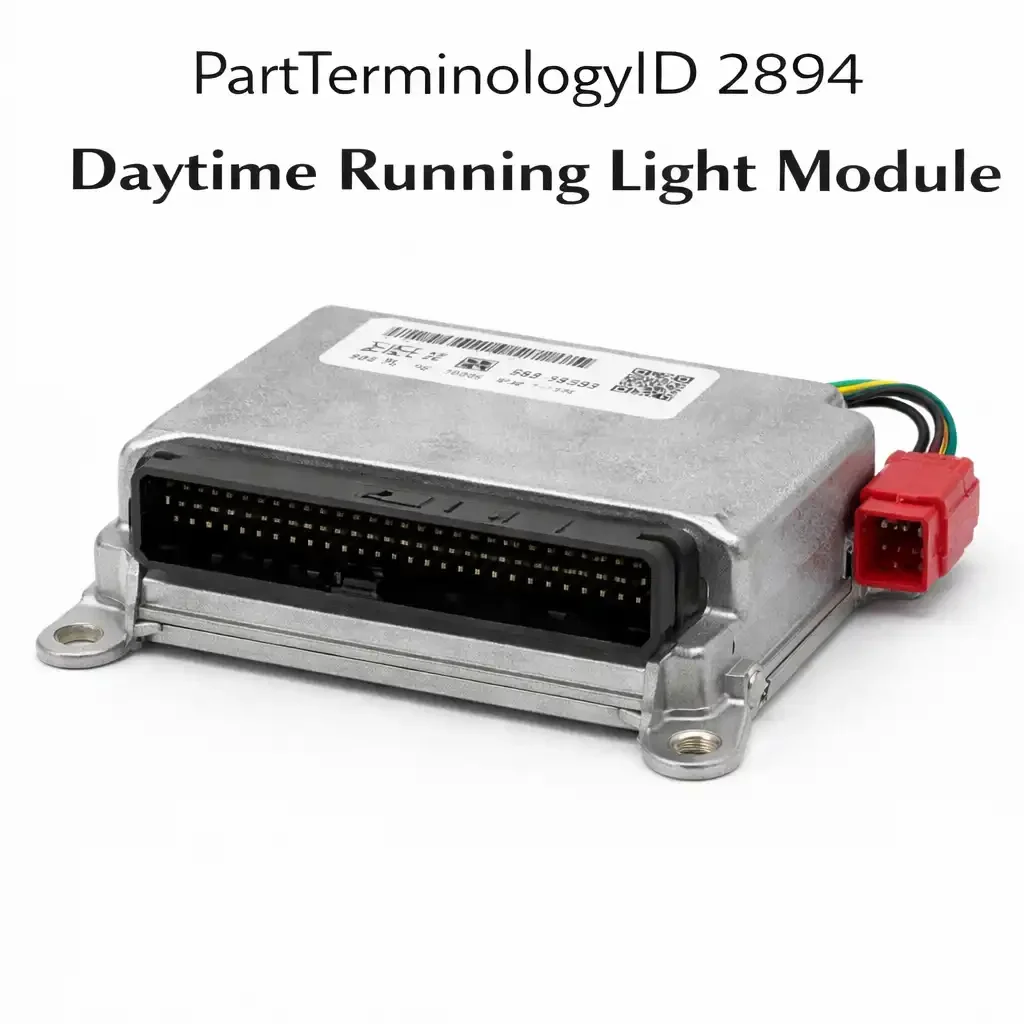
PartTerminologyID 2894, Daytime Running Light Module, is the electronic control unit that manages the activation, dimming, and extinguishing logic for the vehicle's daytime running lamps, monitoring ignition state, parking brake position, headlamp switch status, and in some applications ambient light sensor output to drive the DRL lamp circuit at the correct voltage level during daytime driving and to extinguish the DRL circuit when the headlamps are activated at night. That definition covers the DRL management function correctly and leaves unresolved every question that determines whether the vehicle uses a separate dedicated DRL module or has DRL logic integrated into the BCM making PartTerminologyID 2894 inapplicable, whether the DRL module drives the headlamp high-beam filament at reduced voltage or drives a dedicated DRL lamp element at full voltage, whether the replacement module provides the correct reduced-voltage output for filament-based DRL systems where full voltage would accelerate bulb burnout, whether the module communicates with the BCM over the CAN bus requiring programming after installation or uses a standalone hardwired architecture requiring only correct connector engagement, whether the parking brake switch input is a hardwired signal or a CAN bus message, and whether the part number suffix distinguishes different voltage reduction ratios or different lamp circuit configurations across trim levels that share the same base module housing.
It does not specify whether a separate DRL module exists on the vehicle, the lamp circuit architecture, the voltage reduction ratio, the programming requirement, the parking brake input type, or the part number suffix significance. A listing under PartTerminologyID 2894 that states only year, make, and model cannot be evaluated by a technician on a vehicle where the DRL module drives the low-beam filament at reduced voltage and the replacement module provides the wrong voltage reduction ratio, burning out the low-beam filament in three months rather than three years while appearing to function correctly because the DRLs illuminate as expected.
For sellers, PartTerminologyID 2894 is the module PartTerminologyID with the highest inapplicability rate of any in this series, because the shift from standalone DRL modules to BCM-integrated DRL logic has made a growing share of the catalog's year-make-model fitment range inapplicable to a separate DRL module listing. A buyer whose vehicle manages DRL through the BCM has no separate DRL module to replace, and a listing that covers this vehicle under PartTerminologyID 2894 will deliver a part the buyer cannot install. The inapplicability check is the first verification step that must be documented in every DRL module listing.
What the Daytime Running Light Module Does
Standalone module versus BCM-integrated DRL logic
Vehicles produced before approximately 2008 to 2012 depending on the manufacturer used a dedicated standalone DRL module mounted in the engine bay or behind the instrument panel that managed the DRL circuit independently of the BCM. This module received hardwired inputs from the ignition switch, the parking brake switch, and the headlamp switch, and drove the DRL lamp circuit directly through a relay or solid-state output. The standalone module could be replaced with a new unit of the same part number without programming because it operated on direct input-output logic with no CAN bus communication.
Vehicles produced after this transition period integrated the DRL management logic into the BCM's software, eliminating the standalone DRL module entirely. On these vehicles, a DRL fault is a BCM programming fault or a lamp circuit fault, not a separate module fault. There is no DRL module connector to unplug and no DRL module housing to replace. A listing that covers these BCM-integrated DRL vehicles under PartTerminologyID 2894 will deliver a standalone module housing that has no corresponding mounting location, no harness connector, and no DRL circuit to plug into. The buyer discovers this only after the part arrives and spends time looking for a module that does not exist on their vehicle.
The catalog prevention is straightforward: every DRL module listing must explicitly state the model year range during which the vehicle used a standalone DRL module, and must note the model year at which DRL control transitioned to the BCM. For vehicles beyond the transition point, the listing must direct buyers to the BCM listing or to a BCM programming service rather than a standalone DRL module. This inapplicability note is the most important single line in any DRL module listing.
Reduced-voltage filament DRL architecture and the burnout risk
DRL systems that use the headlamp high-beam or low-beam filament for the DRL function activate the filament at a reduced voltage, typically 60 to 75 percent of the rated 12-volt supply, to extend filament service life under the high daily operating hours that the DRL duty cycle demands. The voltage reduction is performed by the DRL module through a series resistor, a pulse-width modulation circuit, or a dedicated voltage regulator circuit within the module. The specific voltage reduction ratio is calibrated for the lamp wattage and the expected daily operating hours on the specific vehicle application.
A replacement DRL module that provides full 12-volt output to a filament-based DRL circuit delivers approximately twice the power the filament was designed to handle during DRL operation. The filament operates at a higher temperature, experiences faster tungsten evaporation, and burns out in one third to one fifth of the expected service life. From the outside the DRL system appears to function correctly because the lamps illuminate normally. The failure occurs weeks or months later when the filament burns out prematurely, and the owner replaces the bulb only to have it burn out again quickly because the replacement module is still providing full voltage to a filament rated for reduced-voltage DRL operation.
The voltage reduction ratio is the most technically critical specification in any filament-based DRL module listing and it is the specification most frequently omitted because it requires measuring the original module's output rather than reading a part number from a label. The catalog must require the voltage reduction ratio or the equivalent PWM duty cycle specification for every DRL module listing that covers a reduced-voltage filament application, and must flag any replacement module that provides full voltage output as incompatible with reduced-voltage filament DRL systems.
Dedicated DRL lamp elements and the full-voltage module architecture
Vehicles equipped with dedicated DRL lamp elements, separate from the headlamp assembly and designed specifically for the DRL function at full operating voltage, use a DRL module that drives the dedicated lamp at full 12-volt output rather than a reduced voltage. These dedicated DRL lamps are typically LED arrays in modern applications or small halogen lamps in older applications, calibrated for full-voltage operation at the DRL duty cycle without filament fatigue. A replacement DRL module for a dedicated-element application must provide full voltage output rather than a reduced voltage, because providing reduced voltage to a full-voltage dedicated DRL lamp produces dim or partial illumination rather than the correct full-output DRL appearance.
The distinction between reduced-voltage filament DRL and full-voltage dedicated DRL element is the lamp circuit architecture distinction that determines the correct replacement module specification. It is not always obvious from a visual inspection whether the DRL circuit uses the headlamp filament at reduced voltage or a dedicated lamp at full voltage. The determination requires either reading the DRL module's output specification from the original unit or confirming the lamp circuit architecture from the manufacturer's wiring diagram. The listing must state the lamp circuit architecture explicitly so the buyer can verify it against their vehicle before ordering.
Parking brake input, ignition state, and the activation logic
The DRL module's activation logic requires three conditions to be simultaneously satisfied before the DRL circuit activates: the ignition is in the run position, the parking brake is released, and the headlamp switch is in the off position. The parking brake input is particularly important because DRL lamps that remain active when the vehicle is stationary with the parking brake applied are an unnecessary drain on the lamp elements and may confuse observers outside the vehicle who expect DRL lamps to indicate a moving vehicle.
On standalone DRL module architectures, the parking brake input is a hardwired signal from the parking brake switch circuit. On BCM-integrated DRL architectures, the parking brake status is a CAN bus message from the BCM. A standalone replacement module requires the hardwired parking brake input to be connected correctly. If the parking brake input wire is missing from the installation, the module may default to the DRL-active state regardless of parking brake position, leaving the DRL lamps active whenever the ignition is on including when the vehicle is parked. The listing must note the parking brake input wiring requirement and must flag the symptom of DRL lamps that remain active with the parking brake applied as a parking brake input connection fault rather than a module defect.
Why This Part Generates Returns
Buyers return DRL modules because the vehicle uses BCM-integrated DRL logic and has no separate DRL module to replace, the listing covers the model year range without noting the BCM integration transition point, the replacement module provides full 12-volt output to a reduced-voltage filament application and the DRL filament burns out within six weeks, the replacement covers a dedicated full-voltage DRL element and the buyer's vehicle uses a reduced-voltage filament architecture producing half-brightness DRL illumination from the reduced output, the part number suffix is for the high-beam filament DRL application and the vehicle uses the low-beam filament for DRL with a different reduction ratio requiring a different suffix, the parking brake input wire is not connected after installation and the DRL lamps remain active with the parking brake applied causing a customer complaint that the module is malfunctioning, the module communicates on the CAN bus and requires programming that the listing did not mention producing a DRL system that activates but does not extinguish correctly when the headlamps are turned on, and the module is a standalone unit for the 2008 model year and the buyer has the 2009 model year on which this platform transitioned to BCM-integrated DRL.
Status in New Databases
PIES/PCdb: PartTerminologyID 2894, Daytime Running Light Module
PIES 8.0 / PCdb 2.0: No change in PartTerminologyID or terminology label.
Top Return Scenarios
Scenario 1: "BCM-integrated DRL, no standalone module on vehicle, part cannot be installed"
The buyer's vehicle uses BCM-integrated DRL logic. There is no standalone DRL module in the engine bay or behind the instrument panel. The listing covers the model year without noting the BCM transition point. The delivered standalone module housing has no corresponding mounting location or harness connector on this vehicle. The buyer spends 45 minutes looking for a module that does not exist before returning the part.
Prevention language: "DRL architecture: [Standalone module, applies to model years XXXX through XXXX. On XXXX and later, DRL is managed by the BCM and no separate DRL module is present. For XXXX and later, see the BCM listing or BCM programming service.]"
Scenario 2: "Full-voltage module on reduced-voltage filament application, DRL filament burns out in six weeks"
The buyer installs a replacement DRL module. The DRL lamps illuminate normally. Six weeks later the DRL filament burns out. A new bulb is installed. It burns out in four weeks. The replacement module provides full 12-volt output to a filament designed for 8-volt reduced-voltage DRL operation. The filament operates at excessive temperature and burns out at one quarter of normal service life. The listing did not state the voltage output specification.
Prevention language: "Voltage output: [X volts / PWM at X percent duty cycle for reduced-voltage filament applications]. This module is calibrated for [filament type] DRL applications. Installing a full-voltage module on a reduced-voltage filament application causes premature filament burnout. Verify the original module's voltage output specification before ordering."
Scenario 3: "Parking brake input disconnected, DRL active with parking brake applied"
The buyer installs the replacement module but does not connect the parking brake input wire, believing it is an optional connection. With the ignition on and the parking brake applied, the DRL lamps activate because the module defaults to the DRL-active state when the parking brake input is absent. The buyer reports the module as defective. The module is functioning correctly. The parking brake input is not connected.
Prevention language: "Parking brake input: Required connection. The parking brake input wire must be connected to the parking brake switch circuit for the module to extinguish the DRL lamps when the parking brake is applied. DRL lamps that remain active with the parking brake applied indicate a missing or incorrect parking brake input connection, not a module defect."
Scenario 4: "CAN bus DRL module, programming not disclosed, DRL does not extinguish with headlamps"
The buyer installs a CAN bus DRL module without programming. The DRL lamps activate correctly when the ignition is on and the parking brake is released. When the headlamps are turned on, the DRL lamps do not extinguish because the module has not been programmed to receive the headlamp-on CAN bus message from the BCM. The DRL and headlamps illuminate simultaneously. The buyer reports the module as defective. It requires programming to integrate with the BCM's headlamp status message.
Prevention language: "Programming required: Yes. This module communicates with the BCM over the CAN bus and requires programming to receive the headlamp activation signal. Without programming, DRL lamps will not extinguish when the headlamps are turned on. Programming requires a compatible scan tool. Verify programming capability before ordering."
Listing Requirements
PartTerminologyID: 2894
component: Daytime Running Light Module
BCM integration transition note with inapplicability model year (mandatory)
DRL lamp circuit architecture: reduced-voltage filament or full-voltage dedicated element (mandatory)
voltage output or PWM duty cycle specification (mandatory for filament applications)
programming required: yes or no (mandatory)
CAN bus versus standalone hardwired architecture (mandatory)
parking brake input wiring requirement (mandatory)
part number suffix significance where voltage or circuit type varies (mandatory)
headlamp circuit extinguish logic (mandatory)
OEM part number cross-reference (mandatory)
connector pin count and configuration (mandatory)
Catalog Checklist for ACES/PIES Teams
PartTerminologyID = 2894
require BCM integration transition note for every listing (mandatory)
require DRL lamp circuit architecture (mandatory)
require voltage output specification for filament applications (mandatory)
require programming requirement disclosure (mandatory)
require CAN bus versus hardwired architecture (mandatory)
require parking brake input wiring note (mandatory)
require part number suffix significance (mandatory)
prevent BCM-integrated vehicle coverage without inapplicability note: any listing that covers a post-transition model year without noting BCM integration will deliver an uninstallable standalone module to a BCM-integrated vehicle buyer
prevent full-voltage module on reduced-voltage filament application: a module providing wrong voltage output produces premature bulb burnout without an obvious malfunction signal; voltage output specification is mandatory
prevent parking brake input omission: DRL lamps active with parking brake applied is the most common post-installation complaint for incorrectly connected DRL modules; the input wiring requirement is mandatory
differentiate from Body Control Module (PartTerminologyID 2888): on BCM-integrated DRL vehicles the BCM manages DRL logic; a DRL fault on these vehicles is addressed through BCM service, not a separate DRL module
differentiate from Headlight (PartTerminologyID 2712): the headlight is the lamp assembly; the DRL module is the control unit that drives the headlamp filament or dedicated DRL element at the correct voltage; both are involved in DRL function but at different system levels
differentiate from Parking Light (PartTerminologyID 2836): the parking light activates with the headlamp switch; the DRL activates from ignition and parking brake logic independent of the headlamp switch; both may use the same lamp circuit but are driven by different control paths
FAQ (Buyer Language)
What does the DRL module do?
It manages when the daytime running lamps activate and extinguish, monitoring ignition state, parking brake release, and headlamp switch position. It drives the DRL lamp circuit at the correct voltage for the specific lamp architecture and extinguishes the DRL lamps when the headlamps are turned on.
Does my vehicle have a separate DRL module?
It depends on the model year. Vehicles produced roughly before 2008 to 2012 typically have a standalone DRL module. Later vehicles integrated DRL logic into the BCM and have no separate DRL module. If no standalone module exists, a DRL fault on your vehicle is a BCM or lamp circuit fault, not a DRL module fault. Verify the vehicle's DRL architecture before ordering.
Why do my DRL bulbs keep burning out after replacing the module?
Most likely the replacement module provides full 12-volt output to a filament designed for reduced-voltage DRL operation. The excessive voltage overheats the filament and burns it out in weeks rather than years. Verify the original module's voltage output specification and confirm the replacement matches before installing.
Does the DRL module need programming?
Standalone hardwired modules typically do not. CAN bus modules that communicate with the BCM typically require programming to integrate the headlamp extinguish logic. Without programming, CAN bus DRL modules may not extinguish when the headlamps are turned on. Verify the architecture and programming requirement before ordering.
Cross-Sell Logic
Headlight Assembly (PartTerminologyID 2712): for vehicles where the DRL function uses the headlamp high-beam or low-beam filament; if the DRL module failure was accompanied by filament burnout from incorrect voltage, the headlamp assembly may need bulb replacement alongside the module
Body Control Module (PartTerminologyID 2888): for BCM-integrated DRL vehicles where the DRL fault is in the BCM's programming rather than a separate module; the cross-sell directs buyers away from PartTerminologyID 2894 toward PartTerminologyID 2888 on post-transition vehicles
Parking Brake Switch: for vehicles where the DRL module receives a hardwired parking brake input; a sticking or failed parking brake switch produces a DRL module fault code that clears after switch replacement without requiring module replacement
DRL-Rated Replacement Bulb: for vehicles where the DRL module failure caused filament burnout from incorrect voltage; the correct reduced-voltage-rated DRL bulb must be installed alongside the replacement module to restore the correct service life
Final Take for PartTerminologyID 2894
Daytime Running Light Module (PartTerminologyID 2894) is the module PartTerminologyID with the highest inapplicability rate in this series. A growing proportion of vehicles in the catalog no longer have a separate DRL module because BCM integration has replaced the standalone unit across most platforms produced after the early 2010s. Every listing that does not explicitly document the transition point delivers a standalone module to a buyer whose vehicle does not have a standalone module mounting location. This is a preventable return with a single line of text in the listing.
State the BCM integration transition note with the applicable model year range first. State the DRL lamp circuit architecture. State the voltage output specification for filament applications. State the programming requirement. State the CAN bus versus hardwired architecture. Include the parking brake input wiring note. State the part number suffix significance. For PartTerminologyID 2894, BCM integration inapplicability disclosure, voltage output specification, and parking brake input wiring note are the three attributes that prevent the three most common and most frustrating return scenarios in the DRL module replacement market.