
Cruise Control Module (PartTerminologyID 2892): Where Adaptive Versus Conventional Architecture and Programming Requirements Determine Whether Speed Control Is Restored Correctly
Written by Arthur Simitian | PartsAdvisory
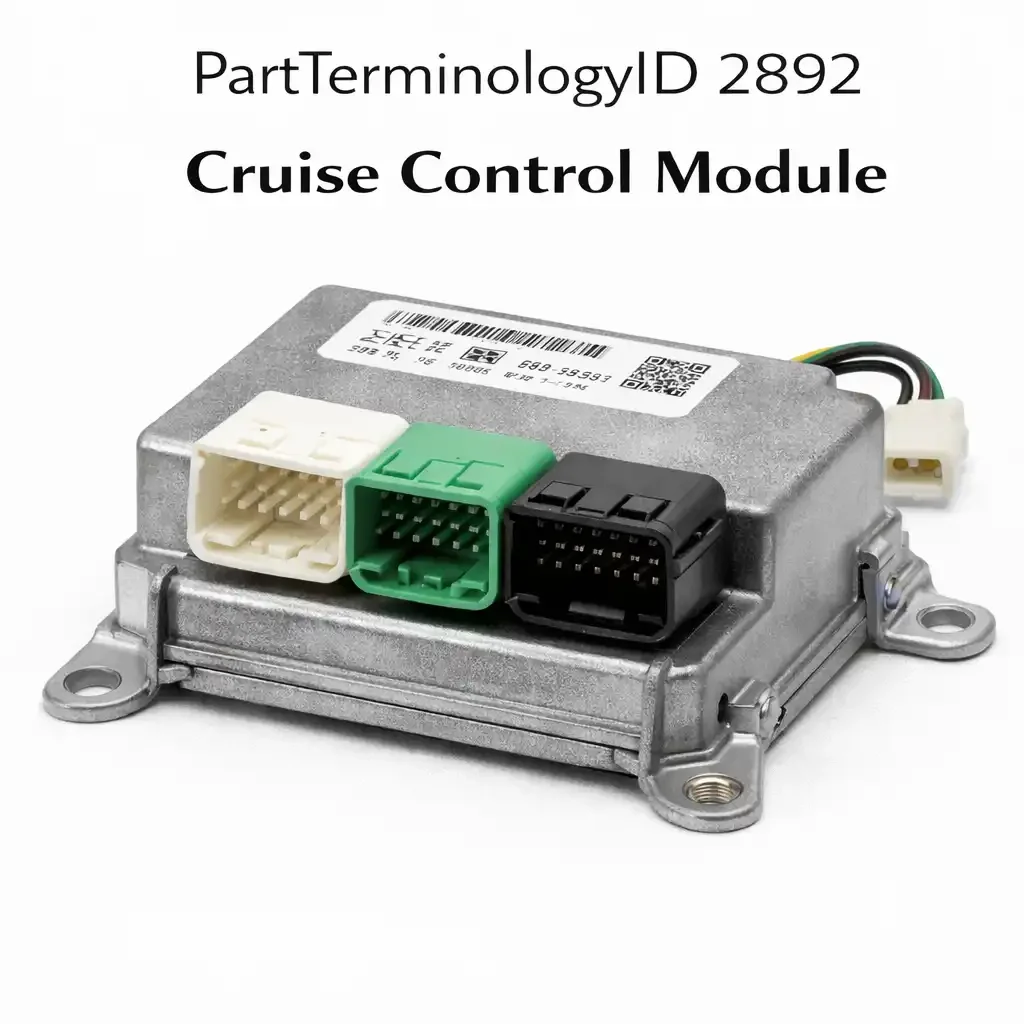
PartTerminologyID 2892, Cruise Control Module, is the electronic control unit that manages the vehicle's speed control system, maintaining a driver-set road speed by commanding the throttle actuator or PCM to hold a target speed without continuous driver input on the accelerator pedal, and on adaptive cruise control systems additionally managing a radar or camera sensor to maintain a programmed following distance from a detected vehicle ahead by autonomously adjusting vehicle speed within a set range. That definition covers the speed control function correctly and leaves unresolved every question that determines whether the replacement module is a conventional fixed-speed cruise unit or an adaptive distance-following unit on a vehicle whose catalog entry uses the same PartTerminologyID for both architectures, whether the OEM part number suffix distinguishes the specific speed sensor input type or CAN bus protocol version the module requires, whether the replacement requires programming, sensor calibration, or radar alignment after installation, whether the module communicates on the CAN bus and requires VIN binding to integrate correctly with the PCM's speed signal output, whether the brake override circuit integration matches the original module's configuration for vehicles where the cruise module interfaces directly with the brake pedal position sensor, and whether the fault code stored in the PCM for the cruise control system reflects a genuine module failure or a secondary code from a vehicle speed sensor fault that caused the cruise module to disengage and store a fault rather than failing independently.
It does not specify the cruise system architecture, the part number suffix, the programming or calibration requirement, the CAN bus integration scope, the brake override circuit configuration, or the diagnostic distinction between a genuine module failure and a secondary fault code. A listing under PartTerminologyID 2892 that states only year, make, and model cannot be evaluated by a technician who needs to know before ordering whether the adaptive cruise module requires a dealership radar calibration appointment that the shop cannot perform, adding one to two days and a calibration fee to the repair that the customer did not budget for.
For sellers, PartTerminologyID 2892 carries the same programming disclosure requirement established for PartTerminologyID 2888, with the additional complexity of the adaptive versus conventional architecture distinction. A catalog that conflates adaptive and conventional cruise modules under a single part number because both bolt to the same location on the firewall or engine bay panel will generate a consistent stream of returns from adaptive cruise buyers who receive a conventional module without radar capability, and from conventional cruise buyers who receive an adaptive module whose radar connector has no corresponding plug in the harness.
What the Cruise Control Module Does
Conventional cruise versus adaptive cruise architecture
Conventional cruise control maintains a fixed set speed by monitoring the vehicle speed signal and commanding the throttle actuator to open or close as needed to hold the target speed against road grade variations. The system disengages when the driver presses the brake pedal, the clutch pedal on manual transmission vehicles, or the cancel button, and requires manual driver input to resume or set a new speed. The module receives the vehicle speed signal from the PCM or directly from the vehicle speed sensor, outputs throttle commands, and monitors the brake pedal switch for disengage inputs. The system has no awareness of other vehicles and cannot reduce speed for traffic without driver brake application.
Adaptive cruise control adds a forward-looking sensor, either a millimeter-wave radar module mounted behind the front grille or bumper fascia, or a camera module mounted at the windshield, that measures the distance and closing rate to the vehicle ahead. The adaptive cruise module uses this distance data to modulate the set speed downward when the gap to the preceding vehicle closes below the programmed following distance, and upward back to the set speed when the gap reopens. On full-range adaptive systems the module also commands the brake system to decelerate below the speed achievable by throttle reduction alone, including bringing the vehicle to a complete stop behind stopped traffic on some implementations. The radar or camera sensor is a separate hardware component from the cruise module itself, and the two communicate over the CAN bus or a dedicated data line. Replacing only the cruise module does not address a failed radar sensor, and replacing only the radar sensor does not address a failed cruise module.
Programming and calibration requirements by architecture type
Conventional cruise control modules on older dedicated wiring architectures, common on vehicles produced before approximately 2005, typically require only correct installation and connector engagement to restore function without programming. The module receives a hardwired speed signal, outputs a hardwired throttle signal, and monitors hardwired switch inputs. There is no VIN binding, no CAN bus integration, and no calibration procedure beyond verifying the speed signal input matches the module's calibration range.
Conventional cruise control modules on CAN bus architectures, common on vehicles produced after approximately 2005, receive the vehicle speed signal from the PCM over the CAN bus rather than from a dedicated speed sensor wire. These modules require VIN binding and in some cases a speed calibration procedure to configure the module's interpretation of the PCM's CAN bus speed signal for the specific vehicle's tire size and final drive ratio. Without the speed calibration, the module may hold a speed that is two to five miles per hour above or below the displayed speedometer reading, a discrepancy that is immediately obvious to the driver and produces a complaint that the replacement is defective.
Adaptive cruise control modules uniformly require programming and sensor calibration after installation. The radar or camera sensor must be calibrated for the specific vehicle's mounting geometry: the height above the road surface, the horizontal aim relative to the vehicle centerline, and the vertical aim angle. A sensor that is not calibrated after module or sensor replacement will measure following distances incorrectly, producing early or late intervention at following distance thresholds and in the worst case engaging the brake system at inappropriate moments. Radar calibration requires a calibration target placed at a specified distance in front of the vehicle and a scan tool procedure that adjusts the sensor's aim parameters to the correct values. This procedure is typically restricted to dealer-level scan tools and is not available with most general-purpose aftermarket scan tools.
Secondary fault codes and the misdiagnosis risk
The cruise control module stores fault codes when it detects conditions that prevent speed control from functioning correctly. Many of the conditions that trigger cruise module faults are external to the module itself. A vehicle speed sensor that produces an intermittent or erratic signal causes the cruise module to disengage and store a vehicle speed signal fault. A brake pedal switch that sticks in the applied position causes the cruise module to store a brake override fault and prevent engagement. A PCM software update that alters the CAN bus message format for the speed signal causes the cruise module to store a communication fault. In all three cases the fault code points to the cruise module as the circuit reporting the fault, but the cruise module itself is functioning correctly and a replacement module will store the same fault from the same root cause.
A complete diagnostic before ordering a cruise control module replacement must include vehicle speed sensor output verification, brake pedal switch continuity test, PCM CAN bus communication check, and a review of any recent PCM software update history that might have changed the speed signal protocol. These verifications take less than 30 minutes with appropriate scan tool access and prevent the most common misdiagnosis scenario in the cruise control module segment: a correctly functioning module replaced at significant cost because its fault code was read as a module failure rather than as a secondary report of an external signal fault.
Why This Part Generates Returns
Buyers return cruise control modules because a conventional module is delivered for an adaptive cruise application leaving the radar sensor without a control module and the adaptive functions entirely non-functional, the adaptive module requires dealership radar calibration that the buyer did not know about and cannot perform independently, the part number suffix is for the older CAN protocol and the vehicle requires the updated protocol suffix producing a persistent communication fault after installation, the speed calibration was not performed and the module holds a speed three miles per hour above the speedometer reading, the replacement is a conventional module and the vehicle's harness has an adaptive cruise radar connector that has no corresponding plug on the conventional module producing a harness fault code for the unconnected radar circuit, a PCM software update on this vehicle changed the speed signal protocol and the module replacement resolves the fault code temporarily before it recurs from the same PCM protocol mismatch, the module fault code was a secondary code from a failed brake pedal switch that remained after module replacement because the root cause was not diagnosed, and the radar sensor is the failed component rather than the cruise module and the replacement module does not resolve the adaptive following distance fault because the sensor is still outputting incorrect distance data.
Status in New Databases
PIES/PCdb: PartTerminologyID 2892, Cruise Control Module
PIES 8.0 / PCdb 2.0: No change in PartTerminologyID or terminology label.
Top Return Scenarios
Scenario 1: "Conventional module delivered for adaptive application, radar functions non-functional"
The buyer has adaptive cruise control. The listing covers the model year without distinguishing cruise system type. The delivered module is the conventional fixed-speed unit without radar integration. The adaptive following distance function is entirely absent. The radar sensor connector in the harness has no corresponding plug on the conventional module. The buyer requires the adaptive cruise module.
Prevention language: "Cruise system type: [conventional fixed-speed / adaptive with radar / adaptive with camera]. This module covers [type]. Verify whether the vehicle is equipped with conventional or adaptive cruise control before ordering. The two architectures use different modules with different connector configurations and are not interchangeable."
Scenario 2: "Adaptive module requires dealer radar calibration, buyer cannot complete repair independently"
The buyer orders an adaptive cruise module. Installation is straightforward. The cruise system engages but the following distance intervention occurs at incorrect ranges. The scan tool shows a radar calibration required fault. The calibration procedure requires a dealer-level tool and a calibration target setup. The buyer's shop does not have dealer tool access. The vehicle must go to the dealership for calibration before the repair is complete.
Prevention language: "Calibration required after installation: Yes. Radar sensor calibration requires a calibration target and a dealer-level scan tool. This step cannot be completed with a general-purpose aftermarket scan tool. Budget for a dealer calibration appointment as part of the total repair cost before ordering."
Scenario 3: "Speed calibration not performed, module holds wrong speed"
The buyer installs a conventional CAN bus cruise module. The module engages and holds a speed, but the held speed is consistently three miles per hour above the displayed speedometer reading. The vehicle cruises at 68 mph while the speedometer shows 65 mph. The speed calibration procedure configuring the module for the vehicle's tire size and final drive ratio was not performed. The buyer returns the module as defective. The module is functioning correctly. The calibration step was omitted.
Prevention language: "Speed calibration: Required after installation on CAN bus applications. The module must be calibrated to the vehicle's tire size and final drive ratio using a compatible scan tool. Without calibration, the held speed will not match the displayed speedometer reading. Verify calibration tool availability before ordering."
Scenario 4: "Secondary fault code, root cause is brake pedal switch, module replacement does not resolve fault"
The cruise control disengages randomly and stores a brake override fault. The technician replaces the cruise module. The brake override fault returns within one drive cycle. The original fault was a brake pedal switch that intermittently reported the pedal as depressed when it was not, causing the cruise module to disengage and store the fault. The module replacement did not address the switch fault and the new module stores the same fault from the same cause.
Prevention language: "Diagnostic note: Many cruise control fault codes are secondary to external signal faults. Before ordering, verify vehicle speed sensor output, brake pedal switch continuity, and PCM CAN bus communication. A module replaced without identifying the root cause will store the same fault from the same source."
Listing Requirements
PartTerminologyID: 2892
component: Cruise Control Module
cruise system type: conventional fixed-speed or adaptive with radar or camera (mandatory, in title)
complete OEM part number including suffix (mandatory)
programming required: yes or no, with scope (mandatory)
speed calibration requirement and tool (mandatory for CAN bus applications)
radar or camera calibration requirement and dealer tool note (mandatory for adaptive)
CAN bus protocol version where suffix distinguishes versions (mandatory)
brake override circuit configuration (mandatory)
secondary fault code diagnostic note (mandatory)
connector pin count and configuration (mandatory)
trim level and option package applicability (mandatory)
OEM part number cross-reference (mandatory)
Catalog Checklist for ACES/PIES Teams
PartTerminologyID = 2892
require cruise system type in title: conventional or adaptive (mandatory)
require complete OEM part number including suffix (mandatory)
require programming requirement disclosure (mandatory)
require speed calibration requirement and tool for CAN bus applications (mandatory)
require radar or camera calibration requirement with dealer tool note for adaptive listings (mandatory)
require secondary fault code diagnostic note (mandatory)
require connector pin count (mandatory)
prevent conventional versus adaptive conflation: the two architectures are not interchangeable; cruise system type must be a required title attribute
prevent calibration omission: an adaptive cruise module installed without radar calibration produces incorrect following distance intervention; the calibration requirement and dealer tool restriction must be stated before purchase
prevent secondary fault code misdiagnosis: many cruise module replacements are ordered on secondary fault codes from external signal faults; the diagnostic verification note is mandatory to prevent module replacement without root cause identification
differentiate from Body Control Module (PartTerminologyID 2888): the BCM manages body electrical systems; the cruise control module manages speed control logic; both are CAN bus modules with programming requirements but in different system domains
differentiate from Daytime Running Light Module (PartTerminologyID 2894): the DRL module is a single-function lighting control unit; the cruise module is a speed and throttle management unit; no functional overlap
FAQ (Buyer Language)
What does the cruise control module do?
It manages the vehicle's speed control system by commanding the throttle actuator to maintain a driver-set speed without continuous accelerator input. On adaptive systems it additionally monitors a radar or camera sensor to maintain a set following distance from the vehicle ahead, automatically reducing speed for traffic and resuming when the gap reopens.
Is adaptive cruise control the same as conventional?
No. Conventional maintains a fixed speed. Adaptive adds a radar or camera sensor and automatically follows traffic at a set distance. The two systems use entirely different module architectures, connector configurations, and programming requirements. They are not interchangeable.
Does a replacement need to be programmed?
For adaptive cruise, yes, including a radar or camera calibration that typically requires a dealer-level scan tool and calibration target. For conventional CAN bus cruise, typically yes for speed calibration. For older hardwired conventional systems, usually no. Verify the requirement for the specific part number before ordering.
What causes cruise control module faults?
Many cruise module fault codes are secondary to external faults: an intermittent vehicle speed sensor, a sticking brake pedal switch, or a PCM software update that changed the speed signal protocol. These external faults cause the cruise module to disengage and store a fault, but the module itself is functioning correctly. Always verify external signal sources before concluding the module has failed.
Cross-Sell Logic
Vehicle Speed Sensor: the most common external cause of cruise module secondary fault codes; should be inspected before and replaced alongside the cruise module if signal quality is questionable
Brake Pedal Position Switch: the second most common external cause of cruise brake-override fault codes; replacement alongside the cruise module prevents repeat fault storage from the same brake switch fault
Adaptive Cruise Radar Sensor: the forward radar unit that communicates with the adaptive cruise module; a failing radar sensor produces following distance faults that persist after cruise module replacement if the sensor is the actual failed component
Body Control Module (PartTerminologyID 2888): for buyers whose module scan reveals both BCM and cruise module faults; secondary cruise faults caused by BCM CAN communication disruption often clear after BCM replacement without requiring cruise module replacement
Final Take for PartTerminologyID 2892
Cruise Control Module (PartTerminologyID 2892) is the module PartTerminologyID where the adaptive versus conventional architecture distinction is the most return-generating omission in the catalog, and where the secondary fault code misdiagnosis is the most return-generating diagnostic error in the buyer population. The first is prevented by making cruise system type a mandatory title attribute. The second is prevented by including the diagnostic verification note in the listing description before the buyer orders. Neither requires technical complexity in the listing. Both require explicit disclosure of information the buyer needs before completing the purchase.
State the cruise system type in the title. State the complete OEM part number including suffix. State the programming and calibration requirements with the dealer tool restriction for adaptive applications. Include the secondary fault code diagnostic note. State the connector configuration. For PartTerminologyID 2892, cruise system type designation, radar calibration dealer tool requirement, and secondary fault code diagnostic note are the three attributes that prevent the three most distinct and most costly return scenarios in the cruise control module replacement market.