
Written by Arthur Simitian | PartsAdvisory
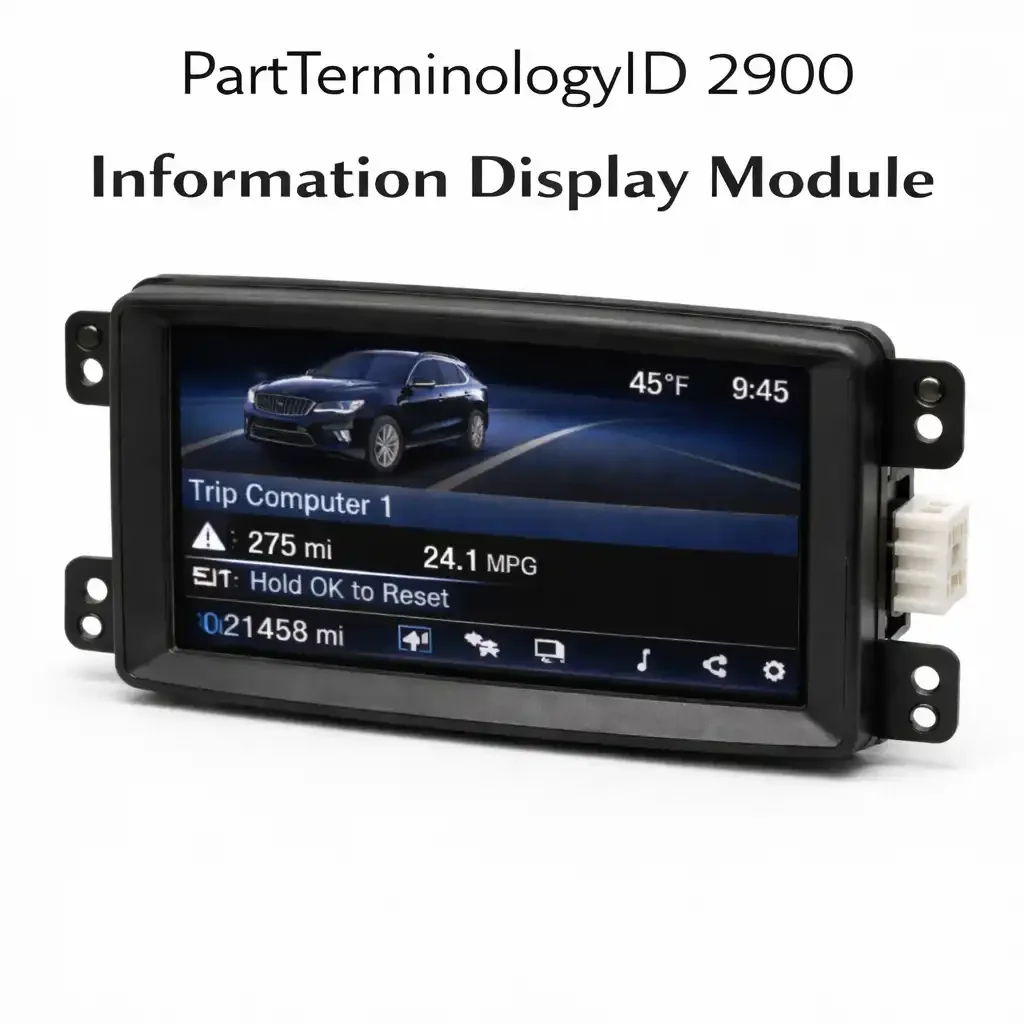
PartTerminologyID 2900, Information Display Module, is the electronic module that manages the visual output of the vehicle's instrument cluster display, center console driver information center, or combined cluster-and-infotainment display, rendering vehicle speed, engine RPM, fuel level, coolant temperature, odometer, warning telltales, and in advanced implementations navigation data, media status, and vehicle systems information received from other control modules over the CAN bus network. That definition covers the display management function correctly and leaves unresolved every question that determines whether the replacement module requires VIN binding and odometer value programming before displaying correct mileage, whether the display module is integrated into the instrument cluster as a single assembly or is a separate center console unit with its own part number, whether the part number suffix distinguishes different display technology types between LCD and digital cluster variants on the same base platform, whether a used module from a salvage vehicle can have its odometer reprogrammed to match the replacement vehicle's accumulated mileage, whether the odometer programming is restricted to dealer-level tools or is available with compatible aftermarket scan tools, and whether the CAN bus data message format the module expects matches the version output by the vehicle's PCM and other CAN network modules.
It does not specify the display integration architecture, the programming and odometer transfer requirements, the part number suffix display technology distinction, the used module odometer reprogramming restrictions, or the CAN bus message version compatibility. A listing under PartTerminologyID 2900 that states only year, make, and model cannot be evaluated by a buyer who needs to know before ordering whether the replacement will display the vehicle's correct accumulated mileage after a programming procedure they can perform with an aftermarket scan tool, or whether the odometer transfer requires a dealer appointment that adds a day and a separate fee to the repair.
For sellers, PartTerminologyID 2900 introduces the odometer accuracy legal dimension that distinguishes this module PartTerminologyID from all others in the series. Installing a replacement information display module without transferring or programming the correct odometer value is a legal compliance failure in most U.S. jurisdictions and in virtually all jurisdictions internationally. The odometer programming requirement is not a technical recommendation in the listing. It is a legal obligation that the buyer must complete before the vehicle is returned to service, and the listing must frame it as such clearly enough that no buyer misses the requirement.
What the Information Display Module Does
Instrument cluster integration versus separate center display architecture
On vehicles where the instrument cluster and information display are integrated into a single assembly, the entire cluster unit contains both the gauge faces and the digital display panel in one housing with a single harness connector. Replacing the information display function requires replacing the entire cluster assembly. The OEM part number covers the complete cluster unit and a replacement cluster must receive the correct VIN binding and odometer value before installation is complete.
On vehicles with a separate driver information center or center console display module that is physically distinct from the gauge cluster, the information display module is a standalone unit at the center console or top of the dashboard with its own part number and its own programming requirement. The gauge cluster continues to function independently after the information display module is replaced, and only the center display module requires reprogramming. The listing must identify which architecture the specific part covers and must prevent a buyer from ordering a center display module listing when their vehicle uses a cluster-integrated display requiring the full cluster assembly.
Odometer programming and the legal compliance dimension
The odometer is a legally regulated instrument in the United States under the Federal Odometer Act and in virtually all international jurisdictions under equivalent statutes. The odometer value displayed by the information display module must accurately reflect the vehicle's accumulated mileage. When the information display module is replaced, the replacement module must be programmed with the vehicle's correct accumulated odometer value before the vehicle is returned to service. Operating a vehicle with an inaccurate odometer display is a violation of federal odometer law and exposes both the owner and the repair facility to legal liability.
The odometer programming procedure reads the accumulated mileage from a secure storage location, typically the PCM on modern vehicles where odometer data is stored in the powertrain module rather than the display module, and writes the correct value to the replacement display module. On some vehicles the odometer data is stored in the original display module and must be read from the original before it is removed. If the original module has failed in a way that prevents data extraction, the accumulated mileage must be reconstructed from maintenance records, service history, or the manufacturer's last recorded odometer entry. The listing must direct buyers to complete the odometer transfer procedure before the vehicle is returned to service and must note whether the procedure requires a dealer-level tool or is available with compatible aftermarket scan tools.
Part number suffix and display technology variants
On platforms where the information display module was updated mid-production to a different display technology, such as a transition from a segment LCD to a full-color TFT display, or from a monochrome driver information center to a color configurable display, the base part number may be shared across the two technology versions while the suffix identifies the specific display technology. A replacement module with the wrong suffix may physically install in the cluster cavity but will not match the original display's visual character, may not render all of the original display's information fields if the newer technology module has a different layout, and in some cases may not communicate correctly with the PCM's CAN bus data message format if the two technology generations used different display protocol versions.
The display technology distinction is also commercially significant because color TFT cluster modules are substantially more expensive than monochrome LCD units, and a buyer who receives a monochrome replacement for a color display application will immediately notice the visual downgrade. Conversely, a buyer who receives a color TFT module for a monochrome application may find the newer module's display layout does not match the gauge cluster's aperture design or the surrounding trim panel's display window geometry. The part number suffix must be verified against the original module's label and the listing must require the suffix as a mandatory matching attribute.
Why This Part Generates Returns
Buyers return information display modules because the odometer programming requirement is not disclosed and the replacement displays zero miles or a default value, the buyer believes it is defective, the listing covers the cluster-integrated display architecture and the buyer has a separate center console display module at a different mounting location with a different connector, the part number suffix is for the monochrome LCD variant and the buyer has the color TFT display whose higher-resolution screen does not match the cluster aperture of the monochrome unit, the used salvage module's odometer value cannot be reprogrammed to the replacement vehicle's mileage on this manufacturer's architecture and the vehicle displays the donor vehicle's mileage, the display module requires a dealer-level odometer transfer that the buyer's shop cannot perform independently adding a day and a programming fee to the repair budget, the module's CAN bus message format is from a software revision incompatible with the vehicle's PCM software version producing garbled speed and fuel data on the replacement display, and the module is a cluster-integrated unit that requires gauge pointer recalibration after installation that the listing did not mention.
Status in New Databases
PIES/PCdb: PartTerminologyID 2900, Information Display Module
PIES 8.0 / PCdb 2.0: No change in PartTerminologyID or terminology label.
Top Return Scenarios
Scenario 1: "Odometer not programmed, module displays zero, buyer believes it is defective"
The buyer installs the replacement display module. The module powers on and displays vehicle data correctly except the odometer shows zero miles. The buyer believes the module is defective. The odometer programming procedure was not performed. The module is functioning correctly. The zero reading is the module's default state before the vehicle's accumulated mileage is written to it.
Prevention language: "Odometer programming required: Yes. After installation, the vehicle's accumulated mileage must be programmed into the replacement module before the vehicle is returned to service. Operating a vehicle with an inaccurate odometer is a violation of federal odometer law. Programming requires [dealer-level / compatible aftermarket] scan tool. Do not return to service until odometer programming is complete."
Scenario 2: "Wrong suffix, monochrome module for color TFT application, display quality mismatch"
The buyer orders using only the base part number. The delivered module is the monochrome LCD variant. The vehicle has the color TFT display. The monochrome module displays data correctly but the display quality is dramatically lower than the original, and the module's physical height does not match the cluster aperture designed for the taller TFT unit. The buyer returns the module and requires the correct color TFT suffix.
Prevention language: "Display technology suffix: [suffix for monochrome LCD / suffix for color TFT]. This module covers the [technology] variant. Verify the complete OEM part number including suffix against the original module's label. Monochrome and color TFT display modules are not interchangeable despite sharing the same base part number on this platform."
Scenario 3: "Used salvage module, odometer cannot be reprogrammed, vehicle shows donor mileage"
The buyer installs a used display module from a salvage vehicle. The scan tool odometer programming procedure returns a security lock error. The manufacturer stores the odometer in secure non-erasable memory that prevents rollback or reprogramming to a lower value. The vehicle displays the donor vehicle's accumulated mileage, which is 47,000 miles higher than the actual accumulated mileage of the replacement vehicle. The module is unusable and federal odometer law prohibits operating the vehicle with the incorrect display.
Prevention language: "Odometer reprogramming: [Supported, accumulated mileage can be matched to replacement vehicle / Not supported, manufacturer stores odometer in secure non-erasable memory. Used modules cannot display lower mileage than the donor vehicle's accumulated value. Federal odometer law prohibits installation of a module that displays incorrect mileage.]"
Listing Requirements
PartTerminologyID: 2900
component: Information Display Module
display integration architecture: cluster-integrated or separate center module (mandatory)
complete OEM part number including suffix (mandatory)
display technology: monochrome LCD, color TFT, or digital cluster (mandatory, in title)
odometer programming required with legal compliance note (mandatory)
odometer transfer tool: dealer only or aftermarket-compatible (mandatory)
used module odometer reprogramming policy (mandatory for salvage listings)
CAN bus message format version compatibility (mandatory)
gauge pointer recalibration requirement where applicable (mandatory)
programming scope beyond odometer: VIN binding, option codes (mandatory)
OEM part number cross-reference (mandatory)
Catalog Checklist for ACES/PIES Teams
PartTerminologyID = 2900
require display integration architecture in listing (mandatory)
require complete OEM part number including suffix (mandatory)
require display technology in title (mandatory)
require odometer programming disclosure with legal compliance framing (mandatory)
require odometer transfer tool tier (mandatory)
require used module odometer reprogramming policy for salvage listings (mandatory)
require CAN bus message version compatibility (mandatory)
prevent odometer omission: any listing without explicit odometer programming disclosure exposes the buyer to federal odometer law liability; the disclosure is a legal obligation, not optional context
prevent suffix omission: monochrome and color TFT modules share base part numbers on many platforms but are not interchangeable; suffix is a mandatory matching attribute
prevent used module odometer ambiguity: secure odometer storage prevents rollback on many platforms; the policy must be stated before the buyer purchases a salvage unit
differentiate from Body Control Module (PartTerminologyID 2888): the BCM manages body electrical outputs; the information display module renders visual data from CAN bus inputs; both communicate on CAN bus but serve entirely different functions
differentiate from Cruise Control Module (PartTerminologyID 2892): cruise module manages speed control logic; information display module renders speed and trip data visually; the display shows the speed that the cruise module targets but the two are separate modules
FAQ (Buyer Language)
What does the information display module do?
It renders vehicle speed, fuel level, odometer, warning indicators, and other data on the instrument cluster or center console display. It receives this data from the PCM, BCM, and other modules over the CAN bus and presents it in the programmed visual format for the specific cluster or display design.
Does the replacement need to be programmed?
Yes. VIN binding is required for CAN bus integration. Odometer value programming is required to display correct accumulated mileage and is a legal requirement under federal odometer law. Verify the programming tool required before ordering. Do not return the vehicle to service until odometer programming is complete.
Can I use a used display module from a salvage vehicle?
Only if the manufacturer allows odometer reprogramming to match the replacement vehicle's mileage. Some manufacturers store the odometer in secure non-erasable memory that cannot be rolled back. Using a used module that displays a different mileage than the vehicle's actual accumulated distance violates federal odometer law. Verify the manufacturer's odometer reprogramming policy before purchasing a salvage unit.
Cross-Sell Logic
Odometer Programming Service: the mandatory companion service for buyers without a compatible scan tool; must be cross-sold with every information display module listing as an either-or alternative to self-service programming
Body Control Module (PartTerminologyID 2888): for buyers whose display fault was preceded by a BCM fault that corrupted the display module's CAN bus data; confirm BCM health before concluding the display module is the sole failed component
Instrument Cluster Assembly: for vehicles where the information display is integrated into the full cluster; a cluster-level failure requires the complete cluster unit, not a separate display module
Final Take for PartTerminologyID 2900
Information Display Module (PartTerminologyID 2900) is the module PartTerminologyID where the legal dimension is the most distinct of any part in this entire series. The BCM has a VIN binding requirement. The cruise module has a calibration requirement. The information display module has a federal odometer law compliance requirement. Every listing without an explicit odometer programming disclosure leaves the buyer vulnerable to installing a legally non-compliant display and returning to service a vehicle whose odometer does not reflect the actual accumulated mileage. That is not a return scenario. It is a federal violation that the listing prevented or failed to prevent.
State the display integration architecture. State the complete OEM part number including suffix. State the display technology in the title. State the odometer programming requirement with the legal compliance framing. State the odometer transfer tool tier. State the used module odometer reprogramming policy for salvage listings. State the CAN bus message version. For PartTerminologyID 2900, odometer programming legal disclosure, display technology suffix matching, and used module odometer reprogramming policy are the three attributes that determine whether the buyer completes a legally compliant repair, installs the correct display technology, and avoids federal odometer law liability.