
Written by Arthur Simitian | PartsAdvisory
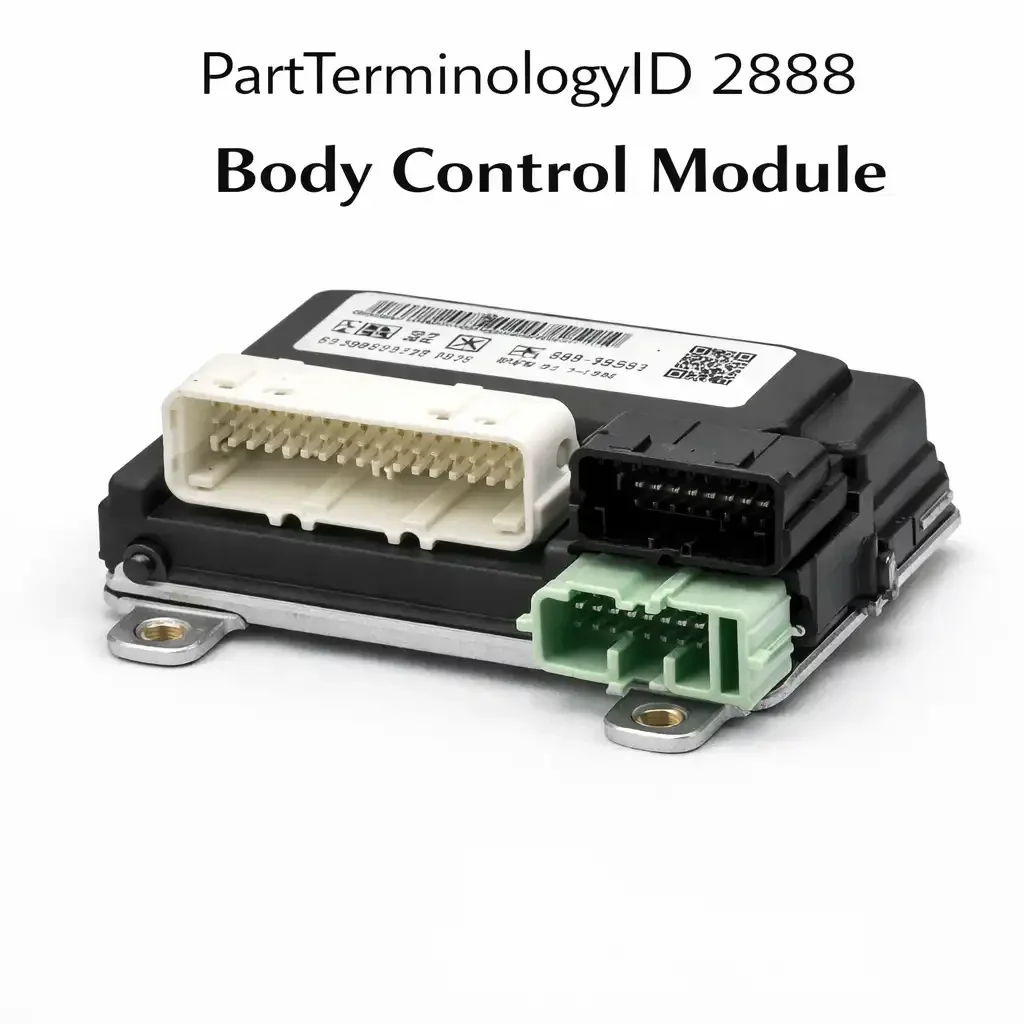
PartTerminologyID 2888, Body Control Module, is the central electronic control unit that manages the vehicle's body electrical systems, receiving inputs from door switches, key fob receivers, rain sensors, and occupant controls and driving outputs to lighting circuits, window motors, door lock actuators, wiper relays, and accessory circuits according to the programmed logic stored in the module's non-volatile memory. That definition covers the centralized body electronics management function correctly and leaves unresolved every question that determines whether the replacement module bears the correct OEM part number suffix for the specific vehicle's option content, whether the replacement requires VIN-specific programming before any body electrical function is restored beyond a basic default state, whether the immobilizer key codes stored in the original module must be transferred or re-registered to the replacement, whether a used module from a salvage vehicle can be reprogrammed to the replacement vehicle's VIN or whether the manufacturer's programming architecture prohibits used module reprogramming entirely, whether the module's physical connector pin count matches the specific vehicle's harness routing, and whether the replacement is a new OEM unit, a remanufactured unit, or a pre-programmed unit whose programming scope the buyer must verify before assuming it is ready to install.
It does not specify the OEM part number suffix, the programming requirement scope, the immobilizer key transfer method, the used module reprogramming restrictions, the connector configuration, or the sourcing tier. A listing under PartTerminologyID 2888 that states only year, make, and model without the complete OEM part number and a clear programming requirement disclosure cannot be evaluated by a technician who has confirmed the BCM as the failed component and needs to know before ordering whether the replacement requires dealer programming that adds two to three days and a separate programming fee to the repair timeline.
For sellers, PartTerminologyID 2888 is the first module PartTerminologyID in this series and it establishes the rule that applies to every control module listing that follows: programming disclosure is not optional and it is not fine print. A buyer who orders a BCM without understanding the programming requirement does not have a complete repair plan. They have a part and an incomplete plan, and the gap between the two is a return, a negative review, or an unplanned dealer appointment that adds cost the buyer did not anticipate. The programming requirement disclosure in the listing title or the first description sentence is the single most return-reducing sentence in any module listing, and every BCM listing published without it is a preventable return waiting to happen.
The BCM also produces the widest range of apparently unrelated symptoms of any PartTerminologyID in this series. A failed BCM can present as a power window that works intermittently, a dome light that stays on after the door closes, a door lock that cycles randomly, a horn that activates briefly during key fob use, a turn signal that does not self-cancel, a wiper that does not park correctly, and a keyless entry system that requires multiple button presses. These symptoms in combination point to the BCM when no single component test identifies a specific failed relay, motor, or switch. The buyer who orders a BCM has typically already replaced multiple individual components and is replacing the module as a last resort after exhausting component-level diagnosis. The listing must serve this buyer with precise part number guidance, clear programming requirements, and an honest scope of what the replacement restores versus what requires additional programming steps.
What the Body Control Module Does
System scope: what the BCM manages and what it does not
The BCM manages a specific set of body electrical systems that are distinct from the powertrain, chassis, and safety systems managed by other control modules. The systems under BCM control vary by manufacturer and model year but typically include interior and exterior lighting circuit activation and timing, power window motor control and one-touch window logic, power door lock actuation and remote keyless entry circuit management, horn activation from the key fob and from the steering wheel, wiper and washer system timing and rain sensor integration, interior courtesy light delay timing, and the theft deterrent system's immobilizer interface on vehicles where the BCM manages security functions.
The BCM communicates with other modules on the vehicle's CAN bus network, receiving status signals from the PCM, ABS module, and instrument cluster to coordinate lighting and accessory functions. On vehicles where the BCM receives a vehicle speed signal from the CAN bus, it uses this signal to perform automatic door locking above a speed threshold, automatic mirror folding, and speed-sensitive wiper interval adjustment. A BCM failure that disrupts CAN bus communication does not only affect the systems the BCM controls directly. It can also generate fault codes in adjacent modules that depend on the BCM's CAN bus messages, producing a fault code landscape that spans multiple modules and may mislead a technician into diagnosing a network-wide fault when only the BCM has failed. A clean module scan after BCM replacement and programming frequently clears fault codes that appeared across multiple modules but were secondary consequences of the BCM communication failure rather than independent component faults.
VIN binding, option codes, and the programming requirement architecture
The BCM's programming architecture requires the module to be bound to the vehicle's VIN and option content before it can perform vehicle-specific functions correctly. VIN binding writes the vehicle identification number into the module's non-volatile memory, associating the module with the specific vehicle in the manufacturer's module registry. Option code programming configures the module's feature set to match the vehicle's build specification: a vehicle equipped with automatic headlights requires the BCM to be programmed to enable the automatic headlamp circuit, and a vehicle without this feature must have the BCM programmed to disable it so the circuit does not activate from the default software state.
The programming depth required for a BCM replacement varies significantly by manufacturer. Some manufacturers allow aftermarket scan tools with the correct software subscription to perform complete BCM programming including VIN binding and option code configuration. Others restrict BCM programming to dealer-level tools only, requiring the buyer to bring the vehicle to a dealership for programming after the replacement module is installed. A third tier restricts even dealer-level programming of used modules from salvage vehicles, requiring that only new, never-programmed modules be installed for immobilizer-related functions. The listing must state which programming tier applies to the specific part number and must direct buyers to the correct programming resource before ordering rather than leaving them to discover the requirement after installation when the repair is already partially complete.
Immobilizer integration and the key code registration requirement
On vehicles where the BCM manages the immobilizer system, the BCM stores the cryptographic key codes for all registered key fobs and transponder keys. When the BCM is replaced, the new module has no key data and the immobilizer prevents the engine from starting until the key codes are registered to the replacement module. This registration process, variously called key programming or IMMO programming, writes the vehicle's key code data to the replacement BCM and is required before the vehicle can be driven.
On some vehicles, key code data can be transferred from the original BCM to the replacement module using a dealer or aftermarket scan tool that reads the encrypted key data from the original and writes it to the replacement. On others, the key data is encrypted in a way that prevents transfer and requires the keys to be physically present at the vehicle during the programming procedure so the scan tool can read their transponder codes directly. On a third group, the key codes reside in a separate security access module rather than the BCM, and the BCM replacement does not require key reprogramming at all. The listing must identify which scenario applies to the specific part number because the key programming requirement determines whether the buyer can complete the repair independently, requires a locksmith with IMMO programming capability, or requires a dealer appointment specifically for key registration that may add a day to the repair timeline.
Part number suffixes and the software content distinction
BCM part numbers typically consist of a base number that identifies the physical module hardware and a suffix that identifies the software content or build configuration loaded into the module at the factory. Two BCMs with the same base number but different suffixes may occupy the same physical mounting location and use the same connector, but contain different software calibrations that configure different feature sets. Installing a BCM with the wrong suffix on a vehicle that requires a specific software configuration produces a module that accepts programming but activates or disables the wrong features, because the baseline software configuration does not match the vehicle's build specification.
Common suffix variations include different software versions for vehicles with and without automatic headlamps, with and without rain-sensing wipers, with and without remote start, with and without a premium sound system that the BCM interfaces with for accessory circuit control, and with and without the trailer towing package whose BCM software includes trailer lighting circuit management logic. A listing that covers only the base part number without requiring the suffix match leaves the buyer to determine the correct suffix independently, which is only possible if the buyer has access to the original module's complete part number from the damaged unit or from the manufacturer's parts system. The listing must require the complete OEM part number including suffix as the primary fitment attribute and must prevent orders that specify only the base number without suffix confirmation.
Remanufactured versus pre-programmed versus new modules
The BCM replacement market segments into three sourcing tiers that each carry different programming implications for the buyer. Understanding which tier the listing covers determines which programming disclosures are required and how the buyer must plan the installation.
The first tier is a new OEM module purchased through the dealer parts system. A new OEM module has never been programmed and arrives in the default factory state. Every vehicle-specific feature, from one-touch window operation to courtesy light delay timing to automatic headlamp activation, requires complete VIN binding and option code programming before it is active. The buyer must have programming capability before ordering a new OEM module or must plan a dealer programming appointment for immediately after installation. The cost of the programming appointment must be factored into the total repair cost, which for dealer-only programming applications may add 100 to 250 dollars to the repair budget beyond the module price.
The second tier is a remanufactured module from an aftermarket supplier who has taken a core unit, verified the hardware is functional, and loaded updated software onto the module. Remanufactured modules typically ship with a baseline software version for the covered application but are not bound to the buyer's VIN. The programming requirement is functionally identical to a new OEM module for VIN-specific features. The advantage over a new OEM module is typically a lower purchase price. The programming step and its associated cost and tool requirement are unchanged.
The third tier is a pre-programmed module service where the buyer provides their VIN, option codes, and in some cases key code data before the module ships, and the supplier programs the module to the buyer's specific vehicle before shipping. A correctly executed pre-programmed service produces a module that is ready to install with minimal or no additional programming required after installation. The critical question is how completely the pre-programming covers the vehicle's feature set and whether any post-installation steps remain. A pre-programmed module that covers VIN binding and option codes but still requires dealer key registration is not a fully plug-and-play solution, and the listing must state exactly which programming steps are completed by the supplier and which remain for the buyer after installation.
Diagnosing a BCM fault correctly before ordering
The BCM's symptom profile overlaps significantly with individual component failures, and a BCM replacement ordered on symptom evidence alone without module-level fault code confirmation frequently results in the return of a correctly functioning BCM when the actual fault is a failed window motor, a stuck door switch, or a corroded connector at one of the BCM's harness connections. Before ordering a BCM replacement, the technician should perform a complete module scan to confirm active fault codes stored in the BCM itself, distinguish BCM-stored faults from secondary faults in adjacent modules caused by BCM communication failure, and rule out the specific component failures that commonly produce BCM-like symptoms: door switch sticking in the closed position, power window relay failure, wiper park switch failure, and water intrusion at the BCM connector.
Water intrusion at the BCM connector is a specific and frequently overlooked root cause for BCM failure on many platforms. The BCM is typically mounted in the passenger compartment behind the instrument panel or under the dashboard, but the connector exits toward the door sill area on some platforms and may be exposed to water intrusion from a clogged drain channel or a leaking windshield seal. A BCM damaged by water intrusion will fail again if a replacement is installed before the water intrusion path is identified and sealed. The listing must note water intrusion as a possible root cause and must recommend inspection of the BCM mounting area and connector for moisture evidence before installation of the replacement.
Why This Part Generates Returns
Buyers return body control modules because the listing does not disclose the dealer programming requirement and the buyer discovers after installation that the module requires a dealer appointment adding two to three days and a separate programming fee not included in the part price, the pre-programmed module covers baseline software but not VIN binding and the vehicle's one-touch window and automatic headlamp functions do not work after installation, the part number suffix is wrong and the installed module activates the automatic headlamp circuit on a vehicle not equipped with automatic headlamps, the immobilizer is managed by the BCM and the replacement module has no key data causing the vehicle to crank without starting, a used salvage BCM was ordered and the manufacturer permanently locks modules to the original VIN making the salvage unit unusable in the replacement application, the connector has fewer pins than the original because the salvage unit is from a base-trim vehicle and the buyer has a premium trim with additional circuits for sunroof and premium audio, the aftermarket remanufactured unit's software version does not include a corrected calibration for the wiper park logic the vehicle requires, the BCM was replaced when the actual cause was a corroded connector at the BCM harness plug which causes the replacement to fail from the same connector fault within weeks, and water intrusion into the mounting area damages the replacement module from the same leak path that destroyed the original.
Status in New Databases
PIES/PCdb: PartTerminologyID 2888, Body Control Module
PIES 8.0 / PCdb 2.0: No change in PartTerminologyID or terminology label.
Top Return Scenarios
Scenario 1: "Dealer programming required, not disclosed, buyer discovers after installation"
The buyer orders a new OEM BCM. The listing states year, make, model, and OEM part number but does not mention programming. The buyer installs the module. The dome light does not time out, one-touch window function is inactive, and keyless entry requires three button presses because the module is in the default factory state without VIN or option programming. The buyer contacts the seller reporting a defective module. It is not defective. It requires programming the listing did not mention.
Prevention language: "Programming required: Yes. This module ships unprogrammed and requires VIN binding and option code programming after installation using a dealer-level or compatible aftermarket scan tool. Without programming, body electrical functions operate in factory default mode only. Verify programming capability and budget the programming cost before ordering."
Scenario 2: "Wrong suffix, automatic headlamps activate on non-equipped vehicle"
The buyer orders using only the base part number. The delivered module has a suffix for the automatic headlamp software configuration. The vehicle has no automatic headlamp equipment. After programming and installation the headlamps activate at dusk from the automatic headlamp circuit the wrong-suffix software enables. The buyer requires the correct non-automatic-headlamp suffix.
Prevention language: "Part number suffix: [suffix]. This module covers the [feature configuration]. Verify the complete OEM part number including suffix against the original module's label before ordering. Modules with the same base number but different suffixes configure different feature sets and are not interchangeable."
Scenario 3: "Immobilizer unregistered, vehicle cranks but does not start"
The buyer installs a replacement BCM that manages the immobilizer. The replacement has no key code data. The vehicle cranks normally but does not start because the immobilizer prevents fuel injection without a recognized key. The buyer believes the BCM is defective. The module is functioning correctly. Key registration is required before the vehicle will start and was not mentioned in the listing.
Prevention language: "Immobilizer key registration: Required on this application. After BCM installation, all keys must be registered to the replacement module before the vehicle will start. Key registration requires [dealer scan tool / compatible aftermarket IMMO tool]. This step is separate from VIN and option programming."
Scenario 4: "Used salvage BCM, manufacturer prohibits reprogramming, unit unusable"
The buyer purchases a used BCM from the correct year and model at a salvage yard. The technician attempts to reprogram it to the replacement vehicle's VIN. The scan tool returns a module-locked error. The manufacturer permanently writes the original VIN into the module's security memory and the used unit cannot be reprogrammed for a different vehicle. The buyer requires a new or remanufactured module.
Prevention language: "Used module reprogramming: Not supported on this application. The manufacturer permanently locks this module to the original VIN. A used salvage unit cannot be reprogrammed for a different vehicle. Only new or remanufactured modules are usable as replacements on this application."
Scenario 5: "Pre-programmed module, VIN not bound, one-touch and automatic functions inactive after install"
The listing states the module is pre-programmed and ready to install. The buyer installs without additional programming. Basic door lock, dome light, and wiper functions operate. One-touch window operation and automatic headlamp activation do not work because the pre-programming covered only baseline software and not VIN-specific option binding. The listing did not distinguish baseline software from full VIN-specific programming.
Prevention language: "Pre-programming scope: Baseline software pre-loaded. VIN binding and option code programming required after installation to activate one-touch windows, automatic headlamps, and other vehicle-specific features. [Or: VIN and option programming completed by supplier, submit VIN at checkout.] State exactly which programming steps are complete and which remain."
Scenario 6: "Water intrusion damages replacement BCM from same leak path as original"
The original BCM failed from water intrusion through a clogged door drain that allowed water to reach the BCM mounting location under the dashboard. The buyer replaces the BCM without identifying the water ingress path. Within six weeks of installation, the replacement BCM begins showing the same symptom cluster as the original from moisture contact at the module connector. The replacement is returned but a third module will fail from the same cause unless the water ingress path is repaired.
Prevention language: "Root cause inspection: Before installing the replacement, inspect the BCM mounting area and connector for evidence of moisture or corrosion. Water intrusion from clogged door drains or damaged windshield seals is a documented cause of BCM failure on this platform. Installing a replacement without repairing the water ingress path will result in repeat failure."
What to Include in the Listing
PartTerminologyID: 2888
component: Body Control Module
complete OEM part number including suffix (mandatory, in title)
programming required: yes or no, with scope (mandatory, in title or first description line)
programming tool required: dealer only, compatible aftermarket, or pre-programmed service (mandatory)
immobilizer key registration requirement and method (mandatory where BCM manages immobilizer)
part number suffix compatibility note (mandatory)
used module reprogramming policy for salvage listings (mandatory)
pre-programming scope: baseline versus full VIN-specific (mandatory for pre-programmed listings)
sourcing tier: new OEM, remanufactured, or pre-programmed service (mandatory)
connector pin count and configuration (mandatory)
trim level and option package applicability (mandatory)
software version or calibration level where multiple versions exist (mandatory)
water intrusion root cause inspection note (mandatory)
OEM part number cross-reference (mandatory)
Catalog Checklist for ACES/PIES Teams
PartTerminologyID = 2888
require complete OEM part number including suffix in title (mandatory)
require programming requirement disclosure in title or first description line (mandatory)
require programming tool tier (mandatory)
require immobilizer key registration requirement and method (mandatory)
require part number suffix note (mandatory)
require used module reprogramming policy for salvage listings (mandatory)
require pre-programming scope disclosure for pre-programmed listings (mandatory)
require connector pin count (mandatory)
require trim level and option applicability (mandatory)
require water intrusion root cause note (mandatory)
prevent programming omission: any BCM listing without explicit programming disclosure generates returns from buyers who did not budget for programming; the disclosure is non-negotiable
prevent suffix omission: same base number, different suffix, different feature set; suffix is a required matching attribute
prevent used module reprogramming ambiguity: manufacturer VIN-locking policies vary by platform; the reprogramming policy must be stated for every used BCM listing
prevent pre-programmed scope ambiguity: baseline software and full VIN-specific programming are not equivalent; the listing must state which steps the supplier completes and which remain
differentiate from Cruise Control Module (PartTerminologyID 2892): cruise module manages throttle and braking logic for speed control; BCM manages body electrical systems; different system domains with different programming architectures
differentiate from Daytime Running Light Module (PartTerminologyID 2894): DRL module is a single-function lighting control unit; BCM is the central body electronics manager that may include DRL circuit control as one of many managed functions
differentiate from Information Display Module (PartTerminologyID 2900): information display module manages cluster or center display content; BCM manages body electrical outputs; both communicate on CAN bus but manage different system domains
FAQ (Buyer Language)
What does the BCM do?
The BCM manages interior and exterior lighting, power windows and door locks, keyless entry, wipers, horn, and accessory circuits. It receives switch and sensor inputs and drives outputs based on programmed logic. A failed BCM produces a cluster of apparently unrelated electrical faults across multiple body systems simultaneously rather than a single-component failure pattern.
Does a replacement BCM need to be programmed?
Yes. VIN binding and option code programming are required to activate vehicle-specific features. Without programming the module operates in factory default mode. On vehicles where the BCM manages the immobilizer, key registration is also required before the vehicle will start. Verify the programming requirement and the tool needed before ordering.
Can I use a used BCM from a salvage yard?
Only if the manufacturer supports reprogramming on your application. Some manufacturers permanently lock the module to the original VIN. A used unit from these platforms cannot be reprogrammed and will not function in a different vehicle. Verify the manufacturer's policy before purchasing a salvage BCM.
What does pre-programmed mean?
It means the supplier loaded baseline software onto the module. It does not automatically mean VIN binding or option code configuration is complete. Verify exactly which programming steps the supplier completes and which you must perform after installation. A module that is not VIN-bound will not activate vehicle-specific features.
Does the part number suffix matter?
Yes. Modules with the same base number but different suffixes configure different feature sets. The wrong suffix can activate circuits your vehicle does not have or disable circuits it does. Verify the complete OEM part number including suffix against the original module's label before ordering.
Cross-Sell Logic
Programming Service: for buyers who need dealer-equivalent BCM programming without a dealer appointment; a remote or in-shop programming service completes the repair and must be factored into the total repair cost before ordering the module
Key Fob Programming Service: for vehicles where BCM replacement requires key re-registration; ensures all key fobs are recognized by the replacement module before the vehicle is returned to service
Wiring Harness Repair Kit: for buyers whose BCM failure was caused by a connector fault; replacing the BCM without repairing the harness will damage the replacement from the same fault within weeks
Cruise Control Module (PartTerminologyID 2892): for buyers whose module scan also revealed cruise control faults; secondary cruise fault codes caused by BCM CAN communication failure often clear automatically after BCM replacement and programming
Final Take for PartTerminologyID 2888
Body Control Module (PartTerminologyID 2888) is the module PartTerminologyID that sets the standard for every control module listing that follows in this series. The programming disclosure rule, the suffix matching requirement, the immobilizer key registration method, the used module reprogramming policy, and the pre-programming scope distinction are not BCM-specific complications. They are module listing fundamentals that apply in the same form to every subsequent module PartTerminologyID. A seller who masters the BCM listing requirements has mastered the template for every module listing in the catalog.
State the complete OEM part number including suffix in the title. State the programming requirement in the title or the first description line. State the programming tool tier. State the immobilizer key registration requirement and method. State the used module reprogramming policy for salvage listings. State the pre-programming scope for pre-programmed listings. State the connector pin count. State the trim level and option applicability. Include the water intrusion root cause inspection note. For PartTerminologyID 2888, programming requirement disclosure, part number suffix matching, and water intrusion root cause inspection are the three attributes that determine whether the buyer has a complete repair plan before ordering, installs the correct configuration for their vehicle's feature set, and avoids repeat failure from the same root cause that destroyed the original module.