
Written by Arthur Simitian | PartsAdvisory
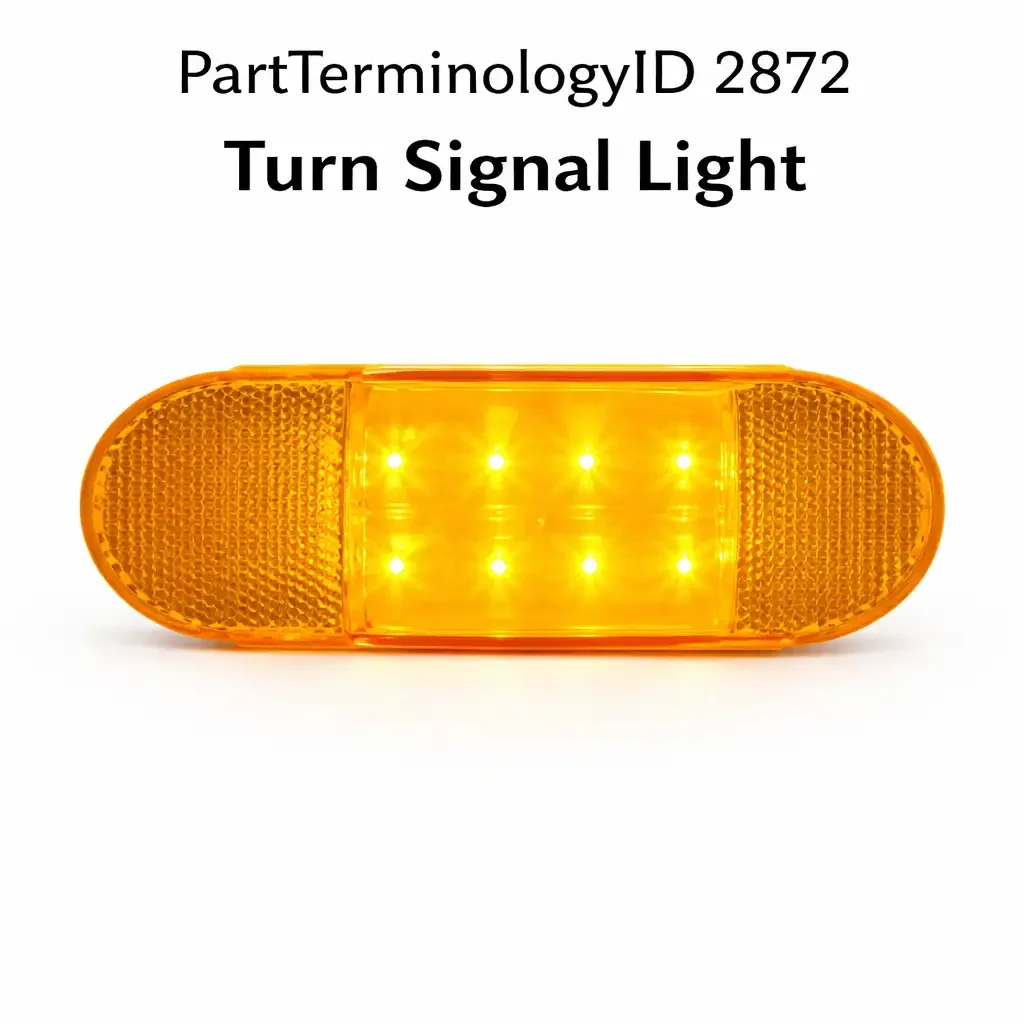
PartTerminologyID 2872, Turn Signal Light, is the flashing directional indicator lamp required by FMVSS 108 on all passenger vehicles, activating at 60 to 120 flashes per minute when the driver signals a left or right turn or lane change, mounted at the front and rear corners of the vehicle and emitting amber light at the front positions and either amber or red light at the rear positions as specified by FMVSS 108. That definition covers the directional signaling function and the flash rate requirement correctly and leaves unresolved every question that determines whether the replacement bulb type is single or dual filament where the turn signal shares a socket with the parking light, whether the lens and bulb combination produces amber output at the front position as required by federal standard, whether the LED replacement triggers hyper-flash from the flasher module's current-load sensing and whether a load resistor or LED-compatible flasher is needed to restore the correct flash rate, whether the front or rear position is covered, whether the assembly is a standalone turn signal housing or a combination unit integrating the parking light, DRL, side marker, or headlight function at the same corner, whether the connector type and pin count cover all circuits active in the original harness, whether the body style affects the front fender or rear quarter panel geometry at the turn signal position, and whether the amber versus red rear turn signal designation matches the vehicle's original rear circuit architecture.
It does not specify the bulb filament type, the lens color and output color, the flash rate correction method for LED replacements, the position, the combination lamp integration content, the connector pin count, the body style, or the amber versus red rear designation. A listing under PartTerminologyID 2872 that states only year, make, and model without position and lens color cannot be evaluated by a buyer who needs the front amber turn signal assembly on a vehicle where the front turn signal is integrated into the headlight assembly rather than being a standalone housing, and where the replacement must include the turn signal element within the headlight assembly rather than a freestanding signal lamp.
For sellers, PartTerminologyID 2872 is the exterior signaling PartTerminologyID where hyper-flash is the single most frequently mentioned buyer complaint in the LED replacement segment, and where the complaint is almost always preventable with a single sentence in the listing. Every LED turn signal replacement listing on a vehicle with a current-sensing flasher module will generate hyper-flash reports from buyers who did not understand the load resistor requirement. The listing either explains the hyper-flash mechanism and the correction method before the buyer orders, or it explains it after the buyer calls with a complaint. The former prevents returns. The latter generates them.
The additional complexity specific to PartTerminologyID 2872 is the front amber color requirement's interaction with the growing market for clear-lens styling upgrades. A clear-lens front turn signal assembly with a white LED element produces white output. White output at the front turn signal position is not compliant amber under FMVSS 108. The buyer who installs a clear-lens white-LED front turn signal for the clean modern aesthetic it provides on the vehicle's front end has installed a non-compliant front turn signal that will fail a vehicle inspection. This is not a hypothetical scenario. It is among the most common compliance failures associated with aftermarket exterior lighting upgrades, and the listing must address it explicitly.
What the Turn Signal Light Does
FMVSS 108 flash rate requirements and the current-sensing flasher mechanism
FMVSS 108 requires turn signal lamps to flash at a rate between 60 and 120 flashes per minute when activated. This range was established to ensure the signal is perceptible as an active flashing event to drivers across a wide range of ambient lighting conditions and viewing distances, while being slow enough to be clearly distinguishable from a malfunctioning lamp. A flash rate below 60 flashes per minute may appear as an intermittent fault rather than an intentional signal. A flash rate above 120 flashes per minute, the hyper-flash condition, was specifically chosen by the SAE and NHTSA as the fault indicator rate because it is fast enough to be recognizable as a circuit problem rather than a normal signal.
The traditional thermal flasher module determines flash rate by heating a bimetallic strip through the current flowing in the turn signal circuit. The strip bends when heated sufficiently to break the circuit, cools and straightens to close the circuit again, and the cycle repeats at a rate determined by the current level. Higher current from a functioning full-load circuit produces the correct 60 to 120 flash rate. Lower current from a partial load, such as a failed bulb or a lower-draw LED replacement, produces less heat per cycle and therefore a faster cycle rate, specifically the hyper-flash that alerts the driver to the fault.
Electronic flasher modules replaced thermal flashers on most vehicles produced after approximately 2005. These modules monitor circuit current electronically rather than thermally, but most still calibrate flash rate to the expected incandescent load current. An LED replacement on an electronic current-monitoring flasher produces the same hyper-flash result as on a thermal flasher because the current shortfall below the calibrated threshold triggers the same rapid-flash fault indication. Only flasher modules with a fixed-rate timer independent of circuit current produce a correct flash rate with any bulb type regardless of current draw.
Front amber color requirement and the clear-lens styling upgrade compliance problem
FMVSS 108 requires front turn signal lamps to produce amber output at the lamp surface. The amber color is produced by the combination of the lens color and the bulb or LED color. An amber lens with a clear bulb produces amber because the lens filters the bulb's white output to the amber wavelength range. A clear lens with an amber bulb produces amber because the bulb emits amber-wavelength light that passes through the clear lens without color filtering. A clear lens with a white LED produces white output because the LED emits white light and the clear lens does not filter it to amber.
The clear-lens styling upgrade market has produced a significant compliance problem in the front turn signal segment. Clear-lens front lamp assemblies designed as visual upgrades are marketed and sold without adequate disclosure that they require amber-output bulbs or LEDs to remain FMVSS 108 compliant. The buyer who installs a clear-lens assembly and then pairs it with a standard white LED, or the default white incandescent included in the packaging, produces a white front turn signal that will fail a vehicle inspection and is a basis for a traffic citation in jurisdictions that check turn signal color. The listing for any clear-lens front turn signal assembly must include the explicit statement that an amber-output bulb or amber LED is required to maintain FMVSS 108 compliance, and must not include a white bulb in the kit or show a white-light product photo that implies white output is acceptable.
Hyper-flash causes, solutions, and the load resistor versus flasher module decision
The hyper-flash problem has two viable solutions for LED turn signal replacements, and the listing should present both with enough information for the buyer to choose correctly for their specific situation. The load resistor solution installs a resistor in parallel with each LED turn signal lamp to restore the circuit current to the level the flasher module expects. The resistor draws the same current as the original incandescent, which the flasher module measures and uses to set the flash rate. The LED continues to draw its low current for light production, and the resistor draws the balance to reach the target total. The combined current from LED plus resistor equals the original incandescent current, and the flasher module produces the correct flash rate.
The load resistor solution has one significant drawback: the resistor converts the wasted current entirely into heat. On a vehicle that uses the turn signal frequently, the resistors accumulate substantial heat over a driving session and must be mounted to a heat-dissipating surface, typically a metal bracket or the vehicle's body metal, rather than to a plastic bracket or wiring loom. A resistor mounted to a plastic surface in an enclosed space will eventually melt the plastic and may create a fire risk. The listing for a load resistor kit must specify the mounting requirements and must explicitly state that resistors must not be mounted to plastic components or enclosed in unventilated spaces.
The LED-compatible flasher module solution replaces the vehicle's flasher module with a unit that determines flash rate by a fixed timer rather than by current monitoring. This eliminates the hyper-flash at the source rather than compensating for it. The LED flasher module produces the correct flash rate regardless of how many LED bulbs are on the circuit and regardless of their current draw. The disadvantage is that the fixed-rate flasher also eliminates the burned-bulb fast-flash warning that the current-sensing flasher provided. If an LED fails and the circuit current drops further, the fixed-rate flasher continues to flash at the normal rate because it does not monitor current. The driver loses the automatic burned-bulb indication. This tradeoff must be disclosed in the listing for LED-compatible flasher modules so buyers can make an informed choice between the two hyper-flash solutions.
Rear amber versus red turn signal and the circuit architecture consequence
FMVSS 108 permits rear turn signals to emit either amber or red light, a regulatory flexibility that has produced two distinct rear turn signal architectures in the market. The red rear turn signal architecture, dominant among domestic manufacturers and common on many Japanese and Korean vehicles, shares the stop lamp's dual-filament socket for both the tail lamp and the turn signal functions. The lower filament provides the tail lamp, the higher filament provides both the stop lamp and the turn signal through the same circuit, and the BCM or turn signal switch modulates the higher filament for flashing when turning and steady output when braking.
The amber rear turn signal architecture, common among European-heritage manufacturers and increasingly adopted on domestic vehicles, uses a separate socket and dedicated circuit for the turn signal function, keeping it entirely independent of the stop lamp circuit. This architecture allows the rear turn signal to flash amber while the stop lamp remains steady red simultaneously, which many argue provides clearer signaling to following drivers than the red-flash turn signal that requires following drivers to distinguish between a steady red stop lamp and a flashing red turn signal in the same lens zone.
The catalog consequence is that amber and red rear turn signal assemblies are not interchangeable without wiring modification. An amber turn signal assembly uses a separate socket and an additional circuit wire that is not present in the harness of a vehicle originally configured for red rear turn signals. A red turn signal assembly uses the dual-filament stop/tail socket and shares the stop lamp circuit wire. Substituting one for the other requires either adding or removing a circuit wire and changing the socket type. The listing must identify the rear turn signal color and circuit type as matching attributes, not merely cosmetic preferences.
Combination lamp integration and the front turn signal in headlight assemblies
On many modern vehicles, the front turn signal is not a standalone housing adjacent to the headlight but is an element integrated into the headlight assembly itself. On these vehicles, replacing the front turn signal requires either accessing the turn signal socket from within the headlight assembly, replacing the headlight assembly if the turn signal element is not separately serviceable, or in some cases replacing only the turn signal module within the headlight assembly if the manufacturer provides a module-level service option.
A listing under PartTerminologyID 2872 for a standalone front turn signal assembly does not apply to a vehicle where the turn signal is integrated into the headlight. The listing must note the standalone versus headlight-integrated distinction and must direct buyers with headlight-integrated turn signals to the headlight assembly listing or the headlight turn signal module listing rather than a standalone signal lamp. Failing to make this distinction delivers a standalone housing to a buyer whose vehicle has no mounting location for a standalone housing and whose turn signal socket is 18 inches inboard inside the headlight assembly.
Why This Part Generates Returns
Buyers return turn signal lights because the LED replacement causes hyper-flash and the buyer did not know a load resistor or LED flasher module was required, a clear-lens front turn signal assembly is paired with a white LED and the white output fails the amber requirement at inspection, the rear turn signal is amber and the delivered assembly covers the red circuit architecture making direct installation impossible without wiring modification, the front turn signal is integrated into the headlight assembly and the delivered standalone housing has no mounting location on this vehicle, a single-filament 1156 is delivered for a dual-filament 1157 socket and the parking light function is lost after installation, the load resistor kit is installed on plastic brackets and the resistors melt the brackets after repeated turn signal use generating a burning smell and requiring load resistor relocation, the driver-side assembly is delivered and the buyer needed the passenger side on a vehicle where the two front fender turn signal housings use different asymmetric contours, the LED-compatible flasher module eliminates the burned-bulb fast-flash warning and a subsequent bulb failure goes undetected for weeks because the flasher no longer indicates the missing load, the assembly covers the base trim turn signal position and the buyer has the sport trim whose front fascia uses a different turn signal pocket depth, and the front turn signal housing is an oval lens and the delivered assembly is a round lens that physically fits the mounting holes but does not match the original oval aperture in the bumper fascia.
Status in New Databases
PIES/PCdb: PartTerminologyID 2872, Turn Signal Light
PIES 8.0 / PCdb 2.0: No change in PartTerminologyID or terminology label.
Top Return Scenarios
Scenario 1: "LED hyper-flash, buyer did not know load resistor was required, returns LED"
The buyer installs LED front turn signal replacements. The vehicle has a current-sensing electronic flasher module. Both LEDs function but flash at approximately 200 flashes per minute. The buyer believes the LEDs are defective because they flash incorrectly and returns both. The LEDs are functioning correctly. The issue is the flasher module's response to reduced LED current. A load resistor in parallel with each LED would have restored the correct flash rate before installation.
Prevention language: "Hyper-flash note: This vehicle uses a current-sensing flasher module. LED replacements draw less current than the original incandescent and will cause hyper-flash without a load resistor or LED-compatible flasher module. Add a load resistor kit (part [X]) or an LED flasher module (part [Y]) to restore the correct 60 to 120 flash rate. This is not a defect in the LED. It is a flasher module compatibility issue."
Scenario 2: "Clear-lens assembly with white LED, non-compliant white output at front position"
The buyer installs a clear-lens front turn signal assembly for the clean front-end appearance. The assembly comes with a white LED or the buyer installs a standard white LED. The lens is clear and does not filter the output. The front turn signal produces white output. At the annual inspection, the inspector records a non-compliant front turn signal color. FMVSS 108 requires amber. White is not amber. The vehicle fails the front turn signal color check.
Prevention language: "FMVSS 108 amber requirement: This assembly has a clear lens. FMVSS 108 requires front turn signals to emit amber light. A clear-lens assembly requires an amber-output bulb or amber LED to produce compliant amber output. A white bulb or white LED behind a clear lens produces white output that does not meet the FMVSS 108 amber requirement and will fail a vehicle inspection."
Scenario 3: "Amber rear turn signal assembly on red-circuit vehicle, wiring incompatible"
The buyer's vehicle uses a red rear turn signal sharing the stop lamp dual-filament socket. The delivered assembly covers the amber rear turn signal architecture with a separate dedicated turn signal socket and an additional circuit wire. The original harness connector does not have a wire for the amber turn signal circuit. The stop and tail functions can be connected but the amber turn signal socket has no corresponding wire in the original connector. The turn signal does not flash because the dedicated amber circuit wire is absent.
Prevention language: "Rear turn signal type: [amber, dedicated circuit / red, shared stop-lamp circuit]. This assembly uses a [type]. Installing an amber turn signal assembly on a vehicle originally configured for red rear turn signals requires adding the amber turn signal circuit wire to the harness. Verify the rear turn signal type before ordering."
Scenario 4: "Front turn signal integrated in headlight, standalone housing delivered, no mounting location"
The buyer needs a front turn signal replacement. The vehicle's front turn signal is integrated into the headlight assembly. The listing covers a standalone front turn signal housing. The delivered standalone housing has no mounting location on this vehicle because the front bumper fascia has no standalone signal lamp pocket. The turn signal socket is inside the headlight assembly. The standalone housing is returned unused.
Prevention language: "Turn signal configuration: [standalone housing / integrated in headlight assembly]. On this vehicle, the front turn signal is [configuration]. A standalone turn signal housing does not apply to headlight-integrated applications. For headlight-integrated applications, see the headlight assembly listing or the headlight turn signal module listing."
Scenario 5: "Load resistors mounted to plastic, melt after repeated use, burning smell, fire risk"
The buyer installs load resistors alongside LED turn signal replacements. The resistors are zip-tied to the plastic turn signal housing bracket inside the front fascia. After several weeks of urban driving with frequent turn signal use, the resistors heat the plastic bracket beyond its glass transition temperature. The bracket deforms and the resistors contact additional plastic surfaces, producing a burning smell. The buyer returns the load resistor kit and requests guidance on correct mounting.
Prevention language: "Load resistor mounting: Mount resistors to bare metal (frame rail, body metal, or metal bracket) only. Do NOT mount to plastic components, wiring looms, or in enclosed unventilated spaces. Load resistors generate substantial heat during extended turn signal use and will melt plastic mounting surfaces. Each resistor should be secured with metal fasteners to a metal heat-dissipating surface with at least 50mm clearance from all plastic and rubber components."
Scenario 6: "LED flasher eliminates burned-bulb warning, subsequent failure goes undetected"
The buyer installs an LED-compatible fixed-rate flasher module to eliminate hyper-flash. The flasher produces the correct flash rate with LED bulbs. Six months later one LED fails on the rear passenger side. The fixed-rate flasher continues to flash at the normal rate because it does not monitor current and does not detect the missing lamp load. The driver does not notice the dark rear turn signal and drives for three weeks with a non-functional rear indicator. The buyer returns the flasher module requesting a unit that will detect a failed LED.
Prevention language: "LED flasher tradeoff: This LED-compatible flasher uses a fixed timer and does not monitor circuit current. It will not hyper-flash when a LED fails. If a turn signal LED fails, the flash rate will remain normal and the driver will not receive the automatic rapid-flash fault indication. Monitor turn signal function visually or install a load-monitoring LED module that provides an audible chime for missing lamp load."
What to Include in the Listing
PartTerminologyID: 2872
component: Turn Signal Light
part type: bulb only or complete assembly (mandatory, in title)
position: front or rear (mandatory, in title)
side: driver side, passenger side, or symmetric (mandatory for asymmetric housings)
bulb filament type: single or dual with bulb number (mandatory, in title for bulb listings)
output color: amber or red at lamp surface with lens-and-bulb color source breakdown (mandatory)
FMVSS 108 amber front requirement note for clear-lens assemblies (mandatory)
hyper-flash note with load resistor and LED flasher module solutions (mandatory for LED listings)
load resistor mounting requirements with plastic prohibition (mandatory for load resistor listings)
LED flasher burned-bulb warning tradeoff disclosure (mandatory for LED flasher module listings)
rear turn signal type: amber dedicated circuit or red shared stop-lamp circuit (mandatory for rear listings)
combination lamp integration content and connector pin count (mandatory for combination assemblies)
standalone versus headlight-integrated configuration (mandatory for front position listings)
body style and trim level where fascia pocket geometry differs (mandatory)
bulb base type and wattage (mandatory)
OEM part number cross-reference (mandatory)
quantity per package (mandatory)
Catalog Checklist for ACES/PIES Teams
PartTerminologyID = 2872
require position: front or rear in title (mandatory)
require part type in title (mandatory)
require bulb filament type in title for bulb listings (mandatory)
require output color with color source breakdown (mandatory)
require FMVSS 108 amber note for clear-lens front listings (mandatory)
require hyper-flash disclosure with both solutions for LED listings (mandatory)
require load resistor mounting requirements for resistor kit listings (mandatory)
require LED flasher burned-bulb warning tradeoff disclosure (mandatory for flasher module listings)
require rear turn signal type: amber or red for rear position listings (mandatory)
require standalone versus headlight-integrated note for front position listings (mandatory)
require combination lamp integration content and connector pin count (mandatory for combination assemblies)
prevent clear-lens without amber output note: a clear-lens assembly without an amber output requirement note will generate non-compliant installations and inspection failures; the amber requirement is mandatory for all clear-lens front turn signal listings
prevent hyper-flash omission: every LED turn signal listing on a current-sensing flasher application must include the hyper-flash explanation and both solutions; the omission is the most return-generating gap in the LED turn signal segment
prevent amber-red architecture conflation: amber and red rear turn signal assemblies are circuit-incompatible without wiring modification; rear turn signal type must be a matching attribute, not a cosmetic preference
prevent headlight-integrated conflation: a standalone housing listing applied to a headlight-integrated application delivers an uninstallable part; the configuration distinction is mandatory for all front turn signal listings
differentiate from Parking Light (PartTerminologyID 2836): the parking light illuminates steadily with headlamps; the turn signal flashes for direction indication; both are amber at the front corner and often in the same socket or housing but on separate circuits
differentiate from Side Marker Light (PartTerminologyID 2824): the side marker provides lateral steady vehicle visibility; the turn signal provides directional flash indication; both may be at the same front corner but with different circuits and FMVSS 108 functions
differentiate from Brake Light (PartTerminologyID 2860): the brake light is the steady-illumination stop lamp; the turn signal is the flashing direction indicator; both may be at the rear corner in the same housing but are activated by different circuits and produce different FMVSS 108 signals
FAQ (Buyer Language)
What does the turn signal do and is it required?
The turn signal is the flashing direction indicator that activates when signaling a turn or lane change. FMVSS 108 requires it on all U.S. vehicles at the front and rear corners, flashing between 60 and 120 times per minute. A non-functional turn signal is one of the most commonly cited traffic violations. Front signals must be amber. Rear signals may be amber or red.
Why does my turn signal flash too fast after installing LEDs?
Your vehicle's flasher module monitors circuit current to set the flash rate. LEDs draw far less current than the incandescent bulbs they replaced, which the flasher interprets as a missing bulb and triggers hyper-flash as a fault signal. A load resistor in parallel with each LED restores the expected current. An LED-compatible fixed-rate flasher module eliminates current monitoring entirely. Both approaches restore the correct 60 to 120 flash rate.
Are front turn signals required to be amber?
Yes. FMVSS 108 mandates amber output at the front turn signal position. If you install a clear-lens assembly, you must use an amber-output bulb or amber LED. A clear lens with a white LED produces white output that is not compliant amber and will fail a vehicle inspection.
What is the difference between amber and red rear turn signals?
Amber rear turn signals use a dedicated circuit and separate socket independent of the stop lamp. Red rear turn signals share the stop lamp's dual-filament socket. The two architectures are not directly interchangeable without wiring modification. Verify which type your vehicle uses before ordering a rear turn signal assembly.
Can I install an LED flasher to fix hyper-flash?
Yes, with one tradeoff. A fixed-rate LED flasher eliminates hyper-flash permanently but also eliminates the automatic burned-bulb warning. When an LED fails, the flasher continues flashing at normal rate rather than hyper-flashing to alert you. You will need to monitor turn signal function visually or use a load-monitoring LED module instead.
Cross-Sell Logic
Load Resistor Kit: the mandatory companion product for LED turn signal replacements on vehicles with current-sensing flasher modules; should be listed as a required add-on in the LED turn signal listing
LED-Compatible Flasher Module: the alternative hyper-flash solution that eliminates wasted resistor heat; should be cross-listed alongside load resistor kits as an either-or solution with the burned-bulb warning tradeoff disclosed
Parking Light (PartTerminologyID 2836): the front corner companion lamp in the same dual-filament socket on many vehicles; replacing the turn signal bulb often means replacing the parking light bulb at the same time since both may have aged similarly
Side Marker Light (PartTerminologyID 2824): the lateral corner lamp wired to flash with the front turn signal on many vehicles; if the front turn signal is being replaced following housing damage, the front side marker at the same corner may have been damaged simultaneously
Headlight Assembly: for vehicles with headlight-integrated front turn signals; when the turn signal element fails inside the headlight assembly and the headlight assembly must be partially or fully replaced to service the turn signal
Final Take for PartTerminologyID 2872
Turn Signal Light (PartTerminologyID 2872) is the exterior signaling PartTerminologyID where a single omitted sentence in the listing generates more LED replacement returns than any other technical omission in this entire series. The hyper-flash explanation takes four lines in a listing description. Without those four lines, every buyer who installs an LED turn signal on a current-sensing flasher application and sees rapid blinking will return the LED as defective. With those four lines, the buyer understands the mechanism before installation, orders the load resistor or LED flasher module simultaneously, and installs both correctly without a return. The hyper-flash note is not optional context. It is the most consequential single piece of information in the turn signal LED listing.
State the position in the title. State the part type. State the bulb filament type for bulb listings. State the output color with the color source breakdown. Include the FMVSS 108 amber note for clear-lens front assemblies. Include the hyper-flash explanation with both solutions for LED listings. Include the load resistor mounting requirements. Include the LED flasher burned-bulb warning tradeoff. State the rear turn signal type for rear listings. State the standalone versus headlight-integrated configuration for front listings. For PartTerminologyID 2872, the hyper-flash disclosure, the amber output compliance note for clear-lens front assemblies, and the amber versus red rear circuit architecture are the three attributes that prevent the three most distinct and most frequently occurring return scenarios in the turn signal replacement market.