
Tail Light (PartTerminologyID 2864): Where Assembly Configuration, Integrated Functions, and Facelift Fitment Determine Whether the Rear Position Lamp Restores Full Rear Corner Visibility
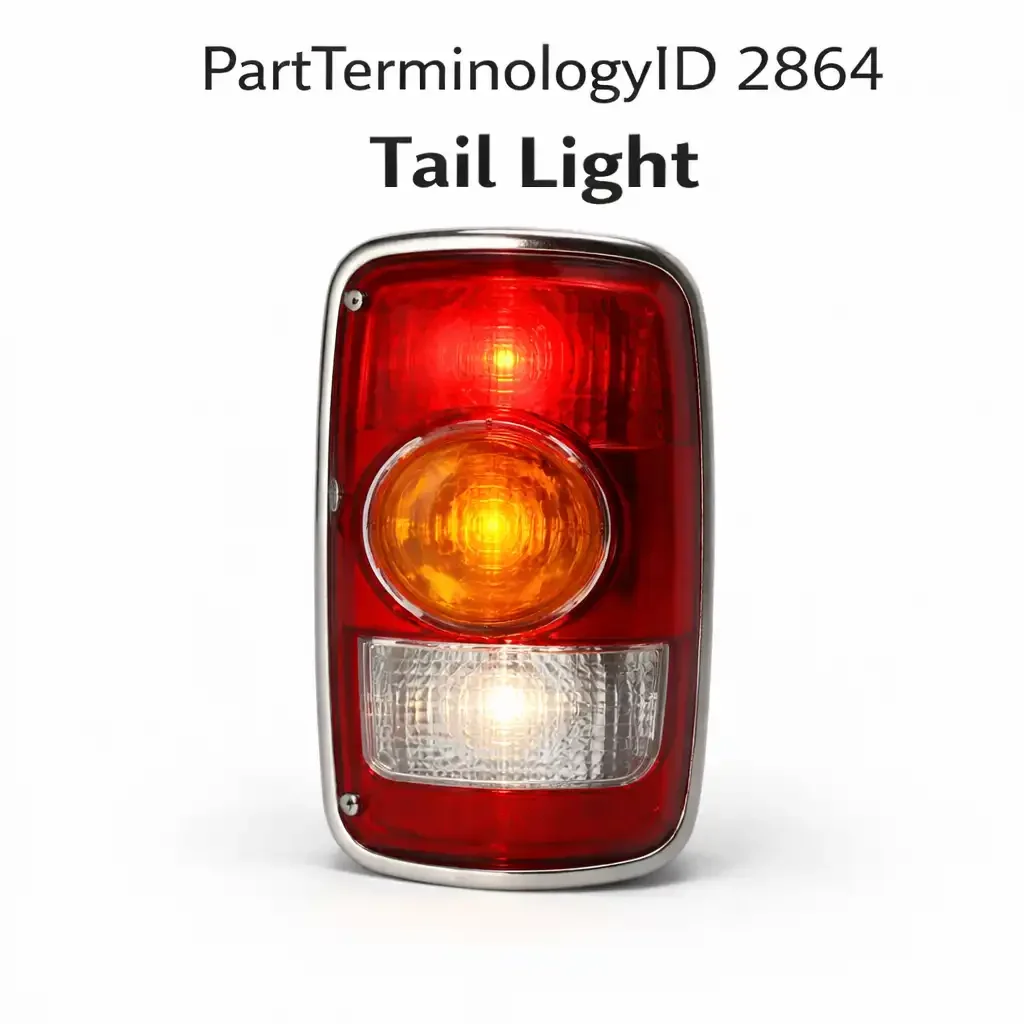
Written by Arthur Simitian | PartsAdvisory
PartTerminologyID 2864, Tail Light, is the rear position lamp that illuminates at low intensity whenever the headlamps or parking lamps are active, making the vehicle's rear visible to following drivers in darkness, required by FMVSS 108 to emit red light at minimum photometric values through a 45-degree horizontal arc to each side of the lamp axis. That definition covers the rear visibility function and the federal requirement correctly and leaves unresolved every question that determines whether the replacement is a bulb for an intact housing or a complete assembly for a cracked or damaged housing, whether the side designation is correct for asymmetric left and right lens contours, whether the assembly covers all integrated functions in the original including the stop lamp, turn signal, back-up light, rear side marker, and fog lamp circuits through a correctly pin-counted harness connector, whether the lens color is red or a combination of red zones and clear zones over separate functional elements, whether the assembly is DOT certified to meet FMVSS 108 photometric requirements, whether the body style affects the rear quarter panel geometry and lens contour dimensions, whether the replacement is a standard direct-fit unit or a cross-year facelift assembly from a later model year that the buyer intends to retrofit for a visual update, and whether the surrounding trim panels and fascia require simultaneous updating when the facelift assembly uses a different lens perimeter contour than the original.
It does not specify whether the part is a bulb or assembly, the side designation, the integrated function content, the connector pin count, the lens color breakdown by zone, the DOT certification status, the body style, or the facelift compatibility. A listing under PartTerminologyID 2864 that states only year, make, and model without side designation and integrated function content cannot be evaluated by a buyer replacing a collision-damaged passenger-side tail lamp assembly whose housing integrates the stop, tail, turn, back-up, and rear side marker functions in a six-pin connector, needing to confirm the replacement covers all six functions before ordering.
For sellers, PartTerminologyID 2864 is the rear exterior lighting PartTerminologyID with the highest visual significance of any rear lamp in the series. The tail lamp assembly defines the vehicle's rear appearance at night more completely than any other exterior component. It is the first thing a following driver sees in darkness, the element that establishes the vehicle's rear visual identity, and the surface most commonly damaged in the rear-end collisions and parking impacts that generate the largest single share of tail lamp replacement demand. The combination of high replacement volume, high visual significance, high multi-function integration complexity, and an active facelift upgrade buyer population makes PartTerminologyID 2864 the rear lighting PartTerminologyID that most rewards comprehensive listing precision across all buyer populations.
The buyer population for PartTerminologyID 2864 divides into three distinct groups. The first is the collision and damage repair buyer who needs a direct like-for-like replacement for a cracked, broken, or shattered housing following a rear impact or parking damage. This buyer's priority is correct fitment, complete integrated function coverage, and DOT certification. The second is the appearance-motivated buyer who wants to restore faded, yellowed, or sun-damaged tail lamp housings to a like-new appearance using quality OEM-equivalent replacements that match the original lens color scheme and visual character. The third is the facelift upgrade buyer who wants to replace the original generation tail lamps with later-model-year assemblies featuring redesigned LED arrays, updated lens geometry, or a more contemporary visual character from the mid-cycle facelift of the same platform. All three buyer populations order under the same PartTerminologyID and each requires different listing attributes to make a confident purchase decision.
What the Tail Light Does
FMVSS 108 rear position lamp requirements and the tail-versus-stop distinction
FMVSS 108 requires two rear position lamps, one at each side of the vehicle, that activate whenever the parking lamps or headlamps are on and emit red light at minimum photometric output values measured at test angles from directly behind the vehicle to 45 degrees to each side. The rear position lamp function is distinct from the stop lamp function despite sharing the same housing and often the same dual-filament socket. The tail light function activates from the headlamp switch circuit at the lower-intensity filament in the dual-filament bulb. The stop lamp function activates from the brake pedal switch circuit at the higher-intensity filament. The two circuits are independent and a failure in one does not affect the other if they are on separate filaments within the same bulb.
The practical importance of the tail light function is most significant in low-visibility driving conditions where the headlamps are on but the vehicle is not braking: steady-speed nighttime highway driving, foggy conditions, and dusk driving when the headlamps are activated before full darkness. In these conditions, the tail light is the primary visual cue that tells a following driver where the rear of the vehicle is and how far ahead it is. A non-functional tail light at one rear corner produces asymmetric rear illumination that following drivers may interpret as a motorcycle, a partially lit vehicle, or a different vehicle type entirely, increasing the risk of following-distance misjudgment.
Multi-function assembly integration and connector pin architecture
The tail lamp assembly is the most functionally dense housing in the vehicle's exterior lighting system. On a fully integrated modern rear corner lamp, a single housing assembly may contain the tail lamp, stop lamp, rear turn signal, back-up light, rear side marker, rear fog lamp, and a passive reflector, all within the same lens-and-housing unit connected to the vehicle harness through a connector with six to eight pins. Each function is a separate circuit. Each circuit must be connected and functional for the assembly to meet FMVSS 108 requirements for every regulated function it contains.
When a replacement assembly integrates fewer functions than the original, the unconnected circuits in the harness connector have nowhere to go. On a BCM-monitored rear lighting circuit, an unconnected rear turn signal circuit generates a fast-flash fault in the turn signal system and may illuminate the hazard warning indicator in the cluster. An unconnected back-up light circuit leaves the reverse illumination dark on that side and may generate a BCM fault. An unconnected rear fog lamp circuit generates a BCM fault on vehicles that monitor the fog lamp load. The catalog must require a complete function-by-function comparison between the original assembly and the replacement before any tail lamp assembly listing is published, because the number of functions is the single most return-generating omission in this PartTerminologyID.
Lens color architecture: red zones, clear zones, and amber turn signal variants
The tail lamp lens color architecture is more complex than a simple red-versus-clear designation. Most modern tail lamp assemblies use a multi-zone lens design where different areas of the lens cover different functional elements: a red zone over the tail and stop lamp elements, a red or amber zone over the turn signal element depending on whether the vehicle uses a red or amber rear turn signal, a clear zone over the back-up light element, and a red or clear zone over the side marker element depending on whether the side marker shares a circuit with the tail lamp or uses a separate element.
The amber versus red rear turn signal distinction is a specific FMVSS 108 design choice that varies by manufacturer and model. FMVSS 108 permits rear turn signals to emit either red or amber light. Most domestic manufacturers use red rear turn signals combined with the stop lamp in a single housing zone. Many European-heritage manufacturers and an increasing number of domestic models use amber rear turn signals in a separate lens zone within the same housing. A replacement assembly must match the original lens color architecture, including the turn signal zone color, because an amber-turn-signal assembly installed in an application that originally used a red turn signal changes the visual signal convention at the rear corner. It also changes the circuit architecture: amber turn signal assemblies typically use a separate single-filament socket for the turn signal function, while red turn signal assemblies use the stop lamp's dual-filament socket for both functions. Changing the lens color zone requires changing the circuit architecture simultaneously, and a direct swap of one for the other without circuit modification leaves one or more functions non-functional.
Over-wattage bulbs and lens heat damage in tail lamp assemblies
The same over-wattage thermal destruction mechanism described for the brake light applies with equal force to the tail light, and in some respects the risk is greater for the tail light because the tail lamp function keeps the socket energized for the entire duration of nighttime driving rather than only during braking events. A driver who makes a two-hour nighttime highway trip has the tail lamp filament energized continuously for two hours. An over-wattage bulb in the tail lamp socket accumulates far more total thermal energy per drive than the same bulb in the stop lamp socket, which is only activated during braking intervals. The lens discoloration from an over-wattage tail lamp bulb therefore progresses faster than from an over-wattage stop lamp bulb, and the socket deformation timeline is compressed proportionally.
The tail lamp lens material is also the most visually prominent surface on the vehicle's rear, so lens yellowing and discoloration from over-wattage thermal damage is immediately obvious to observers and to the owner. A yellowed or browned tail lamp lens that resulted from an over-wattage replacement requires complete assembly replacement to restore appearance, because lens discoloration from heat damage cannot be polished out the way UV surface oxidation can. The listing must state the maximum rated wattage for the tail lamp socket with the same explicit melt-risk warning developed for the brake light listing, because the tail lamp's continuous energization during nighttime driving makes it the higher-consequence socket for wattage-related thermal damage.
Facelift upgrades: updating tail lamps to later model year assemblies
The tail light is the primary visual target for facelift upgrade buyers because it is the element most associated with the vehicle's rear generation identity. When a platform undergoes a mid-cycle facelift, the tail lamp assembly redesign is typically the most visually dramatic change visible from the rear. The LED array pattern changes from round or oval bulb lens clusters to blade LED or pixel LED arrays. The lens geometry becomes sharper or more angular. The light guide technology may change from discrete LED elements to continuous light bars. The overall visual character shifts from the original generation to the updated generation in a way that is immediately recognizable even to non-automotive observers standing behind the vehicle in a parking lot.
For a buyer who purchased their vehicle in the first two years of a model generation and is now seeing the facelifted version on the road three years later, the tail lamp replacement event following a collision or deterioration is an opportunity to simultaneously repair the damage and visually update the vehicle to the current generation appearance. This buyer is prepared to do the compatibility homework if the listing provides the necessary information, and they represent a premium price opportunity for the seller because they are selecting a more expensive facelift assembly rather than a like-for-like original replacement.
Facelift fitment: the five-point verification checklist
The facelift tail lamp upgrade requires the same five-point compatibility verification developed for the brake light section, applied specifically to the tail lamp assembly. The first point is mounting tab position compatibility: the facelift assembly's mounting tabs must align with the pre-facelift body panel's mounting holes without requiring new holes or adapter brackets. On platforms where the rear quarter panel stampings were shared between the original and facelifted generations, this is typically satisfied directly. On platforms where the facelift revised the quarter panel contour, mounting positions may have shifted.
The second point is connector pin count and function compatibility: the facelift assembly's connector must cover all circuits present in the pre-facelift harness. If the facelift assembly added an animated LED driver circuit that requires an additional pin not present in the pre-facelift harness, the animation will not function without supplemental wiring. The third point is lens contour perimeter and trim matching: the facelift lens edge must either align with the original lens-to-panel seam or cover the original seam, and the surrounding garnish panels must be evaluated for replacement if the facelift lens contour does not match the original trim configuration. The fourth point is DOT certification: the facelift assembly must bear DOT certification for all regulated functions. The fifth point is bumper fascia cutout compatibility: if the facelift revised the rear bumper fascia in addition to the tail lamp, the facelift assembly may require the facelift fascia to fit correctly in the rear corner opening.
Trim level variants within the same generation and the function count problem
Before facelift upgrades, the tail lamp replacement market has a more immediate function-count problem caused by trim level variation within the same model year range. The same vehicle produced in the same year may have a base trim tail lamp assembly with four integrated functions and a four-pin connector, a mid-trim assembly with five integrated functions and a five-pin connector that adds the rear fog lamp, and a sport or premium trim assembly with six integrated functions and a six-pin connector that adds sequential LED animation on top of the fog lamp. All three assemblies may share the same outer lens contour and mounting tab positions, making them visually identical in a catalog photo, but they are circuit-incompatible because each has a different connector pin count.
A catalog listing that covers all trim levels under a single part number because the mounting tabs are the same will deliver the base trim three-function assembly to a premium trim buyer whose harness has six active pins. The BCM stores three fault codes for unconnected fog lamp, animation driver, and secondary ground circuits. The premium trim buyer has three non-functional rear corner lamp elements and a cluster full of warning lights for a car that externally appears to have the correct assembly installed. The only way to prevent this failure is to require trim level as a matching attribute for all tail lamp assembly listings and to publish separate listings for each trim level's specific function count and connector pin configuration.
LED technology generations and the replacement market for early LED tail lamps
The tail lamp replacement market for vehicles that originally left the factory with LED tail lamp assemblies, rather than incandescent bulb assemblies, presents a distinct set of considerations that did not exist in the pre-LED era. LED tail lamp assemblies do not have individually replaceable bulb elements in most designs. When a single LED element in an LED tail lamp assembly fails, the failure mode is typically one of three types. The first is a single LED chip failure that produces a dark spot in the otherwise illuminated lens face, visible as a small dark zone within the lit tail lamp surface. The second is an LED driver board failure that produces a complete dark zone in one functional section of the assembly, typically the entire stop lamp zone or the entire tail lamp zone, because the driver board powers all elements in that zone simultaneously. The third is a lens crack or housing breach that admits moisture, which corrodes the LED contacts and produces intermittent flickering followed by progressive element failure across the affected zone.
On original LED tail lamp assemblies, the replacement options are more limited than for incandescent assemblies because the LED elements are typically soldered directly to the circuit board within the housing rather than being socket-mounted. The buyer cannot replace individual LED elements the way they would replace incandescent bulbs. The entire assembly must be replaced when any LED element or driver board fails beyond the level the buyer is willing to accept. This means that the LED tail lamp replacement event is always a complete assembly replacement, never a bulb replacement, and the listing under PartTerminologyID 2864 for LED-original-equipment vehicles must cover only complete assemblies and must note the inapplicability of bulb listings to vehicles that left the factory with LED assemblies.
The secondary implication is cost. An original-equipment LED tail lamp assembly replacement is significantly more expensive than an incandescent assembly replacement for the same vehicle because the LED elements, driver board, and lens are all integrated into a single premium-priced housing. Buyers who receive a price estimate for a LED tail lamp assembly replacement after a minor parking lot impact are frequently surprised to find that the repair cost equals or exceeds the vehicle's deductible, and that the labor cost for the replacement is similar to or greater than an incandescent assembly replacement because the LED assembly requires more careful handling to avoid damaging the integrated driver board during installation. The listing should note the LED assembly's higher price point and the reason for it: the driver board integration that eliminates field-replaceable elements also concentrates the value of every replaceable element into the single assembly purchase.
Performance and appearance upgrades beyond the facelift: custom LED conversions
Beyond the facelift upgrade to a later model year OEM assembly, a segment of the tail lamp aftermarket offers complete custom LED conversion assemblies for vehicles that originally used incandescent bulb assemblies. These assemblies replace the original housing entirely with a new housing that uses LED light guides, blade LED arrays, or pixel LED panels to produce a modern LED tail lamp appearance on a vehicle that was designed before LED tail lamps were standard. For buyers who want the LED aesthetic on a vehicle from the mid-2000s or early 2010s that originally used oval or round-lens incandescent assemblies, these conversion assemblies represent the most complete visual transformation available short of replacing the vehicle.
The catalog and compliance considerations for custom LED conversion assemblies are identical to those for any complete tail lamp replacement but with additional scrutiny required because these assemblies are designed specifically for the appearance upgrade market rather than the like-for-like replacement market. The most important question for every custom LED conversion assembly listing is whether the assembly is DOT certified for all integrated regulated functions. An aftermarket LED conversion assembly that produces visually impressive output but was engineered to a styling specification rather than an FMVSS 108 photometric standard may not meet the minimum stop lamp, tail lamp, or turn signal output requirements at the required lateral test angles despite appearing subjectively bright from directly behind the vehicle. The DOT certification requirement is more important for custom LED conversion assemblies than for any other category in this PartTerminologyID, because the performance upgrade segment attracts exactly the buyer who is most focused on visual output and least focused on regulatory compliance documentation.
The load-sensing circuit compatibility consideration from the brake light section applies equally to custom LED conversion tail lamp assemblies. A full LED assembly replacing an incandescent original will present a significantly lower current load to the BCM's rear lighting circuit monitor. On vehicles with load-sensing tail lamp circuits, this triggers a tail lamp circuit fault that may illuminate a rear lamp warning indicator in the cluster. A load resistor bank or a replacement BCM-compatible module is required alongside the LED conversion assembly on affected applications, and the listing must note this requirement before the buyer orders the LED assembly without the supporting load-compensation hardware.
Collision damage context: when to replace both sides simultaneously
The majority of tail lamp replacement demand is collision-driven: a rear-end impact, a parking lot back-in, or a shopping cart strike that cracks the lens of one tail lamp assembly. The buyer's instinct is to replace the damaged side only and leave the undamaged side in place. This is the minimum necessary repair and it is often the correct approach when the vehicle is relatively new and the undamaged assembly's lens is still clear, the lens color is still true red without significant UV fade, and the LED array or incandescent elements are all functional.
On vehicles with more than five years of exterior UV exposure, the undamaged tail lamp assembly's lens will have undergone some degree of UV-related color shift and surface oxidation. The original deep red lens characteristic of a new assembly gradually shifts toward a lighter, more orange-red or pink-red tone over years of sun exposure. A new replacement assembly installed on the damaged side will have the original deep red optical quality of fresh lens material. The undamaged assembly on the opposite side will show the lighter, UV-shifted tone. The asymmetric appearance between the fresh replacement and the aged original is frequently noticed by the buyer and sometimes by the inspector, and it motivates a second purchase of the undamaged-side assembly within weeks or months of the initial repair.
The listing should address this directly in the fitment notes for any assembly listing covering a vehicle model with more than five years of production history. A suggested-pair note that explains the UV fade asymmetry and recommends simultaneous replacement of both sides for vehicles over five years old converts a single-unit purchase into a two-unit purchase on a significant portion of the collision-repair buyer population, reduces the likelihood of a follow-up single-unit purchase within weeks, and provides genuine value to the buyer by warning them of the visual mismatch before they experience it rather than after.
Why This Part Generates Returns
Buyers return tail lights because the passenger-side assembly is delivered and the buyer needed the driver-side unit on a vehicle where the left and right lens contours are mirror-image asymmetric and neither fits the other's mounting position, the replacement integrates stop, tail, and turn in a three-pin connector while the original integrates stop, tail, turn, back-up, and side marker in a five-pin connector leaving back-up and side marker circuits unconnected, the turn signal zone on the delivered assembly is amber and the original was red creating both a visual mismatch and a circuit architecture incompatibility that prevents a direct swap, the lens is smoked and the tail lamp output falls below FMVSS 108 photometric minimums at the lateral test angles causing an inspection failure, the assembly does not bear DOT markings and the buyer's state requires certified replacement rear position lamps, the body style is a sedan and the delivered assembly is the wagon whose lens extends 45mm higher than the sedan's rear quarter panel opening, the facelift assembly requires the fifth connector pin for the animated LED driver and the pre-facelift harness has four pins leaving the animation permanently inactive, the buyer installed an over-wattage bulb in the previous assembly which yellowed the lens and now the new assembly will also be damaged within months unless the correct-wattage bulb is used, the facelift assembly requires the facelift bumper fascia and the buyer has the original fascia whose corner opening is the wrong shape for the facelift lens contour perimeter, and the assembly covers the driver-side inner tail lamp on a vehicle that uses a two-piece outer-and-inner tail lamp system and the buyer needed the outer assembly.
Status in New Databases
PIES/PCdb: PartTerminologyID 2864, Tail Light
PIES 8.0 / PCdb 2.0: No change in PartTerminologyID or terminology label.
Top Return Scenarios
Scenario 1: "Three-pin replacement for five-pin original, back-up and side marker unconnected"
The original driver-side tail lamp uses a five-pin connector: tail/stop dual-filament, turn signal, back-up, side marker, and ground. The replacement assembly uses a three-pin connector covering tail/stop, turn signal, and ground only. After installation, the back-up light circuit and side marker circuit are unconnected. The back-up light on the driver side does not illuminate in reverse. The BCM stores a back-up light fault and a side marker fault. The driver-side rear corner fails the side marker check at the annual inspection.
Prevention language: "Connector: [X-pin covering tail/stop, turn signal, back-up, side marker, and ground]. Verify the pin count matches all active circuits in the original harness. A replacement with fewer pins than the original leaves regulated lamp functions disabled and generates BCM fault codes."
Scenario 2: "Amber turn signal zone on red-turn-signal application, circuit architecture incompatible"
The buyer's vehicle uses a red rear turn signal sharing the stop lamp dual-filament socket. The delivered assembly uses an amber turn signal zone with a separate single-filament socket for the turn signal function. The two-circuit architecture of the amber turn signal assembly does not match the single-socket dual-filament architecture of the original. After installation, either the stop lamp or the turn signal is connected but not both, because the original harness has a dual-filament socket connector and the replacement has separate connectors for the stop and turn functions.
Prevention language: "Turn signal color and circuit type: [red, shared dual-filament socket / amber, separate single-filament socket]. This assembly uses a [type]. Installing an assembly with a different turn signal circuit architecture than the original requires circuit modification. Verify the turn signal color and circuit type matches the original before ordering."
Scenario 3: "Facelift assembly, fifth pin unconnected, animated LED non-functional"
The buyer orders the facelift tail lamp assembly to update their pre-facelift vehicle. The facelift assembly has a five-pin connector with the fifth pin powering the sequential LED animation module. The pre-facelift harness has four pins. The animation circuit receives no power and the tail lamp operates as a static unit rather than with the animated sweep the buyer wanted. The buyer paid the premium facelift price for a feature that cannot function without supplemental wiring the listing did not mention.
Prevention language: "Facelift upgrade: When installed on pre-facelift vehicles, all basic functions connect to the original [X]-pin harness. Sequential animation requires the [function] circuit not present in the pre-facelift harness. A supplemental pigtail wire is required to activate animation. Confirm animation wiring availability before ordering."
Scenario 4: "Facelift assembly requires facelift bumper fascia, original fascia cutout wrong shape"
The facelift revised both the tail lamp assembly and the rear bumper fascia simultaneously. The facelift tail lamp lens has a wider lower corner contour than the original. The original fascia's corner cutout was shaped for the original lens. The facelift lens does not seat flush in the original fascia opening because the lower corner of the facelift lens extends beyond the original cutout boundary. The facelift assembly cannot be installed without also replacing the fascia with the facelift version.
Prevention language: "Fascia compatibility: This facelift assembly is designed for the [model year] facelift rear bumper fascia. The facelift lens contour at the lower corner is wider than the original fascia cutout. The original bumper fascia must be replaced with the facelift fascia for this assembly to seat correctly. Verify fascia compatibility before ordering."
Scenario 5: "Two-piece tail lamp system, outer delivered, buyer needed inner"
The vehicle uses a two-piece tail lamp system with a separate outer assembly on the rear quarter panel and a separate inner assembly on the trunk lid or liftgate. Both pieces contribute to the overall tail lamp appearance and function. The listing covers the outer assembly without clearly stating inner versus outer. The buyer needed the inner trunk lid assembly whose circuits include the tail and stop functions at that inboard position. The delivered outer quarter panel assembly does not fit the trunk lid mounting position and does not cover the trunk lid circuit.
Prevention language: "Assembly position: [outer quarter panel / inner trunk lid / inner liftgate / fits both, single-piece design]. This assembly is the [position] unit. Two-piece tail lamp systems use separate assemblies at separate positions with different mounting configurations and different circuit content. Verify the position before ordering."
Scenario 6: "Premium trim six-pin original, base trim four-pin delivered, three BCM faults"
The buyer has the premium trim vehicle with a six-pin tail lamp connector covering stop/tail, turn signal, back-up, fog lamp, sequential animation driver, and ground. The listing covers the model year without distinguishing trim level. The delivered assembly is the base trim four-pin unit. After installation the fog lamp, animation, and animation ground circuits are unconnected. The BCM stores three faults. The cluster shows a rear lamp warning. The buyer requires the premium trim assembly with the correct six-pin connector.
Prevention language: "Trim level: [base, [X]-pin / mid, [X]-pin / premium or sport, [X]-pin]. This assembly covers the [trim] variant. Verify the trim level and connector pin count before ordering. Assemblies sharing the same outer lens contour may have different pin counts across trim levels. A lower-trim assembly installed on a higher-trim vehicle leaves active circuits unconnected."
Scenario 7: "UV-faded undamaged side, fresh replacement creates visible asymmetry, second purchase follows"
The buyer replaces the collision-damaged driver-side tail lamp on a seven-year-old vehicle. The new assembly's lens has the deep red optical quality of fresh lens material. The undamaged passenger-side assembly has seven years of UV exposure and has shifted to a lighter orange-red tone. The contrast between the two sides is visible from 20 feet away in daylight and is immediately apparent at night when both lamps illuminate. The buyer orders the passenger-side assembly three weeks later to restore a matched appearance.
Prevention language: "Appearance note for vehicles over five years: On high-mileage or older vehicles, the undamaged opposite-side assembly may show UV-related lens color shift relative to the fresh replacement. Replacing both sides simultaneously avoids visible asymmetry between the new and aged lens tones. Consider ordering the pair if the vehicle is more than five years old."
Core essentials
PartTerminologyID: 2864
component: Tail Light
part type: bulb only or complete assembly (mandatory, in title)
side: driver side, passenger side, or symmetric (mandatory, in title)
assembly position: outer, inner, or single-piece (mandatory for two-piece systems)
integrated functions: complete list of all functions covered (mandatory)
connector pin count with function mapping (mandatory)
turn signal color and circuit type: red shared or amber separate (mandatory)
lens color zones: red, amber, and clear zone breakdown (mandatory)
FMVSS 108 compliance and DOT certification status (mandatory)
smoked lens off-road disclosure (mandatory for smoked listings)
maximum socket wattage with over-wattage melt warning (mandatory for incandescent bulb listings)
body style where rear quarter panel geometry differs (mandatory)
facelift upgrade checklist: mounting, connector, trim, fascia (mandatory for cross-year listings)
additional wiring required for facelift animation functions (mandatory for facelift listings)
bulb base type and wattage for each socket (mandatory)
trim level designation where function count and connector pin count differ by trim (mandatory)
LED original-equipment inapplicability note for bulb listings on LED-OEM vehicles (mandatory)
LED driver board failure modes and complete assembly replacement requirement for LED-OEM applications (mandatory)
load-sensing circuit compatibility for LED conversion assemblies (mandatory)
UV fade asymmetry note for vehicles over five years and simultaneous pair replacement recommendation (recommended)
year/make/model/submodel/trim/body style
side designation
inner versus outer position for two-piece systems
note for trim levels with fog lamp or sequential animation functions not present in base trim
note for amber versus red turn signal variants within the same model year
facelift assembly model year range with compatibility notes for pre-facelift panels
Catalog Checklist for ACES/PIES Teams
PartTerminologyID = 2864
require part type in title (mandatory)
require side designation in title (mandatory)
require assembly position for two-piece systems (mandatory)
require integrated functions complete list (mandatory)
require connector pin count with function mapping (mandatory)
require turn signal color and circuit type (mandatory)
require lens color zone breakdown (mandatory)
require DOT certification status (mandatory)
require smoked off-road disclosure for smoked listings (mandatory)
require maximum socket wattage with melt warning for incandescent listings (mandatory)
require body style where rear quarter panel geometry differs (mandatory)
require facelift upgrade checklist for cross-year listings (mandatory)
prevent trim level function-count conflation: assemblies with the same outer contour may have different pin counts across trim levels; trim level must be a required matching attribute, not a cosmetic preference
prevent LED-OEM bulb listing application: vehicles with factory LED tail lamps have no replaceable bulb elements; bulb listings must note LED-OEM inapplicability
prevent custom LED conversion without DOT certification: performance LED conversion assemblies designed for appearance may not meet FMVSS 108 photometric minimums at lateral test angles; DOT certification must be required for all aftermarket LED conversion assemblies
recommend pair replacement for vehicles over five years: UV fade asymmetry between new and aged assemblies is a documented driver of follow-up returns; a pair recommendation in the listing reduces the second single-unit purchase
a replacement with fewer functions than the original leaves regulated lamps disabled and generates BCM faults; full function count verification is the most return-generating omission in this PartTerminologyID
prevent amber-red turn signal architecture mismatch: the two circuit architectures are not interchangeable without wiring modification; turn signal color and circuit type must be required as a matching attribute
prevent facelift fascia incompatibility omission: some facelifts changed the fascia cutout simultaneously with the lamp; fascia compatibility must be stated for all facelift upgrade listings
prevent two-piece inner-outer conflation: inner and outer assemblies are at different positions with different circuits; assembly position must be required for all two-piece system listings
differentiate from Brake Light (PartTerminologyID 2860): the brake light is the high-intensity stop lamp that activates with the brake pedal; the tail light is the low-intensity rear position lamp that activates with headlamps; both are in the same housing but on separate circuits
differentiate from Turn Signal Light (PartTerminologyID 2872): the turn signal flashes for direction indication; the tail light illuminates steadily for rear position visibility; both may be in the same housing but at different lens zones and on different circuits
differentiate from Back Up Light (PartTerminologyID 2748): the back-up light activates in reverse and emits white light; the tail light activates with headlamps and emits red light; both may be in the same housing but at different lens zones with different color requirements
FAQ (Buyer Language)
What does the tail light do and is it required?
The tail light is the red rear position lamp that illuminates whenever the headlamps or parking lamps are on, making the rear of the vehicle visible to following drivers in darkness. FMVSS 108 requires two rear position lamps, one at each side. A non-functional tail light is an FMVSS 108 violation and a significant rear-end collision risk in darkness.
Is it the same as the brake light?
No. The tail light activates from the headlamp switch and illuminates at low intensity. The brake light activates from the brake pedal switch and illuminates at high intensity. Both are red, both are in the same housing, and on most vehicles both are served by the same dual-filament bulb. A single-filament replacement in that socket disables one of the two functions.
What functions are integrated in the assembly?
Modern tail lamp assemblies commonly integrate the tail lamp, stop lamp, turn signal, and back-up light in a single housing with a multi-pin connector. Some also include the rear side marker and rear fog lamp. The replacement must cover all functions present in the original. A replacement with fewer functions leaves regulated lamps disabled and generates BCM fault codes for missing loads.
Can I upgrade to a facelift tail lamp?
On many vehicles yes. Verify the mounting tabs align with your body panel, the connector pin count covers your harness, the surrounding trim panels match the new lens contour, and the bumper fascia cutout is compatible with the facelift lens. If the facelift added animated LED functions, supplemental wiring may be required for those functions to activate on the pre-facelift harness.
Why does a smoked tail light fail inspection?
FMVSS 108 requires minimum photometric output at lateral test angles as well as directly behind. A smoked lens absorbs output and may reduce lateral illumination below the minimum. An assembly without DOT certification has not been tested to confirm compliance. Smoked tail lamps are for show use only.
Why is my new tail light a different shade of red than the other side?
The new assembly's lens has the deep, saturated red of fresh lens material. The opposite side has years of UV exposure that gradually shifts the lens toward a lighter orange-red tone. The contrast is most visible in daylight and when both lamps illuminate at night. On vehicles over five years old, replacing both sides simultaneously avoids this asymmetry. It is not a defect in the new assembly. It is the expected appearance difference between new and UV-aged lens material.
My vehicle has LED tail lights from the factory. Can I replace just one failed LED element?
On most factory LED tail lamp assemblies, no. The LED elements are soldered directly to the circuit board rather than socket-mounted. A failed element, dark spot, or driver board failure requires replacing the complete assembly. There is no field-replaceable LED bulb in a factory LED tail lamp. Bulb listings under this PartTerminologyID do not apply to vehicles with factory LED tail lamps.
Does trim level affect which tail light assembly I need?
Yes, frequently. On many vehicles the base, mid, and premium trim levels use assemblies with the same outer lens contour but different integrated functions and different connector pin counts. A base trim four-pin assembly installed on a premium trim vehicle with a six-pin harness leaves fog lamp and animation circuits unconnected and generates BCM fault codes. Verify the trim level and connector pin count before ordering, not just the year, make, and model.
Brake Light (PartTerminologyID 2860): the stop lamp function integrated in the same housing; buyers replacing the tail lamp assembly after a collision should confirm the stop lamp elements are undamaged or covered by the replacement assembly simultaneously
Turn Signal Light (PartTerminologyID 2872): the rear turn signal in the same housing; a replacement assembly should confirm turn signal coverage to avoid a fast-flash fault from an unconnected turn signal circuit
Back Up Light (PartTerminologyID 2748): the reverse lamp integrated in most rear corner assemblies; confirm back-up light function is present in the replacement to avoid dark reverse illumination on that side
Rear Bumper Fascia: for facelift upgrades where the facelift assembly requires the updated fascia for correct lens seating; the fascia and lamp should be replaced together for a clean facelift result
Trunk Lid Applique or Garnish Panel: for vehicles with decorative applique trim between the two tail lamp assemblies across the trunk lid; facelift lens contour changes frequently require updating this trim piece to match the new lens perimeter
Final Take for PartTerminologyID 2864
Tail Light (PartTerminologyID 2864) is the rear exterior lighting PartTerminologyID that serves the largest and most diverse buyer population in the series. The collision repair buyer needs integrated function coverage and connector pin count confirmed against their specific trim level, not just their year, make, and model. The deterioration replacement buyer needs lens color accuracy, DOT certification, the UV fade asymmetry note for high-mileage vehicles, and wattage guidance to avoid repeating the over-wattage damage that degraded the original housing. The LED-OEM buyer needs to know their factory LED assembly has no individually replaceable elements and the complete assembly is the only service path. The custom LED conversion buyer needs DOT certification documentation and load-sensing circuit compatibility for their non-OEM replacement. The facelift upgrade buyer needs the five-point upgrade checklist, the additional wiring disclosure for animated functions, and the fascia compatibility note. A listing that addresses only one of these buyer groups with standard fitment attributes serves a fraction of the PartTerminologyID's actual buyer population correctly.
State the part type in the title. State the side designation. State the assembly position for two-piece systems. State the trim level where function counts differ. List all integrated functions with the connector pin count. State the turn signal color and circuit architecture. State the lens color zone breakdown. State DOT certification. State the maximum socket wattage with the melt warning. State the body style where quarter panel geometry differs. Note UV fade asymmetry for vehicles over five years. Note LED-OEM inapplicability for bulb listings. Provide the facelift checklist for cross-year listings. State additional wiring requirements for animation functions. For PartTerminologyID 2864, trim level function count verification, UV fade asymmetry disclosure for older vehicles, and facelift fascia compatibility are the three attributes that convert the three most distinct follow-up purchase events, the trim-mismatch BCM fault, the second single-unit aesthetic return, and the fascia incompatibility discovery, into prevented returns rather than warranty calls.