
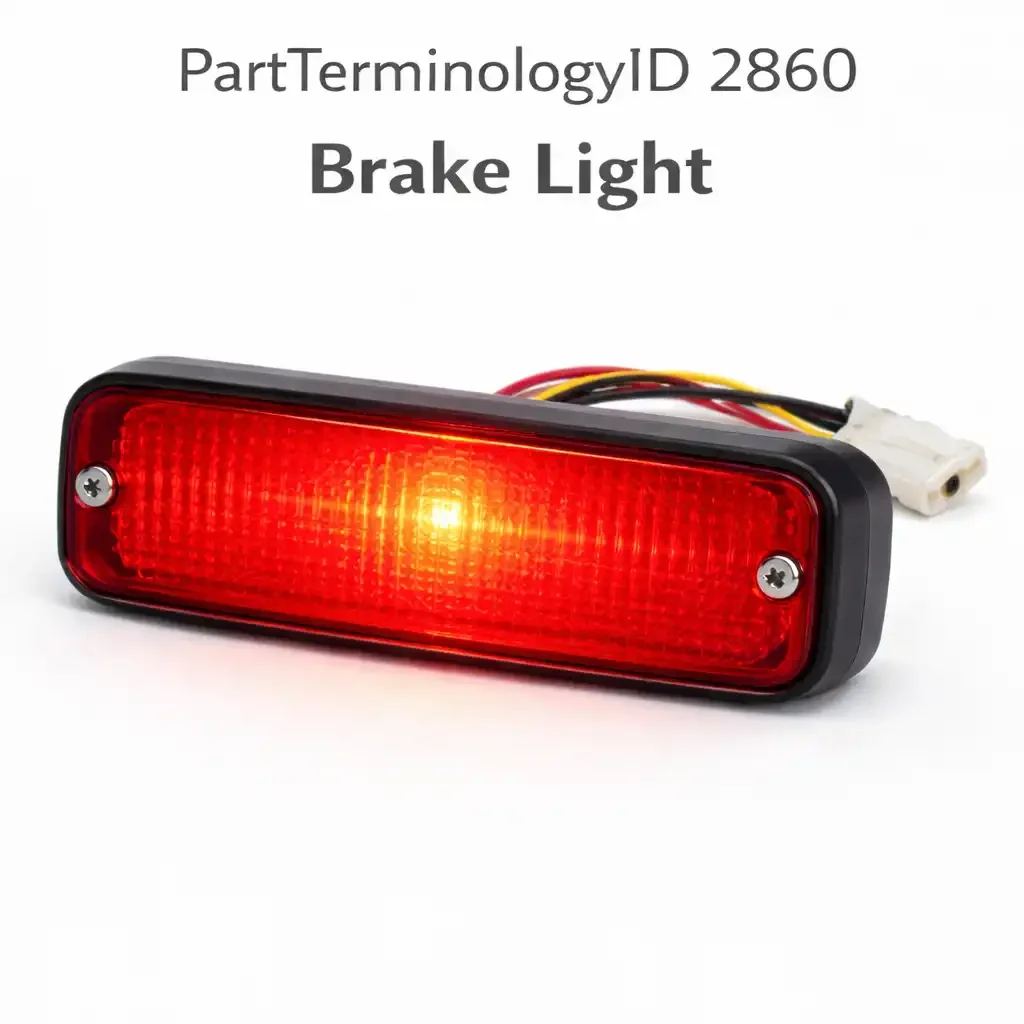
Brake Light (PartTerminologyID 2860): Where Bulb Type, Assembly Configuration, and FMVSS 108 Compliance Determine Whether the Primary Stop Lamp Signals Braking Correctly to Every Following Driver
Written by Arthur Simitian | PartsAdvisory
PartTerminologyID 2860, Brake Light, is the primary red stop lamp mounted at the left and right rear corners of the vehicle that activates when the driver depresses the brake pedal, signaling deceleration to following drivers so they can initiate braking in sufficient time to avoid a rear-end collision, required by FMVSS 108 to emit red light at minimum photometric output values visible through a 45-degree horizontal arc to each side of the lamp axis. That definition covers the stop signal function and the federal requirement correctly and leaves unresolved every question that determines whether the replacement bulb is a single-filament or dual-filament type where the brake light and tail light share a socket, whether the replacement is a bulb for an intact housing or a complete assembly for a cracked or damaged housing, whether the side designation is correct for an asymmetric tail lamp design, whether the assembly covers all integrated functions in the original tail lamp module including the tail light, turn signal, back-up light, side marker, and fog lamp circuits, whether the assembly bears DOT certification markings, whether the lens color is red or whether the lens is clear over a red bulb or red LED element, whether the replacement is a conventional incandescent bulb or an LED element that must produce red output meeting FMVSS 108 stop lamp photometric requirements, whether the body style affects the rear panel geometry and lens contour at the tail lamp position, whether the connector type and pin count cover all active rear corner circuits in the harness, and whether the vehicle has a load-sensing brake light circuit that will generate a bulb-out warning with an LED replacement.
It does not specify the bulb filament count, whether the part is a bulb or assembly, the side designation, the integrated function content, the DOT certification status, the lens color source, the LED photometric compliance, the body style, the connector pin count, or the load-sensing circuit compatibility. A listing under PartTerminologyID 2860 that states only year, make, and model without side designation and integrated function content cannot be evaluated by a technician replacing a cracked driver-side tail lamp assembly on a vehicle where the same housing integrates the brake light, tail light, turn signal, and back-up light in a single four-circuit connector, needing to confirm the replacement covers all four circuits before placing the order.
For sellers, PartTerminologyID 2860 is the rear exterior lighting PartTerminologyID with the highest safety consequence of any stop-lamp-related PartTerminologyID in the series, because the primary stop lamps at the rear corners are the braking signals that every following driver depends on across every braking event. The CHMSL (PartTerminologyID 2804) provides an elevated supplemental signal. The primary stop lamps provide the principal lateral braking signal that following drivers see in direct sightline. A non-functional primary stop lamp on one side is immediately visible to following drivers and patrol officers as an asymmetric rear lighting condition that warrants a stop. It is one of the three most commonly cited lighting violations alongside the headlight and the license plate light, and the buyer's urgency for a replacement is correspondingly high.
The additional complexity specific to PartTerminologyID 2860 is the dual-filament stop-and-tail function overlap and the multi-function tail lamp assembly integration. Both dimensions produce return scenarios that are preventable with explicit listing attributes. The dual-filament overlap is the same problem described for the parking light: a single-filament replacement in a dual-filament stop-and-tail socket loses either the brake light function or the tail light function depending on which filament circuit connects. The multi-function assembly integration is the same problem described for the headlight and parking light: a replacement assembly with fewer integrated functions than the original leaves active rear corner circuits unconnected and generates BCM fault codes. Both problems belong in the listing at the title level, not buried in a disclaimer.
What the Brake Light Does
FMVSS 108 stop lamp requirements and the response time benefit of LED replacements
FMVSS 108 requires passenger vehicles to be equipped with two rear stop lamps, one at each side, that activate when the brake pedal switch closes and meet minimum photometric output requirements measured in candela at specific test angles covering the arc from directly behind the vehicle to 45 degrees lateral and from 10 degrees above to 10 degrees below horizontal. The minimum output values for stop lamps are significantly higher than for tail lamps because the stop lamp must be distinctly brighter than the tail lamp output at the same position, allowing following drivers to unambiguously distinguish active braking from normal tail lamp illumination even at maximum tail lamp brightness with the headlamps on.
LED stop lamp replacements offer a specific safety benefit beyond compliance: faster illumination response time. An incandescent stop lamp filament requires approximately 200 to 250 milliseconds to reach full brightness from cold start because the tungsten filament must heat to operating temperature. An LED stop lamp reaches full brightness in under 5 milliseconds. At 60 miles per hour, 200 milliseconds of additional response time represents approximately 17 feet of additional stopping distance that a following driver loses waiting for the incandescent to reach full brightness. An LED replacement that produces the same FMVSS 108 photometric output as the original incandescent provides 17 feet of additional stopping distance to every following driver on every braking event. This is a genuine, documentable safety benefit that belongs in the listing as a feature distinction between incandescent and LED stop lamp replacements.
Single-filament versus dual-filament stop-and-tail function
On most vehicles, the brake light function and the tail light function are served by a single dual-filament bulb in the same socket at the rear corner position. The lower-intensity filament powers the tail light function when the headlamps are on. The higher-intensity filament powers the stop lamp function when the brake pedal is depressed. Both filaments can be active simultaneously when the headlamps are on and the driver is braking, with the stop lamp filament's higher output overwhelming the tail lamp filament's lower output and producing the required brightness differential.
The most common dual-filament bulb for the combined stop-and-tail function is the 3157 or 1157 series bayonet base. A single-filament 1156 or 3156 installed in the dual-filament 1157 or 3157 socket connects only one of the two filament circuits. If it connects the stop lamp circuit, the tail light is dark when headlamps are on, which is an FMVSS 108 rear position lamp violation. If it connects the tail lamp circuit, the brake light does not activate when the pedal is depressed, which is an FMVSS 108 stop lamp violation and a direct safety deficiency that removes the braking signal from that corner. The filament count must be stated in every brake light bulb listing and must be the primary attribute confirmed against the original socket type before the buyer orders.
Multi-function tail lamp assembly integration and the connector pin count requirement
The tail lamp assembly at each rear corner of modern vehicles integrates multiple functions in a single housing connected to the vehicle harness through a multi-pin connector. The specific functions integrated vary by vehicle and model year but commonly include the stop lamp, the tail lamp, the rear turn signal, the back-up light, and in some applications the rear side marker and the rear fog lamp. Each function is a separate circuit in the multi-pin connector, with the stop lamp circuit and tail lamp circuit sharing the dual-filament socket described above, and each remaining function using separate single-circuit sockets or LED elements within the housing.
A replacement tail lamp assembly must include all integrated functions present in the original. An assembly that omits the back-up light function leaves the back-up light circuit unconnected and the reverse illumination non-functional. An assembly that omits the rear turn signal leaves the turn signal circuit unconnected at that corner, producing a fast-flash condition in the turn signal system and removing the turn signal from the affected corner. An assembly that omits the rear fog lamp on a fog-lamp-equipped application leaves the fog lamp circuit unconnected and generates a BCM fault on vehicles where the BCM monitors the fog lamp circuit load. The integrated function list and the connector pin count are mandatory for every complete brake light assembly listing.
LED stop lamp compliance and the photometric output verification requirement
An LED replacement for the brake light position must produce red light output that meets FMVSS 108 stop lamp photometric minimums at the required test angles. This requires the LED to produce sufficient red-wavelength output to achieve the minimum candela values at the most demanding test angles, not merely at the directly-behind test angle. A directional LED array that produces high output directly behind the vehicle but falls below the minimum candela at the 45-degree lateral test angles does not meet FMVSS 108 even if the center output is impressive.
A DOT-certified LED stop lamp replacement has been tested by the manufacturer to confirm it meets all FMVSS 108 stop lamp photometric requirements at all required test angles. An LED replacement without DOT certification has not been independently verified. The catalog and listing must require DOT certification for every complete LED brake light assembly and must prevent the listing of LED assemblies that produce subjectively bright output but have not been certified to FMVSS 108 stop lamp minimums at the full angular range of required test points.
Load-sensing circuits and the LED bulb-out warning problem
The brake light circuit on some vehicles incorporates a load-sensing element in the BCM or in a dedicated brake light monitoring module that measures the current draw on the stop lamp circuit when the brake pedal is depressed. The load-sensing circuit is calibrated for the current draw of the original incandescent bulbs, typically 2.1 amperes for a pair of 1157 dual-filament bulbs with both stop lamp filaments active. When the original incandescent bulbs are replaced with LED equivalents drawing 300 to 400 milliamperes for the pair, the current draw drops to approximately 15 percent of the original, which the load-sensing circuit interprets as a blown bulb condition. The circuit triggers the brake warning lamp in the instrument cluster or the bulb monitoring warning indicator, notifying the driver that the brake light circuit has a fault even though both LED replacements are functioning normally.
Resolving this false bulb-out warning requires either installing load resistors in parallel with each LED to restore the original current draw, or replacing the brake light monitoring module with an LED-compatible module if the vehicle manufacturer offers one. Both solutions add cost and complexity beyond the bulb replacement itself. The listing must disclose the load-sensing circuit compatibility of every LED brake light replacement and must note whether the fix requires load resistors or module replacement on affected applications.
Over-Wattage Bulbs, Socket Melt, and Why the Wrong Replacement Destroys the Housing
How a bulb that is too bright burns your brake light from the inside out
The single most underestimated risk in the brake light replacement market is the over-wattage bulb. The socket, wiring, and housing of every tail lamp assembly are engineered to handle the specific thermal load produced by the original equipment bulb. A 1157 dual-filament stop-and-tail socket is designed for a maximum of 27 watts on the stop lamp filament and 8 watts on the tail filament. That thermal tolerance is calibrated to the housing's ventilation characteristics, the socket material's temperature rating, and the lens material's heat deflection point. When a buyer installs a 32-watt or 40-watt bulb marketed as a brighter brake light upgrade, the socket and housing absorb significantly more heat than they were designed to handle, and the consequences progress in a predictable sequence.
The first sign is lens discoloration. The red lens directly behind an over-wattage bulb begins to yellow and fade at the hottest zone, producing a bleached or brown patch in the red lens that is visible from outside the vehicle as a discolored area in the stop lamp face. This is not merely cosmetic. The yellowing lens scatters light differently than the original red tint, reducing the stop lamp's effective photometric output at the lens surface and potentially dropping the output below FMVSS 108 minimums at the lateral test angles even though the bulb itself is brighter than the original. A brighter bulb behind a heat-damaged lens may produce less compliant output than the original specification bulb behind an undamaged lens.
The second stage is socket deformation. The plastic socket body surrounding the bulb contacts absorbs the excess heat and softens at its glass transition temperature, which for standard nylon socket materials is approximately 80 to 100 degrees Celsius. An over-wattage bulb operating at 120 degrees Celsius at the socket contacts will deform the socket body over several hundred heat-cool cycles, progressively widening the bulb contact gap until the socket no longer holds the bulb contacts firmly against the bulb base pins. The result is intermittent electrical contact that presents as a flickering or intermittently dark brake light, which the buyer diagnoses as a failed bulb and replaces, only to find the new bulb flickers as well because the socket is damaged, not the bulb.
The third and most costly stage is the point at which the socket deformation becomes severe enough to create an arc gap between the contact pins and the socket contacts. Arcing at low voltages produces localized heat spikes far exceeding steady-state bulb temperatures, and these spikes can ignite the socket body and the surrounding wiring harness insulation. A tail lamp assembly fire from an over-wattage bulb in a deformed socket is not a hypothetical scenario. It is a documented failure mode that produces a housing that is burned from the inside, a connector that is fused to the harness, and a repair scope that has grown from a two-dollar bulb replacement to a complete tail lamp assembly replacement plus wiring repair. The listing must state the maximum rated wattage for the specific socket clearly and must include an explicit over-wattage warning for any bulb listing covering a socket with a known wattage ceiling.
LED conversion as the safe alternative to wattage escalation
The buyer who installs an over-wattage incandescent is typically seeking two things: a brighter stop lamp that following drivers cannot miss, and a longer-lasting bulb that does not require frequent replacement. A properly rated LED replacement delivers both without the thermal destruction of an over-wattage incandescent. A DOT-certified LED stop lamp replacement draws 20 to 40 percent of the original incandescent wattage while producing equivalent or greater photometric output because LED technology converts a higher proportion of input energy into light rather than heat. The socket, housing, and lens receive significantly less thermal load from an LED replacement than from the original incandescent, extending the service life of the housing assembly rather than degrading it.
The catalog implication is that every listing for a brake light bulb replacement should cross-reference the maximum rated wattage for the socket and should note the LED alternative as the thermally safe path to brighter output. A buyer who is considering a 32-watt upgrade bulb for a socket rated at 27 watts needs to see that warning before clicking the add-to-cart button, not after the housing has deformed. The over-wattage warning and the LED alternative cross-sell belong in the same listing section, presented as the thermal safety argument for choosing the LED path over the wattage escalation path.
Performance Brake Lights: What Upgrades Are Legal, What Is Not, and What Buyers Actually Need
The three performance upgrade buyer populations
The brake light performance upgrade market segments into three buyer groups with different motivations, different product requirements, and different legal exposure. Understanding which buyer population the listing is serving determines which product attributes are most important and which compliance disclosures are mandatory.
The first group is the safety-motivated daily driver buyer who has experienced a near rear-end collision and wants a brighter, faster-responding stop lamp to give following drivers more warning time. This buyer needs a DOT-certified LED replacement that produces higher luminous output than the original incandescent while meeting FMVSS 108 photometric requirements at all test angles. The LED's faster 5-millisecond response time versus the incandescent's 200-millisecond warm-up time is the primary selling point for this buyer. The 17 feet of additional stopping distance that the faster response provides at 60 mph is a concrete, documentable safety benefit. This buyer is well-served by a direct-fit DOT-certified LED replacement in the original base type, and the listing should lead with the response time and stopping distance benefit rather than merely citing FMVSS 108 compliance language.
The second group is the appearance-motivated enthusiast buyer who wants sequential or pulsed brake light activation, smoked or darkened lens assemblies, or an LED array design that replaces the original round-lens appearance with a modern flat-panel or blade-LED aesthetic. This buyer's needs create a compliance boundary that the listing must address. Sequential brake light activation that flashes or pulses the stop lamp before reaching steady illumination is regulated under FMVSS 108: the standard requires that stop lamps reach steady illumination within a defined interval after the brake switch closes and prohibits flash sequences that delay the transition to full steady output. A sequential stop lamp that pulses three times before holding steady may violate FMVSS 108 if the pulse sequence delays the full-intensity steady output beyond the permitted interval. The listing must note whether the sequential activation pattern meets FMVSS 108 stop lamp timing requirements or whether the assembly is for track or off-road use only.
The third group is the track and competition buyer who is not operating the vehicle on public roads during competition events and wants maximum brake light output visibility for the race marshal's sightlines or for other competitors following in close proximity at high speed. This buyer is not constrained by FMVSS 108 street compliance requirements during competition use but may need a street-compliant assembly for driving the vehicle to and from the track. The listing should distinguish between street-compliant competition assemblies and track-only assemblies explicitly, noting that track-only assemblies must be replaced with a street-compliant assembly before returning the vehicle to public road operation.
Sequential brake light legality and the FMVSS 108 timing requirement
Sequential rear lighting, where LED elements activate in a left-to-right or outside-to-center sweep before reaching full illumination, is a popular performance and styling feature on European and domestic performance vehicles. Some factory installations by manufacturers who have certified their sequential activation pattern to FMVSS 108 timing requirements are street legal because the full-intensity stop lamp output is achieved within the permitted interval even with a brief sweep animation preceding steady illumination. Aftermarket sequential LED assemblies that replicate this appearance are not automatically compliant simply because factory sequential assemblies exist. The aftermarket assembly must independently meet the same timing requirement to be FMVSS 108 compliant.
An aftermarket sequential assembly that requires 300 milliseconds to sweep through the activation sequence before reaching full steady output is not compliant because FMVSS 108 requires stop lamps to reach full intensity within a substantially shorter interval. A following driver who initiates braking based on seeing partial illumination during the sweep sequence and then experiences a delay before the full-intensity signal is established may misjudge the braking urgency. The listing must state whether the sequential activation is FMVSS 108 certified and what the time-to-full-intensity specification is, rather than relying on the buyer to assume street legality from the attractive appearance of the activation pattern.
High-output brake light performance assemblies and the photometric sweet spot
For the safety-motivated buyer, the ideal performance brake light replacement is a DOT-certified LED assembly that produces output at the upper end of the FMVSS 108 stop lamp photometric range at all required test angles, not merely at the center test point. The upper end of the FMVSS 108 range for stop lamps is significantly higher than the minimum, and an assembly that achieves the upper quartile of the compliant range provides meaningfully better visibility than a minimum-compliance replacement. The catalog distinction between a minimum-compliance LED replacement and a high-output performance-grade DOT-certified replacement belongs in the product description for buyers who are replacing a stop lamp specifically to improve following-driver visibility.
The performance assembly buyer who prioritizes output should also be informed of the lateral test angle performance, not just the center output. A stop lamp that is highly visible directly from behind but falls to near-minimum output at the 45-degree lateral angle provides poor visibility to drivers approaching from intersections and merging lanes. A truly high-performance brake light assembly maintains high output across the full angular range, and the listing should reference the candela output at the 45-degree lateral angle alongside the center output for buyers evaluating performance-grade replacements.
Cross-Year Facelift Upgrades: Replacing Old-Style Brake Lights with Later Model Year Assemblies
Why buyers update brake lights with newer model year assemblies
The facelift brake light upgrade buyer is one of the most consistent and underserved buyer populations in the rear lighting aftermarket. The motivation is straightforward: a vehicle produced from model year 2018 through a mid-cycle facelift in 2021 uses the pre-facelift tail lamp assembly with a lens design, LED array pattern, and overall visual character that was current in 2018. After the 2021 facelift, the updated tail lamp assembly uses a redesigned LED array, a revised lens geometry, and a more contemporary appearance that the buyer wants to adopt on their pre-facelift vehicle. The platform is the same. The rear panel geometry is the same. The harness connector layout is the same. But the facelift assembly's exterior appearance is distinctly different and the buyer wants the updated look without replacing the entire vehicle.
This buyer is performing a legitimate and common modification that is functionally equivalent to a cosmetic upgrade. They are not changing any regulated safety function. They are replacing one DOT-certified stop lamp assembly with another DOT-certified stop lamp assembly from the same manufacturer on the same platform. The upgrade is legal if the replacement assembly is DOT certified, fits the mounting position, and connects to all active harness circuits. The listing that serves this buyer must provide the specific model year range of the facelift assembly, confirm the mounting tab pattern compatibility with the pre-facelift rear panel, confirm the connector pin count compatibility with the pre-facelift harness, note any additional wiring or adapter requirements for functions that are present in the facelift assembly but were not present in the pre-facelift harness, and note whether the rear garnish trim panel or the trunk lid applique requires updating to match the facelift assembly's revised lens contour perimeter.
Mounting compatibility verification for facelift upgrades
The fundamental test for a facelift tail lamp upgrade is whether the later assembly's mounting tab pattern matches the pre-facelift body panel's mounting holes exactly. On platforms where the facelift used the same body panel stamping with only revised lamp assembly contours, the mounting holes are typically in the same positions as the original and the facelift assembly installs directly with no modification. On platforms where the facelift revised the rear panel stamping as part of a more comprehensive exterior refresh, the mounting hole positions may have shifted and the facelift assembly may require drilling new mounting holes in the pre-facelift panel or using adapter brackets that position the facelift assembly at the correct location relative to the panel opening.
The connector pin count compatibility verification is equally important. A pre-facelift tail lamp may have used a four-pin connector covering stop, tail, turn, and ground. The facelift assembly may have added an animated LED driver circuit that requires a fifth pin in the connector to provide power to the sequential activation module. Installing the facelift assembly in the pre-facelift vehicle with the four-pin harness connector leaves the fifth pin unconnected, which may disable the sequential LED animation while leaving the basic stop, tail, and turn functions active. The buyer who wanted the animated facelift appearance will find that the animation does not function because the required circuit wire is absent in the pre-facelift harness. The listing must state which functions require additional wiring that may not be present in the pre-facelift harness and must note what supplemental wiring is required to enable them.
Lens contour perimeter and the trim panel matching requirement
The tail lamp assembly's lens contour defines the visual boundary between the red lens surface and the surrounding body panel. On vehicles where the facelift revised the lens contour shape as well as the LED array design, the facelift lens extends to a different perimeter line than the original. The original body panel's paint surface and any applied trim applique or garnish panel was finished to match the original lens contour perimeter. When the facelift lens is installed with a different contour, the area between the facelift lens edge and the original lens-to-panel seam may be either exposed painted body surface with a visible joint line where the original lens edge used to sit, or covered by the facelift lens extending over the original seam area.
On most facelift upgrades, the updated assembly covers a slightly larger area than the original, hiding the original seam. But this depends on whether the facelift went larger or smaller at the lens edge. The listing for a facelift upgrade assembly must note the lens contour relationship to the original and must state whether the rear garnish panel, trunk lid applique, or body panel trim strip that borders the lens also needs to be updated to the facelift version for a clean finished appearance. A buyer who installs a facelift tail lamp without updating the surrounding trim will often have a visible mismatch at the lamp perimeter that makes the upgrade look incomplete despite the lamp itself being correctly installed.
The upgrade checklist: what to verify before ordering a facelift tail lamp
Facelift tail lamp upgrades require a more thorough pre-order verification than a direct like-for-like replacement because the buyer is intentionally crossing model year boundaries. The verification steps that determine whether the upgrade installs cleanly and functions fully are as follows. First, confirm the mounting tab positions on the facelift assembly match the pre-facelift body panel mounting holes without requiring new holes or adapter brackets. Second, confirm the connector pin count on the facelift assembly matches the pre-facelift harness connector or identify the specific additional wires required for any new functions. Third, confirm whether the facelift assembly's lens contour perimeter is larger, smaller, or the same as the original at all edges, and determine whether the surrounding trim panels require updating. Fourth, confirm the facelift assembly bears DOT certification markings for all stop lamp, tail lamp, and turn signal functions. Fifth, note whether the rear bumper fascia cutout for the tail lamp position also changed in the facelift, because some facelifts revised both the lamp assembly and the fascia cutout simultaneously, making the facelift lamp incompatible with the pre-facelift fascia without also updating the fascia. A listing that provides this five-point checklist in the listing description converts a high-return-risk purchase into a high-confidence purchase for the facelift upgrade buyer population.
Why This Part Generates Returns
Buyers return brake lights because a single-filament 1156 is delivered and the socket requires a dual-filament 1157 and the brake light no longer activates after installation, the assembly is specified for the passenger side and the buyer needed the driver side on a vehicle where the two lens contours are mirror-image asymmetric, the replacement assembly integrates only the stop and tail functions in a three-pin connector while the original integrates stop, tail, turn, and back-up in a five-pin connector leaving the turn signal and back-up circuits unconnected, the LED replacement triggers a false bulb-out warning in the instrument cluster from the load-sensing brake circuit and the buyer believes the LED is defective, the assembly does not bear DOT markings and the buyer's state requires certified replacement stop lamps, the lens is smoked and the stop lamp output falls below FMVSS 108 photometric minimums at the lateral test angles causing an inspection failure, the assembly is designed for the sedan and the buyer has the wagon whose rear panel uses a longer lens contour at the same mounting position, the connector is a four-pin assembly and the vehicle harness uses a six-pin connector with rear fog lamp and side marker circuits that are left unconnected after installation, a clear lens is delivered and the application requires a red lens because the LED elements produce white output that only becomes red through the red lens, and the body style variant has a side-exit exhaust that relocates the driver-side tail lamp assembly upward by 40mm relative to the standard position and the delivered housing does not account for this offset.
Status in New Databases
PIES/PCdb: PartTerminologyID 2860, Brake Light
PIES 8.0 / PCdb 2.0: No change in PartTerminologyID or terminology label.
Top Return Scenarios
Scenario 1: "Single-filament delivered for dual-filament socket, brake light non-functional after installation"
The buyer's stop lamp filament has failed in a dual-filament 1157 socket. The listing covers the vehicle under the brake light PartTerminologyID without specifying filament count. The delivered bulb is a single-filament 1156. After installation in the 1157 socket, the single-filament connects to the tail lamp circuit. The tail lamp illuminates normally. The brake light does not activate when the pedal is depressed because there is no stop lamp filament. The vehicle now has a non-functional stop lamp at one corner, which is an FMVSS 108 violation and a direct safety deficiency.
Prevention language: "Bulb type: [single-filament 1156 / dual-filament 1157 / single-filament 3156 / dual-filament 3157]. This listing covers a [bulb type]. A single-filament replacement in a dual-filament socket will disable either the brake light function or the tail light function. Verify the socket requires a single or dual-filament bulb before ordering. A non-functional stop lamp is an FMVSS 108 violation."
Scenario 2: "LED triggers false bulb-out warning, buyer believes replacement is defective"
The buyer installs LED stop lamp replacements. Both LEDs are functional and illuminate correctly when the brake pedal is depressed. The vehicle's load-sensing brake circuit detects 350 milliamperes instead of the expected 2,100 milliamperes and triggers the brake warning indicator in the cluster. The buyer concludes the LEDs are defective because the warning lamp is on and returns both units. The LEDs are not defective. The false warning requires load resistors or a module update.
Prevention language: "Load-sensing circuit compatibility: [compatible, no additional components required / load resistors required on vehicles with load-sensing brake circuits, see fitment notes]. On vehicles with load-sensing brake light monitoring, LED replacements may trigger a false bulb-out warning because the LED draws significantly less current than the original incandescent. Load resistors in parallel with each LED restore the correct current draw and eliminate the false warning."
Scenario 3: "Five-pin original, three-pin replacement, turn signal and back-up circuits unconnected"
The original driver-side tail lamp uses a five-pin connector: stop/tail (dual-filament), turn signal, back-up, and ground. The replacement assembly uses a three-pin connector covering only stop/tail and ground, omitting the turn signal and back-up circuits. After installation, the driver-side turn signal does not function and the back-up light is dark on the driver side. The BCM stores two fault codes for the unconnected circuits. The buyer requires the five-pin assembly that covers all original functions.
Prevention language: "Connector: [X-pin covering stop/tail, turn signal, back-up, and ground]. This assembly uses a [X]-pin connector. Verify the pin count covers all active circuits in the original harness connector. A replacement with fewer pins leaves active circuits unconnected, disables regulated lamp functions, and generates BCM fault codes."
Scenario 4: "Smoked lens, stop lamp output below FMVSS 108 minimum at 45-degree test angle, fails inspection"
The buyer installs a smoked lens tail lamp assembly. The smoked lens reduces the stop lamp output below the FMVSS 108 minimum candela values at the 45-degree lateral test angles while appearing adequately bright from directly behind. At the annual inspection, the photometric output at the lateral test angle fails the stop lamp minimum. The vehicle must be equipped with a clear-lens DOT-certified replacement to pass reinspection.
Prevention language: "Lens: [red, FMVSS 108 compliant / smoked, output below FMVSS 108 stop lamp minimum at lateral test angles, for show use only]. FMVSS 108 requires stop lamps to meet photometric minimums at 45-degree lateral test angles, not only from directly behind. A smoked lens that reduces lateral output below the minimum fails the standard regardless of center brightness. Smoked tail lamp assemblies are for show use only."
Scenario 5: "Sedan lens for wagon rear panel, contour overhangs wagon body opening"
The vehicle was produced as both a sedan and a wagon on the same platform. The sedan tail lamp assembly has a shorter vertical contour fitted to the sedan's rear quarter panel. The wagon uses a taller lens contour that matches the wagon's higher rear panel opening above the cargo area. The listing covers the model year without distinguishing body style. The delivered assembly is the sedan lens. The sedan lens contour does not fill the wagon's larger rear panel opening and overhangs the body surface incorrectly, leaving a gap at the top of the lamp cavity.
Prevention language: "Body style: [sedan / wagon / hatchback / coupe]. This assembly is designed for the [body style] rear panel configuration. Verify the body style before ordering. Tail lamp lens contours differ between body styles on the same platform where the rear panel geometry changes between body configurations."
Scenario 6: "Over-wattage bulb, socket deforms, lens discolors, housing requires complete assembly replacement"
The buyer installs a 40-watt aftermarket bulb marketed as a high-visibility brake light upgrade in a socket rated for 27 watts. After approximately 60 braking cycles over two months, the socket body deforms from excess heat. The socket contacts widen and the bulb produces intermittent contact. The buyer replaces the bulb and the new bulb also flickers within days. The lens develops a yellowed patch behind the bulb position. The buyer returns for a third bulb before discovering that the socket is damaged and the housing requires complete assembly replacement, a repair that would not have been necessary with a correctly rated bulb.
Prevention language: "Maximum socket wattage: [X] watts for the stop lamp filament. Do not install bulbs exceeding the socket wattage rating. Over-wattage bulbs deform the socket body over repeated heat cycles, cause lens discoloration, and can ignite the socket material in severe cases, requiring complete tail lamp assembly replacement. For brighter output without thermal risk, use the LED alternative listed below."
Scenario 7: "Facelift assembly installed on pre-facelift vehicle, fifth pin unconnected, sequential animation non-functional"
The buyer orders the facelift tail lamp assembly to update their pre-facelift vehicle's appearance. The facelift assembly uses a five-pin connector with the fifth pin powering the sequential LED animation module. The pre-facelift harness has a four-pin connector. The fifth pin is unconnected. The stop, tail, and turn functions work normally but the sequential LED animation does not activate because the animation module has no power supply. The buyer paid a premium for the animated appearance and receives a standard static brake light from the facelift assembly's basic circuits. The listing did not note the additional wiring requirement.
Prevention language: "Facelift upgrade note: This assembly is the [model year] facelift unit. When installed on pre-facelift [model year range] vehicles: stop, tail, and turn functions connect to the original four-pin harness. Sequential animation requires the fifth circuit wire not present in the pre-facelift harness. A supplemental wiring pigtail is required to activate the animation function. Confirm whether animation function is required before ordering."
Scenario 8: "Sequential aftermarket assembly, FMVSS 108 non-compliant pulse delay, vehicle fails inspection"
The buyer installs an aftermarket sequential brake light assembly. The assembly pulses through a three-step sweep sequence over approximately 400 milliseconds before reaching full steady output. At the annual inspection, the inspector tests the stop lamp time-to-full-intensity and records a delay that exceeds the FMVSS 108 maximum. The vehicle fails the stop lamp compliance test and the sequential assembly must be replaced with a FMVSS 108 certified unit before reinspection.
Prevention language: "Sequential activation: [FMVSS 108 certified, time-to-full-intensity within required interval / not certified to FMVSS 108 stop lamp timing requirements, for track and off-road use only]. FMVSS 108 requires stop lamps to reach full steady intensity within a defined interval. A sequential assembly that delays full-intensity output beyond this interval does not meet the standard and will fail a stop lamp timing inspection."
Core essentials
PartTerminologyID: 2860
component: Brake Light
part type: bulb only or complete assembly (mandatory, in title)
side: driver side, passenger side, or fits both (mandatory, in title for assemblies)
bulb filament type: single or dual with bulb number (mandatory, in title for bulb listings)
integrated functions: list all functions covered in the assembly (mandatory)
connector pin count with function mapping (mandatory for complete assemblies)
lens color: red or smoked with FMVSS 108 compliance note for smoked (mandatory)
lens clarity: red lens, clear lens with red LED, or smoked with off-road disclosure (mandatory)
FMVSS 108 compliance and DOT certification status (mandatory for complete assemblies)
LED response time benefit note (recommended for LED listings)
load-sensing circuit compatibility for LED listings (mandatory)
body style where rear panel geometry differs (mandatory)
bulb base type and wattage (mandatory)
maximum socket wattage rating with over-wattage melt warning (mandatory for incandescent bulb listings)
performance upgrade type: safety LED, sequential street-legal, sequential track-only (mandatory for performance listings)
sequential activation FMVSS 108 certification status and time-to-full-intensity (mandatory for sequential assemblies)
facelift upgrade checklist: mounting tab compatibility, connector pin count delta, trim panel matching, fascia cutout compatibility (mandatory for cross-year facelift listings)
additional wiring required for facelift functions absent in pre-facelift harness (mandatory for facelift listings)
year/make/model/submodel/trim/body style
side designation: driver or passenger
note for trim levels with different integrated function content
note for single versus dual filament socket by trim or production date range
note for body style variants with different rear panel lamp contours
note for performance trim levels with relocated exhaust and offset lamp positions
Image essentials
assembly shown from rear with lens clarity and DOT markings visible
assembly shown from front with connector pin count and socket positions labeled
driver and passenger assemblies shown separately with asymmetric lens contours labeled
integrated function zones labeled on assembly if multiple functions are present
load resistor shown alongside LED listing where required for load-sensing circuits
Catalog Checklist for ACES/PIES Teams
PartTerminologyID = 2860
require part type: bulb or assembly in title (mandatory)
require side designation in title for asymmetric assemblies (mandatory)
require bulb filament type in title for bulb listings (mandatory)
require integrated functions list (mandatory)
require connector pin count with function mapping for assembly listings (mandatory)
require lens color and clarity with FMVSS 108 compliance note or smoked off-road disclosure (mandatory)
require DOT certification status (mandatory for complete assemblies)
require load-sensing circuit compatibility for LED listings (mandatory)
require body style where rear panel geometry differs (mandatory)
prevent single versus dual filament omission: a single-filament replacement in a dual-filament socket disables the stop lamp or tail lamp function; filament type must be in the title for all bulb listings without exception
prevent integrated function omission: rear corner assemblies commonly integrate four to six functions; a replacement with fewer functions generates BCM fault codes and disables regulated lamps; all functions must be listed and verified
prevent LED load-sensing omission: a false bulb-out warning from an LED in a load-sensing circuit causes the buyer to believe the LED is defective; load resistor requirement must be disclosed before purchase
prevent smoked lens street-use representation: smoked stop lamp output fails FMVSS 108 lateral minimums; off-road-use-only disclosure is mandatory for all smoked listings
prevent body style conflation: sedan and wagon rear panels use different lens contours; body style must be required where rear panel geometry changes between body configurations
prevent over-wattage bulb installation: a bulb exceeding the socket's wattage rating will deform the socket, discolor the lens, and can ignite the socket material, requiring complete assembly replacement; maximum socket wattage must be stated for all incandescent bulb listings and an over-wattage warning must be included
prevent sequential non-compliance: a sequential assembly with a FMVSS 108 non-compliant pulse delay fails the stop lamp timing inspection; sequential assemblies must state FMVSS 108 certification status and time-to-full-intensity
prevent facelift connector pin omission: a facelift assembly with a higher pin count than the pre-facelift harness leaves animation and accessory circuits unconnected; all additional wiring requirements must be disclosed in facelift upgrade listings
prevent facelift fascia incompatibility: some facelifts revised the bumper fascia cutout simultaneously with the lamp assembly; listings for facelift upgrades must note whether the fascia also requires replacement
the tail light is the red rear position lamp that activates with headlamps; the brake light is the high-intensity stop lamp that activates with brake pedal depression; both are in the same housing and often served by the same dual-filament bulb, but they are separate FMVSS 108 functions with separate circuit activation
differentiate from Center High Mount Stop Light (PartTerminologyID 2804): the CHMSL is the elevated center-mounted third stop lamp; the brake light covers the two primary stop lamps at the rear corners; both activate simultaneously on braking but at different positions and covered by different PartTerminologyIDs
differentiate from Turn Signal Light (PartTerminologyID 2872): the turn signal flashes to indicate direction change; the brake light illuminates steadily on braking; both may be in the same housing but are on separate circuits and serve different FMVSS 108 functions
FAQ (Buyer Language)
What does the brake light do and is it required?
The brake light is the primary red stop lamp that activates when the brake pedal is depressed, signaling deceleration to following drivers. FMVSS 108 requires two primary stop lamps, one at each rear corner, on all U.S. passenger vehicles. A non-functional stop lamp is an FMVSS 108 violation, a universal citation basis, and a direct safety risk that removes the braking signal from that corner for every following driver.
Is the brake light the same as the tail light?
No, though they are typically in the same housing and often served by the same dual-filament bulb. The tail light is the low-intensity rear position lamp that activates with headlamps. The brake light is the high-intensity stop lamp that activates with the brake pedal. Both are red, both are in the same socket on most vehicles, but they are separate circuits. A single-filament replacement in a dual-filament socket disables one of the two functions.
Can I replace brake lights with LEDs?
Yes. A DOT-certified LED in the correct base type produces faster illumination than the incandescent original, giving following drivers approximately 17 feet of additional stopping distance at 60 mph. On vehicles with load-sensing brake circuits, a load resistor may be required to prevent a false bulb-out warning. Verify load-sensing compatibility before purchasing LED stop lamp replacements.
What integrated functions does the assembly include?
Modern rear tail lamp assemblies integrate the stop lamp, tail lamp, turn signal, back-up light, and sometimes the rear side marker and fog lamp in a single housing with a multi-pin connector. The replacement must include all functions present in the original. A replacement with fewer functions leaves active circuits unconnected and generates BCM fault codes for the missing lamp loads.
Does the CHMSL count as the brake light?
No. PartTerminologyID 2860 covers the two primary stop lamps at the rear corners. The CHMSL (PartTerminologyID 2804) is the elevated center-mounted third stop lamp on the vehicle centerline. Both activate simultaneously on braking but at different positions and covered by different PartTerminologyIDs.
Can an over-wattage bulb damage my brake light housing?
Yes. Every tail lamp socket has a maximum wattage rating. Installing a bulb that exceeds that rating puts more heat into the socket body than it was designed to handle. The socket deforms over repeated heat cycles, the lens discolors and yellows behind the hot spot, the contacts widen and produce intermittent flickering, and in the worst cases the socket material ignites. The result is a tail lamp assembly destroyed from the inside by a two-dollar bulb. A DOT-certified LED produces equivalent or greater output at 20 to 40 percent of the wattage, eliminating the thermal risk entirely.
Can I install a newer facelift brake light on my pre-facelift vehicle?
Usually yes, with preparation. Verify the mounting tab positions match your body panel, confirm the connector pin count covers your harness wires, check whether the surrounding trim panels need updating to match the new lens contour, and confirm the facelift assembly does not require a revised bumper fascia cutout. If the facelift assembly has more connector pins than your harness, identify what additional wiring is needed for the new functions before ordering.
Are sequential brake lights street legal?
Factory sequential assemblies certified by the manufacturer to FMVSS 108 timing requirements are legal. Aftermarket sequential assemblies with a pulse delay that pushes past the FMVSS 108 maximum time-to-full-intensity are not legal for street use. The listing must state whether the sequential activation is FMVSS 108 certified. An uncertified sequential assembly is for track or off-road use only and must be replaced with a compliant unit before returning the vehicle to public roads.
Tail Light (PartTerminologyID 2864): the rear position lamp in the same housing as the brake light; buyers replacing a complete tail lamp assembly should confirm the tail light function is included in the replacement; buyers replacing only the stop lamp filament should check whether the tail lamp filament has also failed in the same dual-filament bulb
Turn Signal Light (PartTerminologyID 2872): the rear turn signal in the same housing as the brake light on most vehicles; when the rear corner assembly is replaced, confirm the turn signal element is included in the replacement
Back Up Light (PartTerminologyID 2748): the white reverse lamp frequently integrated into the same rear corner assembly as the brake light; confirm back-up light function is present in the replacement assembly
Center High Mount Stop Light (PartTerminologyID 2804): the third stop lamp that activates simultaneously with the primary stop lamps; when a buyer replaces a primary stop lamp following a collision, confirm the CHMSL housing was not also damaged in the impact
Load Resistor Kit: for LED brake light conversions on vehicles with load-sensing brake circuits; prevents false bulb-out warnings without requiring a module replacement
Final Take for PartTerminologyID 2860
Brake Light (PartTerminologyID 2860) is the exterior lighting PartTerminologyID in this series with the widest range of buyer motivations and the highest stakes at every tier. The safety-motivated buyer replacing a failed stop lamp needs the filament type and integrated function content to avoid disabling a circuit. The wattage-escalation buyer trying to get brighter output needs the socket wattage ceiling and the melt-risk warning before the housing is destroyed. The performance buyer upgrading to LED or sequential needs the FMVSS 108 certification status and the response-time benefit quantified. The facelift buyer wants the updated visual character of a later model year assembly and needs the five-point compatibility checklist before committing to a cross-year purchase. All four buyer populations order under the same PartTerminologyID. A listing that addresses only the first does not serve the other three.
State the part type in the title. State the side designation. State the bulb filament type. State all integrated functions and connector pin count. State the lens color and DOT certification. State the maximum socket wattage with the melt warning for incandescent listings. State the LED response time benefit and load-sensing compatibility. State the sequential activation FMVSS 108 certification and time-to-full-intensity for sequential assemblies. Provide the facelift upgrade checklist for cross-year listings. For PartTerminologyID 2860, socket wattage rating, facelift connector pin count delta, and sequential FMVSS 108 certification status are the three additional attributes beyond the standard fitment checklist that prevent the three most costly and least obvious return scenarios in the brake light buyer population.